Paper II — Q4
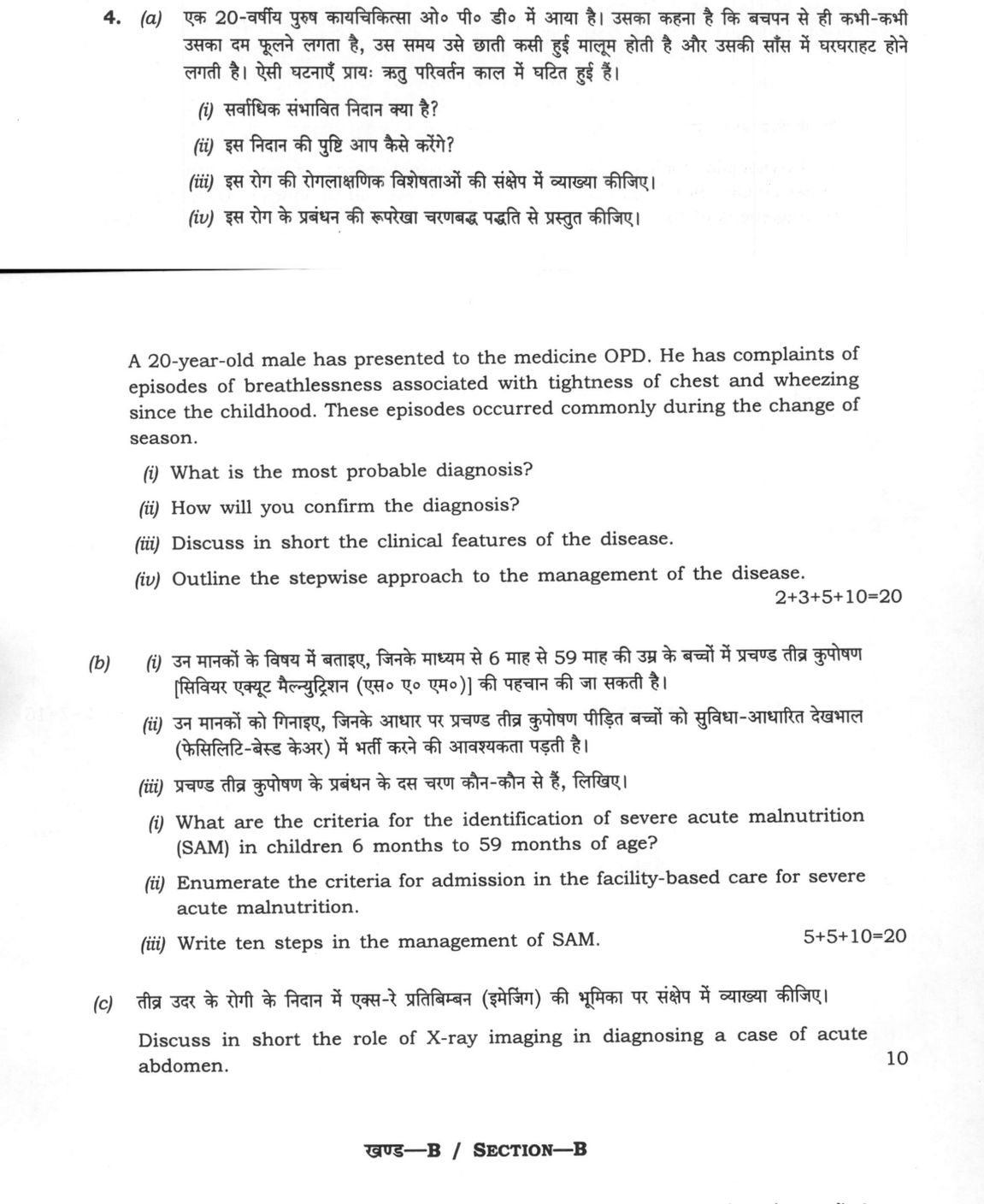
(a) A 20-year-old male has presented to the medicine OPD. He has complaints of episodes of breathlessness associated with…
A 20-year-old male has presented to the medicine OPD. He has complaints of episodes of breathlessness associated with tightness of chest and wheezing since the childhood. These episodes occurred commonly during the change of season. What is the most probable diagnosis? 2 marks
How will you confirm the diagnosis? 3 marks
Discuss in short the clinical features of the disease. 5 marks
Outline the stepwise approach to the management of the disease. (10 marks) (2+3+5+10=20 marks)
What are the criteria for the identification of severe acute malnutrition (SAM) in children 6 months to 59 months of age? 5 marks
Enumerate the criteria for admission in the facility-based care for severe acute malnutrition. 5 marks
Write ten steps in the management of SAM. (10 marks) (5+5+10=20 marks)
Discuss in short the role of X-ray imaging in diagnosing a case of acute abdomen. 10 marks
हिंदी में प्रश्न पढ़ें
एक 20-वर्षीय पुरुष कायचिकित्सा ओ० पी० डी० में आया है। उसका कहना है कि बचपन से ही कभी-कभी उसका दम फूलने लगता है, उस समय उसे छाती कसी हुई मालूम होती है और उसकी साँस में घरघराहट होने लगती है। ऐसी घटनाएँ प्रायः ऋतु परिवर्तन काल में घटित हुई हैं। सर्वाधिक संभावित निदान क्या है? 2 marks
इस निदान की पुष्टि आप कैसे करेंगे? 3 marks
इस रोग की रोगलाक्षणिक विशेषताओं की संक्षेप में व्याख्या कीजिए। 5 marks
इस रोग के प्रबंधन की रूपरेखा चरणबद्ध पद्धति से प्रस्तुत कीजिए। (10) (2+3+5+10=20)
उन मानकों के विषय में बताइए, जिनके माध्यम से 6 माह से 59 माह की उम्र के बच्चों में प्रचंड तीव्र कुपोषण [सिवियर एक्यूट मैलन्यूट्रिशन (एस० ए० एम०)] की पहचान की जा सकती है। 5 marks
उन मानकों को गिनाइए, जिनके आधार पर प्रचंड तीव्र कुपोषण पीड़ित बच्चों को सुविधा-आधारित देखभाल (फैसिलिटी-बेस्ड केयर) में भर्ती करने की आवश्यकता पड़ती है। 5 marks
प्रचंड तीव्र कुपोषण के प्रबंधन के दस चरण कौन-कौन से हैं, लिखिए। (10) (5+5+10=20)
तीव्र उदर के रोगी के निदान में एक्स-रे प्रतिबिंबन (इमेजिंग) की भूमिका पर संक्षेप में व्याख्या कीजिए। 10 marks
Model answer
Written by UPSC Answer Check against this question's marking rubric, to the expected length. UPSC does not publish answers for Mains — this is one way to score well, not an official key.
(a) The childhood-onset episodic breathlessness, chest tightness and wheeze with seasonal variation is most probably bronchial asthma, likely allergic/extrinsic type in India with pollen, dust mite, mould and monsoon-related triggers.
Confirmation: diagnosis is confirmed by objective evidence of variable expiratory airflow obstruction. Spirometry showing FEV1 increase ≥12% and ≥200 ml after 200–400 µg salbutamol is the standard reversibility test. Peak expiratory flow variability >10% in adults and >13% in children supports diagnosis; bronchial provocation tests are used when spirometry is normal.
Clinical features: recurrent episodes of dyspnoea, wheeze, chest tightness and cough, often nocturnal/early morning, triggered by seasonal allergens, cold air, exercise, infections or irritants. Symptoms are variable and may be worse at night or after exercise, with normal lung examination between attacks. Atopy, allergic rhinitis or eczema and family history support the diagnosis. Signs include prolonged expiration, diffuse wheeze, intercostal/subcostal recession and tachypnoea during attacks; severe attacks show silent chest, cyanosis, tachycardia, paradoxical breathing and altered sensorium.
Management: stepwise GINA approach, reassess control and step up/down. Before stepping up, check inhaler technique, adherence, comorbidities and trigger control. Step 1: as-needed SABA (Track 2) or as-needed low-dose ICS-formoterol (preferred Track 1). Step 2: low-dose ICS daily plus as-needed SABA or as-needed low-dose ICS-formoterol. Step 3: low-dose ICS-LABA plus as-needed SABA or as-needed ICS-formoterol. Step 4: medium-dose ICS-LABA plus as-needed reliever. Step 5: high-dose ICS-LABA with add-on LAMA, theophylline, or biologics such as anti-IgE/anti-IL5/anti-IL4R depending on phenotype; oral corticosteroids only for short exacerbations. Acute exacerbations require oxygen, nebulised salbutamol and systemic corticosteroids; step down after sustained control. A written asthma action plan and regular review reduce exacerbations.
(b) SAM in children 6–59 months is identified by weight-for-height/length Z-score < −3 SD, MUAC < 11.5 cm, or bilateral pitting nutritional oedema of any grade. MUAC is measured at mid-arm with a standard tape. These are used in India for screening at PHC/ANM visits and referral.
Facility-based care is required for complicated SAM: bilateral pitting oedema of any grade, severe illness or danger signs, anorexia/inability to eat, severe dehydration, hypoglycaemia, hypothermia, severe anaemia, sepsis, pneumonia, diarrhoea with dehydration, measles, HIV, infant <6 months, or failure to improve on outpatient management. Danger signs include lethargy, unconsciousness, inability to drink, persistent vomiting, convulsions, severe pallor, respiratory distress or persistent fever. Referral is also needed when the child cannot be safely managed at home.
Ten steps: (1) prevent/treat hypoglycaemia with early feeding and glucose if needed; (2) prevent/treat hypothermia by warming, kangaroo care and 25–30°C environment; (3) correct dehydration cautiously with ReSoMal and slow IV fluids only if severe; (4) prevent/treat infection with antibiotics and supportive care; (5) correct electrolyte imbalance, especially potassium and magnesium; (6) give micronutrients (zinc, multivitamin, iron later); (7) initiate cautious feeding with F-75 at 80 kcal/kg/day, small frequent meals, then transition to F-100/RUTF for 110–120 kcal/kg/day for catch-up growth; (8) monitor weight, oedema, vital signs and complications; (9) provide sensory stimulation and psychosocial care; (10) prepare for discharge/follow-up with RUTF, counselling and growth monitoring. Early feeding within 4 hours is critical.
(c) In acute abdomen, plain X-ray gives rapid clues. Erect chest/abdomen shows free air under diaphragm in perforation. Supine abdomen reveals dilated small or large bowel loops, valvulae conniventes, coffee-bean sign in volvulus, air-fluid levels on erect film in obstruction, sentinel loop in pancreatitis, obliteration of psoas shadow in retroperitoneal pathology, renal/ureteric or pancreatic calcifications, and loss of flank stripe in ascites. Plain radiography is quick, inexpensive and useful for initial triage; findings such as free air, obstruction pattern or calcification direct resuscitation and surgical referral, while CT/ultrasound are needed for definitive diagnosis. It helps distinguish surgical from medical causes and identifies patients needing urgent surgical intervention.
What "Outline" is asking you to do
Set out a whole scheme from end to end in its main steps without going into any of them. It is the directive used for protocols and frameworks — a management plan, a reaction mechanism, a statutory scheme — where the mark lies in having the full sequence with nothing missing.
Structure that answers it
What the scheme is for → step one → step two → the remaining steps through to the end point → the condition on which the sequence turns
Where marks are lost
Depth in the wrong place: elaborating the first two steps and never reaching the end of the scheme, which is where completeness is checked.
How this answer will be evaluated
Approach
Framework: Clinical Sequence (Definition > Aetiology > Features > Investigation > Management). (a(i)) define: precise definition > the distinguishing feature > one example | (a(ii)) explain: definition/context > points in order > small example > short close | (a(iii)) describe: define > structure or process in order > labelled diagram > significance | (a(iv)) enumerate: list the items in order > one line each > no commentary | (b(i)) enumerate: list the items in order > one line each > no commentary | (b(ii)) enumerate: list the items in order > one line each > no commentary | (b(iii)) enumerate: list the items in order > one line each > no commentary | (c) discuss: intro > 3-4 dimensions > example > balanced close Full marks: Precise clinical terminology, correct stepwise management, and accurate diagnostic criteria.
Key points expected
- Diagnosis: Bronchial Asthma
- Mention chronic/recurrent nature
- Mention reversible airway obstruction
- Spirometry showing reversible obstruction
- Peak Expiratory Flow (PEF) variability
- Methacholine challenge test (if spirometry normal)
- Episodic wheezing and breathlessness
- Chest tightness and cough (often nocturnal)
Evaluation rubric
Each sub-part is marked on its own, against the marks and word limit printed on the paper.
- (a(i)) State the most probable diagnosis based on the clinical vignette. 2 marks
define— precise definition → the distinguishing feature → one example
Must cover
- Diagnosis: Bronchial Asthma
- Mention chronic/recurrent nature
- Mention reversible airway obstruction
Loses marks
- Diagnosing COPD in a 20-year-old
- Vague diagnosis like 'respiratory infection'
Earns more
- Mention seasonal variation
- Mention childhood onset
- (a(ii)) List investigations to confirm the diagnosis of asthma. 3 marks
explain— definition/context → points in order → small example → short close
Must cover
- Spirometry showing reversible obstruction
- Peak Expiratory Flow (PEF) variability
- Methacholine challenge test (if spirometry normal)
Loses marks
- Listing only chest X-ray
- Omitting functional tests (spirometry/PEF)
Earns more
- Mentioning FeNO (Fractional exhaled Nitric Oxide)
- Mentioning total IgE levels
- (a(iii)) Describe the clinical features of the disease. 5 marks
describe— define → structure or process in order → labelled diagram → significance
Must cover
- Episodic wheezing and breathlessness
- Chest tightness and cough (often nocturnal)
- Expiratory prolongation on auscultation
- Triggers: allergens, exercise, cold air
Loses marks
- Listing symptoms without mechanism
- Describing features of pneumonia instead
Earns more
- Mentioning personal/family history of atopy
- Mentioning 'silent chest' in severe cases
- (a(iv)) Outline the stepwise approach to management of asthma. 10 marks
enumerate— list the items in order → one line each → no commentary
Must cover
- Step 1: SABA (Salbutamol) as needed
- Step 2: Low-dose ICS (Inhaled Corticosteroids)
- Step 3: Low-dose ICS + LABA (Long-acting Beta Agonist)
- Step 4/5: High-dose ICS + LABA + LTRA/Omalizumab
Loses marks
- Management without priority/stepwise logic
- Omitting ICS as the cornerstone of therapy
Earns more
- Mentioning GINA guidelines
- Mentioning patient education and trigger avoidance
- Mentioning oral steroids for acute exacerbations
Extra mark
- Mentioning specific National Asthma Policy
- (b(i)) List criteria for identifying Severe Acute Malnutrition (SAM). 5 marks
enumerate— list the items in order → one line each → no commentary
Must cover
- Mu/AZ < -3 Z-scores (Weight-for-age)
- WHZ < -3 Z-scores (Weight-for-height)
- Bilateral pitting oedema (Grade 2 or 3)
Loses marks
- Confusing SAM with MAM (Moderate Acute Malnutrition)
- Omitting oedema as a diagnostic criterion
Earns more
- Mentioning age range 6-59 months
- Mentioning mid-upper arm circumference (MUAC) < 115mm
- (b(ii)) List criteria for admission to facility-based care for SAM. 5 marks
enumerate— list the items in order → one line each → no commentary
Must cover
- Presence of medical complications (fever, dehydration, etc.)
- Inability to drink or breastfeed
- Severe anaemia or hypoglycaemia
- Lack of caregiver support or severe malnutrition
Loses marks
- Listing general malnutrition signs instead of admission criteria
- Omitting complications as a trigger for admission
Earns more
- Mentioning 'danger signs' specifically
- Mentioning severe oedema (Grade 3)
- (b(iii)) Write ten steps in the management of SAM. 10 marks
enumerate— list the items in order → one line each → no commentary
Must cover
- Treat/prevent hypoglycaemia
- Treat/prevent hypothermia
- Treat/prevent dehydration (ReSoMal)
- Correct electrolyte imbalance (low potassium)
Loses marks
- Listing steps out of clinical priority
- Omitting the 'stabilization' phase before feeding
Earns more
- Treat/prevent infection (antibiotics)
- Start careful feeding (F-75 then F-100)
- Micronutrient supplementation (Zinc, Multivitamin)
- Psychosocial care/stimulation
Extra mark
- Mentioning specific WHO 10-step protocol
- (c) Discuss the role of X-ray imaging in diagnosing acute abdomen. 10 marks
discuss— intro → 3-4 dimensions → example → balanced close
Must cover
- Detecting free air (pneumoperitoneum) under diaphragm
- Identifying bowel obstruction (air-fluid levels)
- Detecting foreign bodies or calcifications (gallstones)
- Assessing bowel gas pattern (ileus vs obstruction)
Loses marks
- Claiming X-ray is the gold standard for all acute abdomen
- Ignoring the specific utility for perforation/obstruction
Earns more
- Mentioning Erect vs Supine views
- Mentioning limitations (soft tissue, early appendicitis)
Extra mark
- Mentioning specific signs like 'Rigler's sign' or 'Coffee bean sign'
Practice this exact question
Write your answer and it is marked point by point against the model answer above — what you covered, what you missed, what you got wrong.
Evaluate my answer →More from Medical Science 2023 Paper II
- Q1 (a) (i) Enlist the clinical features of dengue fever. (ii) Outline the management of a pa…
- Q2 (a) A 30-year-old female has been brought to medical emergency with a history of low-grad…
- Q3 (a) Discuss in short the aetiology, clinical features, investigations and management of c…
- Q4 (a) A 20-year-old male has presented to the medicine OPD. He has complaints of episodes o…
- Q5 (a) A 65-year-old lady has progressively increasing dysphagia for last 6 months. She also…
- Q6 (a) (i) Enumerate the causes for postpartum haemorrhage (PPH). (ii) Discuss the managemen…
- Q7 (a) (i) Enumerate the causes of radio-opacities on a plain abdominal radiograph. (ii) Enl…