Paper II — Q2
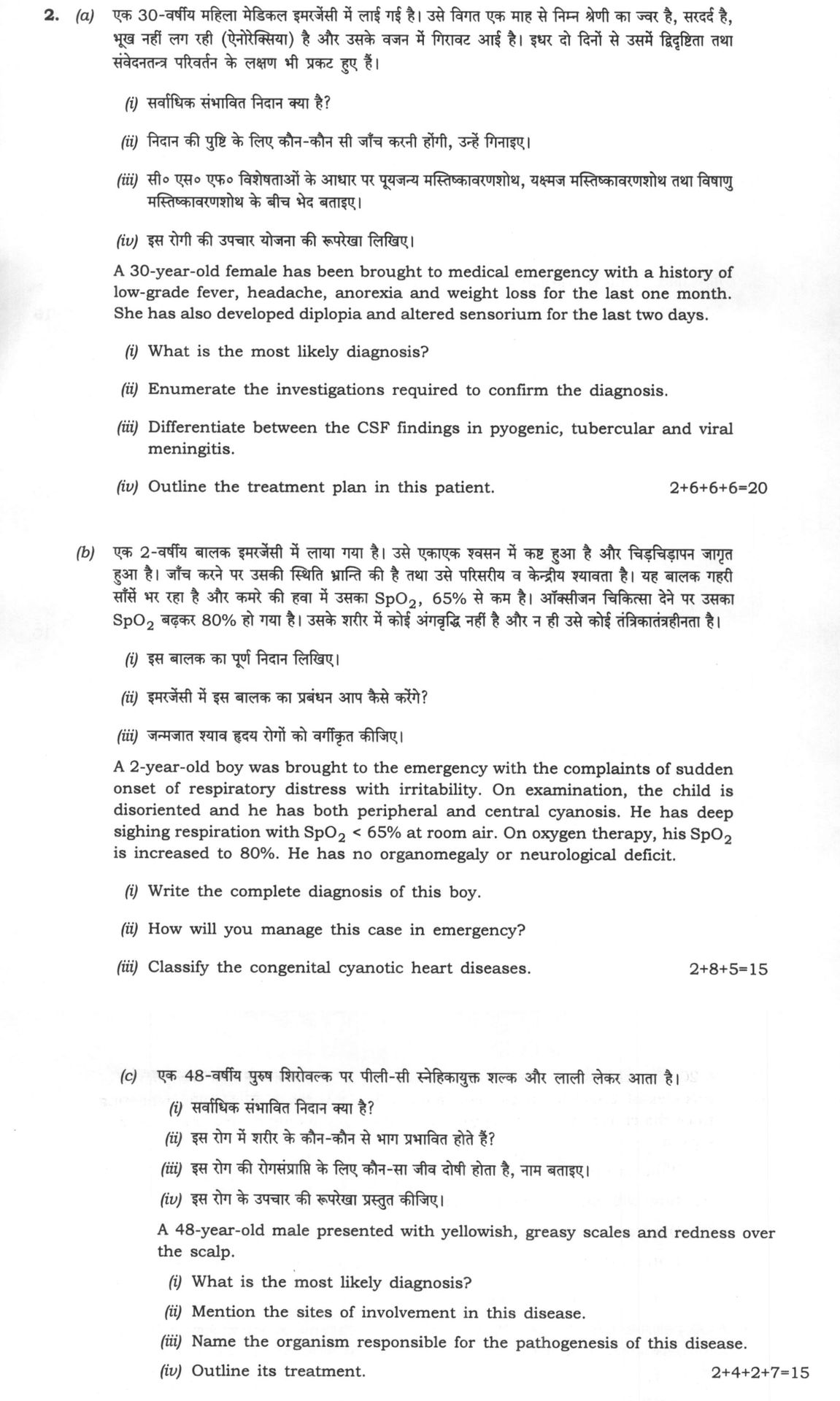
(a) A 30-year-old female has been brought to medical emergency with a history of low-grade fever, headache, anorexia and weight…
A 30-year-old female has been brought to medical emergency with a history of low-grade fever, headache, anorexia and weight loss for the last one month. She has also developed diplopia and altered sensorium for the last two days. What is the most likely diagnosis?
Enumerate the investigations required to confirm the diagnosis.
Differentiate between the CSF findings in pyogenic, tubercular and viral meningitis.
Outline the treatment plan in this patient. (2+6+6+6=20 marks)
A 2-year-old boy was brought to the emergency with the complaints of sudden onset of respiratory distress with irritability. On examination, the child is disoriented and he has both peripheral and central cyanosis. He has deep sighing respiration with SpO₂ < 65% at room air. On oxygen therapy, his SpO₂ is increased to 80%. He has no organomegaly or neurological deficit. Write the complete diagnosis of this boy.
How will you manage this case in emergency?
Classify the congenital cyanotic heart diseases. (2+8+5=15 marks)
A 48-year-old male presented with yellowish, greasy scales and redness over the scalp. What is the most likely diagnosis?
Mention the sites of involvement in this disease.
Name the organism responsible for the pathogenesis of this disease.
Outline its treatment. (2+4+2+7=15 marks)
हिंदी में प्रश्न पढ़ें
(क) एक 30-वर्षीय महिला मेडिकल इमरजेंसी में लाई गई है। उसे विगत एक माह से निम्न श्रेणी का ज्वर है, सरदर्द है, भूख नहीं लग रही (एनोरेक्सिया) है और उसके वजन में गिरावट आई है। इधर दो दिनों से उसमें द्विदृष्टिता तथा संवेदनतंत्र परिवर्तन के लक्षण भी प्रकट हुए हैं। सर्वाधिक संभावित निदान क्या है?
निदान की पुष्टि के लिए कौन-कौन सी जाँच करनी होंगी, उन्हें गिनाइए।
सी० एस० एफ० विशेषताओं के आधार पर पूयजन्य मस्तिष्कावरणशोथ, यक्ष्मज मस्तिष्कावरणशोथ तथा विषाणु मस्तिष्कावरणशोथ के बीच भेद बताइए।
इस रोगी की उपचार योजना की रूपरेखा लिखिए। (2+6+6+6=20)
(ख) एक 2-वर्षीय बालक इमरजेंसी में लाया गया है। उसे एकाएक श्वसन में कष्ट हुआ है और चिड़चिड़ापन जागृत हुआ है। जाँच करने पर उसकी स्थिति भ्रांति की है तथा उसे परिसरिय व केन्द्रीय श्यावता है। यह बालक गहरी साँसें भर रहा है और कमरे की हवा में उसका SpO₂, 65% से कम है। ऑक्सीजन चिकित्सा देने पर उसका SpO₂ बढ़कर 80% हो गया है। उसके शरीर में कोई अंगवृद्धि नहीं है और न ही उसे कोई तंत्रिकातंत्रहीनता है।
इस बालक का पूर्ण निदान लिखिए।
इमरजेंसी में इस बालक का प्रबंधन आप कैसे करेंगे?
जन्मजात श्याव हृदय रोगों को वर्गीकृत कीजिए। (2+8+5=15)
(ग) एक 48-वर्षीय पुरुष शिरोवल्क पर पीली-सी स्नेहिकायुक्त शल्क और लाली लेकर आता है।
सर्वाधिक संभावित निदान क्या है?
इस रोग में शरीर के कौन-कौन से भाग प्रभावित होते हैं?
इस रोग की रोगसंग्रामि के लिए कौन-सा जीव दोषी होता है, नाम बताइए।
इस रोग के उपचार की रूपरेखा प्रस्तुत कीजिए। (2+4+2+7=15)
Model answer
Written by UPSC Answer Check against this question's marking rubric, to the expected length. UPSC does not publish answers for Mains — this is one way to score well, not an official key.
(a) Most likely diagnosis. The one-month prodrome of low-grade fever, headache, anorexia and weight loss, followed by diplopia and altered sensorium, points to tubercular meningitis with cranial nerve involvement, most commonly sixth nerve palsy causing diplopia.
Investigations to confirm. Lumbar puncture is central: opening pressure, cell count and differential, protein, glucose, Gram stain, bacterial culture, acid-fast bacilli smear, mycobacterial culture, GeneXpert MTB/RIF, adenosine deaminase, India ink and cryptococcal antigen if HIV infection is suspected, and CSF cytology. Imaging with CT or MRI brain with contrast should show basal meningeal enhancement, hydrocephalus or infarcts; chest X-ray may show a tubercular focus. Mantoux test or IGRA, HIV test, complete blood count, ESR, liver and renal function, and blood cultures help baseline assessment and exclude mimics.
CSF differentiation. In pyogenic meningitis, opening pressure is raised, cells are predominantly neutrophilic, protein is high, glucose is low, Gram stain or culture is positive, and onset is acute. In tubercular meningitis, cells are lymphocytic, protein is high, often 100–500 mg/dL, glucose is low, ADA is raised, AFB smear, culture or GeneXpert supports the diagnosis, and onset is subacute. In viral meningitis, cells are lymphocytic, protein is normal or mildly raised, glucose is normal, routine cultures are negative, and the course is usually self-limiting.
Treatment plan. Start anti-tubercular therapy under the DOTS strategy of the National TB Elimination Programme with 2 months HRZE followed by 10 months HR, or HRE where indicated, for a total of 12 months. Add dexamethasone or prednisolone for cerebral edema, raised intracranial pressure and cranial nerve inflammation, tapering over 6–8 weeks. Manage raised intracranial pressure with head elevation, anticonvulsants if seizures occur, and neurosurgical referral for hydrocephalus if needed. Monitor for hepatotoxicity, visual symptoms, renal function and treatment response. Ensure drug resistance testing, adherence support and nutritional support.
(b) Complete diagnosis. The sudden central and peripheral cyanosis with irritability and disorientation, deep sighing, severe hypoxaemia and poor response to oxygen in a 2-year-old without organomegaly or neurological deficit is an acute hypercyanotic spell in Tetralogy of Fallot, with severe hypoxaemia and risk of cerebral hypoperfusion.
Emergency management. Place the child in knee-chest position, give high-flow oxygen, calm the child, and start IV access. Monitor SpO₂, ECG, arterial blood gas and urine output. Give morphine in small doses to reduce agitation and venous return, IV normal saline bolus to improve preload, and a beta-blocker such as esmolol or propranolol to reduce infundibular spasm. Correct acidosis with sodium bicarbonate if pH is low. If refractory, obtain urgent paediatric cardiac surgery/anaesthesia review; avoid sedatives that depress respiration; prepare for intubation if respiratory failure develops.
Classification of cyanotic CHD. Cyanotic congenital heart disease may be classified as: (1) increased pulmonary blood flow, e.g. total anomalous pulmonary venous connection and transposition of great arteries; (2) decreased pulmonary blood flow, e.g. Tetralogy of Fallot and tricuspid atresia; and (3) parallel circulation, e.g. single ventricle physiology and truncus arteriosus.
(c) Most likely diagnosis. Yellowish greasy scales with redness over the scalp in a middle-aged male is seborrheic dermatitis.
Sites of involvement. It commonly affects the scalp, eyebrows, glabella, nasolabial folds, post-auricular area, presternal region, interscapular region and flexural areas such as axillae and groin.
Organism. Malassezia furfur, also called Pityrosporum ovale, is the key organism implicated in pathogenesis through lipid metabolism and inflammatory response.
Treatment. Use ketoconazole shampoo or selenium sulphide shampoo, topical antifungals such as clotrimazole or miconazole, and short courses of mild topical corticosteroids for inflammation. For maintenance or steroid-sparing therapy, use topical calcineurin inhibitors such as tacrolimus or pimecrolimus. Advise regular washing, avoidance of irritants, use of emollients, and treatment of predisposing conditions.
What "Outline" is asking you to do
Set out a whole scheme from end to end in its main steps without going into any of them. It is the directive used for protocols and frameworks — a management plan, a reaction mechanism, a statutory scheme — where the mark lies in having the full sequence with nothing missing.
Structure that answers it
What the scheme is for → step one → step two → the remaining steps through to the end point → the condition on which the sequence turns
Where marks are lost
Depth in the wrong place: elaborating the first two steps and never reaching the end of the scheme, which is where completeness is checked.
How this answer will be evaluated
Approach
Framework: Clinical Case Analysis (Diagnosis, Investigation, Management). (a(i)) define: precise definition > the distinguishing feature > one example | (a(ii)) enumerate: list the items in order > one line each > no commentary | (a(iii)) compare: paired headings or table > key differences > significance > conclusion | (a(iv)) suggest: the problem in one line > implementable measures > who acts > conclusion | (b(i)) define: precise definition > the distinguishing feature > one example | (b(ii)) suggest: the problem in one line > implementable measures > who acts > conclusion | (b(iii)) enumerate: list the items in order > one line each > no commentary | (c(i)) define: precise definition > the distinguishing feature > one example | (c(ii)) enumerate: list the items in order > one line each > no commentary | (c(iii)) define: precise definition > the distinguishing feature > one example | (c(iv)) suggest: the problem in one line > implementable measures > who acts > conclusion Full marks: Accurate diagnosis with specific etiology; management follows clinical priority (immediate to definitive); CSF differentiation is precise.
Key points expected
- Diagnosis of Tubercular Meningitis
- Lumbar Puncture (CSF analysis)
- Chest X-ray (hilar lymphadenopathy)
- CT/MRI Brain (basal exudates)
- CSF AFB smear/culture
- Pyogenic: High WBC (neutrophils), Low Glucose
- Tubercular: High WBC (lymphocytes), Low Glucose
- Viral: Normal Glucose, Lymphocytic predominance
Evaluation rubric
Each sub-part is marked on its own, against the marks and word limit printed on the paper.
- (a(i)) Identify the specific clinical syndrome. 2 marks
define— precise definition → the distinguishing feature → one example
Must cover
- Diagnosis of Tubercular Meningitis
Loses marks
- Diagnosis of generic 'Meningitis' without etiology
- Diagnosis of Pyogenic Meningitis
Earns more
- Mention of subacute presentation
- (a(ii)) List diagnostic tests in order of priority. 6 marks
enumerate— list the items in order → one line each → no commentary
Must cover
- Lumbar Puncture (CSF analysis)
- Chest X-ray (hilar lymphadenopathy)
- CT/MRI Brain (basal exudates)
- CSF AFB smear/culture
Loses marks
- Listing blood tests only
- Omitting imaging
Earns more
- Mention of GeneXpert/PCR
- Mantoux test
Extra mark
- Mention of CSF ADA levels
- (a(iii)) Differentiate CSF profiles of three meningitis types. 6 marks
compare— paired headings or table → key differences → significance → conclusion
Must cover
- Pyogenic: High WBC (neutrophils), Low Glucose
- Tubercular: High WBC (lymphocytes), Low Glucose
- Viral: Normal Glucose, Lymphocytic predominance
- Appearance: Pyogenic (Purulent) vs TB (Fibrin web)
Loses marks
- Confusing glucose levels in TB vs Viral
- Omitting cell type differentiation
Earns more
- Mention of protein levels
Extra mark
- Tabular format
- (a(iv)) Outline the treatment plan. 6 marks
suggest— the problem in one line → implementable measures → who acts → conclusion
Must cover
- Anti-tubercular therapy (ATT) regimen
- Corticosteroids (Dexamethasone/Prednisolone)
- Management of raised ICP (Mannitol)
- Supportive care (fluids/electrolytes)
Loses marks
- Omitting steroids
- Listing only antibiotics
Earns more
- Mention of specific ATT drugs (HRZE)
Extra mark
- Mention of follow-up imaging
- (b(i)) State the complete diagnosis. 2 marks
define— precise definition → the distinguishing feature → one example
Must cover
- Tetralogy of Fallot (TOF)
- Tet spell / Hypercyanotic spell
Loses marks
- Diagnosis of generic 'Cyanosis'
- Diagnosis of VSD without TOF
Earns more
- Mention of congenital heart disease
- (b(ii)) Describe emergency management steps. 8 marks
suggest— the problem in one line → implementable measures → who acts → conclusion
Must cover
- Knee-chest position
- Oxygen therapy
- Morphine (sedation)
- IV Fluids (volume expansion)
Loses marks
- Omitting positional therapy
- Suggesting diuretics (contraindicated)
Earns more
- IV Beta-blockers (Esmolol/Propranolol)
- IV Phenylephrine (vasopressor)
Extra mark
- Mention of emergency surgery if refractory
- (b(iii)) Classify congenital cyanotic heart diseases. 5 marks
enumerate— list the items in order → one line each → no commentary
Must cover
- Group 1: Single ventricle (e.g., Tricuspid Atresia)
- Group 2: Transposition of Great Arteries (TGA)
- Group 3: Tetralogy of Fallot (TOF)
- Group 4: Truncus Arteriosus
Loses marks
- Listing only one example
- Mixing acyanotic diseases
Earns more
- Mention of Pulmonary Atresia
Extra mark
- Mention of 5T classification
- (c(i)) Identify the dermatological condition. 2 marks
define— precise definition → the distinguishing feature → one example
Must cover
- Seborrheic Dermatitis
Loses marks
- Diagnosis of Psoriasis
- Diagnosis of Tinea Capitis
Earns more
- Mention of scalp involvement
- (c(ii)) List sites of involvement. 4 marks
enumerate— list the items in order → one line each → no commentary
Must cover
- Scalp
- Face (nasolabial folds, eyebrows)
- Chest (sternum)
- Axillae/Inguinal folds
Loses marks
- Listing only scalp
- Listing non-sebaceous areas
Earns more
- Mention of retro-auricular area
- (c(iii)) Name the causative organism. 2 marks
define— precise definition → the distinguishing feature → one example
Must cover
- Malassezia furfur (Pityrosporum ovale)
Loses marks
- Naming bacteria (Staph)
- Naming dermatophytes
Earns more
- Mention of lipophilic yeast
- (c(iv)) Outline the treatment plan. 7 marks
suggest— the problem in one line → implementable measures → who acts → conclusion
Must cover
- Topical Antifungals (Ketoconazole)
- Topical Steroids (for inflammation)
- Keratolytics (Salicylic acid/Sulfur)
- Oral Antifungals (for severe cases)
Loses marks
- Omitting antifungal component
- Suggesting systemic antibiotics
Earns more
- Mention of maintenance therapy
- Lifestyle advice (stress management)
Extra mark
- Mention of specific shampoo frequency
Practice this exact question
Write your answer and it is marked point by point against the model answer above — what you covered, what you missed, what you got wrong.
Evaluate my answer →More from Medical Science 2023 Paper II
- Q1 (a) (i) Enlist the clinical features of dengue fever. (ii) Outline the management of a pa…
- Q2 (a) A 30-year-old female has been brought to medical emergency with a history of low-grad…
- Q3 (a) Discuss in short the aetiology, clinical features, investigations and management of c…
- Q4 (a) A 20-year-old male has presented to the medicine OPD. He has complaints of episodes o…
- Q5 (a) A 65-year-old lady has progressively increasing dysphagia for last 6 months. She also…