Paper II — Q8
(a) State the vision, goals and objectives of the National Framework for Malaria Elimination in India, 2016-2030. What are the…
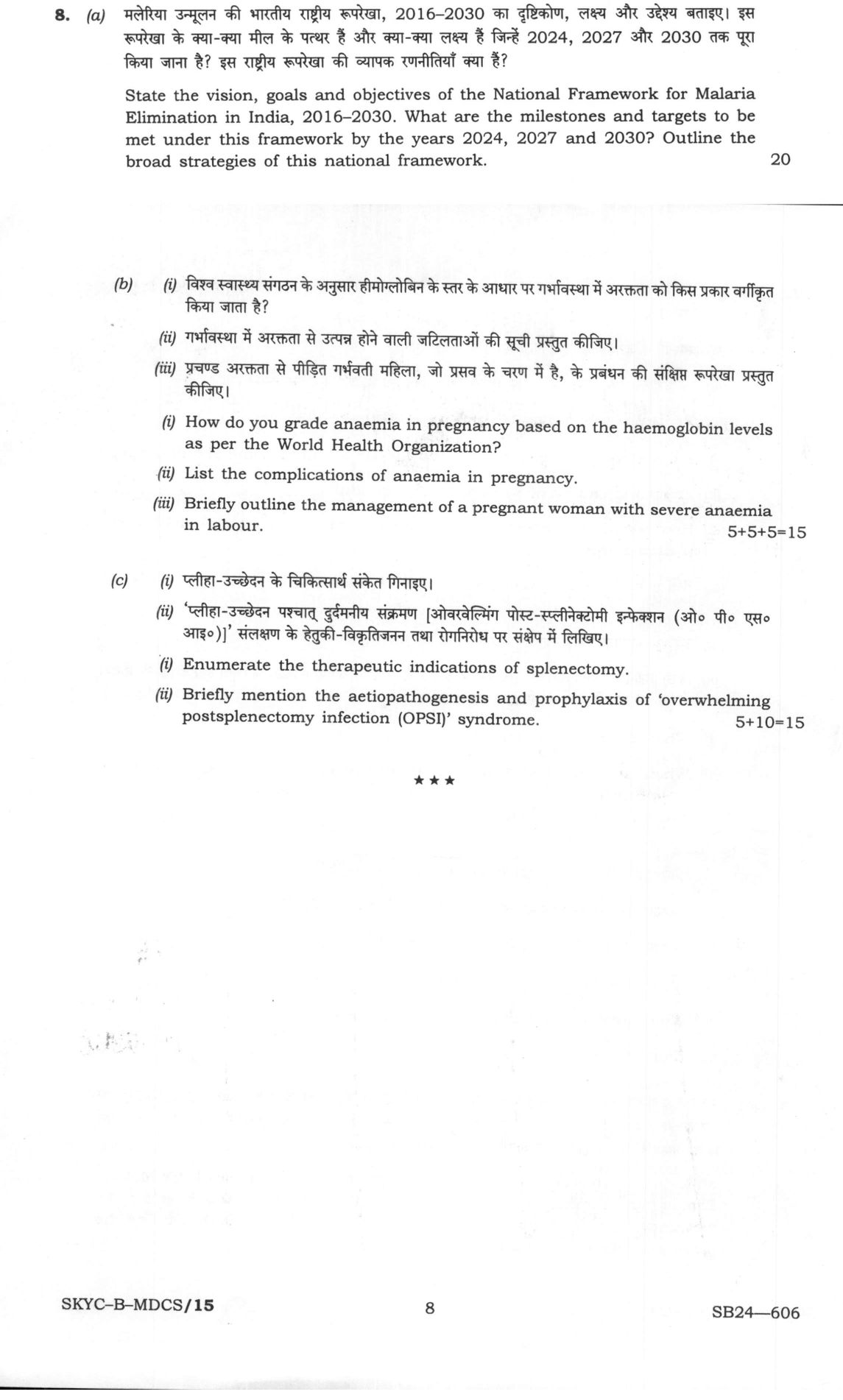
State the vision, goals and objectives of the National Framework for Malaria Elimination in India, 2016-2030. What are the milestones and targets to be met under this framework by the years 2024, 2027 and 2030? Outline the broad strategies of this national framework. 20 marks
How do you grade anaemia in pregnancy based on the haemoglobin levels as per the World Health Organization?
List the complications of anaemia in pregnancy.
Briefly outline the management of a pregnant woman with severe anaemia in labour. (5+5+5=15 marks)
Enumerate the therapeutic indications of splenectomy.
Briefly mention the aetiopathogenesis and prophylaxis of 'overwhelming postsplenectomy infection (OPSI)' syndrome. (5+10=15 marks)
हिंदी में प्रश्न पढ़ें
मलेरिया उन्मूलन की भारतीय राष्ट्रीय रूपरेखा, 2016-2030 का दृष्टिकोण, लक्ष्य और उद्देश्य बताइए। इस रूपरेखा के क्या-क्या मील के पत्थर हैं और क्या-क्या लक्ष्य हैं जिन्हें 2024, 2027 और 2030 तक पूरा किया जाना है? इस राष्ट्रीय रूपरेखा की व्यापक रणनीतियाँ क्या हैं? 20 marks
विश्व स्वास्थ्य संगठन के अनुसार हीमोग्लोबिन के स्तर के आधार पर गर्भावस्था में अरक्तता को किस प्रकार वर्गीकृत किया जाता है?
गर्भावस्था में अरक्तता से उत्पन्न होने वाली जटिलताओं की सूची प्रस्तुत कीजिए।
प्रचंड अरक्तता से पीड़ित गर्भवती महिला, जो प्रसव के चरण में है, के प्रबंधन की संक्षिप्त रूपरेखा प्रस्तुत कीजिए। (5+5+5=15)
प्लीहा-उच्छेदन के चिकित्सार्थ संकेत गिनाइए।
'प्लीहा-उच्छेदन पश्चात् दुर्दमनीय संक्रमण [ओवरवेल्मिंग पोस्ट-स्प्लीनिक्टोमी इन्फेक्शन (ओ. पी. एस. आई.)]' संलक्षण के हेतुकी-विकृतिजनन तथा रोगनिरोध पर संक्षेप में लिखिए। (5+10=15)
Model answer
Written by UPSC Answer Check against this question's marking rubric, to the expected length. UPSC does not publish answers for Mains — this is one way to score well, not an official key.
(a) National Framework for Malaria Elimination, 2016–2030 The vision of the National Framework for Malaria Elimination in India, 2016–2030, is a malaria-free India. Its goals are to eliminate malaria in low-burden states by 2024, in all states by 2027, and to maintain elimination by preventing re-establishment by 2030. The objectives are to reduce malaria incidence to less than one annual parasite incidence (API) per 1,000 population in all states and union territories by 2024, to achieve zero indigenous malaria cases in all states and union territories by 2027, and to prevent re-establishment of malaria transmission by 2030, while reducing malaria-related mortality and indigenous cases. Category 1 and Category 2 states/UTs were targeted for elimination by 2022; therefore the 2024 milestone is not zero indigenous cases in those categories but API below 1 per 1,000 population in all states/UTs, especially in the remaining high-burden/Category 3 areas. The 2027 milestone is zero indigenous cases nationwide, and the 2030 milestone is sustained prevention of re-establishment. The broad strategies are case-based surveillance with active case detection and rapid response, strengthened diagnosis and treatment, vector control through indoor residual spraying, insecticide-treated nets and indoor-focused interventions, health education, capacity building, research and monitoring, and cross-border coordination with neighbouring countries. These strategies are applied with special attention to high-burden districts, imported cases and border surveillance.
(b) Anaemia in pregnancy WHO grades anaemia in pregnancy by haemoglobin concentration: mild anaemia is 10.0–10.9 g/dL, moderate anaemia is 7.0–9.9 g/dL, and severe anaemia is below 7.0 g/dL. Because physiological plasma-volume expansion dilutes the blood, anaemia in pregnancy is defined as Hb below 11 g/dL in the first and third trimesters and below 10.5 g/dL in the second trimester. Severe anaemia reduces oxygen-carrying capacity, increasing the risk of maternal decompensation and fetal hypoxia. Maternal complications include heart failure, infection, postpartum haemorrhage, eclampsia, and maternal death. Fetal and neonatal complications include intrauterine growth restriction, preterm labour, low birth weight, and perinatal mortality. In a pregnant woman in labour with severe anaemia, management is urgent and supportive: give oxygen, secure intravenous access, monitor cardiorespiratory status, crossmatch blood, and transfuse packed red cells, particularly when Hb is below 5 g/dL or between 5 and 7 g/dL with symptoms or obstetric complications. Transfusion should be guided by symptoms, haemodynamic stability and obstetric risk. Use active management of the third stage with oxytocin to prevent postpartum haemorrhage, and avoid ergometrine because of its hypertensive effect. Correct iron and folate deficiency with supplementation, manage bleeding promptly, and provide close postnatal monitoring.
(c) Splenectomy and OPSI Therapeutic indications for splenectomy include hereditary spherocytosis, immune thrombocytopenic purpura refractory to medical therapy, autoimmune haemolytic anaemia, thalassaemia major with hypersplenism, other causes of hypersplenism, splenic trauma, and lymphoproliferative disorders; it was also used for staging laparotomy in Hodgkin lymphoma. Overwhelming postsplenectomy infection (OPSI) occurs because the spleen is lost: opsonisation is impaired, IgM and IgG production and clearance are reduced, and clearance of encapsulated bacteria is defective. The common organisms are Streptococcus pneumoniae, Haemophilus influenzae type b, and Neisseria meningitidis. OPSI can present as fulminant sepsis, most often within the first two years after splenectomy, and is especially dangerous in children and after emergency splenectomy. The risk is lifelong, though greatest in the first two years. Prophylaxis includes vaccination against pneumococcus, meningococcus, and Hib; in elective splenectomy vaccines are ideally given before surgery or after recovery, while in emergency splenectomy they should be given as soon as possible postoperatively, with repeat vaccination if required. Vaccines may need to be repeated if the initial response is inadequate or if the patient is immunocompromised. Daily penicillin prophylaxis is used, particularly in children and high-risk patients, along with patient education about fever, emergency standby antibiotics, and prompt medical care.
What "State" is asking you to do
Give the formulation itself — the theorem, rule, statutory provision or position — worded accurately. Precision of wording is the whole of the mark; no background or justification is being asked for.
Structure that answers it
The statement in full, complete in itself → the conditions under which it holds → an illustration only where the stem asks for one
Where marks are lost
Approximating the wording. A theorem or a provision stated loosely forfeits the mark that exact statement would have carried.
How this answer will be evaluated
Approach
Framework: Clinical Sequence (Definition > Aetiology/Pathophysiology > Features > Investigation/Management). (a) discuss: intro > 3-4 dimensions > example > balanced close | (b(i)) explain: definition/context > points in order > small example > short close | (b(ii)) enumerate: list the items in order > one line each > no commentary | (b(iii)) explain: definition/context > points in order > small example > short close | (c(i)) enumerate: list the items in order > one line each > no commentary | (c(ii)) explain: definition/context > points in order > small example > short close Full marks: Comprehensive, clinically accurate, follows the clinical sequence, and includes specific guidelines/names.
Key points expected
- State the vision of malaria-free India by 2030
- List specific milestones for 2024, 2027, and 2030
- Outline broad strategies (e.g., vector control, case management)
- Mention the role of National Malaria Elimination Programme (NMEP)
- Define Mild, Moderate, and Severe anaemia
- Provide specific Hb cut-offs (e.g., <11, <10, <7 g/dL)
- Specify that these are WHO standards for pregnancy
- Maternal complications (e.g., heart failure, infection)
Evaluation rubric
Each sub-part is marked on its own, against the marks and word limit printed on the paper.
- (a) Comprehensive overview of the National Framework for Malaria Elimination (NFME) 2016-2030. 20 marks
discuss— intro → 3-4 dimensions → example → balanced close
Must cover
- State the vision of malaria-free India by 2030
- List specific milestones for 2024, 2027, and 2030
- Outline broad strategies (e.g., vector control, case management)
- Mention the role of National Malaria Elimination Programme (NMEP)
Loses marks
- Confusing NFME with general malaria treatment protocols
- Missing the specific year-wise milestones (2024/2027/2030)
Earns more
- Reference to 'Zero Malaria' goal
- Mention of specific vector control methods (ITNs, IRS)
- Reference to diagnostic testing (RDTs)
Extra mark
- Mention of specific funding or international partnerships (e.g., Global Fund)
- (b(i)) Classification of anaemia in pregnancy based on WHO haemoglobin levels. 5 marks
explain— definition/context → points in order → small example → short close
Must cover
- Define Mild, Moderate, and Severe anaemia
- Provide specific Hb cut-offs (e.g., <11, <10, <7 g/dL)
- Specify that these are WHO standards for pregnancy
Loses marks
- Using non-pregnant adult Hb cut-offs
- Missing the 'Severe' category definition
Earns more
- Mentioning trimester-specific variations if applicable
Extra mark
- Mentioning the target Hb level for pregnant women
- (b(ii)) List of complications arising from anaemia in pregnancy. 5 marks
enumerate— list the items in order → one line each → no commentary
Must cover
- Maternal complications (e.g., heart failure, infection)
- Fetal complications (e.g., IUGR, preterm birth)
- Perinatal complications (e.g., stillbirth, low birth weight)
Loses marks
- Listing symptoms of anaemia instead of complications
- Vague listing without categorization (maternal/fetal)
Earns more
- Mentioning specific risks like postpartum haemorrhage
Extra mark
- Mentioning long-term effects on child development
- (b(iii)) Management protocol for severe anaemia in a woman in labour. 5 marks
explain— definition/context → points in order → small example → short close
Must cover
- Immediate management: Blood transfusion (packed RBCs)
- Monitoring: Vital signs, fluid balance
- Definitive management: Delivery planning (mode of delivery)
- Follow-up: Postpartum care and iron supplementation
Loses marks
- Management without priority (e.g., discussing diet before transfusion)
- Ignoring the 'in labour' context (e.g., suggesting long-term oral iron)
Earns more
- Mentioning cross-matching and blood bank coordination
- Mentioning oxygen support
Extra mark
- Mentioning specific transfusion triggers (e.g., Hb < 7 g/dL)
- (c(i)) List of therapeutic indications for splenectomy. 5 marks
enumerate— list the items in order → one line each → no commentary
Must cover
- Trauma (ruptured spleen)
- Haematological disorders (e.g., ITP, hereditary spherocytosis)
- Malignancy (e.g., lymphoma, metastasis)
Loses marks
- Listing contraindications instead of indications
- Vague listing without specific disease names
Earns more
- Mentioning specific conditions like Thrombocytopenic Purpura
- Mentioning splenic abscess or cysts
Extra mark
- Mentioning specific haematological conditions like Sickle Cell Disease
- (c(ii)) Aetiopathogenesis and prophylaxis of Overwhelming Postsplenectomy Infection (OPSI). 10 marks
explain— definition/context → points in order → small example → short close
Must cover
- Aetiology: Role of encapsulated organisms (S. pneumoniae, H. influenzae)
- Pathogenesis: Loss of splenic macrophages and opsonization
- Prophylaxis: Vaccination (Pneumococcal, Meningococcal, Hib)
- Prophylaxis: Antibiotic prophylaxis (e.g., Penicillin)
Loses marks
- Confusing OPSI with general post-surgical infection
- Missing the role of encapsulated bacteria in pathogenesis
Earns more
- Mentioning specific vaccines (e.g., 13-valent pneumococcal)
- Mentioning timing of vaccination (pre-op vs post-op)
Extra mark
- Mentioning specific antibiotics used for prophylaxis (e.g., Amoxicillin)
Practice this exact question
Write your answer and it is marked point by point against the model answer above — what you covered, what you missed, what you got wrong.
Evaluate my answer →More from Medical Science 2023 Paper II
- Q5 (a) A 65-year-old lady has progressively increasing dysphagia for last 6 months. She also…
- Q6 (a) (i) Enumerate the causes for postpartum haemorrhage (PPH). (ii) Discuss the managemen…
- Q7 (a) (i) Enumerate the causes of radio-opacities on a plain abdominal radiograph. (ii) Enl…
- Q8 (a) State the vision, goals and objectives of the National Framework for Malaria Eliminat…