Paper II — Q7
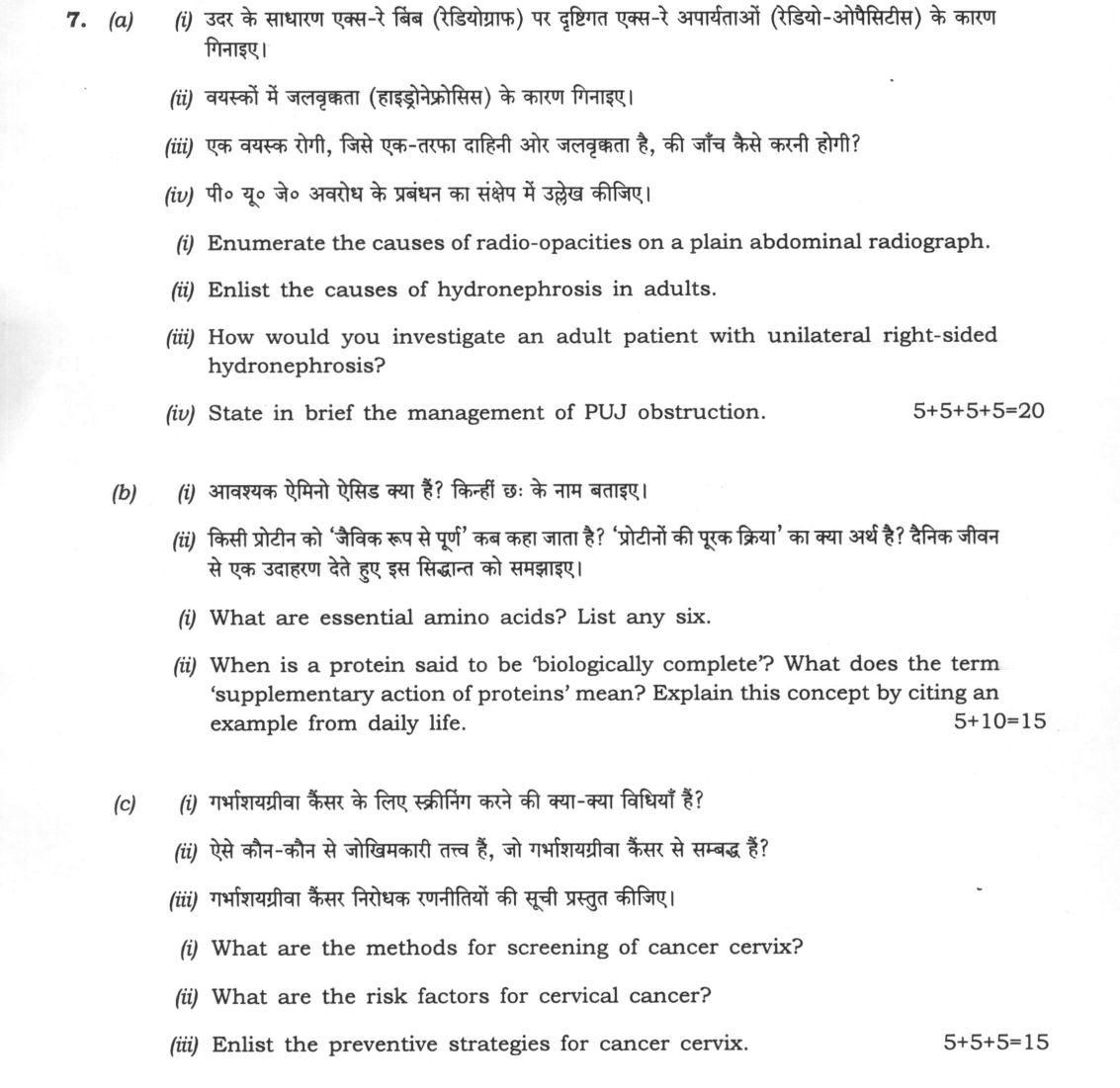
(a) (i) Enumerate the causes of radio-opacities on a plain abdominal radiograph. (ii) Enlist the causes of hydronephrosis in…
Enumerate the causes of radio-opacities on a plain abdominal radiograph.
Enlist the causes of hydronephrosis in adults.
How would you investigate an adult patient with unilateral right-sided hydronephrosis?
State in brief the management of PUJ obstruction. (5+5+5+5=20 marks)
What are essential amino acids? List any six.
When is a protein said to be 'biologically complete'? What does the term 'supplementary action of proteins' mean? Explain this concept by citing an example from daily life. (5+10=15 marks)
What are the methods for screening of cancer cervix?
What are the risk factors for cervical cancer?
Enlist the preventive strategies for cancer cervix. (5+5+5=15 marks)
हिंदी में प्रश्न पढ़ें
उदर के साधारण एक्स-रे बिंब (रेडियोग्राफ) पर दृश्यगत एक्स-रे अपारदर्शिताओं (रेडियो-ओपेसिटीज) के कारण गिनाइए।
वयस्कों में जलवृक्कता (हाइड्रोनेफ्रोसिस) के कारण गिनाइए।
एक वयस्क रोगी, जिसे एक-तरफा दाहिनी ओर जलवृक्कता है, की जाँच कैसे करनी होगी?
पी० यू० जे० अवरोध के प्रबंधन का संक्षेप में उल्लेख कीजिए। (5+5+5+5=20)
आवश्यक ऐमिनो ऐसिड क्या हैं? किन्हीं छः के नाम बताइए।
किसी प्रोटीन को 'जैविक रूप से पूर्ण' कब कहा जाता है? 'प्रोटीनों की पूरक क्रिया' का क्या अर्थ है? दैनिक जीवन से एक उदाहरण देते हुए इस सिद्धांत को समझाइए। (5+10=15)
गर्भाशयग्रीवा कैंसर के लिए स्क्रीनिंग करने की क्या-क्या विधियाँ हैं?
ऐसे कौन-कौन से जोखिमकारी तत्त्व हैं, जो गर्भाशयग्रीवा कैंसर से संबंधित हैं?
गर्भाशयग्रीवा कैंसर निरोधक रणनीतियों की सूची प्रस्तुत कीजिए। (5+5+5=15)
Model answer
Written by UPSC Answer Check against this question's marking rubric, to the expected length. UPSC does not publish answers for Mains — this is one way to score well, not an official key.
Causes of Radio-Opacities on Plain Abdominal Radiograph
Radio-opacities observed on a plain abdominal X-ray (KUB/erect) are classified by anatomical system:
- Urinary tract: Nephrolithiasis and ureteric calculi (calcium oxalate, calcium phosphate, struvite), nephrocalcinosis, and bladder calculi.
- Biliary tract: Calcified gallstones (10–15% of all gallstones) and porcelain gallbladder.
- Gastrointestinal: Appendicoliths, enteroliths, swallowed radio-opaque foreign bodies, and ingested heavy medications (e.g., bismuth, iron tablets).
- Vascular: Calcified abdominal aortic aneurysm, splenic artery calcification, atherosclerosis of iliac vessels, and pelvic phleboliths.
- Lymphatic and soft tissue: Calcified mesenteric lymph nodes (post-tubercular), calcified uterine leiomyomas, and calcifications in pelvic dermoid cysts (teeth/bone).
Etiology and Evaluation of Hydronephrosis
Causes in Adults:
- Obstructive:
- Luminal: Ureteric/renal calculi, sloughed papillae, blood clots.
- Mural: Pelvi-ureteric junction (PUJ) obstruction, ureteric strictures (tuberculous, post-radiation, or iatrogenic), and urothelial carcinoma.
- Extramural: Pelvic malignancy (cervical, ovarian, prostate, rectal carcinoma), retroperitoneal fibrosis, retroperitoneal lymphadenopathy, benign prostatic hyperplasia (BPH), and aberrant crossing lower-pole renal vessels.
- Non-obstructive: High-output diuresis, pregnancy (progestational smooth muscle relaxation and mechanical compression), vesicoureteral reflux (VUR), and persistent caliceal dilatation following relief of obstruction.
Investigation of Unilateral Right-Sided Hydronephrosis:
- Baseline assessment: Urinalysis (microscopy for hematuria, pyuria) and serum renal function tests (BUN, creatinine).
- Ultrasound (USG) KUB: Initial imaging to confirm hydronephrosis, grade the severity, assess cortical thickness, evaluate the contralateral kidney, and identify proximal calculi or pelvic masses.
- Non-Contrast Computed Tomography (NCCT) / Contrast-Enhanced CT Urography (CT-IVU): Gold standard anatomical investigation to identify the exact level, extrinsic causes, ureteric path, and vascular relations (such as aberrant crossing vessels in PUJ obstruction).
- Diuretic Renography (99mTc-EC / MAG3 / DTPA with F+15/F+20 protocol): Assesses split renal function (SRF) and dynamic clearance, objectively differentiating mechanical obstruction from non-obstructive dilatation.
- Retrograde/Antegrade Pyelography: Reserved for patients with compromised renal function or indeterminate imaging to map the distal extent of the obstruction.
Management of PUJ Obstruction: The primary goal is preservation of renal function and relief of symptoms.
- Surgical Intervention: Indicated for split renal function <40%, progressive functional deterioration (>10% drop on serial renograms), recurrent infection, stone formation, or pain.
- Dismembered Pyeloplasty (Anderson-Hynes technique): Performed via open, laparoscopic, or robotic approaches. It is the gold-standard procedure (>90% success rate), involving excision of the stenotic segment, reduction of the dilated pelvis, and re-anastomosis over a Double-J (DJ) stent.
- Endopyelotomy: Antegrade or retrograde incisional endourological repair; indicated for secondary PUJ strictures or high-risk surgical candidates.
- Nephrectomy: Indicated when the affected kidney is non-functioning (SRF <10–15%) with recurrent pyelonephritis and a normal contralateral kidney.
Biochemical Principles of Dietary Proteins
Essential Amino Acids: Essential amino acids (EAAs) are amino acids that cannot be synthesized de novo by the human body at rates commensurate with demand and must be obtained preformed from the diet. Six examples include Leucine, Isoleucine, Lysine, Methionine, Phenylalanine, and Tryptophan (along with Valine, Threonine, and Histidine).
Biologically Complete Proteins and Supplementary Action: A protein is termed biologically complete (or a first-class protein) when it contains all the essential amino acids in adequate proportions and amounts necessary to support human growth, tissue repair, and maintenance (e.g., egg albumin, milk casein).
Supplementary action of proteins refers to the nutritional phenomenon where two or more incomplete dietary proteins, each deficient in a different essential amino acid (limiting amino acid), are consumed together. The amino acid surplus of one protein compensates for the deficit in the other, raising the overall biological value (BV) and net protein utilization (NPU) of the mixed meal.
Daily Life Example: In the traditional Indian staple diet, the combination of cereals (such as wheat or rice) and pulses (such as dal or lentils) illustrates this principle. Cereals are deficient in lysine but rich in methionine, whereas pulses are deficient in methionine but rich in lysine. When consumed together in a single meal (e.g., Khichdi or Roti-Dal), they provide a complete amino acid profile. This principle forms the operational nutritional foundation of India's PM POSHAN (Mid-day Meal Scheme) and Integrated Child Development Services (ICDS).
Cervical Cancer: Screening, Risk Factors, and Prevention
Screening Methods:
- High-Risk HPV DNA Testing: Molecular detection (e.g., Hybrid Capture 2, PCR) of oncogenic HPV strains; standard primary screening modality recommended by the WHO for women aged 30 and older.
- Cervical Cytology: Conventional Papanicolaou (Pap) smear or Liquid-Based Cytology (LBC) to identify premalignant dysplastic changes (Bethesda system: LSIL, HSIL).
- Visual Inspection with Acetic Acid (VIA) / Lugol’s Iodine (VILI): Cost-effective, point-of-care screening methods that produce identifiable acetowhitening or mustard-yellow non-staining areas at the transformation zone.
Risk Factors:
- Persistent infection with high-risk oncogenic HPV types (predominantly HPV-16 and HPV-18).
- Early age at marriage/first coitus (<18 years) and early childbearing.
- High parity and multiparity.
- Multiple sexual partners or partner with high-risk sexual behavior.
- Tobacco smoking (metabolites concentrate in cervical mucus, impairing local Langerhans cell immunity).
- Immunosuppression, particularly HIV infection.
- Long-term use of oral contraceptive pills (>5 years).
- Low socioeconomic status associated with poor genital hygiene and lack of access to screening.
Preventive Strategies:
- Primary Prevention: Prophylactic HPV vaccination targeting adolescent girls aged 9–14 years before sexual debut using quadrivalent/bivalent or indigenous quadrivalent vaccines (Cervavac); promoting barrier contraception (condom use) and tobacco cessation.
- Secondary Prevention: Population-based screening integrated into primary healthcare via the National Programme for Prevention & Control of Non-Communicable Diseases (NP-NCD), coupled with immediate "screen-and-treat" protocols using thermal ablation, cryotherapy, or Loop Electrosurgical Excision Procedure (LEEP) for pre-invasive lesions (CIN II/III).
- Tertiary Prevention: Prompt staging, radical surgery (Wertheim's hysterectomy), or concurrent chemoradiation for invasive disease to minimize morbidity and mortality, structured around the WHO global cervical cancer elimination strategy (90% HPV vaccination, 70% screening coverage, 90% access to treatment).
Targeted urological interventions, community-level balanced dietary strategies, and programmatic screening and vaccination align clinical practice with national health outcomes.
What "Enumerate" is asking you to do
Produce the complete set of items asked for, countable and correctly named. The examiner marks against a checklist, so a missing item costs and an elaborated one gains nothing — where discussion is wanted the stem asks for it as a separate sub-part.
Structure that answers it
One line naming the basis on which the set is drawn → items numbered, each in a phrase or a single line → the discussion sub-part taken up separately, after the list is complete
Where marks are lost
Treating it as an essay. Six items named in six lines score better than three items explained at length.
How this answer will be evaluated
Approach
Framework: Clinical Sequence (Definition > Aetiology > Features > Investigation/Management). (a(i)) enumerate: list the items in order > one line each > no commentary | (a(ii)) enumerate: list the items in order > one line each > no commentary | (a(iii)) explain: definition/context > points in order > small example > short close | (a(iv)) explain: definition/context > points in order > small example > short close | (b(i)) define: precise definition > the distinguishing feature > one example | (b(ii)) explain: definition/context > points in order > small example > short close | (c(i)) enumerate: list the items in order > one line each > no commentary | (c(ii)) enumerate: list the items in order > one line each > no commentary | (c(iii)) enumerate: list the items in order > one line each > no commentary Full marks: Accurate clinical sequence, specific named entities (e.g., Anderson-Hynes, HPV 16/18), and clear distinction between screening and diagnosis.
Key points expected
- Gallstones (calcified)
- Renal/ureteric calculi
- Vascular calcification (aorta)
- Foreign bodies
- Ureteric calculi
- Extrinsic compression (tumors/pregnancy)
- Ureteric stricture (post-surgical)
- Neurogenic bladder
Evaluation rubric
Each sub-part is marked on its own, against the marks and word limit printed on the paper.
- (a(i)) List causes of radio-opacities on plain abdominal radiograph. 5 marks
enumerate— list the items in order → one line each → no commentary
Must cover
- Gallstones (calcified)
- Renal/ureteric calculi
- Vascular calcification (aorta)
- Foreign bodies
Loses marks
- Listing soft tissue masses (not radio-opaque)
- Listing causes of radio-lucency
Earns more
- Phleboliths
- Pancreatic calcification
- Ovarian teratoma (Rokitansky nodule)
Extra mark
- Mention of 'eggshell' calcification in aneurysm
- (a(ii)) List causes of hydronephrosis in adults. 5 marks
enumerate— list the items in order → one line each → no commentary
Must cover
- Ureteric calculi
- Extrinsic compression (tumors/pregnancy)
- Ureteric stricture (post-surgical)
- Neurogenic bladder
Loses marks
- Listing causes of hydronephrosis in children only
- Listing causes of renal failure
Earns more
- Ureteric tumors
- Retroperitoneal fibrosis
- Pelvic mass (fibroid)
Extra mark
- Mention of 'congenital' causes despite adult context
- (a(iii)) Describe investigation protocol for unilateral right hydronephrosis. 5 marks
explain— definition/context → points in order → small example → short close
Must cover
- Ultrasound (USG) as first line
- CT KUB (non-contrast) for stone
- IVU (Intravenous Urography)
- DMSA scan (if differential function needed)
Loses marks
- Starting with invasive procedures (cystoscopy)
- Omitting imaging modalities
Earns more
- MR Urography (if renal impairment)
- Cystoscopy (if lower tract obstruction suspected)
Extra mark
- Mention of 'diuretic renography' for obstruction confirmation
- (a(iv)) State management of PUJ (Pelvi-Ureteric Junction) obstruction. 5 marks
explain— definition/context → points in order → small example → short close
Must cover
- Pyeloplasty (Anderson-Hynes) as gold standard
- Indications for surgery (renal function <40%)
- Conservative management for mild cases
- Nephrectomy for non-functioning kidney
Loses marks
- Suggesting antibiotics as definitive treatment
- Omitting surgical options
Earns more
- Laparoscopic/Robotic pyeloplasty
- Endopyelotomy (alternative)
Extra mark
- Mention of 'success rate' of pyeloplasty
- (b(i)) Define essential amino acids and list six. 5 marks
define— precise definition → the distinguishing feature → one example
Must cover
- Definition: Cannot be synthesized by body
- Must be obtained from diet
- List: Leucine, Isoleucine, Valine
- List: Lysine, Methionine, Phenylalanine
Loses marks
- Listing non-essential amino acids
- Failing to provide definition
Earns more
- List: Threonine, Tryptophan, Histidine
- Mention of 'limiting amino acid' concept
Extra mark
- Mention of 'conditionally essential' (e.g., Arginine)
- (b(ii)) Explain biologically complete protein and supplementary action. 10 marks
explain— definition/context → points in order → small example → short close
Must cover
- Definition: Contains all essential amino acids in right ratio
- Supplementary action: Combining incomplete proteins
- Example: Rice (low lysine) + Beans (low methionine)
- Result: Complete protein profile
Loses marks
- Confusing 'complete' with 'high protein content'
- Failing to give a daily life example
Earns more
- Mention of 'limiting amino acid' in mix
- Example: Corn + Beans (Maize + Legumes)
Extra mark
- Mention of 'PDCAAS' or 'Biological Value' scores
- (c(i)) List methods for screening cancer cervix. 5 marks
enumerate— list the items in order → one line each → no commentary
Must cover
- Pap smear (cytology)
- HPV DNA testing
- Visual inspection with acetic acid (VIA)
- Colposcopy (diagnostic/secondary)
Loses marks
- Listing treatment methods (e.g., LLETZ)
- Listing risk factors
Earns more
- HPV vaccination (primary prevention/screening adjunct)
- Self-sampling for HPV
Extra mark
- Mention of 'Liquid-based cytology' (LBC)
- (c(ii)) List risk factors for cervical cancer. 5 marks
enumerate— list the items in order → one line each → no commentary
Must cover
- Persistent HPV infection (16/18)
- Early sexual debut / multiple partners
- Smoking
- Immunosuppression (HIV)
Loses marks
- Listing symptoms of cancer
- Listing risk factors for other cancers
Earns more
- Long-term oral contraceptive use
- High parity
- Lack of screening
Extra mark
- Mention of 'co-factors' like Chlamydia
- (c(iii)) List preventive strategies for cancer cervix. 5 marks
enumerate— list the items in order → one line each → no commentary
Must cover
- HPV vaccination (primary)
- Regular screening (Pap/HPV)
- Safe sex practices (condoms)
- Smoking cessation
Loses marks
- Listing diagnostic methods
- Listing treatment of established cancer
Earns more
- Treatment of precancerous lesions (CIN)
- Public health education
Extra mark
- Mention of 'National Cervical Cancer Screening Programme'
Practice this exact question
Write your answer and it is marked point by point against the model answer above — what you covered, what you missed, what you got wrong.
Evaluate my answer →More from Medical Science 2023 Paper II
- Q4 (a) A 20-year-old male has presented to the medicine OPD. He has complaints of episodes o…
- Q5 (a) A 65-year-old lady has progressively increasing dysphagia for last 6 months. She also…
- Q6 (a) (i) Enumerate the causes for postpartum haemorrhage (PPH). (ii) Discuss the managemen…
- Q7 (a) (i) Enumerate the causes of radio-opacities on a plain abdominal radiograph. (ii) Enl…
- Q8 (a) State the vision, goals and objectives of the National Framework for Malaria Eliminat…