Paper II — Q5
(a) A 65-year-old lady has progressively increasing dysphagia for last 6 months. She also has significant weight loss. How will…
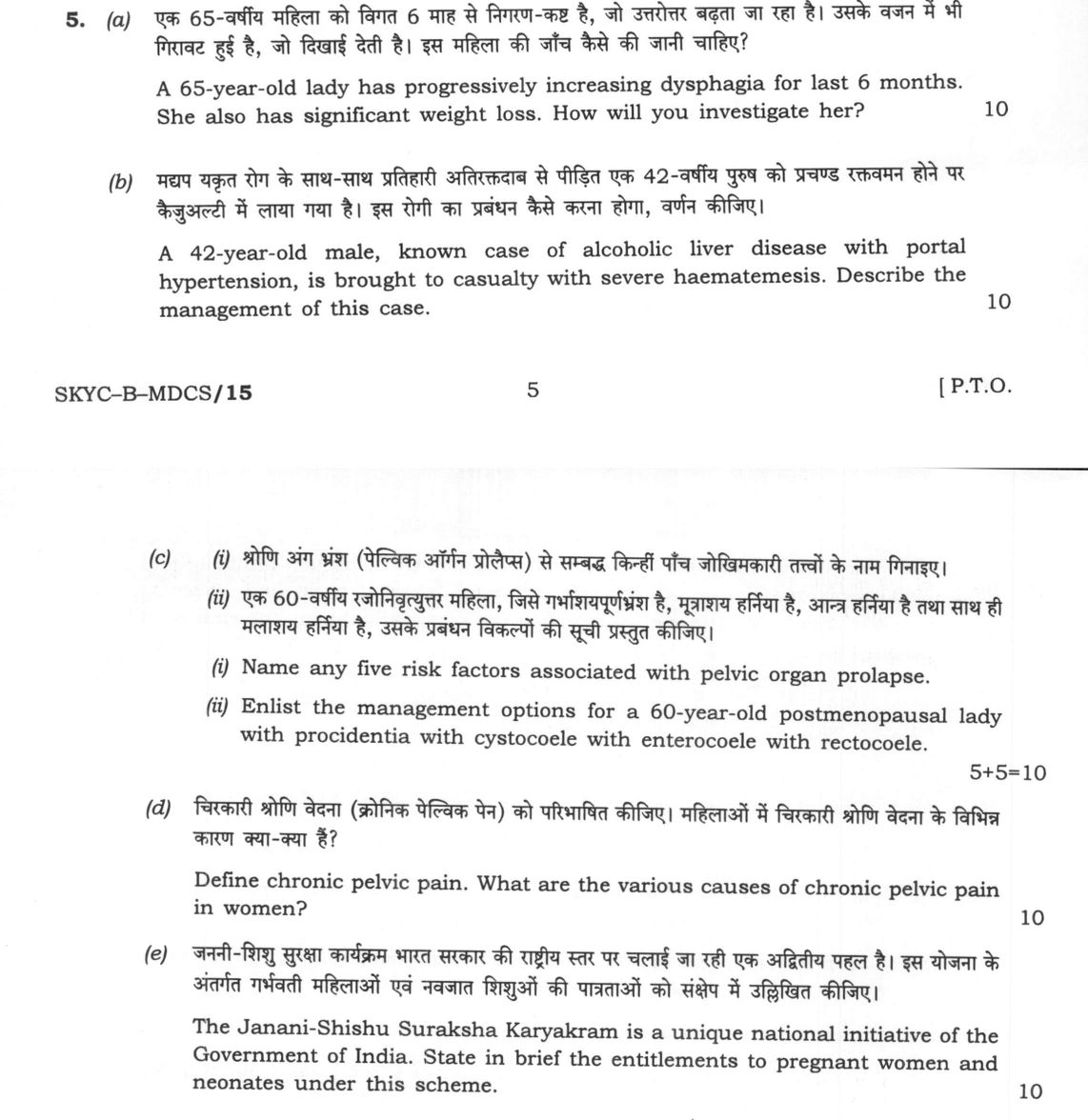
A 65-year-old lady has progressively increasing dysphagia for last 6 months. She also has significant weight loss. How will you investigate her? 10 marks
A 42-year-old male, known case of alcoholic liver disease with portal hypertension, is brought to casualty with severe haematemesis. Describe the management of this case. 10 marks
Name any five risk factors associated with pelvic organ prolapse.
Enlist the management options for a 60-year-old postmenopausal lady with procidentia with cystocoele with enterocoele with rectocoele. (5+5=10 marks)
Define chronic pelvic pain. What are the various causes of chronic pelvic pain in women? 10 marks
The Janani-Shishu Suraksha Karyakram is a unique national initiative of the Government of India. State in brief the entitlements to pregnant women and neonates under this scheme. 10 marks
हिंदी में प्रश्न पढ़ें
एक 65-वर्षीय महिला को विगत 6 माह से निगरण-कष्ट है, जो उत्तरोत्तर बढ़ता जा रहा है। उसके वजन में भी गिरावट हुई है, जो दिखाई देती है। इस महिला की जाँच कैसे की जानी चाहिए? (10 अंक)
मद्य युक्त रोग के साथ-साथ प्रतिहारी अतिरक्तदाब से पीड़ित एक 42-वर्षीय पुरुष को प्रचंड रक्तवमन होने पर कैजुअल्टी में लाया गया है। इस रोगी का प्रबंधन कैसे करना होगा, वर्णन कीजिए। (10 अंक)
श्रोणि अंग भ्रंश (पेल्विक ऑर्गन प्रोलैप्स) से संबंध किन्हीं पांच जोखिमकारी तत्वों के नाम गिनाइए।
एक 60-वर्षीय रजोनिवृत्तुतर महिला, जिसे गर्भाशयपूर्णभ्रंश है, मूत्राशय हर्निया है, आत्र हर्निया है तथा साथ ही मलाशय हर्निया है, उसके प्रबंधन विकल्पों की सूची प्रस्तुत कीजिए। (5+5=10 अंक)
चिरकारी श्रोणि वेदना (क्रोनिक पेल्विक पेन) को परिभाषित कीजिए। महिलाओं में चिरकारी श्रोणि वेदना के विभिन्न कारण क्या-क्या हैं? (10 अंक)
जननी-शिशु सुरक्षा कार्यक्रम भारत सरकार की राष्ट्रीय स्तर पर चलाई जा रही एक अद्वितीय पहल है। इस योजना के अंतर्गत गर्भवती महिलाओं एवं नवजात शिशुओं की पात्रताओं को संक्षेप में उल्लिखित कीजिए। (10 अंक)
Model answer
Written by UPSC Answer Check against this question's marking rubric, to the expected length. UPSC does not publish answers for Mains — this is one way to score well, not an official key.
(a) Investigation of progressive dysphagia In a 65-year-old woman with six months of progressive dysphagia and significant weight loss, the investigation is directed first toward excluding oesophageal carcinoma. The history should clarify solid versus liquid dysphagia, regurgitation, pain, reflux, smoking, alcohol, and nutritional status; examination should look for anaemia, cachexia, cervical or supraclavicular lymph nodes, and abdominal masses. The first radiological test is a barium swallow, which may show an irregular apple-core or shouldering lesion in carcinoma, while a smooth rat-tail tapering suggests achalasia. Upper gastrointestinal endoscopy is the central investigation; it localises the lesion, assesses length and mucosal pattern, and allows biopsy for histopathology. Staging is done with contrast-enhanced CT of chest and abdomen to detect local invasion, lymphadenopathy and distant metastasis; PET-CT is added when available to clarify equivocal nodes or distant disease. Additional tests include complete blood count, liver and renal function, coagulation profile, and nutritional assessment. Differential diagnoses to exclude are achalasia, peptic stricture, external compression, and benign inflammatory stricture. Before invasive tests, the patient is assessed for dehydration, anaemia and malnutrition, and consent is taken for biopsy and staging. The aim is to confirm malignancy, stage it accurately, and identify benign mimics. The sequence is therefore barium swallow, endoscopy with biopsy, cross-sectional staging, and PET-CT where indicated, with early multidisciplinary planning to enable timely diagnosis, accurate staging, and treatment that preserves nutrition and quality of life.
(b) Management of severe haematemesis in portal hypertension The management is emergency, simultaneous resuscitation, haemostasis and prevention of rebleeding. The patient is kept nil by mouth, monitored, and two large-bore IV lines are started. The patient is placed in a monitored bed or ICU if unstable, with oxygen, pulse oximetry, and frequent vital signs. Blood samples are sent for cross-match, liver function, coagulation, and lactate. Fluids are given cautiously, with packed red cells to maintain haemoglobin around 7–8 g/dL, fresh frozen plasma or platelets if coagulopathic, and correction of electrolytes. Overtransfusion is avoided because it may raise portal pressure. Child-Pugh and MELD scoring are done early to grade liver reserve and guide prognosis. Vasoactive drugs are started immediately: terlipressin or octreotide/somatostatin to reduce portal pressure. Prophylactic antibiotics, commonly IV ceftriaxone, are given because infection worsens rebleeding and mortality. Urgent upper GI endoscopy is performed within 12 hours after initial stabilisation; if oesophageal varices are bleeding, endoscopic variceal ligation is preferred, while sclerotherapy is used when ligation is not feasible. If bleeding continues, balloon tamponade with a Sengstaken-Blakemore tube is a short bridge, not definitive therapy. Rebleeding is watched for by repeated haemoglobin, melaena, and haemodynamic instability. Refractory or recurrent bleeding is managed by TIPS, and selected patients are referred for liver transplantation. The ordered steps are resuscitation, vasoactive drugs, antibiotics, endoscopic haemostasis, rescue tamponade, and TIPS/transplant when needed, aiming to stop bleeding, prevent rebleeding, reduce infection, and preserve liver function.
(c) Pelvic organ prolapse (i) Five risk factors are parity with vaginal delivery, advancing age, menopause with estrogen deficiency, chronic raised intra-abdominal pressure from chronic cough, constipation or heavy lifting, and connective tissue disorders. These factors weaken the pelvic support or increase the load on it. (ii) For a 60-year-old postmenopausal woman with procidentia, cystocoele, enterocoele and rectocoele, management is individualised. Conservative options include pelvic floor muscle training, weight reduction if overweight, treatment of constipation, and a vaginal pessary for symptom relief or as a bridge when surgery is unsuitable. A pessary may be used long-term if surgery is declined. Surgical correction is the main option for symptomatic advanced prolapse. Preoperative assessment includes anaesthetic fitness, bladder and bowel function, and discussion of recurrence. A vaginal approach may include vaginal hysterectomy with anterior colporrhaphy for cystocoele, posterior colporrhaphy for rectocoele, McCall culdoplasty for enterocoele, and sacrospinous fixation for apical support. An abdominal or laparoscopic sacrocolpopexy is considered when the patient is fit, has good tissue quality, and needs durable apical suspension, especially with significant enterocoele. The combined repair must address the apical, anterior, posterior and vault compartments. The choice depends on fitness, comorbidities, patient preference, sexual function, and surgeon expertise. Postoperative care includes pelvic rest, stool softeners, and follow-up for recurrence, with the goal of durable symptom relief, continence, and restoration of pelvic organ function.
(d) Chronic pelvic pain Chronic pelvic pain in women is defined as non-cyclic pelvic pain lasting six months or more, with or without functional limitation, and not limited to menstruation. Chronic pelvic pain may be primary, without identifiable pathology, or secondary to an organic cause. It can affect quality of life, sexual function, and work. The history should distinguish cyclic from non-cyclic pain, radiation, urinary or bowel symptoms, and psychological stress. Causes are best organised anatomically. Gynaecological causes include endometriosis, adenomyosis, chronic pelvic inflammatory disease, ovarian remnant syndrome, pelvic congestion, and fibroids. Urological causes include interstitial cystitis, recurrent urinary tract infection, and urethral syndrome. Gastrointestinal causes include irritable bowel syndrome, inflammatory bowel disease, constipation, and adhesions. Musculoskeletal causes include pelvic floor tension myalgia, myofascial pain, and postural or spinal disorders. Psychological and neurogenic factors, such as anxiety, depression, central sensitisation, and neuropathic pain, may coexist and amplify pain. Examination includes abdominal, pelvic, and rectal assessment, and targeted tests are chosen only when clinically indicated. The description is therefore a systematic review of gynaecological, urological, gastrointestinal, musculoskeletal and psychological contributors, with investigation guided by history, examination and targeted tests, aiming to identify reversible causes, reduce pain, and restore function.
(e) Janani-Shishu Suraksha Karyakram The Janani-Shishu Suraksha Karyakram, under the Ministry of Health and Family Welfare, provides free and quality institutional care to pregnant women and neonates. Entitlements to pregnant women include free antenatal care, free delivery including normal delivery and caesarean section when medically indicated, free postnatal care, and free diagnostics, drugs, consumables and skilled attendance. Free transport from home to the facility and back is provided, including ambulance or other arranged transport where needed. For neonates, the scheme provides free treatment of sick neonates up to 30 days, including neonatal intensive care where available, and free transport between facilities for referral and return. The entitlements are intended to make institutional delivery financially safe, with no out-of-pocket charges for the listed services. The scheme is linked with Janani Suraksha Yojana and ASHA incentives to encourage institutional delivery. In effect, JSSK removes cost and transport barriers so that every pregnant woman and neonate can access safe institutional care.
What "Describe" is asking you to do
Give a full, ordered account of the thing named — its parts, stages or mechanism — in the sequence in which it actually exists or occurs. Most describe questions come from the science optionals, where the marks sit in correct technical detail and, where the stem says so, a labelled diagram.
Structure that answers it
One-line identification of the subject → the parts or stages in their real order, each with its defining detail → labelled diagram where the subject is structural → closing line on function or significance
Where marks are lost
Loose general prose where the examiner is ticking named parts, correct terminology and their sequence; and in the General Studies papers, turning to evaluation before the description is finished.
How this answer will be evaluated
Approach
Framework: Clinical Sequence (Definition > Aetiology > Features > Investigation/Management). (a) explain: definition/context > points in order > small example > short close | (b) describe: define > structure or process in order > labelled diagram > significance | (c(i)) enumerate: list the items in order > one line each > no commentary | (c(ii)) enumerate: list the items in order > one line each > no commentary | (d) define: precise definition > the distinguishing feature > one example | (e) highlight: name the salient points > one line of substance each > close Full marks: Comprehensive clinical reasoning, correct prioritization of management, and accurate statutory details.
Key points expected
- History: onset, progression, associated symptoms
- Physical exam: oral cavity, neck, abdomen
- Barium swallow: site and nature of obstruction
- Upper GI endoscopy: visualization and biopsy
- Immediate: ABC, fluid resuscitation, blood transfusion
- Pharmacological: IV vasoconstrictors (Terlipressin/Somatostatin)
- Prophylaxis: IV antibiotics, PPI/H2 blockers
- Definitive: Urgent endoscopy for banding/sclerotherapy
Evaluation rubric
Each sub-part is marked on its own, against the marks and word limit printed on the paper.
- (a) Investigation protocol for progressive dysphagia with weight loss. 10 marks
explain— definition/context → points in order → small example → short close
Must cover
- History: onset, progression, associated symptoms
- Physical exam: oral cavity, neck, abdomen
- Barium swallow: site and nature of obstruction
- Upper GI endoscopy: visualization and biopsy
Loses marks
- Omitting biopsy in endoscopy
- Listing investigations without clinical priority
Earns more
- CT scan for staging
- Blood work: CBC, LFT, tumor markers
- Assessment of nutritional status
Extra mark
- Mention of specific tumor markers (CEA, CA 19-9)
- (b) Management of severe haematemesis in portal hypertension. 10 marks
describe— define → structure or process in order → labelled diagram → significance
Must cover
- Immediate: ABC, fluid resuscitation, blood transfusion
- Pharmacological: IV vasoconstrictors (Terlipressin/Somatostatin)
- Prophylaxis: IV antibiotics, PPI/H2 blockers
- Definitive: Urgent endoscopy for banding/sclerotherapy
Loses marks
- Delaying endoscopy for medical management
- Ignoring airway protection in massive haematemesis
Earns more
- Sengstaken-Blakemore tube for uncontrolled bleeding
- TIPS or shunt surgery for refractory cases
Extra mark
- Mention of specific antibiotic choice (Ceftriaxone)
- (c(i)) List five risk factors for pelvic organ prolapse. 5 marks
enumerate— list the items in order → one line each → no commentary
Must cover
- Vaginal delivery (especially multiple)
- Advanced age / Menopause
- Chronic straining (constipation/cough)
- Obesity / High BMI
Loses marks
- Listing symptoms instead of risk factors
- Vague answers like 'weakness'
Earns more
- Connective tissue disorders
- Heavy lifting / Physical labor
Extra mark
- Mention of specific connective tissue gene
- (c(ii)) Management options for complex prolapse (procidentia + cysto/entero/rectocele). 5 marks
enumerate— list the items in order → one line each → no commentary
Must cover
- Conservative: Pelvic floor exercises, Pessary
- Surgical: Vaginal hysterectomy with repair
- Surgical: Abdominal sacrocolpopexy
- Surgical: Uterosacral ligament suspension
Loses marks
- Suggesting hysterectomy alone without prolapse repair
- Ignoring the postmenopausal status (atrophy)
Earns more
- Mention of specific repair techniques (e.g., McCall)
- Assessment of continence before surgery
Extra mark
- Mention of mesh augmentation (with caution)
- (d) Definition of chronic pelvic pain and its various causes. 10 marks
define— precise definition → the distinguishing feature → one example
Must cover
- Definition: Non-cyclical pain >6 months
- Gynecological causes: Endometriosis, Adenomyosis
- Non-gynecological: IBS, Musculoskeletal, UTI
- Psychological: Depression, Anxiety, Abuse
Loses marks
- Defining pain as cyclical (menstrual)
- Listing only gynecological causes
Earns more
- Mention of Pelvic Congestion Syndrome
- Mention of Interstitial Cystitis
Extra mark
- Reference to specific diagnostic criteria (e.g., ACOG)
- (e) Entitlements for pregnant women and neonates under JSSK. 10 marks
highlight— name the salient points → one line of substance each → close
Must cover
- Free delivery: Normal and C-section
- Free drugs and consumables
- Free transport: Ambulance to facility
- Free neonatal care: 28 days post-birth
Loses marks
- Confusing with other schemes (e.g., Ayushman Bharat)
- Omitting the transport component
Earns more
- Mention of 'Zero Out-of-Pocket' expense
- Mention of coverage for complications
Extra mark
- Mention of specific scheme launch year (2011)
Practice this exact question
Write your answer and it is marked point by point against the model answer above — what you covered, what you missed, what you got wrong.
Evaluate my answer →More from Medical Science 2023 Paper II
- Q2 (a) A 30-year-old female has been brought to medical emergency with a history of low-grad…
- Q3 (a) Discuss in short the aetiology, clinical features, investigations and management of c…
- Q4 (a) A 20-year-old male has presented to the medicine OPD. He has complaints of episodes o…
- Q5 (a) A 65-year-old lady has progressively increasing dysphagia for last 6 months. She also…
- Q6 (a) (i) Enumerate the causes for postpartum haemorrhage (PPH). (ii) Discuss the managemen…
- Q7 (a) (i) Enumerate the causes of radio-opacities on a plain abdominal radiograph. (ii) Enl…
- Q8 (a) State the vision, goals and objectives of the National Framework for Malaria Eliminat…