Paper II — Q6
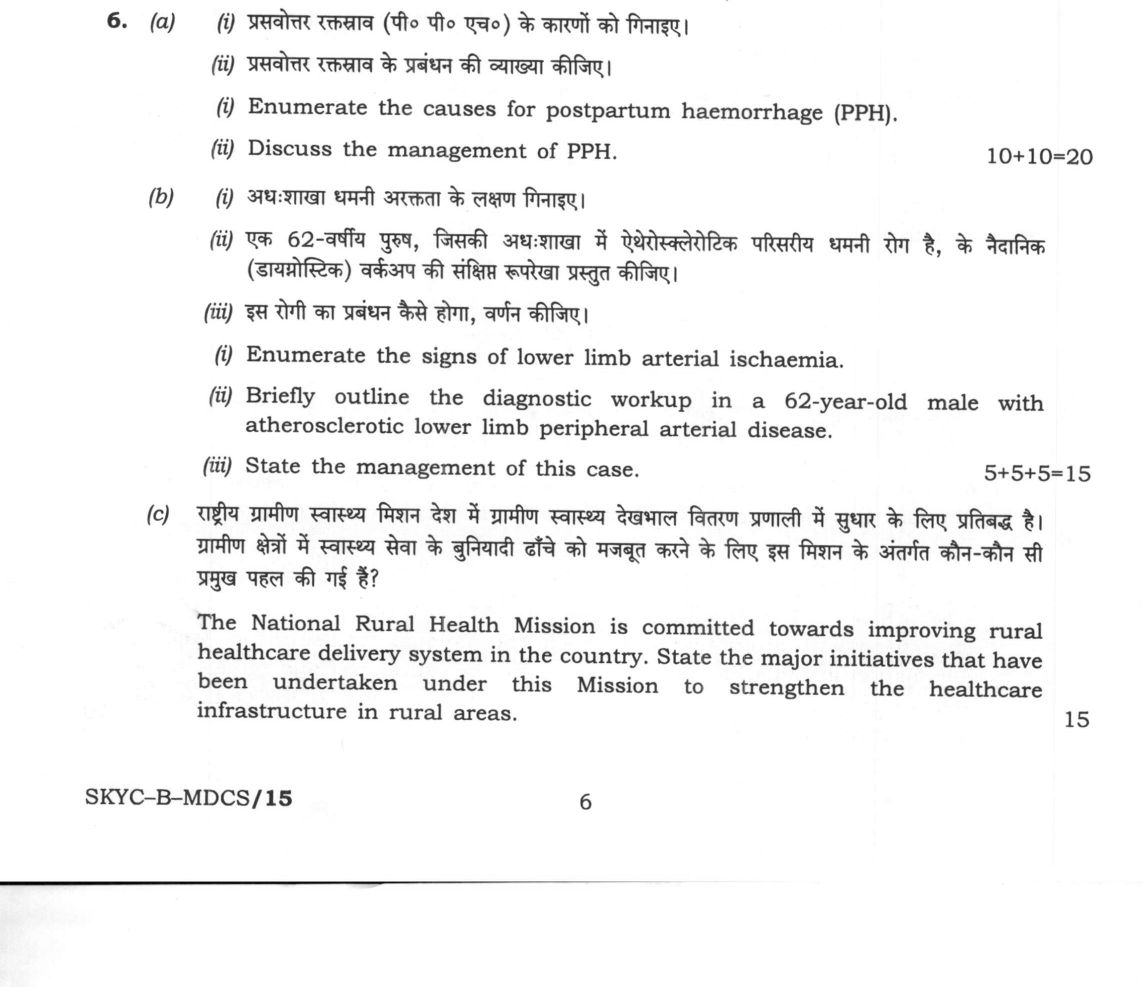
(a) (i) Enumerate the causes for postpartum haemorrhage (PPH). (ii) Discuss the management of PPH. (10+10=20 marks) (b) (i)…
Enumerate the causes for postpartum haemorrhage (PPH).
Discuss the management of PPH. (10+10=20 marks)
Enumerate the signs of lower limb arterial ischaemia.
Briefly outline the diagnostic workup in a 62-year-old male with atherosclerotic lower limb peripheral arterial disease.
State the management of this case. (5+5+5=15 marks)
The National Rural Health Mission is committed towards improving rural healthcare delivery system in the country. State the major initiatives that have been undertaken under this Mission to strengthen the healthcare infrastructure in rural areas. 15 marks
हिंदी में प्रश्न पढ़ें
प्रसवोत्तर रक्तस्राव (पी. पी. एच.) के कारणों को गिनाइए।
प्रसवोत्तर रक्तस्राव के प्रबंधन की व्याख्या कीजिए। (10+10=20 अंक)
अधःशाखा धमनी अरक्तता के लक्षण गिनाइए।
एक 62-वर्षीय पुरुष, जिसकी अधःशाखा में एथेरोस्क्लेरोटिक परिसरिय धमनी रोग है, के नैदानिक (डायग्नोस्टिक) वर्क-अप की संक्षिप्त रूपरेखा प्रस्तुत कीजिए।
इस रोगी का प्रबंधन कैसे होगा, वर्णन कीजिए। (5+5+5=15 अंक)
राष्ट्रीय ग्रामीण स्वास्थ्य मिशन देश में ग्रामीण स्वास्थ्य देखभाल वितरण प्रणाली में सुधार के लिए प्रतिबद्ध है। ग्रामीण क्षेत्रों में स्वास्थ्य सेवा के बुनियादी ढांचे को मजबूत करने के लिए इस मिशन के अंतर्गत कौन-कौन सी प्रमुख पहल की गई हैं? (15 अंक)
Model answer
Written by UPSC Answer Check against this question's marking rubric, to the expected length. UPSC does not publish answers for Mains — this is one way to score well, not an official key.
Postpartum Haemorrhage (PPH)
Causes of PPH: Primary postpartum haemorrhage (blood loss ≥500 mL following vaginal delivery or ≥1000 mL following caesarean section within 24 hours) is systematically classified using the 4Ts framework:
- Tone (Uterine Atony, accounting for >70% of cases): Precipitated by overdistended uterus (multiple gestation, polyhydramnios), prolonged or precipitate labour, grand multiparity, chorioamnionitis, and tocolytic drugs.
- Trauma (20%): Cervical, vaginal, or perineal lacerations, uterine rupture, broad ligament haematoma, and acute uterine inversion.
- Tissue (10%): Retained placenta, succenturiate lobes, placental fragments, and morbidly adherent placenta (accreta, increta, percreta).
- Thrombin (1%): Pre-existing coagulopathies (haemophilia, von Willebrand disease) or acquired coagulopathies including disseminated intravascular coagulation (DIC) from abruptio placentae, severe pre-eclampsia, HELLP syndrome, and amniotic fluid embolism.
Management of PPH: Management follows simultaneous resuscitation, diagnosis, and stepwise intervention aligned with WHO and FIGO guidelines.
Resuscitation and Assessment: High-flow oxygen, rapid establishment of two large-bore (14–16G) IV access lines, fluid resuscitation with warm crystalloids, type-specific cross-matched blood transfusion, early administration of Intravenous Tranexamic Acid (1 g over 10 minutes within 3 hours of birth), and bladder catheterization.
Mechanical and Medical Methods: Initial uterine massage and bimanual uterine compression. First-line uterotonic is Oxytocin (10–20 IU infusion or 10 IU IM). Second-line agents include Methylergometrine (0.2 mg IM, contraindicated in hypertension/cardiac disease), 15-methyl PGF2α / Carboprost (0.25 mg IM every 15 minutes up to 8 doses, contraindicated in asthma), and Misoprostol (800 mcg sublingually or rectally). In non-atony cases, immediate repair of genital tract lacerations, manual removal of placenta under anaesthesia, or manual repositioning of uterine inversion (Johnson’s manoeuvre) is performed.
Tamponade and Surgical Interventions: If medical management fails, intrauterine balloon tamponade (Bakri balloon, condom catheter) is deployed. Refractory bleeding mandates laparotomy: uterine compression sutures (B-Lynch or Hayman sutures), stepwise devascularization via bilateral uterine artery ligation (O’Leary) and internal iliac (hypogastric) artery ligation, or selective pelvic arterial embolization in hemodynamically stable setups. Emergency peripartum hysterectomy serves as the definitive life-saving measure.
---
Lower Limb Arterial Ischaemia
Signs of Lower Limb Arterial Ischaemia: Acute limb ischaemia manifests with the classical 6 Ps: Pain, Pallor, Pulselessness, Paraesthesia, Paralysis (denoting impending tissue loss), and Poikilothermia (perishing cold). Chronic ischaemia, categorized by the Rutherford classification (ranging from asymptomatic to mild/moderate/severe claudication, ischaemic rest pain, minor tissue loss, and major tissue loss), presents with dry, shiny skin, loss of hair, thickened brittle nails, muscle atrophy, dependent rubor with pallor on elevation (Buerger’s sign), non-healing punched-out arterial ulcers, and gangrene characteristic of Chronic Limb-Threatening Ischaemia (CLTI).
Diagnostic Workup: In a 62-year-old male with atherosclerotic peripheral arterial disease:
- Bedside Vascular Testing: Resting Ankle-Brachial Index (ABI) via Doppler; ABI <0.9 is diagnostic, while <0.4 indicates severe ischaemia/CLTI. Toe-Brachial Index (TBI) is assessed if vessels are non-compressible due to medial calcinosis.
- Duplex Ultrasound: Arterial Doppler to map stenosis, peak systolic velocity ratios, and occlusions.
- Vascular Imaging: Computed Tomography Angiography (CTA) or Magnetic Resonance Angiography (MRA) from infrarenal aorta to runoff vessels to define anatomic lesion extent and plan intervention. Digital Subtraction Angiography (DSA) remains the gold standard, often reserved for concurrent therapeutic procedures.
- Metabolic Workup: Fasting lipid profile, HbA1c, renal function tests, and baseline ECG to assess systemic atherosclerotic burden.
Management:
- Risk Factor Modification and Medical Therapy: Smoking cessation, aggressive control of diabetes and hypertension, single antiplatelet therapy (Aspirin 75–100 mg daily or Clopidogrel 75 mg daily), high-intensity statin therapy (Atorvastatin 80 mg), and Cilostazol (100 mg twice daily) for claudication distance improvement. Supervised exercise therapy is first-line for claudication.
- Revascularization: Indicated for lifestyle-limiting claudication unresponsive to medical therapy or CLTI. Endovascular intervention (percutaneous transluminal angioplasty, drug-coated balloons, or bare-metal/drug-eluting stenting) is preferred for focal, shorter lesions (TASC II A/B). Surgical bypass (autologous saphenous vein graft or PTFE synthetic graft) or endarterectomy is indicated for extensive, multilevel occlusions (TASC II C/D).
---
National Rural Health Mission (NRHM) Initiatives
Launched to restructure the architectural delivery of primary and secondary healthcare, the NRHM (now under the National Health Mission) has strengthened rural healthcare infrastructure through key interventions:
- Indian Public Health Standards (IPHS): Established quality and infrastructural norms covering physical facilities, human resources, essential drug lists, and diagnostic capabilities across Sub-Centres, Primary Health Centres (PHCs), and Community Health Centres (CHCs).
- Accredited Social Health Activists (ASHA): Deployment of trained female community health activists at the village level (1 per 1000 population) as the vital link connecting rural households to institutional healthcare facilities.
- Demand-Side Maternal and Child Health Schemes: Janani Suraksha Yojana (JSY) provides direct cash transfers promoting institutional deliveries, complemented by Janani Shishu Suraksha Karyakram (JSSK), which guarantees zero out-of-pocket expenditure for delivery, caesarean sections, drugs, diagnostics, diet, and emergency transport.
- Decentralized Management and Untied Grants: Institution of Rogi Kalyan Samitis (Hospital Management Committees) to facilitate local hospital governance, maintenance, and flexible deployment of untied funds.
- Mobile Medical Units (MMUs) and Emergency Response Systems: Deployment of MMUs to provide outreach clinical care in unserved, hilly, and tribal regions, alongside dedicated Dial 108/102 emergency ambulance networks.
- Facility Upgradation: Upgrading CHCs into 24x7 First Referral Units (FRUs) equipped with emergency obstetric care, blood storage units, and newborn stabilization units, progressing toward comprehensive primary healthcare via Ayushman Arogya Mandirs (Health and Wellness Centres).
A coordinated way forward requires consolidating clinical emergency protocols with strengthened decentralized rural health infrastructure to deliver equitable, continuum-based care.
What "Discuss" is asking you to do
Lay the issue out from more than one side — how it arose, what is claimed for it, what is held against it, and where it now stands. UPSC attaches discuss to broad topics with several live dimensions, so coverage of the dimensions earns more than the strength of your opinion.
Structure that answers it
Set the issue up → the case as it is made → the case against → the dimension both sides leave out → where the balance now lies
Where marks are lost
Listing facts with no thread between them, or arguing one side throughout and calling it a discussion.
How this answer will be evaluated
Approach
Framework: Clinical Sequence (Definition > Aetiology > Features > Investigation > Management). (a(i)) enumerate: list the items in order > one line each > no commentary | (a(ii)) discuss: intro > 3-4 dimensions > example > balanced close | (b(i)) enumerate: list the items in order > one line each > no commentary | (b(ii)) explain: definition/context > points in order > small example > short close | (b(iii)) explain: definition/context > points in order > small example > short close | (c) highlight: name the salient points > one line of substance each > close Full marks: Comprehensive, clinically accurate, follows sequence, uses mnemonics.
Key points expected
- Uterine atony (primary cause)
- Trauma (cervical/vaginal tears)
- Retained products of conception
- Coagulation disorders
- Immediate resuscitation (IV fluids/blood)
- Bimanual uterine compression
- Oxytocin administration
- Surgical options (e.g., B-Lynch suture)
Evaluation rubric
Each sub-part is marked on its own, against the marks and word limit printed on the paper.
- (a(i)) List causes of PPH in order of frequency. 10 marks
enumerate— list the items in order → one line each → no commentary
Must cover
- Uterine atony (primary cause)
- Trauma (cervical/vaginal tears)
- Retained products of conception
- Coagulation disorders
Loses marks
- Descriptive paragraphs instead of list
- Omission of uterine atony
Earns more
- Mnemonic (4 Ts) used
- Distinction between primary/secondary PPH
Extra mark
- Mention of specific risk factors (e.g., polyhydramnios)
- (a(ii)) Outline management of PPH in clinical sequence. 10 marks
discuss— intro → 3-4 dimensions → example → balanced close
Must cover
- Immediate resuscitation (IV fluids/blood)
- Bimanual uterine compression
- Oxytocin administration
- Surgical options (e.g., B-Lynch suture)
Loses marks
- Management without priority order
- Omission of resuscitation steps
Earns more
- Mention of uterine artery ligation
- Hysterectomy as last resort
Extra mark
- Reference to WHO/RCOG guidelines
- (b(i)) List signs of lower limb arterial ischaemia. 5 marks
enumerate— list the items in order → one line each → no commentary
Must cover
- Pallor
- Pulselessness
- Pain
- Poikilothermia (coldness)
Loses marks
- Listing symptoms only without signs
- Omission of pulselessness
Earns more
- Mention of '6 Ps' mnemonic
- Distinction between acute and chronic signs
Extra mark
- Mention of motor/sensory deficits
- (b(ii)) Outline diagnostic workup for atherosclerotic PAD. 5 marks
explain— definition/context → points in order → small example → short close
Must cover
- Ankle-Brachial Index (ABI)
- Doppler ultrasound
- CT Angiography (CTA)
- Risk factor assessment (lipid/diabetes)
Loses marks
- Omission of ABI
- Listing investigations without priority
Earns more
- Mention of exercise treadmill test
- MRA as alternative to CTA
Extra mark
- Reference to specific diagnostic criteria
- (b(iii)) State management of atherosclerotic PAD. 5 marks
explain— definition/context → points in order → small example → short close
Must cover
- Lifestyle modification (smoking cessation)
- Antiplatelet therapy (Aspirin)
- Statin therapy
- Revascularization (PTA/Stent)
Loses marks
- Management without priority
- Omission of risk factor control
Earns more
- Mention of supervised exercise therapy
- Amputation for gangrene
Extra mark
- Reference to ACC/AHA guidelines
- (c) State major NRHM initiatives for rural infrastructure. 15 marks
highlight— name the salient points → one line of substance each → close
Must cover
- Sub-Centres (SC) construction
- Primary Health Centres (PHC) construction
- Community Health Centres (CHC) construction
- Health and Wellness Centres (HWC)
Loses marks
- Generalities without specific infrastructure
- Omission of PHC/CHC
Earns more
- Mention of 24/7 emergency care
- Mention of referral systems
Extra mark
- Reference to specific NRHM guidelines
Practice this exact question
Write your answer and it is marked point by point against the model answer above — what you covered, what you missed, what you got wrong.
Evaluate my answer →More from Medical Science 2023 Paper II
- Q3 (a) Discuss in short the aetiology, clinical features, investigations and management of c…
- Q4 (a) A 20-year-old male has presented to the medicine OPD. He has complaints of episodes o…
- Q5 (a) A 65-year-old lady has progressively increasing dysphagia for last 6 months. She also…
- Q6 (a) (i) Enumerate the causes for postpartum haemorrhage (PPH). (ii) Discuss the managemen…
- Q7 (a) (i) Enumerate the causes of radio-opacities on a plain abdominal radiograph. (ii) Enl…
- Q8 (a) State the vision, goals and objectives of the National Framework for Malaria Eliminat…