Paper I — Q1
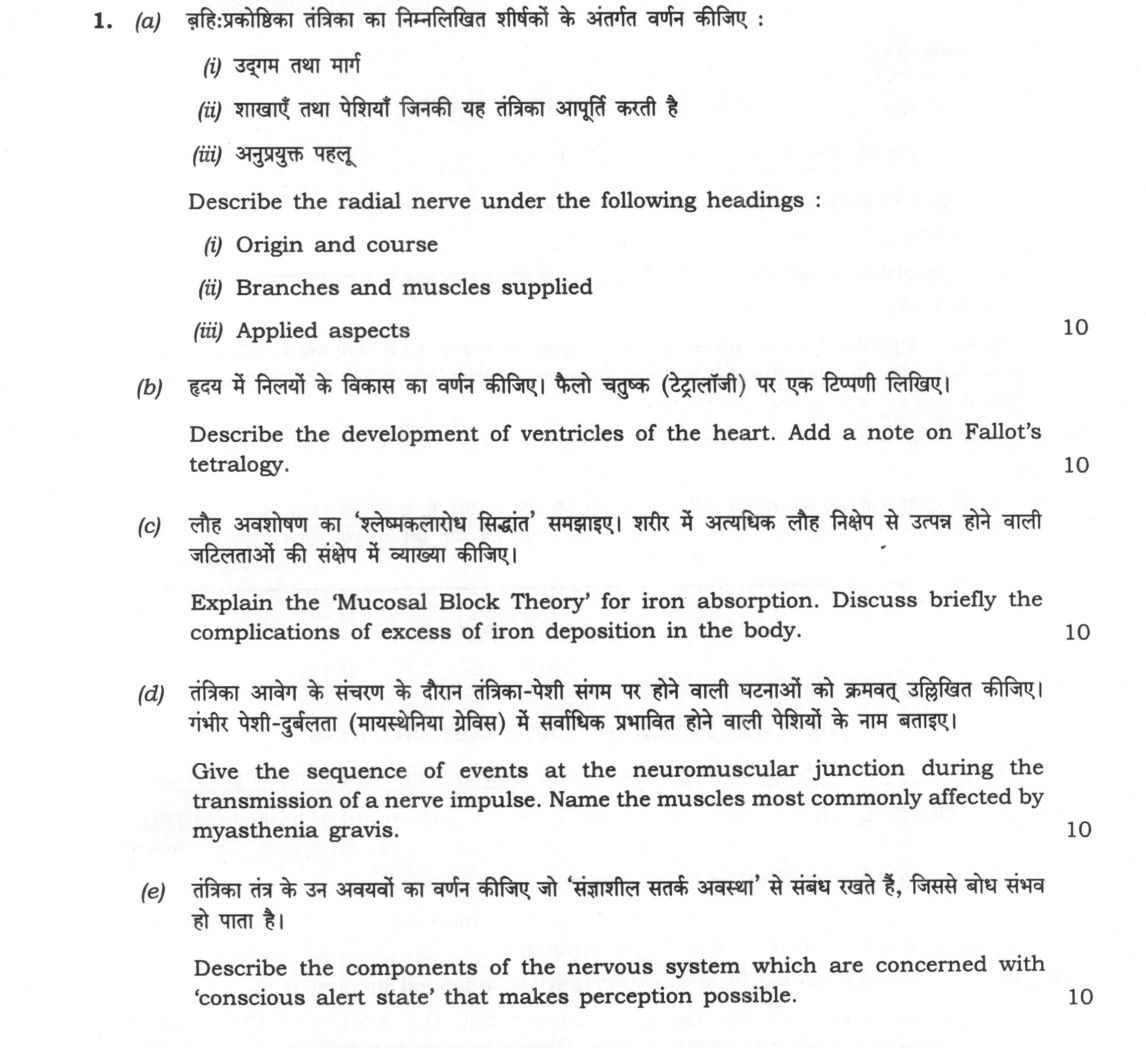
Describe the radial nerve under the following headings: (i) Origin and course (ii) Branches and muscles supplied (iii) Applied…
Describe the radial nerve under the following headings: Origin and course
Branches and muscles supplied
Applied aspects
Describe the development of ventricles of the heart. Add a note on Fallot's tetralogy.
Explain the 'Mucosal Block Theory' for iron absorption. Discuss briefly the complications of excess of iron deposition in the body.
Give the sequence of events at the neuromuscular junction during the transmission of a nerve impulse. Name the muscles most commonly affected by myasthenia gravis.
Describe the components of the nervous system which are concerned with 'conscious alert state' that makes perception possible.
हिंदी में प्रश्न पढ़ें
बहिःप्रकोष्ठिका तंत्रिका का निम्नलिखित शीर्षकों के अंतर्गत वर्णन कीजिए : उद्गम तथा मार्ग
शाखाएँ तथा पेशियाँ जिनकी यह तंत्रिका आपूर्ति करती है
अनुप्रयुक्त पहलू
हृदय में निलयों के विकास का वर्णन कीजिए। फैलो चतुष्क (टेट्रालॉजी) पर एक टिप्पणी लिखिए।
लोह अवशोषण का 'श्लेष्मकलारोध सिद्धांत' समझाइए। शरीर में अत्यधिक लोह निक्षेप से उत्पन्न होने वाली जटिलताओं की संक्षेप में व्याख्या कीजिए।
तंत्रिका आवेग के संचरण के दौरान तंत्रिका-पेशी संगम पर होने वाली घटनाओं को क्रमवत उल्लिखित कीजिए। गंभीर पेशी-दुर्बलता (मायस्थेनिया ग्रेविस) में सर्वाधिक प्रभावित होने वाली पेशियों के नाम बताइए।
तंत्रिका तंत्र के उन अवयवों का वर्णन कीजिए जो 'संजाग्रीत सतर्क अवस्था' से संबंध रखते हैं, जिससे बोध संभव हो पाता है।
Model answer
Written by UPSC Answer Check against this question's marking rubric, to the expected length. UPSC does not publish answers for Mains — this is one way to score well, not an official key.
Radial nerve. The radial nerve arises from the posterior cord (C5–T1), passes posterior to the third part of the axillary artery, leaves the axilla through the triangular interval, and runs in the spiral groove of the humerus. At the elbow it divides into a superficial sensory branch and a deep branch; the deep branch supplies the supinator and extensor carpi radialis brevis before piercing the supinator to become the posterior interosseous nerve. It supplies triceps, anconeus, brachioradialis, extensor carpi radialis longus, and forearm extensors. Cutaneous branches include posterior cutaneous nerve of arm, lower lateral cutaneous nerve of arm, posterior cutaneous nerve of forearm, and superficial radial nerve to the dorsum of hand and radial digits. Mid-shaft humeral fracture or Saturday-night palsy in the spiral groove causes wrist drop, impaired finger extension, and dorsal hand sensory loss.
Ventricles and Fallot’s tetralogy. The primitive ventricle is divided into right and left ventricles by a muscular interventricular septum growing from the floor; the membranous part forms by fusion of endocardial cushions, the aorticopulmonary septum, and the muscular septum. The bulbus cordis partitions into the outflow tracts, and the aorticopulmonary septum spirals to separate the truncus arteriosus into aorta and pulmonary trunk. Fallot’s tetralogy results from anterior and cephalad deviation of the infundibular septum, producing a VSD, overriding aorta, pulmonary stenosis/right ventricular outflow obstruction, and right ventricular hypertrophy.
Mucosal block theory. In the duodenum, ferric iron is reduced to ferrous iron and enters enterocytes via DMT1. The classic mucosal block occurs when intracellular iron binds apoferritin to form ferritin; adequate stores trap iron, limit further absorption, and the iron is lost when the enterocyte sloughs. Hepcidin reinforces this by inhibiting ferroportin export. Excess deposition causes haemochromatosis/haemosiderosis: liver cirrhosis, hepatocellular carcinoma, cardiomyopathy, bronze diabetes, hypogonadism, arthropathy; transfusional overload in thalassaemia is a common Indian setting.
Neuromuscular junction. A nerve action potential depolarises the motor end-plate, opening voltage-gated Ca2+ channels. Calcium influx releases acetylcholine into the cleft; ACh binds nicotinic receptors, opening Na+/K+ channels and producing an end-plate potential. If threshold is reached, a muscle action potential follows; acetylcholinesterase hydrolyses ACh. Myasthenia gravis, due to anti-ACh receptor antibodies, commonly affects extraocular, facial, bulbar, and proximal limb muscles.
Conscious alert state. The conscious alert state depends on the reticular activating system in the brainstem reticular formation, especially midbrain and pons, projecting to the thalamus and cortex. Posterior hypothalamus, orexin/hypocretin neurons, and cholinergic/monoaminergic pathways—locus coeruleus, raphe nuclei, ventral tegmental area—maintain arousal; thalamocortical activation makes perception possible. Damage to these circuits produces coma or altered sensorium.
What "Describe" is asking you to do
Give a full, ordered account of the thing named — its parts, stages or mechanism — in the sequence in which it actually exists or occurs. Most describe questions come from the science optionals, where the marks sit in correct technical detail and, where the stem says so, a labelled diagram.
Structure that answers it
One-line identification of the subject → the parts or stages in their real order, each with its defining detail → labelled diagram where the subject is structural → closing line on function or significance
Where marks are lost
Loose general prose where the examiner is ticking named parts, correct terminology and their sequence; and in the General Studies papers, turning to evaluation before the description is finished.
How this answer will be evaluated
Approach
Framework: Anatomical & Physiological Description. (a) describe: define > structure or process in order > labelled diagram > significance | (b) describe: define > structure or process in order > labelled diagram > significance | (c) explain: definition/context > points in order > small example > short close | (d) describe: define > structure or process in order > labelled diagram > significance | (e) describe: define > structure or process in order > labelled diagram > significance Full marks: Comprehensive, accurate, and well-structured answers with diagrams and clinical correlations.
Key points expected
- Origin from posterior cord of brachial plexus
- Course through radial groove of humerus
- Branches: Deep (posterior interosseous) and Superficial
- Muscles supplied: Extensor group of forearm
- Development from primitive heart tube
- Septation of the ventricular cavity
- Components of Fallot's tetralogy (4 defects)
- Mechanism of right-to-left shunt
Evaluation rubric
Each sub-part is marked on its own, against the marks and word limit printed on the paper.
- (a) Anatomical description of the radial nerve covering origin, course, branches, and clinical significance. 10 marks
describe— define → structure or process in order → labelled diagram → significance
Must cover
- Origin from posterior cord of brachial plexus
- Course through radial groove of humerus
- Branches: Deep (posterior interosseous) and Superficial
- Muscles supplied: Extensor group of forearm
Loses marks
- Confusing radial nerve with median nerve
- Omitting the course in the radial groove
- Listing muscles without grouping (extensors)
Earns more
- Sensory distribution of posterior arm/forearm
- Applied aspect: Radial nerve palsy (Saturday night palsy)
- Labelled diagram of nerve course
- Mention of 'Wrist drop' sign
Extra mark
- Mention of specific landmark: Spiral groove
- Distinction between deep and superficial branches
- (b) Embryological development of heart ventricles and a note on Fallot's tetralogy. 10 marks
describe— define → structure or process in order → labelled diagram → significance
Must cover
- Development from primitive heart tube
- Septation of the ventricular cavity
- Components of Fallot's tetralogy (4 defects)
- Mechanism of right-to-left shunt
Loses marks
- Listing Fallot's defects without explaining the shunt
- Confusing atrial and ventricular septation
- Omitting the 'tetralogy' components
Earns more
- Mention of conotruncal ridges
- Labelled diagram of ventricular septation
- Clinical features of Fallot's (Cyanosis)
- Mention of 'Boot-shaped heart' on X-ray
Extra mark
- Specific embryological timing (weeks 4-7)
- Mention of surgical correction (Rastelli procedure)
- (c) Explanation of Mucosal Block Theory for iron absorption and complications of excess iron. 10 marks
explain— definition/context → points in order → small example → short close
Must cover
- Definition of Mucosal Block Theory
- Role of mucosal cells in regulating absorption
- Complications: Hemochromatosis
- Organ damage: Liver, heart, pancreas
Loses marks
- Confusing iron absorption with calcium absorption
- Listing complications without linking to organ damage
- Omitting the 'block' mechanism
Earns more
- Mention of 'Iron overload' mechanism
- Labelled diagram of absorption process
- Mention of 'Bronze diabetes'
- Mention of ferritin levels
Extra mark
- Mention of phlebotomy as treatment
- Specific mention of hemosiderin deposition
- (d) Sequence of events at neuromuscular junction and muscles affected in myasthenia gravis. 10 marks
describe— define → structure or process in order → labelled diagram → significance
Must cover
- Arrival of action potential at nerve terminal
- Acetylcholine release and binding to receptors
- Muscles affected: Ocular (extraocular) muscles
- Muscles affected: Facial and bulbar muscles
Loses marks
- Confusing NMJ with synapse in CNS
- Omitting the sequence of events
- Listing wrong muscles for myasthenia
Earns more
- Mention of 'End plate potential'
- Labelled diagram of NMJ
- Mention of 'Fatigability' in myasthenia
- Mention of 'Ptosis' as a sign
Extra mark
- Mention of acetylcholinesterase role
- Mention of 'Tensilon test' for diagnosis
- (e) Components of the nervous system concerned with conscious alert state and perception. 10 marks
describe— define → structure or process in order → labelled diagram → significance
Must cover
- Reticular Activating System (RAS)
- Thalamus as relay station
- Cerebral cortex for perception
- Role of neurotransmitters (Acetylcholine, Norepinephrine)
Loses marks
- Confusing RAS with motor pathways
- Omitting the role of thalamus
- Listing components without explaining their function
Earns more
- Mention of 'Ascending Reticular Activating System'
- Labelled diagram of RAS pathway
- Mention of 'Arousal' mechanism
- Mention of 'Sleep-Wake cycle'
Extra mark
- Mention of specific nuclei in RAS
- Mention of 'Consciousness' vs 'Alertness'
Practice this exact question
Write your answer and it is marked point by point against the model answer above — what you covered, what you missed, what you got wrong.
Evaluate my answer →More from Medical Science 2024 Paper I
- Q1 Describe the radial nerve under the following headings: (i) Origin and course (ii) Branch…
- Q2 A middle-aged female notices a lump in the midline of the neck. She notices it moves with…
- Q3 Describe the uterus under the following headings: (i) Gross anatomy (ii) Ligaments and su…
- Q4 Describe the facial nerve under the following headings: 1. Functional columns and nuclei…