Paper I — Q3
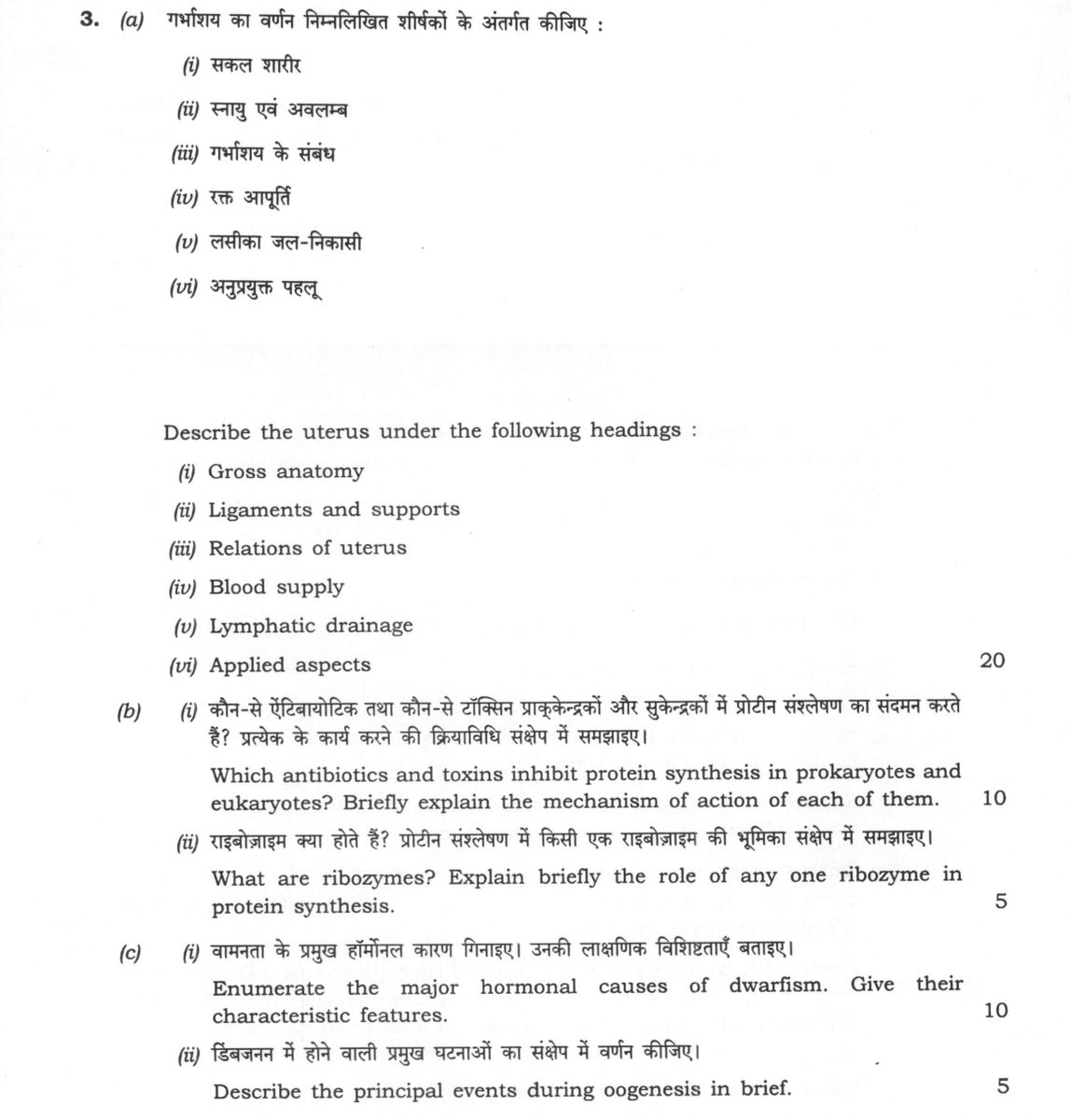
Describe the uterus under the following headings: (i) Gross anatomy (ii) Ligaments and supports (iii) Relations of uterus (iv)…
Describe the uterus under the following headings: Gross anatomy
Ligaments and supports
Relations of uterus
Blood supply
Lymphatic drainage
Applied aspects
Which antibiotics and toxins inhibit protein synthesis in prokaryotes and eukaryotes? Briefly explain the mechanism of action of each of them.
What are ribozymes? Explain briefly the role of any one ribozyme in protein synthesis.
Enumerate the major hormonal causes of dwarfism. Give their characteristic features.
Describe the principal events during oogenesis in brief.
हिंदी में प्रश्न पढ़ें
गर्भाशय का वर्णन निम्नलिखित शीर्षकों के अंतर्गत कीजिए : सकल शारीर
स्नायु एवं अवलम्ब
गर्भाशय के संबंध
रक्त आपूर्ति
लसीका जल-निकासी
अनुप्रयुक्त पहलू
कौन-से एंटीबायोटिक तथा कौन-से टॉक्सिन प्राकृतिककों और युक्रियकों में प्रोटीन संश्लेषण का संदमन करते हैं? प्रत्येक के कार्य करने की क्रियाविधि संक्षेप में समझाइए।
राइबोजाइम क्या होते हैं? प्रोटीन संश्लेषण में किसी एक राइबोजाइम की भूमिका संक्षेप में समझाइए।
बामना के प्रमुख हार्मोनल कारण गिनाइए। उनकी लाक्षणिक विशिष्टताएं बताइए।
डिंबजनन में होने वाली प्रमुख घटनाओं का संक्षेप में वर्णन कीजिए।
Model answer
Written by UPSC Answer Check against this question's marking rubric, to the expected length. UPSC does not publish answers for Mains — this is one way to score well, not an official key.
Uterus. The uterus is a pear-shaped, thick-walled muscular organ, about 7.5 × 5 × 2.5 cm and 50–70 g, with fundus, body, isthmus and cervix. Its wall has perimetrium, thick myometrium and endometrium (basal and functional layers). The broad ligament (mesometrium, mesosalpinx, mesovarium), round ligament (covered by peritoneum), uterosacral and cardinal/transverse cervical ligaments of Mackenrodt, with levator ani and urogenital diaphragm, support it. Anteriorly it lies with bladder and vesicouterine pouch; posteriorly with rectum and rectouterine pouch of Douglas; laterally with broad ligament, uterine artery and ureter. Blood supply is from uterine artery (anterior division of internal iliac) and ovarian artery (aorta); arcuate arteries in myometrium give radial arteries, which give basal and spiral arterioles; veins drain via uterine and ovarian plexuses, chiefly to internal iliac veins. Lymph from fundus/upper body goes to para-aortic nodes along ovarian vessels; lower body/cervix to external/internal iliac, and cervix also to obturator/sacral nodes. Applied aspects include retroversion, prolapse with cystocele/rectocele, hysterectomy with ureter injury, endometrial carcinoma staging and leiomyoma.
Protein synthesis inhibitors. In prokaryotes, tetracyclines block the A-site on 30S; chloramphenicol inhibits 50S peptidyl transferase; macrolides block translocation on 50S; aminoglycosides cause 30S misreading; linezolid inhibits 70S initiation. Prokaryotic toxins include bacteriocins such as colicin M, which blocks aminoacyl-tRNA binding. In eukaryotes, cycloheximide blocks 60S translocation; puromycin mimics aminoacyl-tRNA and causes premature termination; diphtheria toxin ADP-ribosylates eEF-2; ricin depurinates 28S rRNA.
Ribozymes. Ribozymes are catalytic RNAs; examples include RNase P and self-splicing introns. In protein synthesis, the peptidyl-transferase centre of 23S rRNA (bacteria) or 28S rRNA (eukaryotes) catalyses peptide-bond formation between peptidyl-tRNA and aminoacyl-tRNA.
Hormonal dwarfism. GH deficiency causes proportionate short stature with delayed bone age. Hypothyroidism/cretinism causes disproportionate short stature, coarse facies, hypotonia and intellectual disability. Glucocorticoid excess causes growth failure with obesity, hypertension and striae. Hypopituitarism/panhypopituitarism causes multiple hormone deficiencies; Laron GH resistance (high GH, low IGF-1) causes short stature. Precocious puberty causes early sexual maturation and early epiphyseal closure, limiting adult height.
Oogenesis. Fetal oogonia proliferate mitotically and enter meiosis I, arresting in dictyate/prophase I. From puberty, one primary oocyte completes meiosis I to form secondary oocyte and first polar body; it arrests in metaphase II, ovulates, and completes meiosis II only if fertilized, forming the second polar body. Thus, the uterus and these molecular, hormonal and developmental processes follow defined anatomical and regulatory sequences.
What "Describe" is asking you to do
Give a full, ordered account of the thing named — its parts, stages or mechanism — in the sequence in which it actually exists or occurs. Most describe questions come from the science optionals, where the marks sit in correct technical detail and, where the stem says so, a labelled diagram.
Structure that answers it
One-line identification of the subject → the parts or stages in their real order, each with its defining detail → labelled diagram where the subject is structural → closing line on function or significance
Where marks are lost
Loose general prose where the examiner is ticking named parts, correct terminology and their sequence; and in the General Studies papers, turning to evaluation before the description is finished.
How this answer will be evaluated
Approach
Framework: Medical Science, Paper 1. (a) describe: define > structure or process in order > labelled diagram > significance | (b(i)) explain: definition/context > points in order > small example > short close | (b(ii)) explain: definition/context > points in order > small example > short close | (c(i)) enumerate: list the items in order > one line each > no commentary | (c(ii)) describe: define > structure or process in order > labelled diagram > significance Full marks: Comprehensive, accurate, and well-structured answers with specific examples and mechanisms.
Key points expected
- Gross anatomy: pear-shaped, fundus/body/cervix, dimensions
- Ligaments: broad, round, uterosacral, cardinal, ovarian
- Relations: anterior (urinary bladder), posterior (rectum)
- Blood supply: uterine artery (internal iliac), ovarian artery
- Prokaryotic inhibitors: Tetracycline, Chloramphenicol, Macrolides
- Eukaryotic inhibitors: Cycloheximide, Puromycin
- Specific ribosomal subunit targets (30S vs 60S vs 80S)
- Mechanism: initiation, elongation, or termination block
Evaluation rubric
Each sub-part is marked on its own, against the marks and word limit printed on the paper.
- (a) Systematic anatomical description of the uterus across six specific headings. 20 marks
describe— define → structure or process in order → labelled diagram → significance
Must cover
- Gross anatomy: pear-shaped, fundus/body/cervix, dimensions
- Ligaments: broad, round, uterosacral, cardinal, ovarian
- Relations: anterior (urinary bladder), posterior (rectum)
- Blood supply: uterine artery (internal iliac), ovarian artery
Loses marks
- Omitting specific named ligaments
- Confusing blood supply sources (e.g., aorta vs iliac)
Earns more
- Lymphatic drainage: external/internal iliac nodes
- Applied aspects: pregnancy, surgical approaches
- Labelled diagram of uterus and ligaments
Extra mark
- Mention of specific surgical landmarks (e.g., infundibulopelvic ligament)
- (b(i)) Mechanism of action of antibiotics and toxins inhibiting protein synthesis. 10 marks
explain— definition/context → points in order → small example → short close
Must cover
- Prokaryotic inhibitors: Tetracycline, Chloramphenicol, Macrolides
- Eukaryotic inhibitors: Cycloheximide, Puromycin
- Specific ribosomal subunit targets (30S vs 60S vs 80S)
- Mechanism: initiation, elongation, or termination block
Loses marks
- Listing drugs without mechanism of action
- Confusing prokaryotic and eukaryotic targets
Earns more
- Toxins: Diphtheria toxin, Shiga toxin (ADP-ribosylation)
- Comparison of prokaryotic vs eukaryotic targets
Extra mark
- Mention of specific clinical applications or resistance mechanisms
- (b(ii)) Definition of ribozymes and role of one in protein synthesis. 5 marks
explain— definition/context → points in order → small example → short close
Must cover
- Definition: catalytic RNA molecules
- Example: Peptidyl transferase (23S rRNA)
- Role: peptide bond formation in ribosome
Loses marks
- Confusing ribozyme with ribosome
- Failing to name a specific ribozyme
Earns more
- Mention of self-splicing introns or RNase P
- Distinction between ribozyme and ribosome
Extra mark
- Mention of Nobel Prize (Cech/Altman) for discovery
- (c(i)) List major hormonal causes of dwarfism with characteristic features. 10 marks
enumerate— list the items in order → one line each → no commentary
Must cover
- Growth Hormone (GH) deficiency (Pituitary dwarfism)
- Hypothyroidism (Cretinism)
- Characteristic features: proportionate vs disproportionate
- Specific clinical signs (e.g., delayed bone age, myxedema)
Loses marks
- Listing non-hormonal causes (e.g., Turner syndrome)
- Failing to distinguish features of different types
Earns more
- Mention of IGF-1 deficiency
- Distinction between eutopoid and hypotopoid dwarfism
Extra mark
- Mention of specific genetic causes (e.g., Laron syndrome)
- (c(ii)) Principal events during oogenesis in brief. 5 marks
describe— define → structure or process in order → labelled diagram → significance
Must cover
- Oogonia to primary oocyte (mitosis to meiosis I)
- Meiosis I arrest (diplotene stage)
- Completion of Meiosis I (ovulation)
- Meiosis II arrest (metaphase II)
Loses marks
- Confusing oogenesis with spermatogenesis
- Omitting the meiotic arrests
Earns more
- Mention of follicular development (primordial to mature)
- Fate of polar bodies
Extra mark
- Mention of hormonal regulation (FSH/LH)
Practice this exact question
Write your answer and it is marked point by point against the model answer above — what you covered, what you missed, what you got wrong.
Evaluate my answer →More from Medical Science 2024 Paper I
- Q1 Describe the radial nerve under the following headings: (i) Origin and course (ii) Branch…
- Q2 A middle-aged female notices a lump in the midline of the neck. She notices it moves with…
- Q3 Describe the uterus under the following headings: (i) Gross anatomy (ii) Ligaments and su…
- Q4 Describe the facial nerve under the following headings: 1. Functional columns and nuclei…
- Q5 Discuss the antiviral spectrum and therapeutic uses of acyclovir. Doxorubicin is an antib…
- Q6 Describe the microscopic features of breast cancer. Enumerate any five major prognostic f…