Paper I — Q6
Describe the microscopic features of breast cancer. Enumerate any five major prognostic factors. Enumerate any five differences…
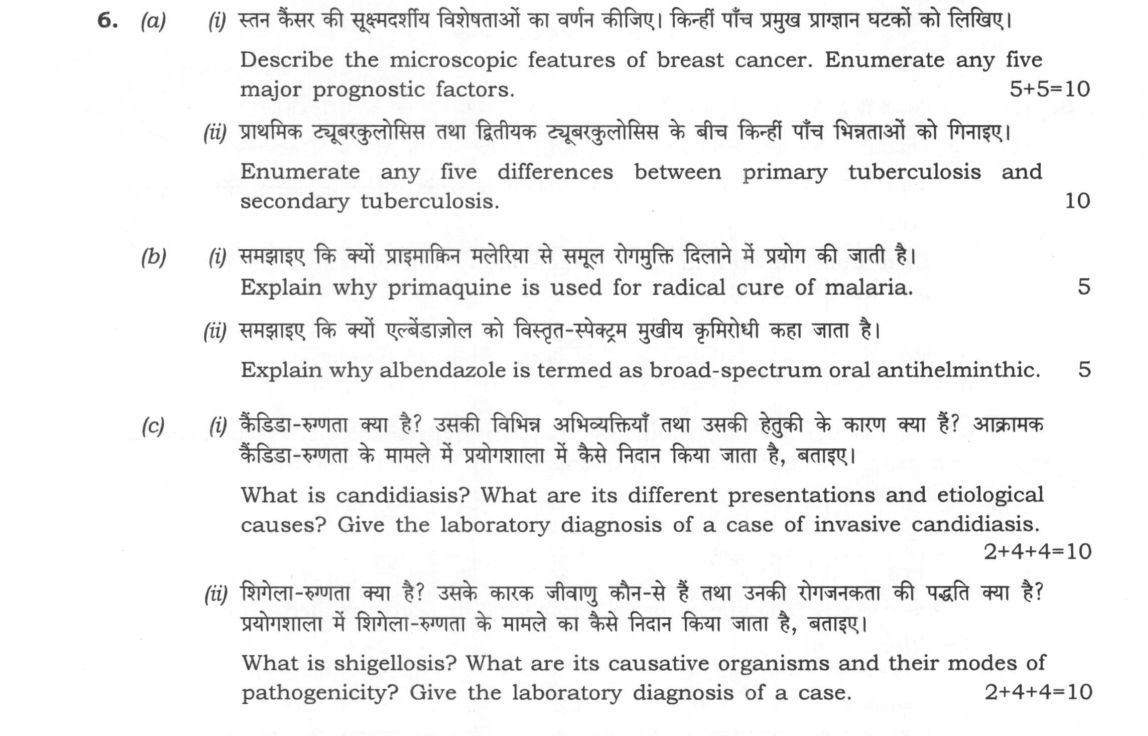
Describe the microscopic features of breast cancer. Enumerate any five major prognostic factors.
Enumerate any five differences between primary tuberculosis and secondary tuberculosis.
Explain why primaquine is used for radical cure of malaria.
Explain why albendazole is termed as broad-spectrum oral antihelminthic.
What is candidiasis? What are its different presentations and etiological causes? Give the laboratory diagnosis of a case of invasive candidiasis.
What is shigellosis? What are its causative organisms and their modes of pathogenicity? Give the laboratory diagnosis of a case.
हिंदी में प्रश्न पढ़ें
स्तन कैंसर की सूक्ष्मदर्शीय विशेषताओं का वर्णन कीजिए। किन्हीं पाँच प्रमुख प्राज्ञान घटकों को लिखिए।
प्राथमिक ट्यूबरक्यूलोसिस तथा द्वितीयक ट्यूबरक्यूलोसिस के बीच किन्हीं पाँच भिन्नताओं को गिनाइए।
समझाइए कि क्यों प्राइमाक्विन मलेरिया से समूल रोगमुक्ति दिलाने में प्रयोग की जाती है।
समझाइए कि क्यों एल्बेंडाजोल को विस्तृत-स्पेक्ट्रम मुख्य कृमिरोधी कहा जाता है।
कैंडिडा-रणता क्या है? उसकी विभिन्न अभिव्यक्तियों तथा उसकी हेतुकी के कारण क्या हैं? आक्रामक कैंडिडा-रणता के मामले में प्रयोगशाला में कैसे निदान किया जाता है, बताइए।
शिगेला-रणता क्या है? उसके कारक जीवाणु कौन-से हैं तथा उनकी रोगजनकता की पद्धति क्या है? प्रयोगशाला में शिगेला-रणता के मामले का कैसे निदान किया जाता है, बताइए।
Model answer
Written by UPSC Answer Check against this question's marking rubric, to the expected length. UPSC does not publish answers for Mains — this is one way to score well, not an official key.
Microscopic features of breast cancer: Invasive ductal carcinoma (NOS) shows tubule formation, nuclear pleomorphism and mitotic count, graded by the Nottingham system; variants include mucinous, medullary and Paget disease (large pale cells in epidermis). Invasive lobular carcinoma shows single-file cell cords. Five prognostic factors: tumour size, axillary nodal status, histological grade, hormone receptor (ER/PR) status, and HER2 overexpression; lymphovascular invasion and Ki-67 also matter.
Primary vs secondary tuberculosis (five differences): Primary occurs in non-immune hosts, affects the lower lobe/subpleural region, produces the Ghon complex with prominent hilar lymphadenopathy, shows type IV hypersensitivity absent initially, and heals by fibrosis/calcification. Secondary occurs in previously sensitised hosts, affects the upper lobe apex, forms fibrocaseous cavitary lesions, has minimal lymph node involvement, and shows marked hypersensitivity with cavitation.
Primaquine for radical cure: It is an 8-aminoquinoline that eliminates hypnozoites of P. vivax and P. ovale persisting in hepatocytes, preventing relapse; it has no action on erythrocytic stages, so it is given after schizontocidal therapy. G6PD deficiency must be excluded to avoid haemolysis.
Albendazole as broad-spectrum oral antihelminthic: It inhibits tubulin polymerisation, impairing glucose uptake and causing worm death. It is effective against nematodes (roundworm, hookworm, whipworm), cestodes (tapeworms) and some protozoa; its active metabolite albendazole sulfoxide gives good oral bioavailability and tissue penetration.
Candidiasis: It is infection by Candida species, chiefly C. albicans. Presentations include mucocutaneous forms (oropharyngeal, oesophageal, vulvovaginal, cutaneous) and invasive forms (candidemia, hepatosplenic, CNS). Causes/risk factors include immunosuppression, broad-spectrum antibiotics, TPN and indwelling catheters. Laboratory diagnosis: blood culture, beta-D-glucan assay, mannan/anti-mannan antibodies, and tissue biopsy showing pseudohyphae and budding yeast.
Shigellosis: It is bacillary dysentery caused by Shigella dysenteriae (type 1, Shiga toxin), S. flexneri, S. boydii and S. sonnei. Pathogenicity involves invasion of colonic M cells, intercellular spread, Shiga toxin inhibiting protein synthesis, and polymorphonuclear infiltration causing ulceration. Laboratory diagnosis: stool culture on SS agar and MacConkey–tellurite, serotyping, PCR for ipaH, and antibiotic sensitivity testing.
What "Describe" is asking you to do
Give a full, ordered account of the thing named — its parts, stages or mechanism — in the sequence in which it actually exists or occurs. Most describe questions come from the science optionals, where the marks sit in correct technical detail and, where the stem says so, a labelled diagram.
Structure that answers it
One-line identification of the subject → the parts or stages in their real order, each with its defining detail → labelled diagram where the subject is structural → closing line on function or significance
Where marks are lost
Loose general prose where the examiner is ticking named parts, correct terminology and their sequence; and in the General Studies papers, turning to evaluation before the description is finished.
How this answer will be evaluated
Approach
Framework: Clinical Pathology & Microbiology Diagnostic Framework. (a) describe: Definition > Microscopic features (ordered) > Prognostic factors (list) | (b) explain: Definition/Context > Mechanism of action > Clinical application | (c) describe: Definition > Aetiology/Pathogenesis > Lab Diagnosis (ordered) Full marks: Accurate histology, precise mechanisms, and correct lab diagnostic hierarchy.
Key points expected
- Invasive ductal carcinoma
- Nottingham grading
- Hypnozoites
- Microtubule synthesis
- Pseudohyphae
- Beta-D-glucan
- Shiga toxin
- Stool culture
Evaluation rubric
Each sub-part is marked on its own, against the marks and word limit printed on the paper.
- (a) Histological features of breast carcinoma and 5 prognostic factors.
describe— Definition → Microscopic features (ordered) → Prognostic factors (list)
Must cover
- Invasive ductal carcinoma features
- Nuclear grade and mitotic count
- Lymphovascular invasion
- 5 Prognostic factors (e.g., ER/PR, HER2, Stage)
Loses marks
- Confusing benign fibroadenoma features with cancer
- Listing symptoms instead of histology
Earns more
- Mention of Nottingham grading system
- Reference to TNM staging
Extra mark
- Labelled diagram of invasive ductal carcinoma
- Mention of Ki-67 index
- (b) Mechanism of Primaquine in malaria and Albendazole's broad spectrum.
explain— Definition/Context → Mechanism of action → Clinical application
Must cover
- Primaquine targets hypnozoites (radical cure)
- Primaquine targets gametocytes (transmission blocking)
- Albendazole inhibits microtubule synthesis
- Albendazole covers nematodes, cestodes, trematodes
Loses marks
- Confusing Primaquine with Chloroquine (blood schizonticide)
- Listing drugs without mechanism
Earns more
- Mention of G6PD deficiency risk for Primaquine
- Specific mention of Ascaris, Hookworm, Taenia
Extra mark
- Mention of WHO guidelines for Malaria
- Mention of WHO guidelines for STH
- (c) Candidiasis and Shigellosis: definition, causes, pathogenicity, and lab diagnosis.
describe— Definition → Aetiology/Pathogenesis → Lab Diagnosis (ordered)
Must cover
- Candida albicans (pseudohyphae, budding yeast)
- Invasive Candidiasis: Blood culture, Beta-D-glucan
- Shigella species (S. dysenteriae, S. flexneri)
- Shigellosis: Stool culture, Serotyping
Loses marks
- Confusing Candida with Aspergillus
- Confusing Shigella with Salmonella (invasion vs non-invasion)
Earns more
- Mention of Shiga toxin in Shigella
- Mention of Sabouraud's dextrose agar for Candida
Extra mark
- Mention of PCR for Shigella
- Mention of MALDI-TOF for Candida
Practice this exact question
Write your answer and it is marked point by point against the model answer above — what you covered, what you missed, what you got wrong.
Evaluate my answer →More from Medical Science 2024 Paper I
- Q3 Describe the uterus under the following headings: (i) Gross anatomy (ii) Ligaments and su…
- Q4 Describe the facial nerve under the following headings: 1. Functional columns and nuclei…
- Q5 Discuss the antiviral spectrum and therapeutic uses of acyclovir. Doxorubicin is an antib…
- Q6 Describe the microscopic features of breast cancer. Enumerate any five major prognostic f…
- Q7 Define death due to hanging. What are the probable causes of death in hanging? What are t…
- Q8 What is enteric fever? What are its causative agents? Give a detailed presentation of a c…