Paper I — Q2
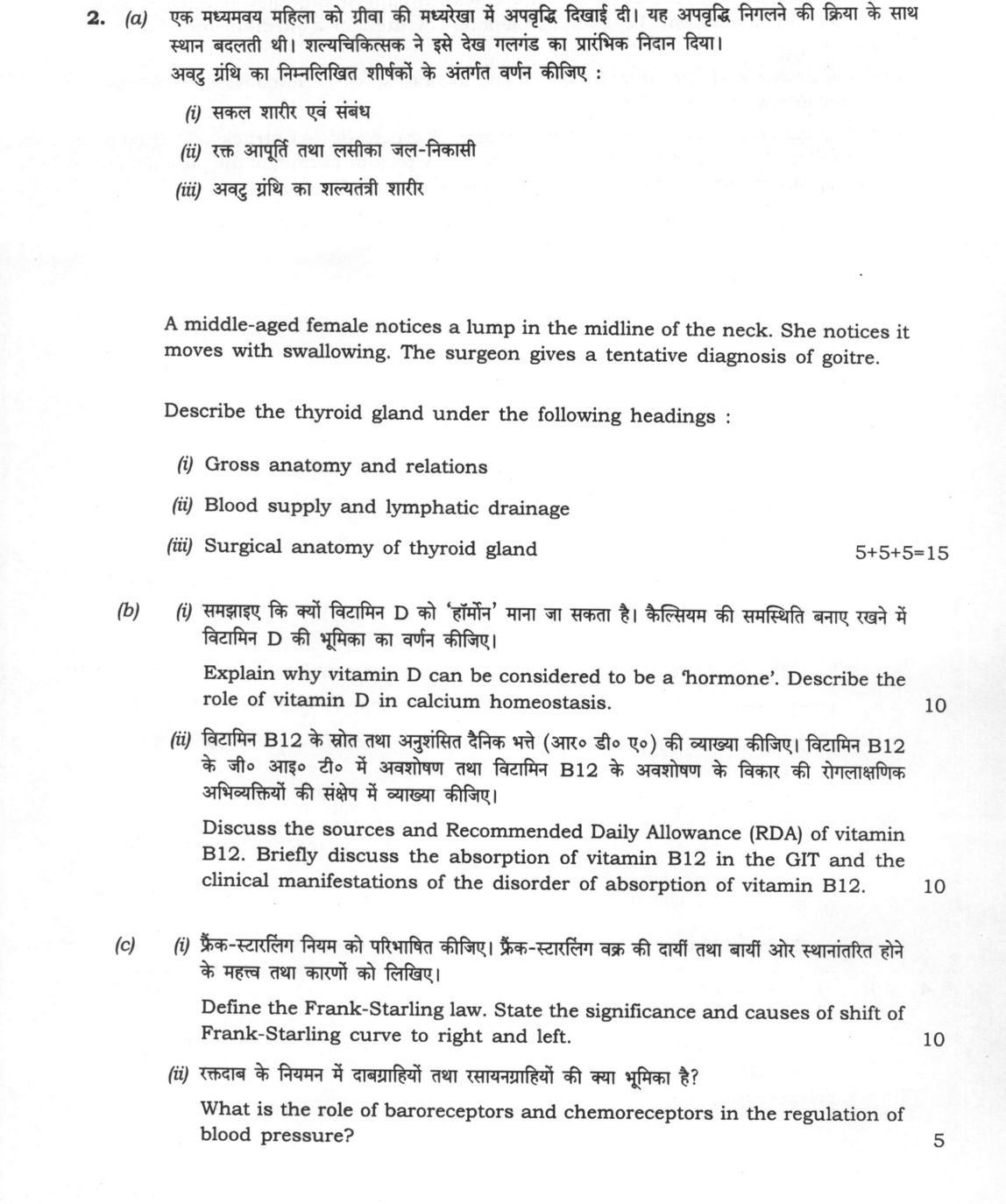
A middle-aged female notices a lump in the midline of the neck. She notices it moves with swallowing. The surgeon gives a…
A middle-aged female notices a lump in the midline of the neck. She notices it moves with swallowing. The surgeon gives a tentative diagnosis of goitre.
Describe the thyroid gland under the following headings: Gross anatomy and relations
Blood supply and lymphatic drainage
Surgical anatomy of thyroid gland
Explain why vitamin D can be considered to be a 'hormone'. Describe the role of vitamin D in calcium homeostasis.
Discuss the sources and Recommended Daily Allowance (RDA) of vitamin B12. Briefly discuss the absorption of vitamin B12 in the GIT and the clinical manifestations of the disorder of absorption of vitamin B12.
Define the Frank-Starling law. State the significance and causes of shift of Frank-Starling curve to right and left.
What is the role of baroreceptors and chemoreceptors in the regulation of blood pressure?
हिंदी में प्रश्न पढ़ें
एक मध्यमवय महिला को ग्रीवा की मध्यरेखा में अपृदुर्द दिखाई दी। यह अपृदुर्द निगलने की क्रिया के साथ स्थान बदलती थी। शल्यचिकित्सक ने इसे देख गलगंड का प्रारंभिक निदान दिया।
अवटु ग्रंथि का निम्नलिखित शीर्षकों के अंतर्गत वर्णन कीजिए : सकल शारीर एवं संबंध
रक्त आपूर्ति तथा लसीका जल-निकासी
अवटु ग्रंथि का शल्यतंत्री शारीर
समझाइए कि क्यों विटामिन D को 'हार्मोन' माना जा सकता है। कैल्शियम की समस्थिति बनाए रखने में विटामिन D की भूमिका का वर्णन कीजिए।
विटामिन B12 के स्रोत तथा अनुशंसित दैनिक भत्ते (आर० डी० ए०) की व्याख्या कीजिए। विटामिन B12 के जी० आई० टी० में अवशोषण तथा विटामिन B12 के अवशोषण के विकार की रोगलाक्षणिक अभिव्यक्तियों की संक्षेप में व्याख्या कीजिए।
फ्रैंक-स्टारलिंग नियम को परिभाषित कीजिए। फ्रैंक-स्टारलिंग वक्र की दायीं तथा बायीं ओर स्थानांतरित होने के महत्व तथा कारणों को लिखिए।
रक्तदाब के नियमन में दाबग्राहियों तथा रसायनग्राहियों की क्या भूमिका है?
Model answer
Written by UPSC Answer Check against this question's marking rubric, to the expected length. UPSC does not publish answers for Mains — this is one way to score well, not an official key.
A midline neck lump that moves with swallowing suggests thyroid pathology, often goitre, because the gland is bound to the trachea by pretracheal fascia.
Gross anatomy and relations. The thyroid has two lateral lobes over the trachea, connected by the isthmus over the 2nd–4th tracheal rings; a pyramidal lobe may be present. Anteriorly it lies deep to infrahyoid/strap muscles; posteriorly it relates to trachea, oesophagus, recurrent laryngeal nerve in the tracheoesophageal groove, and parathyroid glands.
Blood supply and lymphatic drainage. Arterial supply is from superior thyroid artery (external carotid), inferior thyroid artery (thyrocervical trunk), and variable thyroid ima artery. Veins drain via superior, middle and inferior thyroid veins. Lymphatics pass to prelaryngeal, pretracheal and lateral deep cervical nodes.
Surgical anatomy. Danger zones include the recurrent laryngeal nerve, external branch of the superior laryngeal nerve, and parathyroid glands, which must be preserved with their blood supply. Berry’s ligament fixes the gland to the trachea and is a key landmark.
Vitamin D as a hormone and calcium homeostasis. Vitamin D can be considered a hormone because it is synthesised in skin by UV-B, hydroxylated in liver to 25-hydroxyvitamin D and in kidney to 1,25-dihydroxyvitamin D (calcitriol), and acts through nuclear vitamin D receptors in target tissues. In calcium homeostasis calcitriol increases intestinal calcium absorption, renal tubular reabsorption, and, with PTH, promotes bone resorption/mobilisation of calcium into plasma; bone mineralisation is a separate bone-health effect that can lower plasma calcium. It also suppresses PTH secretion.
Vitamin B12: sources, RDA, absorption and deficiency. B12 occurs in animal products—meat, fish, eggs, dairy—and fortified foods in India. ICMR RDA is 2.4 µg/day for adults. Absorption requires intrinsic factor from parietal cells; the B12–intrinsic factor complex is absorbed in the terminal ileum via cubilin–amnionless receptors and transported by transcobalamin II. Malabsorption causes megaloblastic anaemia, subacute combined degeneration of the cord, and glossitis.
Frank-Starling law. Stroke volume increases as end-diastolic volume/preload increases, allowing matched output of ventricles. A rightward shift indicates decreased contractility, as in heart failure; a leftward shift indicates increased contractility, as with catecholamines or exercise.
Baroreceptors and chemoreceptors. Carotid sinus and aortic arch baroreceptors provide rapid short-term blood pressure regulation by altering sympathetic and parasympathetic outflow from the medullary vasomotor centre. Carotid and aortic bodies respond to hypoxia, hypercapnia and acidosis, increasing ventilation and reflex vasoconstriction to maintain perfusion.
Together, these systems explain the thyroid’s clinical presentation and the endocrine, nutritional and cardiovascular mechanisms that maintain homeostasis.
What "Describe" is asking you to do
Give a full, ordered account of the thing named — its parts, stages or mechanism — in the sequence in which it actually exists or occurs. Most describe questions come from the science optionals, where the marks sit in correct technical detail and, where the stem says so, a labelled diagram.
Structure that answers it
One-line identification of the subject → the parts or stages in their real order, each with its defining detail → labelled diagram where the subject is structural → closing line on function or significance
Where marks are lost
Loose general prose where the examiner is ticking named parts, correct terminology and their sequence; and in the General Studies papers, turning to evaluation before the description is finished.
How this answer will be evaluated
Approach
Framework: Clinical Sequence (Definition > Aetiology/Pathophysiology > Features > Investigation/Management). (a(i)) describe: define > structure or process in order > labelled diagram > significance | (a(ii)) describe: define > structure or process in order > labelled diagram > significance | (a(iii)) describe: define > structure or process in order > labelled diagram > significance | (b(i)) explain: definition/context > points in order > small example > short close | (b(ii)) discuss: intro > 3-4 dimensions > example > balanced close | (c(i)) define: precise definition > the distinguishing feature > one example | (c(ii)) explain: definition/context > points in order > small example > short close Full marks: Comprehensive, accurate, and well-structured answers with diagrams and clinical relevance.
Key points expected
- Position relative to trachea and larynx
- Relation to pretracheal fascia
- Relation to recurrent laryngeal nerve
- Relation to parathyroid glands
- Superior and inferior thyroid arteries
- Venous drainage to brachiocephalic veins
- Lymphatic drainage to deep cervical nodes
- Identification of thyroid ima artery
Evaluation rubric
Each sub-part is marked on its own, against the marks and word limit printed on the paper.
- (a(i)) Anatomical position, shape, and specific relations of the thyroid gland. 5 marks
describe— define → structure or process in order → labelled diagram → significance
Must cover
- Position relative to trachea and larynx
- Relation to pretracheal fascia
- Relation to recurrent laryngeal nerve
- Relation to parathyroid glands
Loses marks
- Confusing thyroid with parathyroid location
- Omitting relation to recurrent laryngeal nerve
Earns more
- Mention of Berry's ligament
- Relation to esophagus
Extra mark
- Labelled diagram of thyroid relations
- (a(ii)) Arterial supply, venous drainage, and lymphatic pathways of the thyroid. 5 marks
describe— define → structure or process in order → labelled diagram → significance
Must cover
- Superior and inferior thyroid arteries
- Venous drainage to brachiocephalic veins
- Lymphatic drainage to deep cervical nodes
- Identification of thyroid ima artery
Loses marks
- Omitting inferior thyroid artery
- Incorrect venous drainage destination
Earns more
- Mention of anastomosis with inferior thyroid artery
- Specific lymph node levels (II-V)
Extra mark
- Diagram of vascular supply
- (a(iii)) Surgical planes, ligaments, and nerve preservation during thyroidectomy. 5 marks
describe— define → structure or process in order → labelled diagram → significance
Must cover
- Pretracheal fascia as surgical plane
- Berry's ligament and its contents
- Preservation of recurrent laryngeal nerve
- Preservation of parathyroid glands
Loses marks
- Ignoring parathyroid preservation
- Failing to mention Berry's ligament
Earns more
- Mention of external branch of superior laryngeal nerve
- Technique of ligation of vessels
Extra mark
- Mention of intraoperative nerve monitoring
- (b(i)) Hormonal nature of Vitamin D and its mechanism in calcium regulation. 10 marks
explain— definition/context → points in order → small example → short close
Must cover
- Definition of Vitamin D as a hormone
- Role in intestinal calcium absorption
- Role in bone resorption (osteoclasts)
- Role in renal calcium reabsorption
Loses marks
- Listing symptoms without mechanism
- Omitting renal reabsorption role
Earns more
- Mention of PTH interaction
- Mention of FGF-23
Extra mark
- Flow diagram of Vitamin D activation
- (b(ii)) Sources, RDA, absorption mechanism, and clinical features of B12 deficiency. 10 marks
discuss— intro → 3-4 dimensions → example → balanced close
Must cover
- Sources of Vitamin B12 (animal products)
- Recommended Daily Allowance (RDA)
- Absorption mechanism (Intrinsic factor)
- Clinical manifestations (Megaloblastic anemia, neurological)
Loses marks
- Omitting Intrinsic factor role
- Confusing B12 with B9 deficiency features
Earns more
- Mention of Schilling test
- Mention of subacute combined degeneration
Extra mark
- Mention of specific RDA values (e.g., 2.4 mcg)
- (c(i)) Definition of Frank-Starling law and factors shifting the curve. 10 marks
define— precise definition → the distinguishing feature → one example
Must cover
- Definition of Frank-Starling law
- Significance of the law
- Causes of right shift (decreased contractility)
- Causes of left shift (increased contractility)
Loses marks
- Confusing preload with afterload
- Incorrect direction of curve shift
Earns more
- Mention of preload and afterload
- Mention of inotropic state
Extra mark
- Labelled Frank-Starling curve diagram
- (c(ii)) Role of baroreceptors and chemoreceptors in blood pressure regulation. 5 marks
explain— definition/context → points in order → small example → short close
Must cover
- Baroreceptor location and function
- Chemoreceptor location and function
- Reflex arc for blood pressure regulation
- Role in short-term vs long-term regulation
Loses marks
- Omitting chemoreceptor role
- Confusing baroreceptor with chemoreceptor function
Earns more
- Mention of carotid sinus and aortic arch
- Mention of medullary centers
Extra mark
- Diagram of baroreceptor reflex arc
Practice this exact question
Write your answer and it is marked point by point against the model answer above — what you covered, what you missed, what you got wrong.
Evaluate my answer →More from Medical Science 2024 Paper I
- Q1 Describe the radial nerve under the following headings: (i) Origin and course (ii) Branch…
- Q2 A middle-aged female notices a lump in the midline of the neck. She notices it moves with…
- Q3 Describe the uterus under the following headings: (i) Gross anatomy (ii) Ligaments and su…
- Q4 Describe the facial nerve under the following headings: 1. Functional columns and nuclei…
- Q5 Discuss the antiviral spectrum and therapeutic uses of acyclovir. Doxorubicin is an antib…