Paper I — Q5
Discuss the antiviral spectrum and therapeutic uses of acyclovir. Doxorubicin is an antibiotic. Enumerate its role in cancer…
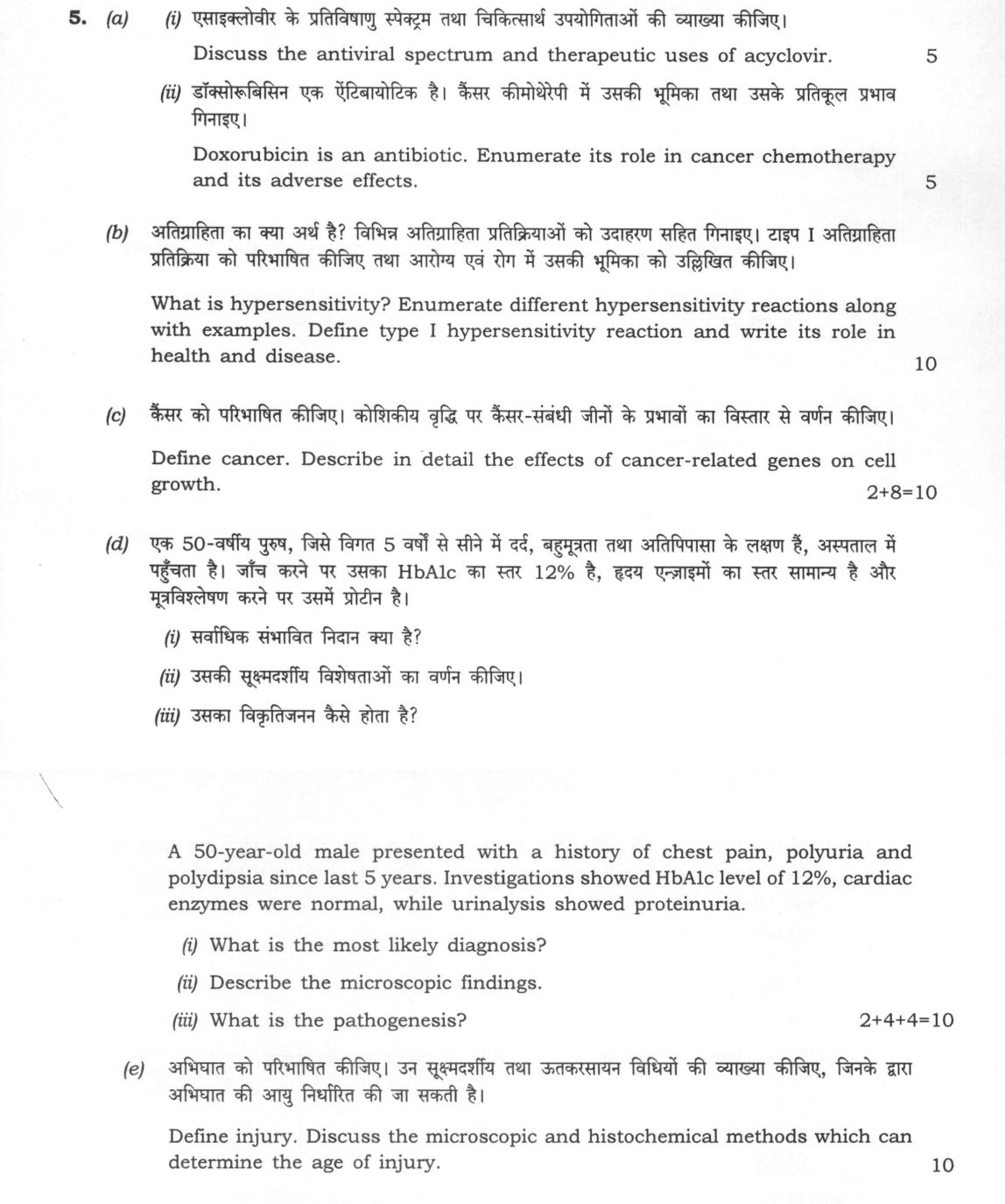
Discuss the antiviral spectrum and therapeutic uses of acyclovir.
Doxorubicin is an antibiotic. Enumerate its role in cancer chemotherapy and its adverse effects.
What is hypersensitivity? Enumerate different hypersensitivity reactions along with examples. Define type I hypersensitivity reaction and write its role in health and disease.
Define cancer. Describe in detail the effects of cancer-related genes on cell growth.
A 50-year-old male presented with a history of chest pain, polyuria and polydipsia since last 5 years. Investigations showed HbA1c level of 12%, cardiac enzymes were normal, while urinalysis showed proteinuria. What is the most likely diagnosis?
Describe the microscopic findings.
What is the pathogenesis?
Define injury. Discuss the microscopic and histochemical methods which can determine the age of injury.
हिंदी में प्रश्न पढ़ें
एसाइक्लोविर के प्रतिविषाणु स्पेक्ट्रम तथा चिकित्सार्थ उपयोगिताओं की व्याख्या कीजिए।
डॉक्सोरुबिसिन एक ऐंटिबायोटिक है। कैंसर कीमोथेरेपी में उसकी भूमिका तथा उसके प्रतिकूल प्रभाव गिनाइए।
अतिप्रतिक्रिया का क्या अर्थ है? विभिन्न अतिप्रतिक्रिया प्रतिक्रियाओं को उदाहरण सहित गिनाइए। टाइप I अतिप्रतिक्रिया प्रतिक्रिया को परिभाषित कीजिए तथा आरोग्य एवं रोग में उसकी भूमिका को उद्घिष्ट कीजिए।
कैंसर को परिभाषित कीजिए। कोशिकीय वृद्धि पर कैंसर-संबंधी जीनों के प्रभावों का विस्तार से वर्णन कीजिए।
एक 50-वर्षीय पुरुष, जिसे विगत 5 वर्षों से सीने में दर्द, बहुमूत्रता तथा अतिपिपासा के लक्षण हैं, अस्पताल में पहुँचता है। जाँच करने पर उसका HbA1c का स्तर 12% है, हृदय एन्जाइमों का स्तर सामान्य है और मूत्रविश्लेषण करने पर उसमें प्रोटीन है। सर्वाधिक संभावित निदान क्या है?
उसकी सूक्ष्मदर्शीय विशेषताओं का वर्णन कीजिए।
उसका विकृतिजनन कैसे होता है?
अभिघात को परिभाषित कीजिए। उन सूक्ष्मदर्शीय तथा उत्कर्षायन विधियों की व्याख्या कीजिए, जिनके द्वारा अभिघात की आयु निर्धारित की जा सकती है।
What "Discuss" is asking you to do
Lay the issue out from more than one side — how it arose, what is claimed for it, what is held against it, and where it now stands. UPSC attaches discuss to broad topics with several live dimensions, so coverage of the dimensions earns more than the strength of your opinion.
Structure that answers it
Set the issue up → the case as it is made → the case against → the dimension both sides leave out → where the balance now lies
Where marks are lost
Listing facts with no thread between them, or arguing one side throughout and calling it a discussion.
How this answer will be evaluated
Approach
Framework: Clinical Sequence (Definition > Aetiology/Pathophysiology > Features > Investigation/Management). (a) discuss: intro > 3-4 dimensions > example > balanced close | (b) discuss: intro > 3-4 dimensions > example > balanced close | (c) discuss: intro > 3-4 dimensions > example > balanced close | (d) discuss: intro > 3-4 dimensions > example > balanced close | (e) discuss: intro > 3-4 dimensions > example > balanced close Full marks: Precise mechanisms, specific examples, and clear clinical correlation
Key points expected
- Acyclovir: HSV/VZV spectrum
- Doxorubicin: Cardiotoxicity
- Hypersensitivity: Gell & Coombs types
- Cancer: Oncogenes vs Tumor Suppressors
- Diabetic Nephropathy: Kimmelstiel-Wilson nodules
- Injury: Collagen maturation stages
Evaluation rubric
Each sub-part is marked on its own, against the marks and word limit printed on the paper.
- (a) Acyclovir spectrum/uses and Doxorubicin role/adverse effects
discuss— intro → 3-4 dimensions → example → balanced close
Must cover
- Acyclovir: HSV-1, HSV-2, VZV spectrum
- Acyclovir: Herpes zoster, encephalitis, prophylaxis
- Doxorubicin: Anthracycline, DNA intercalation mechanism
- Doxorubicin: Cardiotoxicity, myelosuppression, alopecia
Loses marks
- Listing drugs without mechanism
- Omitting cardiotoxicity for Doxorubicin
Earns more
- Acyclovir: Mechanism (guanosine analogue)
- Doxorubicin: Topoisomerase II inhibition
- Doxorubicin: Cumulative dose limit
- Doxorubicin: Secondary leukemia risk
Extra mark
- Doxorubicin: Liposomal formulation for reduced toxicity
- (b) Hypersensitivity types, examples, and Type I role in health/disease 10 marks
discuss— intro → 3-4 dimensions → example → balanced close
Must cover
- Definition of hypersensitivity (Gell & Coombs)
- Types I-IV with specific examples
- Type I: IgE, mast cells, immediate
- Type I: Anaphylaxis, asthma, atopy
Loses marks
- Listing types without examples
- Confusing Type I and IV mechanisms
Earns more
- Type II: Cytotoxic (e.g., Rh)
- Type III: Immune complex (e.g., SLE)
- Type IV: Delayed (e.g., TB test)
- Role in health: Parasite defense
Extra mark
- Mention of specific cytokines (IL-4, IL-5)
- (c) Cancer definition and detailed effects of cancer-related genes 10 marks
discuss— intro → 3-4 dimensions → example → balanced close
Must cover
- Definition: Clonal, uncontrolled growth
- Oncogenes: Gain of function (e.g., RAS)
- Tumor suppressors: Loss of function (e.g., p53)
- DNA repair genes: Mismatch repair (e.g., MLH1)
Loses marks
- Defining cancer without clonality
- Omitting tumor suppressor genes
Earns more
- Knudson's two-hit hypothesis
- Telomerase activation
- Angiogenesis (VEGF)
- Epigenetic changes
Extra mark
- Specific gene mutation examples (e.g., BRCA1)
- (d) Diagnosis, microscopic findings, and pathogenesis of diabetic nephropathy 10 marks
discuss— intro → 3-4 dimensions → example → balanced close
Must cover
- Diagnosis: Diabetic Nephropathy
- Microscopy: GBM thickening, mesangial expansion
- Microscopy: Kimmelstiel-Wilson nodules
- Pathogenesis: Hyperglycemia, AGEs, hemodynamic
Loses marks
- Diagnosing without linking to HbA1c
- Omitting Kimmelstiel-Wilson nodules
Earns more
- Mention of proteinuria as key feature
- Exclusion of cardiac cause (normal enzymes)
- Pathogenesis: Polyol pathway
- Pathogenesis: Oxidative stress
Extra mark
- Mention of ACE inhibitors in management
- (e) Injury definition and methods to determine age of injury 10 marks
discuss— intro → 3-4 dimensions → example → balanced close
Must cover
- Definition of injury (forensic)
- Microscopy: Inflammation stages (acute/chronic)
- Histochemistry: Collagen maturation (Type I/III)
- Histochemistry: Enzyme markers (e.g., LDH)
Loses marks
- Defining injury without mechanism
- Listing methods without time correlation
Earns more
- Neutrophil infiltration (early)
- Fibroblast proliferation (healing)
- Hyalinization (old injury)
- Specific timeframes for stages
Extra mark
- Mention of specific stains (e.g., Masson's trichrome)
Model answer coming soon
Every evaluation on this site is marked against a verified model answer. This question's answer is still being written; evaluation opens the moment it lands.
More from Medical Science 2024 Paper I
- Q2 A middle-aged female notices a lump in the midline of the neck. She notices it moves with…
- Q3 Describe the uterus under the following headings: (i) Gross anatomy (ii) Ligaments and su…
- Q4 Describe the facial nerve under the following headings: 1. Functional columns and nuclei…
- Q5 Discuss the antiviral spectrum and therapeutic uses of acyclovir. Doxorubicin is an antib…
- Q6 Describe the microscopic features of breast cancer. Enumerate any five major prognostic f…
- Q7 Define death due to hanging. What are the probable causes of death in hanging? What are t…
- Q8 What is enteric fever? What are its causative agents? Give a detailed presentation of a c…