Paper I — Q7
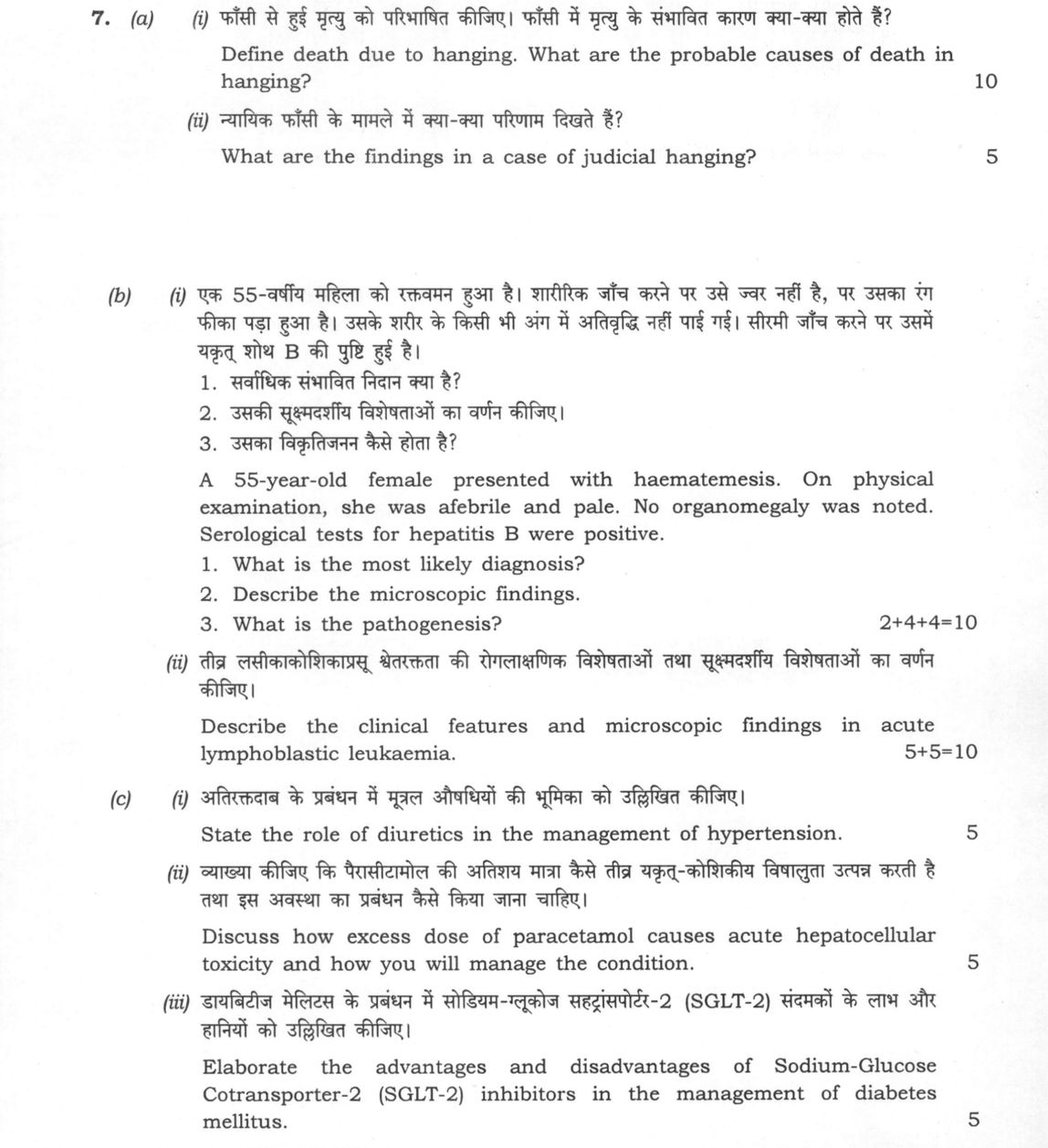
Define death due to hanging. What are the probable causes of death in hanging? What are the findings in a case of judicial…
Define death due to hanging. What are the probable causes of death in hanging?
What are the findings in a case of judicial hanging?
A 55-year-old female presented with haematemesis. On physical examination, she was afebrile and pale. No organomegaly was noted. Serological tests for hepatitis B were positive. 1. What is the most likely diagnosis? 2. Describe the microscopic findings. 3. What is the pathogenesis?
Describe the clinical features and microscopic findings in acute lymphoblastic leukaemia.
State the role of diuretics in the management of hypertension.
Discuss how excess dose of paracetamol causes acute hepatocellular toxicity and how you will manage the condition.
Elaborate the advantages and disadvantages of Sodium-Glucose Cotransporter-2 (SGLT-2) inhibitors in the management of diabetes mellitus.
हिंदी में प्रश्न पढ़ें
फाँसी से हुई मृत्यु को परिभाषित कीजिए। फाँसी में मृत्यु के संभावित कारण क्या-क्या होते हैं?
न्यायिक फाँसी के मामले में क्या-क्या परिणाम दिखते हैं?
एक 55-वर्षीय महिला को रक्तवमन हुआ है। शारीरिक जाँच करने पर उसे ज्वर नहीं है, पर उसका रंग फीका पड़ा हुआ है। उसके शरीर के किसी भी अंग में अतिवृद्धि नहीं पाई गई। सीरमी जाँच करने पर उसमें यकृत शोथ B की पुष्टि हुई है। 1. सर्वाधिक संभावित निदान क्या है? 2. उसकी सूक्ष्मदर्शीय विशेषताओं का वर्णन कीजिए। 3. उसका विकृतिजनन कैसे होता है?
तीव्र लसीकाकोशिकाप्रसू श्वेतरक्तता की रोगलाक्षणिक विशेषताओं तथा सूक्ष्मदर्शीय विशेषताओं का वर्णन कीजिए।
अतिरक्तदाब के प्रबंधन में मूत्रल औषधियों की भूमिका को उल्लिखित कीजिए।
व्याख्या कीजिए कि पैरासिटामोल की अतिशय मात्रा कैसे तीव्र यकृत-कोशिकीय विषाक्तता उत्पन्न करती है तथा इस अवस्था का प्रबंधन कैसे किया जाना चाहिए।
डायबिटीज मेलिटस के प्रबंधन में सोडियम-ग्लूकोज सहट्रांसपोर्टर-2 (SGLT-2) संदमकों के लाभ और हानियों को उल्लिखित कीजिए।
Model answer
Written by UPSC Answer Check against this question's marking rubric, to the expected length. UPSC does not publish answers for Mains — this is one way to score well, not an official key.
Hanging. Death due to hanging is death from suspension by a ligature around the neck, causing asphyxia, cerebral hypoxia, vagal inhibition, or cervical fracture-dislocation. Probable causes are airway compression, carotid/jugular compression, vagal inhibition, and fracture-dislocation of C2–C3. In judicial hanging, findings include a ligature mark, hangman’s fracture at C2–C3, internal decapitation, petechiae and lividity.
Hepatitis B case. The most likely diagnosis is chronic hepatitis B with cirrhosis and portal hypertension causing bleeding oesophageal varices. Microscopically, cirrhosis shows bridging fibrosis, regenerative nodules and ground-glass hepatocytes due to HBsAg in the endoplasmic reticulum. Pathogenesis: persistent HBV infection produces chronic hepatocellular injury and fibrosis; architectural distortion raises portal pressure, forming portosystemic collaterals; oesophageal varices rupture and cause haematemesis.
Acute lymphoblastic leukaemia. Clinically it presents with bone pain, pallor, fever, bleeding, hepatosplenomegaly, lymphadenopathy and CNS involvement such as headache or cranial nerve palsy. Microscopically, marrow is hypercellular with >20% lymphoblasts. FAB L1 shows small uniform blasts, L2 large pleomorphic blasts, and L3 large blasts with basophilic, vacuolated cytoplasm. TdT is positive in most precursor B/T ALL, but L3/Burkitt-like cases may be TdT negative; Auer rods are absent.
Diuretics in hypertension. Thiazide and thiazide-like diuretics lower blood pressure by reducing plasma volume and peripheral resistance; they are useful first-line or add-on agents, especially in elderly, salt-sensitive patients and those with heart failure. Monitoring of sodium, potassium, glucose and uric acid is essential.
Paracetamol toxicity. Excess paracetamol saturates glucuronidation and sulfation; CYP2E1 forms NAPQI, depleting glutathione. NAPQI binds mitochondrial proteins, causing centrilobular hepatic necrosis. Management includes early N-acetylcysteine, ideally within the 8-hour window, with a 150 mg/kg loading dose followed by maintenance infusion, plus supportive care. Transplant assessment is guided by King’s College criteria: pH <7.3 despite resuscitation, or all three of INR >6.5, creatinine >3.4 mg/dL and grade III/IV encephalopathy.
SGLT-2 inhibitors. They block proximal tubular glucose reabsorption, causing glucosuria, lowering glucose, intraglomerular pressure, weight and blood pressure. Advantages include cardiovascular protection, as shown in EMPA-REG OUTCOME, renal protection, weight loss and heart-failure benefit. Disadvantages include euglycaemic DKA, genital mycotic infections and volume depletion. Therefore, SGLT-2 inhibitors are best used selectively in diabetes with CVD, CKD or heart failure, after counselling on infection, hydration and DKA risk.
What "Discuss" is asking you to do
Lay the issue out from more than one side — how it arose, what is claimed for it, what is held against it, and where it now stands. UPSC attaches discuss to broad topics with several live dimensions, so coverage of the dimensions earns more than the strength of your opinion.
Structure that answers it
Set the issue up → the case as it is made → the case against → the dimension both sides leave out → where the balance now lies
Where marks are lost
Listing facts with no thread between them, or arguing one side throughout and calling it a discussion.
How this answer will be evaluated
Approach
Framework: Clinical Sequence (Definition > Aetiology/Pathophysiology > Features > Investigation/Management). (a) describe: definition > process in order > significance | (b) describe: definition > structure or process in order > significance | (c) discuss: intro > 3-4 dimensions > balanced close Full marks: Precise definitions, correct pathophysiology, and balanced management.
Key points expected
- Hanging: Asphyxia vs Vagal inhibition
- Cirrhosis: Pseudolobules and portal hypertension
- ALL: Clinical features and microscopic blasts
- Diuretics: First-line for hypertension
- Paracetamol: NAC antidote
- SGLT-2: Cardio-renal benefits vs side effects
Evaluation rubric
Each sub-part is marked on its own, against the marks and word limit printed on the paper.
- (a) Define hanging death and list probable causes and judicial findings.
describe— definition → process in order → significance
Must cover
- Definition of death due to hanging
- Probable causes: asphyxia, vagal inhibition, fracture
- Judicial findings: ligature mark, hyoid fracture
- Differentiation from suicidal hanging
Loses marks
- Listing symptoms without mechanism
- Confusing judicial with suicidal findings
Earns more
- Mention of 'V' shaped depression
- Reference to 'Pugilist posture'
Extra mark
- Diagram of ligature mark types
- (b) Diagnose case, describe microscopic findings, and explain pathogenesis.
describe— definition → structure or process in order → significance
Must cover
- Diagnosis: Hepatic cirrhosis with portal hypertension
- Microscopy: Pseudolobules, bridging fibrosis
- Pathogenesis: HBV -> Cirrhosis -> Portal HTN -> Varices
- Link to haematemesis (ruptured varices)
Loses marks
- Diagnosis without microscopic support
- Pathogenesis without clinical link
Earns more
- Mention of Mallory bodies
- Reference to 'spider naevi'
Extra mark
- Flow diagram of pathogenesis
- (c) Role of diuretics, paracetamol toxicity management, and SGLT-2 pros/cons.
discuss— intro → 3-4 dimensions → balanced close
Must cover
- Diuretics: Thiazides/Loop for HTN management
- Paracetamol: NAC antidote, mechanism of toxicity
- SGLT-2: Glycemic control, cardiovascular benefits
- SGLT-2: Side effects (UTI, euglycemic DKA)
Loses marks
- Management without priority
- One-sided view of SGLT-2 inhibitors
Earns more
- Mention of 'N-acetylcysteine' timing
- Reference to 'euglycemic DKA' risk
Extra mark
- Current guideline reference for SGLT-2
Practice this exact question
Write your answer and it is marked point by point against the model answer above — what you covered, what you missed, what you got wrong.
Evaluate my answer →More from Medical Science 2024 Paper I
- Q4 Describe the facial nerve under the following headings: 1. Functional columns and nuclei…
- Q5 Discuss the antiviral spectrum and therapeutic uses of acyclovir. Doxorubicin is an antib…
- Q6 Describe the microscopic features of breast cancer. Enumerate any five major prognostic f…
- Q7 Define death due to hanging. What are the probable causes of death in hanging? What are t…
- Q8 What is enteric fever? What are its causative agents? Give a detailed presentation of a c…