Paper I — Q4
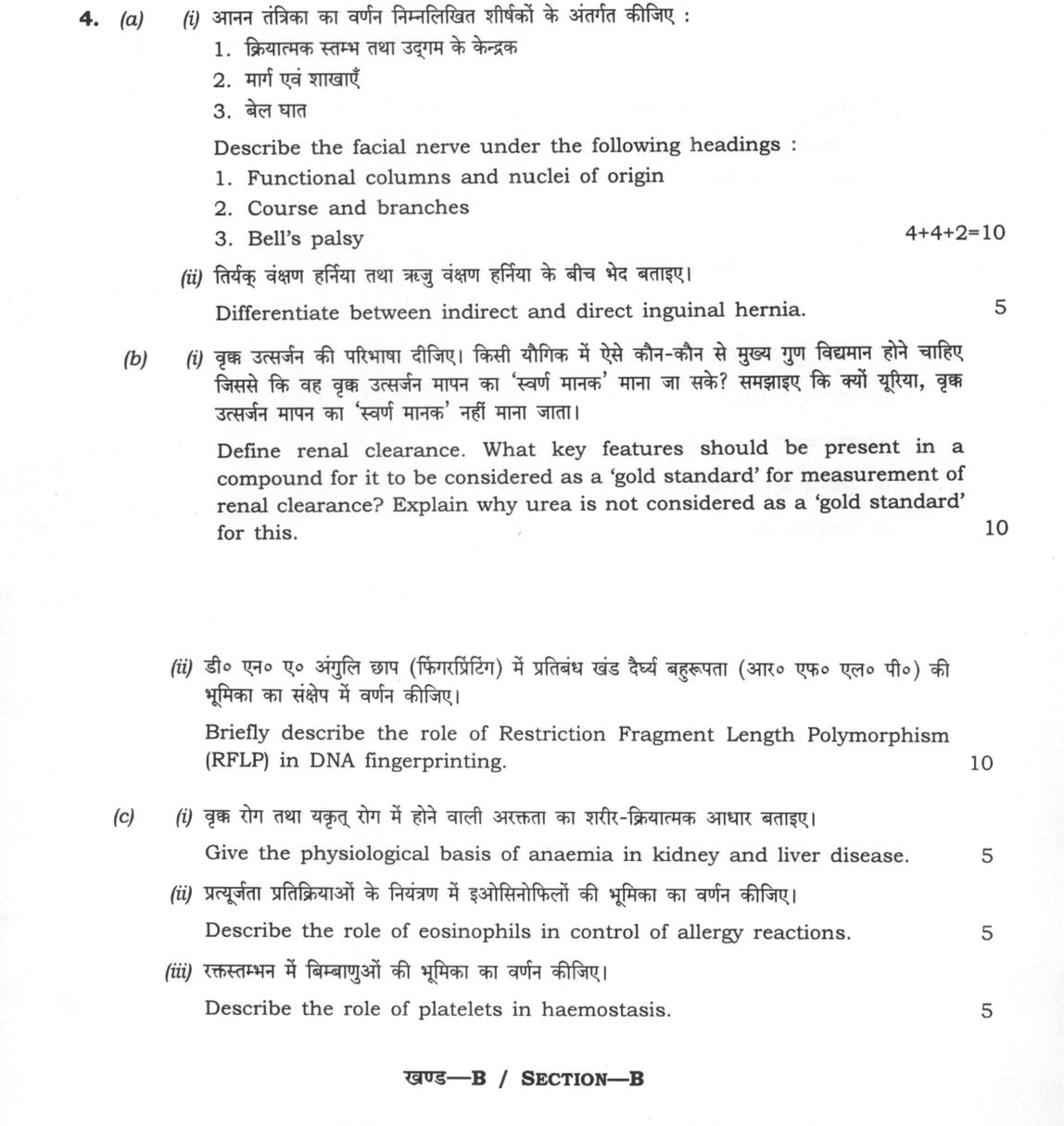
Describe the facial nerve under the following headings: 1. Functional columns and nuclei of origin 2. Course and branches 3…
Describe the facial nerve under the following headings: 1. Functional columns and nuclei of origin 2. Course and branches 3. Bell's palsy
Differentiate between indirect and direct inguinal hernia.
Define renal clearance. What key features should be present in a compound for it to be considered as a 'gold standard' for measurement of renal clearance? Explain why urea is not considered as a 'gold standard' for this.
Briefly describe the role of Restriction Fragment Length Polymorphism (RFLP) in DNA fingerprinting.
Give the physiological basis of anaemia in kidney and liver disease.
Describe the role of eosinophils in control of allergy reactions.
Describe the role of platelets in haemostasis.
हिंदी में प्रश्न पढ़ें
आनन तंत्रिका का वर्णन निम्नलिखित शीर्षकों के अंतर्गत कीजिए : 1. क्रियात्मक स्तंभ तथा उद्गम के केंद्रक 2. मार्ग एवं शाखाएं 3. बेल पाल्सी
तिर्यक वंक्षण हर्निया तथा ऋजु वंक्षण हर्निया के बीच भेद बताइए।
वृक्क उत्सर्जन की परिभाषा दीजिए। किसी यौगिक में ऐसे कौन-कौन से मुख्य गुण विद्यमान होने चाहिए जिससे कि वह वृक्क उत्सर्जन मापन का 'स्वर्ण मानक' माना जा सके? समझाइए कि क्यों यूरिया, वृक्क उत्सर्जन मापन का 'स्वर्ण मानक' नहीं माना जाता।
डी० एन० ए० अंगुलि छाप (फिंगरप्रिंटिंग) में प्रतिबंध खंड दैर्घ्य बहुरूपता (आर० एफ० एल० पी०) की भूमिका का संक्षेप में वर्णन कीजिए।
वृक्क रोग तथा यकृत रोग में होने वाली अरक्तता का शरीर-क्रियात्मक आधार बताइए।
प्रत्यूर्जता प्रतिक्रियाओं के नियंत्रण में इओसिनोफिल्स की भूमिका का वर्णन कीजिए।
रक्तस्तम्भन में बिम्बाणुओं की भूमिका का वर्णन कीजिए।
Model answer
Written by UPSC Answer Check against this question's marking rubric, to the expected length. UPSC does not publish answers for Mains — this is one way to score well, not an official key.
Facial nerve. Its functional columns are SVE, GVE, SVA and GSA, with nuclei/tracts: facial motor, superior salivatory, lacrimal, solitary tract and geniculate ganglion. SVE supplies facial expression muscles; GVE supplies lacrimal/salivary glands; SVA/GSA carry taste/external ear sensation. It enters the internal acoustic meatus, runs in the facial canal, with labyrinthine, tympanic and mastoid segments, and exits the stylomastoid foramen. Five intratemporal branches are greater petrosal, nerve to stapedius, chorda tympani, nerve to stylohyoid and nerve to digastric; five extratemporal are temporal, zygomatic, buccal, marginal mandibular and cervical. Bell’s palsy is idiopathic LMN facial palsy, graded by House-Brackmann; unlike UMN lesion, forehead is not spared; it affects all facial muscles; Ramsay Hunt syndrome is a key differential.
Inguinal hernia. Indirect hernia passes through deep inguinal ring, lateral to inferior epigastric artery, covered by internal oblique fascia, congenital, common in children/young males, may present as scrotal swelling. Direct hernia protrudes through Hesselbach’s triangle, medial to inferior epigastric artery, uncovered by internal oblique, acquired, common in older males. Both are assessed for reduction, cough impulse and Zeman’s triad: cough impulse, reducibility, absence of tenderness.
Renal clearance. Clearance C=UV/P, where U, V and P are urine concentration, flow and plasma concentration. A gold-standard marker must be freely filtered, neither secreted nor reabsorbed, metabolically inert and non-toxic; inulin is the exogenous standard. Urea is unsuitable because it is not inert: it undergoes net tubular reabsorption, about half in some states, and varies with hydration; although some tubular secretion may occur, net reabsorption makes urea clearance underestimate GFR.
RFLP. RFLP DNA fingerprinting uses restriction endonuclease digestion, gel electrophoresis, Southern blotting and probe hybridisation to detect variable-length polymorphic bands from genomic DNA. It was used in early forensic identification (Colin Pitchfork case), paternity disputes and prenatal diagnosis.
Anaemia. In CKD, anaemia results from EPO deficiency, iron deficiency, blood loss, shortened RBC survival and uraemic toxins suppressing marrow; Indian CKD/dialysis cohorts show high prevalence, often in a majority of patients. In liver disease, causes include hypersplenism, folate deficiency, bleeding and bone marrow suppression.
Eosinophils. They contain major basic protein, eosinophil cationic protein and peroxidase; via degranulation they kill helminths; modulate IgE-mediated mast-cell/basophil responses; and in allergic asthma balance protection against tissue damage.
Platelets. Platelets adhere via vWF–GPIb, activate with ADP and thromboxane A2, expose GP IIb/IIIa, secrete dense/alpha granule contents, aggregate to form a platelet plug, and stabilise the clot by fibrin-mediated clot retraction.
What "Describe" is asking you to do
Give a full, ordered account of the thing named — its parts, stages or mechanism — in the sequence in which it actually exists or occurs. Most describe questions come from the science optionals, where the marks sit in correct technical detail and, where the stem says so, a labelled diagram.
Structure that answers it
One-line identification of the subject → the parts or stages in their real order, each with its defining detail → labelled diagram where the subject is structural → closing line on function or significance
Where marks are lost
Loose general prose where the examiner is ticking named parts, correct terminology and their sequence; and in the General Studies papers, turning to evaluation before the description is finished.
How this answer will be evaluated
Approach
Framework: Clinical Sequence (Definition > Aetiology/Pathophysiology > Features > Investigation/Management). (a) describe: define > structure or process in order > labelled diagram > significance | (b) explain: definition/context > points in order > small example > short close | (c) describe: define > structure or process in order > labelled diagram > significance Full marks: Precise anatomical/physiological mechanisms with correct terminology and diagrams.
Key points expected
- Facial nerve nuclei: Facial, Superior salivatory, Lacrymal
- Indirect hernia: Medial to inferior epigastric vessels
- Direct hernia: Lateral to inferior epigastric vessels
- Inulin: Freely filtered, not reabsorbed or secreted
- Urea: Reabsorbed in tubules, overestimates GFR
- RFLP: Restriction enzymes cut DNA at specific sites
- Kidney anaemia: Lack of Erythropoietin
- Liver anaemia: Shortened RBC survival
- Eosinophils: Major basic protein, anti-parasitic, allergy modulation
- Platelets: Primary haemostasis, adhesion, aggregation
Evaluation rubric
Each sub-part is marked on its own, against the marks and word limit printed on the paper.
- (a) Systematic anatomical description of facial nerve and comparative table for hernias.
describe— define → structure or process in order → labelled diagram → significance
Must cover
- Facial nerve functional columns (SVE, GVE, GSE)
- Nuclei of origin (facial, salivatory, lacrymal)
- Course: temporal bone, parotid, branches
- Differentiation: Indirect vs Direct inguinal hernia
Loses marks
- Listing branches without anatomical sequence
- Confusing direct and indirect hernia origins
Earns more
- Bell's palsy pathophysiology (compression at stylomastoid foramen)
- Hernia: relation to inferior epigastric vessels
- Hernia: content and risk of strangulation
- Facial nerve: chorda tympani and greater petrosal branches
Extra mark
- Labelled diagram of facial nerve course
- Labelled diagram of inguinal canal anatomy
- (b) Definition of renal clearance, criteria for gold standard, and RFLP mechanism.
explain— definition/context → points in order → small example → short close
Must cover
- Definition of renal clearance (volume of plasma cleared)
- Gold standard criteria: freely filtered, not reabsorbed/secreted
- Why urea fails: tubular reabsorption
- RFLP: restriction enzymes and DNA fragment length variation
Loses marks
- Defining clearance without the volume concept
- Describing RFLP without mentioning restriction enzymes
Earns more
- Inulin as the actual gold standard
- RFLP: use of VNTRs/Minisatellites
- RFLP: Southern blotting process
- Urea clearance overestimates GFR
Extra mark
- Formula for clearance (C = U x V / P)
- Diagram of RFLP banding pattern
- (c) Physiological mechanisms for anaemia, allergy control, and haemostasis.
describe— define → structure or process in order → labelled diagram → significance
Must cover
- Kidney anaemia: Erythropoietin (EPO) deficiency
- Liver anaemia: RBC lifespan reduction / folate deficiency
- Eosinophils: release of major basic protein
- Platelets: adhesion, aggregation, and plug formation
Loses marks
- Listing symptoms of anaemia without mechanism
- Describing haemostasis without platelet activation steps
Earns more
- Kidney: Uraemic toxins inhibiting marrow
- Liver: Impaired heme synthesis
- Eosinophils: Inhibition of histamine release
- Platelets: Release of ADP and Thromboxane A2
Extra mark
- Flow diagram of coagulation cascade
- Diagram of platelet plug formation
Practice this exact question
Write your answer and it is marked point by point against the model answer above — what you covered, what you missed, what you got wrong.
Evaluate my answer →More from Medical Science 2024 Paper I
- Q1 Describe the radial nerve under the following headings: (i) Origin and course (ii) Branch…
- Q2 A middle-aged female notices a lump in the midline of the neck. She notices it moves with…
- Q3 Describe the uterus under the following headings: (i) Gross anatomy (ii) Ligaments and su…
- Q4 Describe the facial nerve under the following headings: 1. Functional columns and nuclei…
- Q5 Discuss the antiviral spectrum and therapeutic uses of acyclovir. Doxorubicin is an antib…
- Q6 Describe the microscopic features of breast cancer. Enumerate any five major prognostic f…
- Q7 Define death due to hanging. What are the probable causes of death in hanging? What are t…