Paper I — Q8
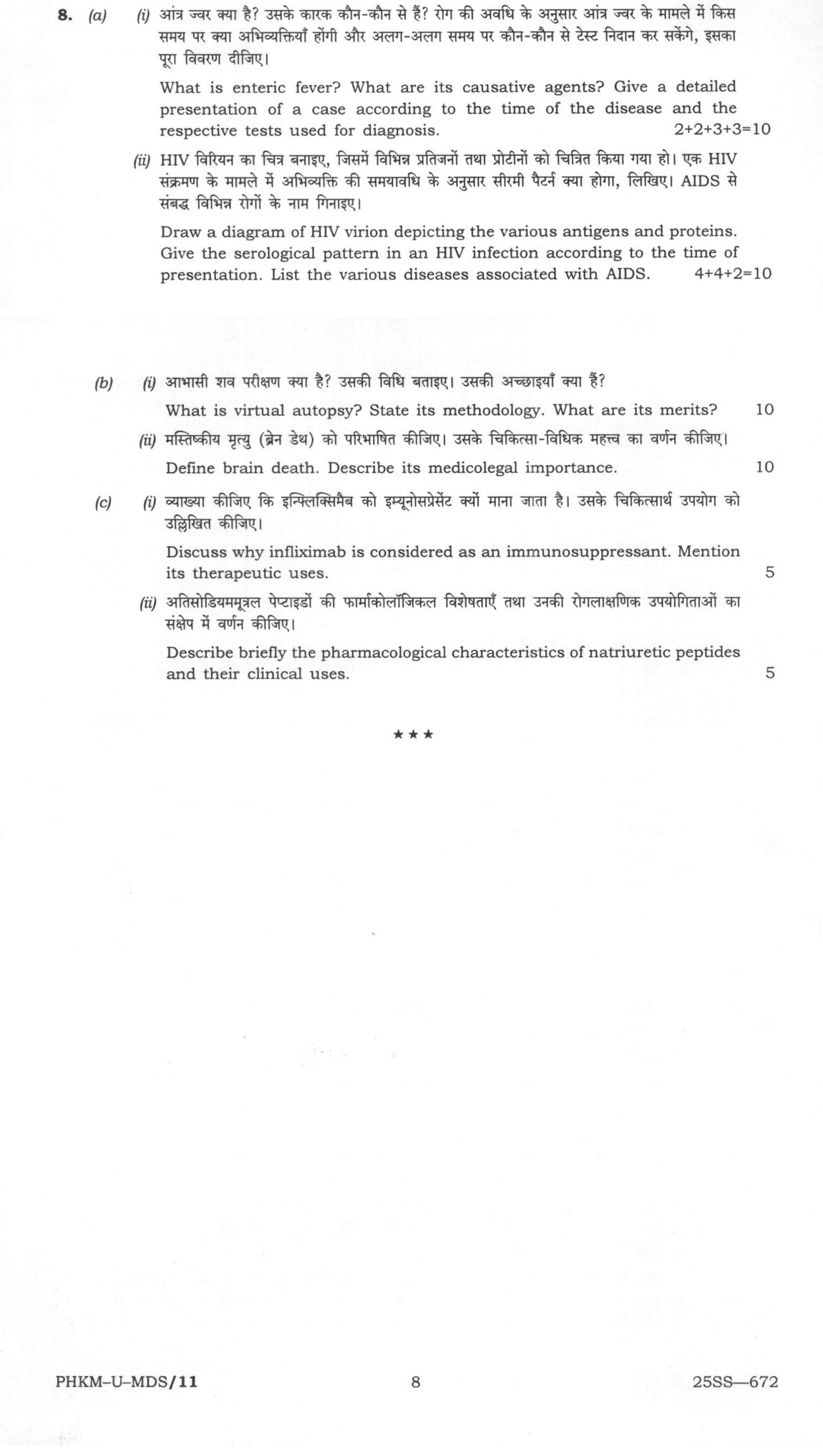
What is enteric fever? What are its causative agents? Give a detailed presentation of a case according to the time of the disease…
What is enteric fever? What are its causative agents? Give a detailed presentation of a case according to the time of the disease and the respective tests used for diagnosis.
Draw a diagram of HIV virion depicting the various antigens and proteins. Give the serological pattern in an HIV infection according to the time of presentation. List the various diseases associated with AIDS.
What is virtual autopsy? State its methodology. What are its merits?
Define brain death. Describe its medicolegal importance.
Discuss why infliximab is considered as an immunosuppressant. Mention its therapeutic uses.
Describe briefly the pharmacological characteristics of natriuretic peptides and their clinical uses.
हिंदी में प्रश्न पढ़ें
आंत्र ज्वर क्या है? उसके कारक कौन-कौन से हैं? रोग की अवधि के अनुसार आंत्र ज्वर के मामले में किस समय पर क्या अभिव्यक्तियाँ होंगी और अलग-अलग समय पर कौन-कौन से टेस्ट निदान कर सकेंगे, इसका पूरा विवरण दीजिए।
HIV विरियन का चित्र बनाइए, जिसमें विभिन्न प्रतिजनों तथा प्रोटीनों को चिह्नित किया गया हो। एक HIV संक्रमण के मामले में अभिव्यक्ति की समयावधि के अनुसार सीरमी पैटर्न क्या होगा, लिखिए। AIDS से संबद्ध विभिन्न रोगों के नाम गिनाइए।
आभासी शव परीक्षण क्या है? उसकी विधि बताइए। उसकी अच्छाइयाँ क्या हैं?
मस्तिष्कीय मृत्यु (ब्रेन डेथ) को परिभाषित कीजिए। उसके चिकित्सा-विधिक महत्व का वर्णन कीजिए।
व्याख्या कीजिए कि इन्फ्लिक्सिमैब को इम्युनोसप्रेसेंट क्यों माना जाता है। उसके चिकित्सार्थ उपयोग को उल्लिखित कीजिए।
अतिसोडियममुक्त पेप्टाइडों की फार्माकोलॉजिकल विशेषताएँ तथा उनकी रोगलाक्षणिक उपयोगिताओं का संक्षेप में वर्णन कीजिए।
Model answer
Written by UPSC Answer Check against this question's marking rubric, to the expected length. UPSC does not publish answers for Mains — this is one way to score well, not an official key.
Enteric fever. Enteric fever is an acute systemic infection common in India, caused by Salmonella Typhi and S. Paratyphi A, B, C. After 1–2 weeks incubation, week 1 shows fever, headache, malaise and relative bradycardia; blood culture is positive. Typhoid state and leucopenia may be present. Week 2 shows step-ladder fever, rose spots on trunk, hepatosplenomegaly; stool culture becomes positive. Week 3 may show intestinal haemorrhage or perforation; Widal test shows rising O and H titres, and urine culture may be positive. Week 4 is defervescence and recovery.
HIV. Virion diagram: [envelope: gp120 surface spikes, gp41 transmembrane] → [matrix: p17] → [capsid: conical p24] → [core: two ssRNA, reverse transcriptase, integrase, protease, RNase H]. Serologically, HIV RNA appears at 10–14 days; p24 antigen at 15–20 days; antibody by ELISA at 3–12 weeks (window period), shortened to about 2–4 weeks by 4th-generation p24/antibody assays; Western blot confirms; CD4 count falls progressively. AIDS is diagnosed when CD4 <200 cells/µL or an AIDS-defining illness appears. Diseases include TB, PCP, cryptococcal meningitis, Kaposi sarcoma, CMV retinitis, toxoplasmosis, MAC, candidiasis, histoplasmosis, non-Hodgkin lymphoma, HIV encephalopathy, wasting and invasive cervical cancer.
Virtual autopsy. It is non-invasive post-mortem examination using CT/MRI, 3D reconstruction and virtual dissection. Methodology includes imaging, radiological interpretation, comparison with antemortem records and, where needed, targeted correlation. It documents internal injuries without opening the body. Merits: preserves the body, is rapid in mass disasters, useful in trauma and religious objections, though histopathology is limited.
Brain death. Brain death is irreversible loss of all brain and brainstem function, shown by absent brainstem reflexes, apnoea test, and confirmatory EEG/angiography. Medicolegally, under the Transplantation of Human Organs Act, 1994, in India, as amended in 2011, formal declaration by two doctors is mandatory for legal death, consent and organ retrieval. It permits withdrawal of life support and legal death certificate.
Infliximab. Infliximab is a chimeric anti-TNF-α monoclonal antibody; it neutralises soluble and membrane-bound TNF-α, suppressing macrophage/T-cell activation and granulomatous inflammation, hence immunosuppressant. It is used in moderate-severe Crohn’s disease, ulcerative colitis, rheumatoid arthritis, ankylosing spondylitis and psoriasis; risks include TB reactivation and hepatosplenic T-cell lymphoma.
Natriuretic peptides. ANP is atrial, BNP ventricular and CNP endothelial; they activate GC-A/GC-B receptors, raise cGMP, causing vasodilation, natriuresis and diuresis. Clinically, BNP >400 pg/mL or NT-proBNP >900 (<50 y), >1800 (50–75 y) or >3000 (>75 y) pg/mL rules in acute heart failure; they guide prognosis and nesiritide is used in acute decompensated heart failure.
What "Describe" is asking you to do
Give a full, ordered account of the thing named — its parts, stages or mechanism — in the sequence in which it actually exists or occurs. Most describe questions come from the science optionals, where the marks sit in correct technical detail and, where the stem says so, a labelled diagram.
Structure that answers it
One-line identification of the subject → the parts or stages in their real order, each with its defining detail → labelled diagram where the subject is structural → closing line on function or significance
Where marks are lost
Loose general prose where the examiner is ticking named parts, correct terminology and their sequence; and in the General Studies papers, turning to evaluation before the description is finished.
How this answer will be evaluated
Approach
Framework: Clinical Sequence & Pathophysiology. (a) describe: definition > aetiology > chronological clinical presentation > diagnostic timeline | (b) describe: definition > structure or process in order > labelled diagram > significance | (c) describe: definition > structure or process in order > labelled diagram > significance Full marks: Accurate clinical sequence, labelled diagrams, specific tests/agents, and clear medicolegal points.
Key points expected
- S. typhi/paratyphi
- Week 1-3 clinical progression
- Blood culture (Wk 2), Stool culture (Wk 3)
- HIV virion structure (gp120, p24)
- Window period and seroconversion
- AIDS-defining illnesses (PCP, Kaposi's)
- Virtual autopsy (CT/MRI based)
- Non-invasive nature of virtual autopsy
Evaluation rubric
Each sub-part is marked on its own, against the marks and word limit printed on the paper.
- (a) Define enteric fever, name agents, and map clinical signs to diagnostic tests by week.
describe— definition → aetiology → chronological clinical presentation → diagnostic timeline
Must cover
- Define enteric fever and name S. typhi/paratyphi
- Week 1: fever, headache, Widal negative
- Week 2: rose spots, relative bradycardia, blood culture positive
- Week 3: complications, stool/urine culture positive
Loses marks
- Listing symptoms without time correlation
- Omitting specific tests for each week
- Confusing enteric fever with other fevers
Earns more
- Mention bone marrow culture as gold standard
- Note relative bradycardia (Faget sign)
- Mention rose spots on trunk
- Mention Widal test limitations
Extra mark
- Mention Typhoid vaccine (Vi polysaccharide)
- Mention National Typhoid Control Programme
- (b) Draw HIV virion, show serological pattern over time, and list AIDS-defining illnesses.
describe— definition → structure or process in order → labelled diagram → significance
Must cover
- Draw HIV virion with gp120, gp41, p24
- Serological pattern: window period, seroconversion
- List AIDS-defining illnesses (e.g., PCP, Kaposi's)
- Mention CD4 count thresholds
Loses marks
- Missing labelled diagram of virion
- Confusing serological pattern with viral load
- Listing non-AIDS defining illnesses
Earns more
- Mention reverse transcriptase
- Mention proviral DNA
- Mention specific CD4 counts for AIDS
- Mention opportunistic infections
Extra mark
- Mention WHO staging of HIV
- Mention National AIDS Control Programme
- (c) Define virtual autopsy, state methodology, and list merits.
describe— definition → structure or process in order → labelled diagram → significance
Must cover
- Define virtual autopsy (radiological post-mortem)
- Methodology: CT, MRI, angiography
- Merits: non-invasive, repeatable
- Mention use in medicolegal cases
Loses marks
- Confusing with traditional autopsy
- Omitting specific imaging modalities
- Listing merits without context
Earns more
- Mention 3D reconstruction
- Mention virtual endoscopy
- Mention use in mass disasters
- Mention cultural/religious acceptance
Extra mark
- Mention specific software used
- Mention comparison with traditional autopsy
Practice this exact question
Write your answer and it is marked point by point against the model answer above — what you covered, what you missed, what you got wrong.
Evaluate my answer →More from Medical Science 2024 Paper I
- Q5 Discuss the antiviral spectrum and therapeutic uses of acyclovir. Doxorubicin is an antib…
- Q6 Describe the microscopic features of breast cancer. Enumerate any five major prognostic f…
- Q7 Define death due to hanging. What are the probable causes of death in hanging? What are t…
- Q8 What is enteric fever? What are its causative agents? Give a detailed presentation of a c…