Paper II — Q1
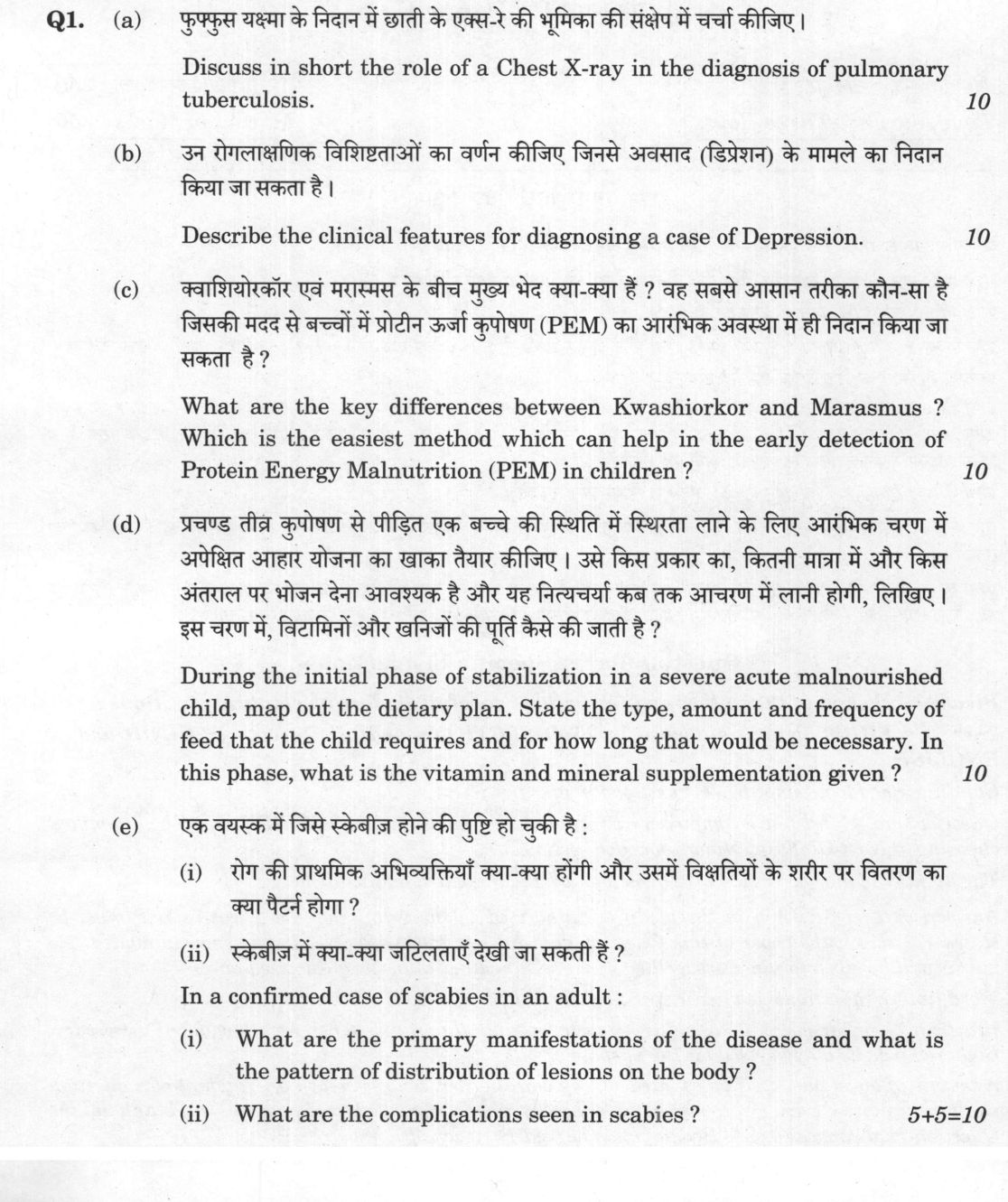
(a) Discuss in short the role of a Chest X-ray in the diagnosis of pulmonary tuberculosis. (10 marks) (b) Describe the clinical…
Discuss in short the role of a Chest X-ray in the diagnosis of pulmonary tuberculosis. 10 marks
Describe the clinical features for diagnosing a case of Depression. 10 marks
What are the key differences between Kwashiorkor and Marasmus ? Which is the easiest method which can help in the early detection of Protein Energy Malnutrition (PEM) in children ? 10 marks
During the initial phase of stabilization in a severe acute malnourished child, map out the dietary plan. State the type, amount and frequency of feed that the child requires and for how long that would be necessary. In this phase, what is the vitamin and mineral supplementation given ? 10 marks
In a confirmed case of scabies in an adult : What are the primary manifestations of the disease and what is the pattern of distribution of lesions on the body ?
What are the complications seen in scabies ? (5+5=10 marks)
हिंदी में प्रश्न पढ़ें
फुफ्फुस यक्ष्मा के निदान में छाती के एक्स-रे की भूमिका की संक्षेप में चर्चा कीजिए। (10 अंक)
उन रोगलाक्षणिक विशिष्टताओं का वर्णन कीजिए जिनसे अवसाद (डिप्रेशन) के मामले का निदान किया जा सकता है। (10 अंक)
क्वाशियोरकोर एवं मरास्मस के बीच मुख्य भेद क्या-क्या हैं ? वह सबसे आसान तरीका कौन-सा है जिसकी मदद से बच्चों में प्रोटीन ऊर्जा कुपोषण (PEM) का आरंभिक अवस्था में ही निदान किया जा सकता है ? (10 अंक)
प्रचंड तीव्र कुपोषण से पीड़ित एक बच्चे की स्थिति में स्थिरता लाने के लिए आरंभिक चरण में अपेक्षित आहार योजना का खाका तैयार कीजिए। उसे किस प्रकार का, कितनी मात्रा में और किस अंतराल पर भोजन देना आवश्यक है और यह नित्यचर्या कब तक आचरण में लानी होगी, लिखिए। इस चरण में, विटामिनों और खनिजों की पूर्ति कैसे की जाती है ? (10 अंक)
एक वयस्क में जिसे स्केबीज होने की पुष्टि हो चुकी है : रोग की प्राथमिक अभिव्यक्तियाँ क्या-क्या होंगी और उसमें विशिष्टियों के शरीर पर वितरण का क्या पैटर्न होगा ?
स्केबीज में क्या-क्या जटिलताएँ देखी जा सकती हैं ? (5+5=10 अंक)
Model answer
Written by UPSC Answer Check against this question's marking rubric, to the expected length. UPSC does not publish answers for Mains — this is one way to score well, not an official key.
(a) Role of Chest X-ray in the Diagnosis of Pulmonary Tuberculosis
Chest radiography (CXR) serves as a sensitive, rapid, and non-invasive screening and triage tool in the diagnostic algorithm of pulmonary tuberculosis (TB) under India's National Tuberculosis Elimination Program (NTEP).
CXR demonstrates high sensitivity (85–95%) for pulmonary TB, making it the primary modality for active case finding, triage in presumptive TB, and screening high-risk populations (contacts of smear-positive patients, prisoners, and healthcare workers). Classic radiological features of post-primary TB include apical and posterior segment infiltrates of the upper lobes, cavitation, fibro-cavitary lesions, and endobronchial dissemination. Primary TB commonly presents with unilateral hilar or mediastinal lymphadenopathy, subpleural parenchymal focus (Ghon focus), or pleural effusion. Miliary TB presents with uniform, diffuse 1–2 mm reticulonodular seedings throughout both lung fields.
However, CXR has notable limitations. Its specificity is low to moderate (60–75%), as lesions can mimic bacterial pneumonia, fungal infections, sarcoidosis, and malignancies. It cannot differentiate between active disease, inactive fibro-calcific scars, and non-tuberculous mycobacterial (NTM) infections. Furthermore, in immunocompromised hosts, particularly people living with HIV (PLHIV) with low CD4 counts, CXR often exhibits atypical presentations such as lower lobe consolidation, isolated lymphadenopathy, or even normal findings in 10–15% of cases.
Under NTEP, CXR is not a standalone diagnostic tool. It functions as an adjunct to bacteriological confirmation. Every patient with suggestive CXR findings must undergo upfront molecular testing (CBNAAT/GeneXpert or Truenat) or sputum smear microscopy and culture to establish a microbiological diagnosis and detect rifampicin resistance.
(b) Clinical Features for Diagnosing a Case of Depression
Under standard psychiatric diagnostic systems (ICD-10 / DSM-5), a diagnosis of a Major Depressive Episode requires the persistence of symptoms for a minimum duration of two consecutive weeks, representing a distinct change from previous functioning and causing significant socio-occupational impairment.
Core (Primary) Symptoms:
- Depressed mood: Pervasive, unyielding sadness, feeling empty or hopeless, present for most of the day, nearly every day.
- Anhedonia: Markedly diminished interest or pleasure in all or almost all activities previously enjoyed.
- Decreased energy / Fatigability: Subjective sense of exhaustion, where even trivial daily tasks require substantial effort.
Secondary (Accessory) Symptoms:
- Cognitive disturbances: Reduced concentration, indecisiveness, poor attention span, and memory lapses.
- Altered self-worth: Excessive, irrational feelings of guilt, worthlessness, self-reproach, and diminished self-esteem.
- Pessimistic outlook: Bleak and fatalistic views regarding the future.
- Suicidal ideation: Recurrent thoughts of death, suicidal intent, or attempted self-harm.
- Psychomotor changes: Observable psychomotor agitation or retardation.
- Biological/Vegetative signs: Sleep disturbances (classically early morning awakening/terminal insomnia, or hypersomnia); appetite and weight changes (significant anorexia with weight loss, or hyperphagia).
In Indian primary healthcare settings, depression frequently manifests atypically through somatic presentations, such as chronic non-specific body aches, persistent headaches, gastrointestinal distress, fatigue, and culturally patterned complaints (such as "Dhat" or vitality loss), masking the underlying affective disturbance.
(c) Differences Between Kwashiorkor and Marasmus, and Early Detection of PEM
Kwashiorkor and Marasmus represent the two polar clinical entities of Severe Protein Energy Malnutrition (PEM):
- Etiopathogenesis: Kwashiorkor results from inadequate protein intake in the presence of fair-to-normal caloric intake (dysadaptation), while Marasmus is caused by severe, balanced deficiency of both calories and proteins (adaptation to chronic starvation).
- Edema: Nutritional edema (pitting, bilateral, starting in the lower extremities) is the sine qua non of Kwashiorkor; it is entirely absent in Marasmus.
- Muscle and Fat Wasting: In Marasmus, there is extreme loss of subcutaneous fat and severe muscle wasting leading to a "skin and bone" appearance. In Kwashiorkor, muscle wasting is present but masked by edema and preserved subcutaneous adipose tissue.
- Facial Appearance: Kwashiorkor presents with a rounded, edematous "moon face," whereas Marasmus exhibits an "old man" or "monkey-like" facies due to loss of buccal fat pads (Bichat fat pads).
- Mental State: Children with Kwashiorkor are characteristically apathetic, lethargic, and irritable when disturbed. Marasmic children are alert, anxious, and voraciously hungry.
- Cutaneous and Hair Changes: Kwashiorkor features "flaky-paint" / "crazy-paving" dermatosis, hyperpigmentation, and sparse, brittle hair with alternating bands of depigmentation ("flag sign"). In Marasmus, skin is dry, thin, and inelastic, with minimal hair changes.
- Organ Changes & Laboratory: Kwashiorkor manifests with marked hepatomegaly (due to fatty infiltration) and severe hypoalbuminemia (<2.0 g/dL). In Marasmus, the liver is normal and serum albumin is normal or slightly reduced.
Early Detection of PEM: The easiest, most reliable method for community-level early detection of acute malnutrition is Mid-Upper Arm Circumference (MUAC) measurement using a Shakir tape (tripartite color-coded tape). A MUAC <11.5 cm indicates Severe Acute Malnutrition (SAM), and 11.5–12.5 cm indicates Moderate Acute Malnutrition (MAM). Combined with Weight-for-Height/Length Z-scores plotted on WHO growth charts at Anganwadi centers under the Poshan Abhiyaan (ICDS), it allows rapid identification before overt edema develops.
(d) Dietary Plan and Supplementation during the Stabilization Phase of SAM
The stabilization phase (Days 1–7) in a child with Severe Acute Malnutrition admitted to a Nutrition Rehabilitation Centre (NRC) aims to re-establish cellular homeostasis and manage life-threatening complications (hypoglycemia, hypothermia, electrolyte imbalance) without overloading the metabolic and circulatory systems.
Dietary Plan:
- Type of Feed: Starter therapeutic milk formula, F-75 (providing 75 kcal and 0.9 g protein per 100 ml). It is formulated to have low osmolarity, low sodium, and high potassium.
- Amount of Feed: Total daily volume of 130 ml/kg/day, providing approximately 80–100 kcal/kg/day and 1–1.5 g protein/kg/day. If the child has severe bilateral pitting edema (grade +++), the volume is restricted to 100 ml/kg/day.
- Frequency of Feed:
- Days 1 to 2: 11 ml/kg per feed given every 2 hours (12 feeds in 24 hours, including overnight).
- Days 3 to 5: 16 ml/kg per feed given every 3 hours (8 feeds in 24 hours).
- Days 6 to 7: 22 ml/kg per feed given every 4 hours (6 feeds in 24 hours).
- Duration: 2 to 7 days. The child is transitioned to the rehabilitation phase (using F-100 therapeutic milk) only when appetite returns and bilateral pitting edema has largely resolved.
Vitamin and Mineral Supplementation:
- Vitamin A: Single oral dose on Day 1 (50,000 IU for <6 months; 100,000 IU for 6–12 months; 200,000 IU for >12 months), unless documented as received within the past month.
- Folic Acid: 5 mg on Day 1, followed by 1 mg daily.
- Potassium and Magnesium: Added to feeds or ReSoMal (Potassium 3–4 mmol/kg/day, Magnesium 0.4–0.6 mmol/kg/day) to correct intracellular deficits.
- Zinc and Copper: Zinc (2 mg/kg/day) and Copper (0.3 mg/kg/day) administered daily via electrolyte-mineral premix.
- Multivitamins: Iron-free multivitamin syrup daily. Crucial Contraindication: Iron supplementation must strictly be withheld during the stabilization phase. Iron promotes free-radical injury, exacerbates oxidative stress, and promotes bacterial proliferation in the absence of adequate transferrin. Iron is initiated only during the catch-up phase once infections are controlled and the child gains weight.
(e) Confirmed Case of Scabies in an Adult
(i) Primary Manifestations and Distribution Pattern:
Scabies, caused by the ectoparasite Sarcoptes scabiei var. hominis, presents with:
- Intense Pruritus: Severe, intractable itching that is characteristically nocturnal, triggered by a type IV hypersensitivity reaction to the mite, its ova, and scybala (feces).
- Burrows: The pathognomonic lesion—a short, elevated, thin, grey-white or skin-colored serpiginous thread (2–15 mm long) representing the intra-epidermal tunnel made by the female mite, often terminating in a tiny vesicle or papule containing the mite.
- Primary Eruptions: Tiny, erythematous, excoriated papules, inflammatory vesicles, and indurated nodular lesions (scabietic nodules).
Distribution Pattern (Circle of Hebra): Lesions exhibit predilection for regions with thin stratum corneum:
- Interdigital web spaces of the fingers and lateral borders of the hands
- Flexor aspect of the wrists and extensor surfaces of the elbows
- Anterior axillary folds
- Periumbilical skin, waistline, and belt-line
- Buttocks and lower natal cleft
- Genitalia: Shaft of the penis, scrotum, and glans in males; areolae and nipples in females
- Adult Sparing: In adult classical scabies, lesions characteristically spare the head, neck, face, scalp, palms, and soles (which are involved only in infants, bedridden, and immunosuppressed patients).
(ii) Complications of Scabies:
- Secondary Bacterial Infections: Excoriation breaches the epidermal barrier, predisposing to impetigo, ecthyma, cellulitis, folliculitis, and abscesses, primarily driven by Streptococcus pyogenes (Group A Streptococcus) and Staphylococcus aureus.
- Post-Infectious Non-Suppurative Sequelae: Chronic streptococcal skin colonization from scabies lesions can trigger Post-Streptococcal Glomerulonephritis (PSGN), a significant cause of pediatric and adult renal morbidity in tropical and low-resource settings.
- Crusted (Norwegian) Scabies: A severe, hyperkeratotic, highly contagious variant occurring in immunocompromised individuals (HIV/AIDS, transplant recipients, systemic corticosteroid therapy) or neurological deficits. Characterized by thick, psoriasiform, fissured crusts teeming with millions of mites, with minimal or absent itching.
- Nodular Scabies: Persistent, severely pruritic, reddish-brown inflammatory nodules occurring on the scrotum, penis, or axillae that persist for months even after successful eradication of viable mites, representing an exaggerated hypersensitivity response.
- Psychological Morbidity: Chronic sleep deprivation, secondary anxiety, significant socio-familial stigmatization, and scabiophobia (delusion of parasitosis following successful clearance).
Comprehensive management of these communicable conditions and nutritional disorders requires an integrated public health approach in India, combining community screening via primary care workers, accurate diagnostic protocols, and targeted therapeutics to reduce disease burden.
What "Discuss" is asking you to do
Lay the issue out from more than one side — how it arose, what is claimed for it, what is held against it, and where it now stands. UPSC attaches discuss to broad topics with several live dimensions, so coverage of the dimensions earns more than the strength of your opinion.
Structure that answers it
Set the issue up → the case as it is made → the case against → the dimension both sides leave out → where the balance now lies
Where marks are lost
Listing facts with no thread between them, or arguing one side throughout and calling it a discussion.
How this answer will be evaluated
Approach
Framework: Clinical Sequence (Definition > Aetiology > Features > Investigation/Management). (a) discuss: intro > 3-4 dimensions > example > balanced close | (b) describe: define > structure or process in order > labelled diagram > significance | (c) compare: paired headings or table > key differences > significance > conclusion | (d) map: locate accurately > label > one line on why it matters | (e(i)) describe: define > structure or process in order > labelled diagram > significance | (e(ii)) describe: define > structure or process in order > labelled diagram > significance Full marks: Precise clinical terminology, correct guidelines, clear structure, no errors.
Key points expected
- Identify upper lobe cavitary lesions
- Mention miliary pattern for disseminated TB
- Note hilar lymphadenopathy in children
- State X-ray as screening/diagnostic aid
- List core symptoms (low mood, anhedonia)
- Mention somatic symptoms (sleep, appetite)
- Note cognitive symptoms (concentration, guilt)
- Specify duration criteria (e.g., 2 weeks)
Evaluation rubric
Each sub-part is marked on its own, against the marks and word limit printed on the paper.
- (a) Role of Chest X-ray in diagnosing pulmonary tuberculosis. 10 marks
discuss— intro → 3-4 dimensions → example → balanced close
Must cover
- Identify upper lobe cavitary lesions
- Mention miliary pattern for disseminated TB
- Note hilar lymphadenopathy in children
- State X-ray as screening/diagnostic aid
Loses marks
- Listing symptoms without radiological link
- Ignoring the 'diagnosis' aspect
Earns more
- Mention pleural effusion
- Reference NTEP guidelines
- Contrast with other pathologies
Extra mark
- Reference specific WHO/NTEP diagnostic algorithm
- (b) Clinical features for diagnosing a case of Depression. 10 marks
describe— define → structure or process in order → labelled diagram → significance
Must cover
- List core symptoms (low mood, anhedonia)
- Mention somatic symptoms (sleep, appetite)
- Note cognitive symptoms (concentration, guilt)
- Specify duration criteria (e.g., 2 weeks)
Loses marks
- Listing symptoms without mechanism
- Omitting duration criteria
Earns more
- Reference DSM-5 or ICD-10 criteria
- Mention suicide risk assessment
- Distinguish from normal grief
Extra mark
- Mention specific rating scales (e.g., PHQ-9)
- (c) Differences between Kwashiorkor and Marasmus; easiest early detection method. 10 marks
compare— paired headings or table → key differences → significance → conclusion
Must cover
- Contrast edema (Kwashiorkor) vs wasting (Marasmus)
- Contrast hair/skin changes
- Identify MUAC as easiest method
- Mention specific MUAC cutoff (e.g., <11.5cm)
Loses marks
- Confusing the two conditions
- Failing to name MUAC
Earns more
- Mention protein levels (albumin)
- Reference IAP/WHO guidelines
- Mention 'flag sign' for Kwashiorkor
Extra mark
- Reference specific national nutrition survey data
- (d) Dietary plan for stabilization phase of severe acute malnutrition. 10 marks
map— locate accurately → label → one line on why it matters
Must cover
- Specify F-75 formula (or equivalent)
- State frequency (e.g., 8-10 times/day)
- Mention duration (2-3 days)
- List specific supplements (Zinc, Multivitamin)
Loses marks
- Management without priority
- Omitting specific formula name
Earns more
- Mention fluid restriction
- Reference WHO/IMNCI guidelines
- Mention specific electrolyte correction
Extra mark
- Reference specific national protocol (e.g., IAP)
- (e(i)) Primary manifestations and distribution pattern of scabies in an adult. 5 marks
describe— define → structure or process in order → labelled diagram → significance
Must cover
- Identify intense pruritus (worse at night)
- Mention papules/vesicles
- Describe distribution (interdigital, wrists, axilla)
- Note sparing of head/neck in adults
Loses marks
- Ignoring the distribution pattern
- Confusing with other rashes
Earns more
- Mention burrows (pathognomonic)
- Reference specific dermatological signs
- Mention family clustering
Extra mark
- Mention specific mite species (Sarcoptes scabiei)
- (e(ii)) Complications seen in scabies. 5 marks
describe— define → structure or process in order → labelled diagram → significance
Must cover
- Mention secondary bacterial infection (impetigo)
- Mention cellulitis
- Mention glomerulonephritis (post-streptococcal)
- Mention scabetic dermatitis
Loses marks
- Listing unrelated complications
- Omitting secondary infection
Earns more
- Mention crusted scabies (Norwegian)
- Reference specific bacterial pathogens
- Mention psychological impact
Extra mark
- Reference specific case studies or guidelines
Practice this exact question
Write your answer and it is marked point by point against the model answer above — what you covered, what you missed, what you got wrong.
Evaluate my answer →More from Medical Science 2024 Paper II
- Q1 (a) Discuss in short the role of a Chest X-ray in the diagnosis of pulmonary tuberculosis…
- Q2 (a) (i) Discuss in short about the different modalities used in the diagnosis of Extra-Pu…
- Q3 (a) Describe the clinical features, diagnosis and treatment of Kala-azar. 20 marks (b) Wh…
- Q4 (a) A sixty-year-old male develops central chest pain while walking uphill. The pain is s…