Paper II — Q5
(a) (i) Enlist conditions having an increased risk of malignant disease in bone and cartilage. (ii) Briefly mention…
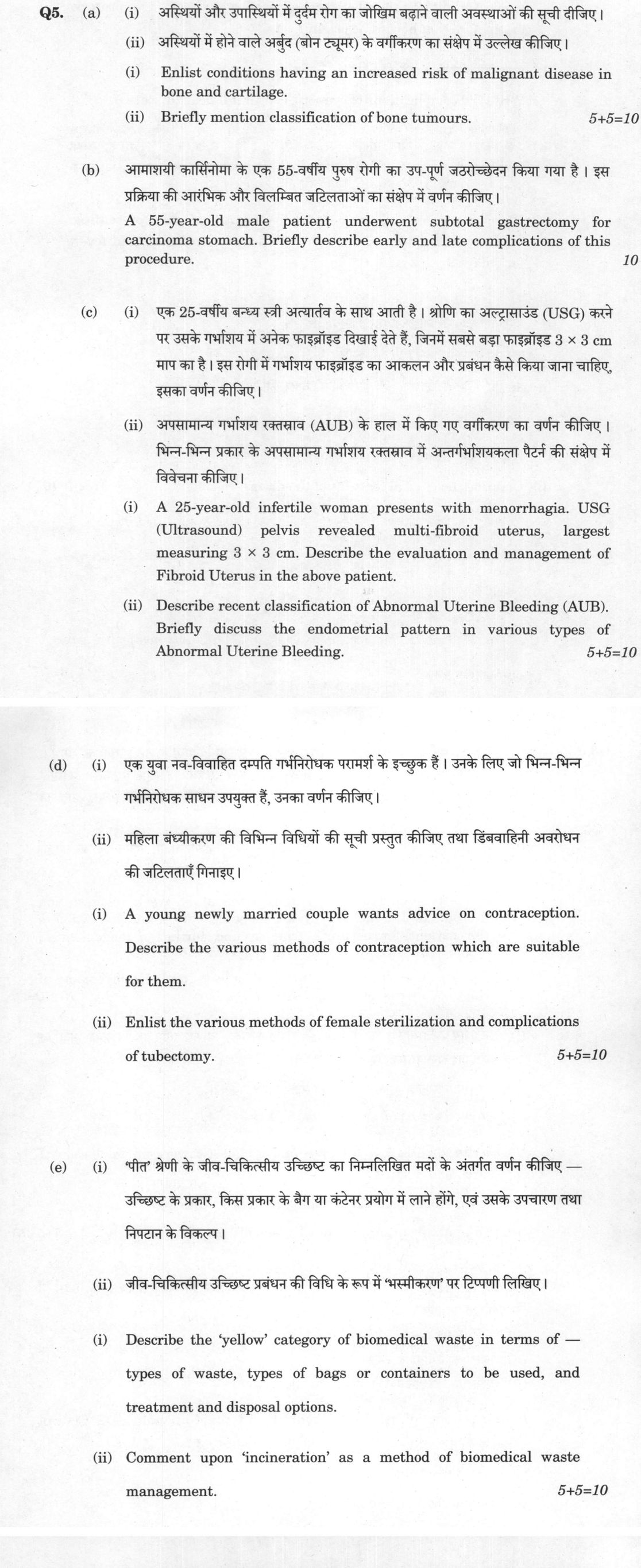
Enlist conditions having an increased risk of malignant disease in bone and cartilage.
Briefly mention classification of bone tumours. 5+5=10
A 55-year-old male patient underwent subtotal gastrectomy for carcinoma stomach. Briefly describe early and late complications of this procedure. 10 marks
A 25-year-old infertile woman presents with menorrhagia. USG (Ultrasound) pelvis revealed multi-fibroid uterus, largest measuring 3 × 3 cm. Describe the evaluation and management of Fibroid Uterus in the above patient.
Describe recent classification of Abnormal Uterine Bleeding (AUB). Briefly discuss the endometrial pattern in various types of Abnormal Uterine Bleeding. 5+5=10
A young newly married couple wants advice on contraception. Describe the various methods of contraception which are suitable for them.
Enlist the various methods of female sterilization and complications of tubectomy. 5+5=10
Describe the 'yellow' category of biomedical waste in terms of — types of waste, types of bags or containers to be used, and treatment and disposal options.
Comment upon 'incineration' as a method of biomedical waste management. 5+5=10
हिंदी में प्रश्न पढ़ें
अस्थियों और उपास्थियों में दुर्दम रोग का जोखिम बढ़ने वाली अवस्थाओं की सूची दीजिए।
अस्थियों में होने वाले अर्बुद (बोन ट्यूमर) के वर्गीकरण का संक्षेप में उल्लेख कीजिए। 5+5=10
आमाशयी कार्सिनोमा के एक 55-वर्षीय पुरुष रोगी का उप-पूर्ण जठरोच्छेदन किया गया है। इस प्रक्रिया की आरंभिक और विलंबित जटिलताओं का संक्षेप में वर्णन कीजिए। 10
एक 25-वर्षीय बंध्य स्त्री अत्यातव के साथ आती है। श्रोणि का अल्ट्रासाउंड (USG) करने पर उसके गर्भाशय में अनेक फाइब्रॉइड दिखाई देते हैं, जिनमें सबसे बड़ा फाइब्रॉइड 3 × 3 cm माप का है। इस रोगी में गर्भाशय फाइब्रॉइड का आकलन और प्रबंधन कैसे किया जाना चाहिए, इसका वर्णन कीजिए।
अपसामान्य गर्भाशय रक्तस्राव (AUB) के हाल में किए गए वर्गीकरण का वर्णन कीजिए। भिन्न-भिन्न प्रकार के अपसामान्य गर्भाशय रक्तस्राव में अंतर्गर्भाशयकला पैटर्न की संक्षेप में विवेचना कीजिए। 5+5=10
एक युवा नव-विवाहित दम्पति गर्भनिरोधक परामर्श के इच्छुक हैं। उनके लिए जो भिन्न-भिन्न गर्भनिरोधक साधन उपयुक्त हैं, उनका वर्णन कीजिए।
महिला बंध्यीकरण की विभिन्न विधियों की सूची प्रस्तुत कीजिए तथा डिंबवाहिनी अवरोधन की जटिलताएँ गिनाइए। 5+5=10
'पीट' श्रेणी के जीव-चिकित्सीय उच्छिष्ट का निम्नलिखित मदों के अंतर्गत वर्णन कीजिए — उच्छिष्ट के प्रकार, किस प्रकार के बैग या कंटेनर प्रयोग में लाने होंगे, एवं उसके उपचारण तथा निपटान के विकल्प।
जीव-चिकित्सीय उच्छिष्ट प्रबंधन की विधि के रूप में 'भस्मीकरण' पर टिप्पणी लिखिए। 5+5=10
Model answer
Written by UPSC Answer Check against this question's marking rubric, to the expected length. UPSC does not publish answers for Mains — this is one way to score well, not an official key.
(a)(i) Conditions that increase the risk of malignant disease in bone and cartilage include Paget’s disease of bone, in which sarcomatous change, usually osteosarcoma, may occur; multiple hereditary osteochondromas, which can transform into chondrosarcoma; enchondromas, especially in Ollier disease and Maffucci syndrome, with risk of chondrosarcoma; fibrous dysplasia, which may undergo malignant change to fibrosarcoma or osteosarcoma; prior radiation exposure to bone; and chronic osteomyelitis, particularly with long-standing draining sinuses. The risk is higher in long-standing and multiple lesions.
(a)(ii) The WHO 2020 classification of bone tumours is based on tissue of origin and differentiation. It includes cartilage-forming tumours, osteogenic tumours, fibrogenic tumours, fibrohistiocytic tumours, undifferentiated small round cell sarcomas such as Ewing sarcoma, haematopoietic tumours, giant cell tumour, notochordal tumours, vascular tumours, myogenic tumours, lipogenic tumours, epithelial tumours, and tumours of uncertain differentiation. This classification guides histopathological reporting and treatment planning.
(b) After subtotal gastrectomy for carcinoma stomach, complications are best described in two time phases. Early complications, usually within 30 days, are predominantly mechanical or functional and require prompt recognition because they influence mortality. Duodenal stump leak or blow-out is a serious early complication, especially after Billroth II reconstruction, and may cause peritonitis and sepsis. Gastric atony produces delayed emptying, nausea, vomiting and distension. Dumping syndrome may appear once oral feeding starts, with early vasomotor symptoms and, later, hypoglycaemic features. Afferent loop obstruction causes bilious vomiting and postprandial pain, while efferent loop obstruction causes postprandial vomiting of food. Late complications develop over months to years and often present with anaemia, weight loss, reflux symptoms or malabsorption. Gastric remnant carcinoma is a recognised long-term risk, particularly after many years. Bile reflux gastritis causes epigastric pain, nausea and haematemesis. Nutritional complications include iron, vitamin B12 and folate deficiency, malabsorption, and osteoporosis due to reduced calcium and vitamin D absorption.
(c)(i) In a 25-year-old infertile woman with menorrhagia and multiple uterine fibroids, the aim is to confirm the cause of bleeding, map the fibroids, and preserve fertility. Evaluation should include a detailed menstrual and fertility history, pelvic examination, and targeted imaging. Ultrasound has already shown multiple fibroids; MRI pelvis is useful for mapping number, size and location, especially intramural or subserosal lesions. Hysteroscopy assesses the endometrial cavity and identifies submucous fibroids. Endometrial biopsy is important to exclude hyperplasia or malignancy, although risk is low at this age. Management should be fertility-sparing. Hysteroscopic resection is suitable for submucous fibroids causing menorrhagia. For intramural or subserosal fibroids, myomectomy, laparoscopic or open according to size and number, is the main fertility-preserving option. The small size of the largest fibroid makes hysteroscopic or laparoscopic approach feasible if location is suitable. GnRH agonists may be given before surgery to reduce fibroid size and correct anaemia. Uterine artery embolisation can be considered in selected cases, but its effect on future fertility requires careful counselling.
(c)(ii) The recent FIGO classification of abnormal uterine bleeding, introduced in 2011, uses the mnemonic PALM-COEIN. It separates structural from non-structural causes and directs investigation. Structural causes are polyp, adenomyosis, leiomyoma, and malignancy or hyperplasia. Non-structural causes are coagulopathy, ovulatory dysfunction, endometrial causes, iatrogenic causes, and not yet classified. The endometrial pattern helps distinguish aetiology. A secretory pattern indicates ovulation. A proliferative pattern suggests anovulatory or ovulatory dysfunction, where unopposed oestrogen maintains a pre-secretory endometrium. A hyperplastic pattern suggests unopposed oestrogen stimulation and may be seen in ovulatory dysfunction or endometrial pathology. An atrophic pattern suggests hypoestrogenic states, iatrogenic effects, or perimenopausal change.
(d)(i) For a young newly married couple, contraceptive counselling should be individualised according to desired duration of fertility spacing, health, and preference. Combined oral contraceptives are suitable for many women; they are highly effective when taken correctly, reversible, and may regulate cycles, but they do not protect against sexually transmitted infections. Barrier methods, including male and female condoms, diaphragm, cervical cap and spermicides, are reversible and user-dependent; condoms provide STI protection, whereas diaphragm and other barriers do not reliably prevent STIs. The levonorgestrel intrauterine device is a long-acting reversible option with high efficacy and quick return to fertility, but it also does not protect against STIs. Natural family planning may be used by couples with regular cycles and willingness to abstain during fertile periods, but it has lower efficacy and requires careful education. Counselling should also cover side effects, contraindications, and the need for follow-up.
(d)(ii) Female sterilisation methods include laparoscopic tubal ligation, in which the tubes are occluded by bipolar coagulation, Falope ring or Filshie clip; postpartum mini-laparotomy, commonly using Pomeroy’s technique; and hysteroscopic sterilisation with Essure, which has been withdrawn from use. Informed consent and surgical safety are essential. Complications of tubectomy include bleeding, infection, bowel or urinary tract injury, failed sterilisation, ectopic pregnancy if conception occurs after failure, and post-tubal ligation syndrome, a controversial condition of persistent pelvic pain or menstrual disturbance attributed to the procedure.
(e)(i) The yellow category of biomedical waste, in the context of this question, includes human anatomical waste, animal waste, soiled waste, expired or discarded medicines, and chemical waste. It should be segregated in yellow non-chlorinated bags or containers, with appropriate labelling and secondary containment where needed. Segregation at source prevents cross-contamination. Treatment and disposal options are incineration, plasma pyrolysis, or deep burial, the latter being restricted to anatomical waste in rural areas where permitted. Autoclaving or microwaving followed by shredding is not the appropriate route for yellow-category waste; that method belongs to red-category management.
(e)(ii) Incineration is a thermal treatment method with both advantages and limitations. Its advantages are reliable pathogen destruction, substantial volume reduction, and the possibility of waste-to-energy recovery. However, it can generate dioxins and furans if combustion temperature, residence time and flue-gas treatment are inadequate, and it may release mercury and other toxic emissions. It also has high capital and operational costs, requires skilled maintenance, and produces ash that needs safe disposal. Therefore, incineration should be used only with emission controls meeting WHO and EPA standards, and with monitoring by CPCB or State Pollution Control Boards under the Biomedical Waste Management Rules, 2016. In India, incinerators must be sited and operated according to CPCB norms.
What "Describe" is asking you to do
Give a full, ordered account of the thing named — its parts, stages or mechanism — in the sequence in which it actually exists or occurs. Most describe questions come from the science optionals, where the marks sit in correct technical detail and, where the stem says so, a labelled diagram.
Structure that answers it
One-line identification of the subject → the parts or stages in their real order, each with its defining detail → labelled diagram where the subject is structural → closing line on function or significance
Where marks are lost
Loose general prose where the examiner is ticking named parts, correct terminology and their sequence; and in the General Studies papers, turning to evaluation before the description is finished.
How this answer will be evaluated
Approach
Framework: Clinical Sequence (Definition > Aetiology > Features > Investigation > Management). (a(i)) enumerate: list the items in order > one line each > no commentary | (a(ii)) describe: define > structure or process in order > labelled diagram > significance | (b) describe: define > structure or process in order > labelled diagram > significance | (c(i)) describe: define > structure or process in order > labelled diagram > significance | (c(ii)) describe: define > structure or process in order > labelled diagram > significance | (d(i)) describe: define > structure or process in order > labelled diagram > significance | (d(ii)) enumerate: list the items in order > one line each > no commentary | (e(i)) describe: define > structure or process in order > labelled diagram > significance | (e(ii)) comment: context > arguments both sides > judgment > close Full marks: Comprehensive, clinically accurate, follows sequence, uses specific terminology, addresses all sub-parts.
Key points expected
- Paget's disease of bone
- Hereditary multiple exostoses
- Neurofibromatosis
- Prior radiation therapy
- WHO classification (histological)
- Enneking staging (functional)
- Distinction between benign and malignant
- Distinction between primary and secondary
Evaluation rubric
Each sub-part is marked on its own, against the marks and word limit printed on the paper.
- (a(i)) List conditions with increased risk of malignant bone/cartilage disease. 5 marks
enumerate— list the items in order → one line each → no commentary
Must cover
- Paget's disease of bone
- Hereditary multiple exostoses
- Neurofibromatosis
- Prior radiation therapy
Loses marks
- Listing benign conditions without malignant risk
- Vague descriptions without specific disease names
Earns more
- Gorham's disease
- Fibrous dysplasia
- Osteochondromas
Extra mark
- Mention of specific sarcoma types associated
- (a(ii)) Provide classification of bone tumours. 5 marks
describe— define → structure or process in order → labelled diagram → significance
Must cover
- WHO classification (histological)
- Enneking staging (functional)
- Distinction between benign and malignant
- Distinction between primary and secondary
Loses marks
- Listing only histological types without staging
- Confusing primary and secondary tumours
Earns more
- Specific examples of benign (osteoma) and malignant (osteosarcoma)
- Mention of cartilage tumours
Extra mark
- Reference to specific WHO 2020 updates
- (b) Describe early and late complications of subtotal gastrectomy. 10 marks
describe— define → structure or process in order → labelled diagram → significance
Must cover
- Early: Anastomotic leak, haemorrhage, sepsis
- Early: Dumping syndrome (early)
- Late: Dumping syndrome (late), B12 deficiency
- Late: Iron deficiency anaemia, bile reflux
Loses marks
- Mixing early and late complications without distinction
- Listing general surgical complications only
Earns more
- Alkaline reflux gastritis
- Stomal stenosis
- Afferent loop syndrome
Extra mark
- Mention of specific management for complications
- (c(i)) Describe evaluation and management of fibroid uterus in infertile patient. 5 marks
describe— define → structure or process in order → labelled diagram → significance
Must cover
- Evaluation: USG, MRI, hysteroscopy
- Assessment of fibroid location (submucosal vs intramural)
- Management: Myomectomy (hysteroscopic/laparoscopic)
- Consideration of fertility preservation
Loses marks
- Suggesting hysterectomy for infertile patient
- Ignoring the infertility aspect in management
Earns more
- Role of GnRH agonists pre-op
- Assessment of tubal patency
Extra mark
- Mention of IVF as alternative if myomectomy fails
- (c(ii)) Describe AUB classification and endometrial patterns. 5 marks
describe— define → structure or process in order → labelled diagram → significance
Must cover
- PALM-COEIN classification
- Structural causes (Polyp, Adenomyosis, Leiomyoma, Malignancy)
- Non-structural causes (Coagulation, Ovulatory, Endometrial, Iatrogenic)
- Endometrial pattern: Hyperplasia, atrophy, polyp
Loses marks
- Using outdated classification systems
- Failing to link classification to endometrial changes
Earns more
- Specific endometrial changes in anovulation
- Endometrial changes in IUD use
Extra mark
- Mention of specific histological features
- (d(i)) Describe suitable contraception methods for newly married couple. 5 marks
describe— define → structure or process in order → labelled diagram → significance
Must cover
- Barrier methods (condoms)
- Oral contraceptives (OCPs)
- IUDs (Copper/Levonorgestrel)
- Injectables (DMPA)
Loses marks
- Suggesting sterilization for newly married couple
- Ignoring the 'newly married' context
Earns more
- Discussion of efficacy and side effects
- Mention of fertility return after stopping
Extra mark
- Mention of specific brand names or formulations
- (d(ii)) List female sterilization methods and tubectomy complications. 5 marks
enumerate— list the items in order → one line each → no commentary
Must cover
- Methods: Tubectomy, hysterectomy, oophorectomy
- Tubectomy techniques: Pomeroy, Filshie clip, ring
- Complications: Haemorrhage, infection, bowel injury
- Complications: Ectopic pregnancy, regret
Loses marks
- Listing only one method of sterilization
- Ignoring complications of tubectomy
Earns more
- Mention of specific instruments used
- Distinction between immediate and late complications
Extra mark
- Mention of specific success rates
- (e(i)) Describe 'yellow' category of biomedical waste. 5 marks
describe— define → structure or process in order → labelled diagram → significance
Must cover
- Types: Human anatomical waste, soiled waste
- Containers: Yellow bags, yellow bins
- Treatment: Autoclaving, microwaving
- Disposal: Secure landfill, incineration
Loses marks
- Confusing yellow with red or white categories
- Failing to mention treatment options
Earns more
- Mention of specific waste items (placenta, amputated limbs)
- Mention of specific treatment parameters (temperature, time)
Extra mark
- Reference to specific biomedical waste management rules
- (e(ii)) Comment on incineration as a method of biomedical waste management. 5 marks
comment— context → arguments both sides → judgment → close
Must cover
- Advantages: Volume reduction, pathogen destruction
- Disadvantages: Air pollution, cost, ash disposal
- Environmental impact: Dioxins, furans
- Regulatory requirements: Stack height, emission standards
Loses marks
- Presenting incineration as the only solution
- Ignoring environmental concerns
Earns more
- Comparison with other methods (autoclaving)
- Mention of specific emission limits
Extra mark
- Mention of specific technologies (fluidized bed incinerators)
Practice this exact question
Write your answer and it is marked point by point against the model answer above — what you covered, what you missed, what you got wrong.
Evaluate my answer →More from Medical Science 2024 Paper II
- Q2 (a) (i) Discuss in short about the different modalities used in the diagnosis of Extra-Pu…
- Q3 (a) Describe the clinical features, diagnosis and treatment of Kala-azar. 20 marks (b) Wh…
- Q4 (a) A sixty-year-old male develops central chest pain while walking uphill. The pain is s…
- Q5 (a) (i) Enlist conditions having an increased risk of malignant disease in bone and carti…
- Q6 (a) (i) A 22-year-old Unbooked Primigravida at 38 weeks of gestation presents to Emergenc…
- Q7 (a) A 50-year-old male presented with a 3 cm nodule in the left lobe of thyroid gland wit…
- Q8 (a) (i) What are the different types of epidemiological studies? (ii) What are the possib…