Paper II — Q4
(a) A sixty-year-old male develops central chest pain while walking uphill. The pain is squeezing in character, radiating to left…
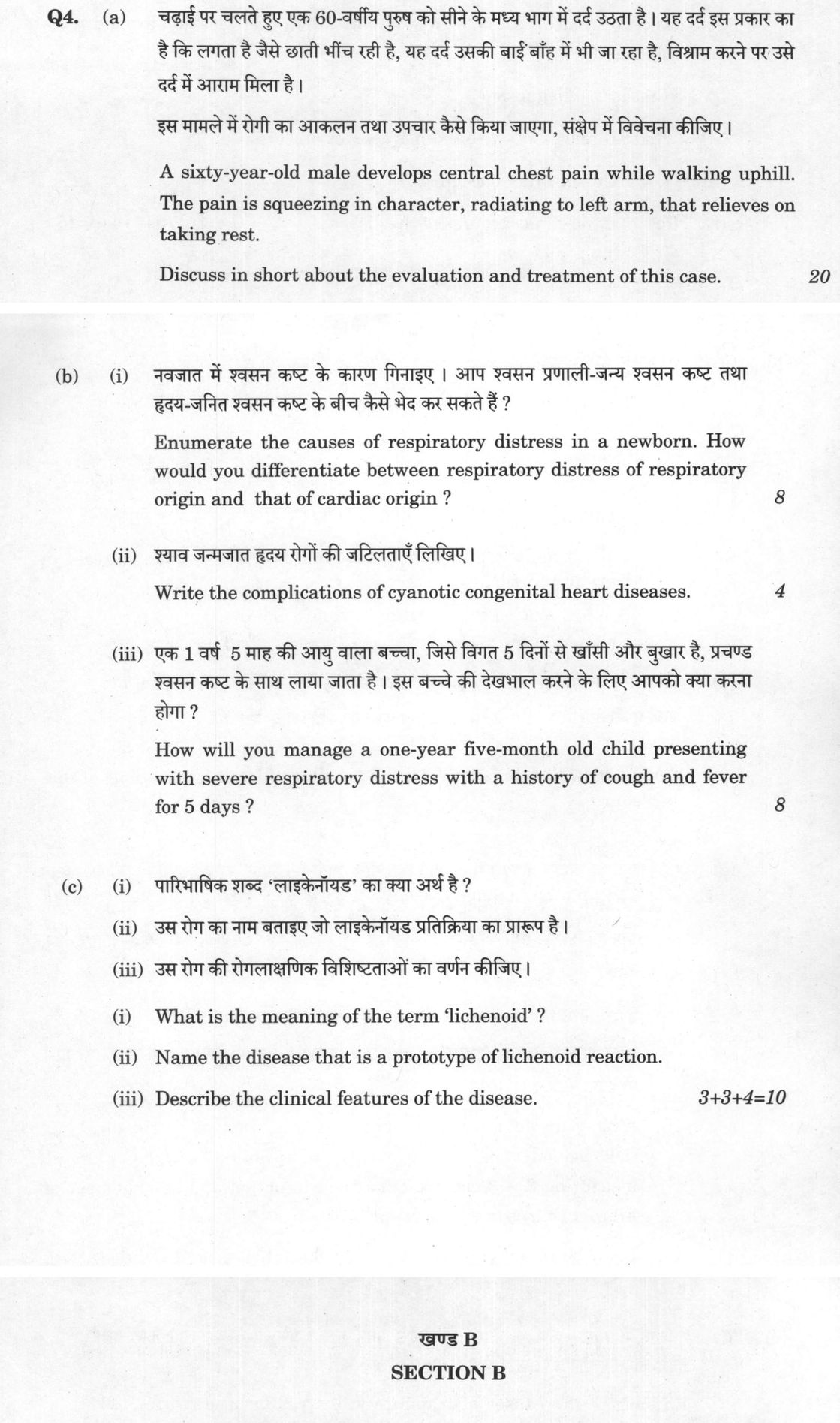
A sixty-year-old male develops central chest pain while walking uphill. The pain is squeezing in character, radiating to left arm, that relieves on taking rest. Discuss in short about the evaluation and treatment of this case. 20 marks
Enumerate the causes of respiratory distress in a newborn. How would you differentiate between respiratory distress of respiratory origin and that of cardiac origin ? 8 marks
Write the complications of cyanotic congenital heart diseases. 4 marks
How will you manage a one-year five-month old child presenting with severe respiratory distress with a history of cough and fever for 5 days ? 8 marks
What is the meaning of the term 'lichenoid' ?
Name the disease that is a prototype of lichenoid reaction.
Describe the clinical features of the disease. 3+3+4=10 marks
हिंदी में प्रश्न पढ़ें
चढ़ाई पर चलते हुए एक 60-वर्षीय पुरुष को सीने के मध्य भाग में दर्द उठता है। यह दर्द इस प्रकार का है कि लगता है जैसे छाती भींच रही है, यह दर्द उसकी बाईं बाँह में भी जा रहा है, विश्राम करने पर उसे दर्द में आराम मिलता है। इस मामले में रोगी का आकलन तथा उपचार कैसे किया जाएगा, संक्षेप में विवेचना कीजिए। 20 अंक
नवजात में श्वसन कष्ट के कारण गिनाइए । आप श्वसन प्रणाली-जन्य श्वसन कष्ट तथा हृदय-जनित श्वसन कष्ट के बीच कैसे भेद कर सकते हैं ? 8 अंक
श्याव जन्मजात हृदय रोगों की जटिलताएँ लिखिए। 4 अंक
एक 1 वर्ष 5 माह की आयु वाला बच्चा, जिसे विगत 5 दिनों से खाँसी और बुखार है, प्रचंड श्वसन कष्ट के साथ लाया जाता है । इस बच्चे की देखभाल करने के लिए आपको क्या करना होगा ? 8 अंक
पारिभाषिक शब्द 'लाइकेनॉयड' का क्या अर्थ है ?
उस रोग का नाम बताइए जो लाइकेनॉयड प्रतिक्रिया का प्राकृत है ।
उस रोग की रोगलाक्षणिक विशिष्टताओं का वर्णन कीजिए । 3+3+4=10 अंक
Model answer
Written by UPSC Answer Check against this question's marking rubric, to the expected length. UPSC does not publish answers for Mains — this is one way to score well, not an official key.
Evaluation and Treatment of Stable Angina Pectoris
The clinical presentation is indicative of stable angina pectoris, resulting from a transient myocardial oxygen supply-demand mismatch secondary to fixed atherosclerotic coronary artery narrowing. Disease severity is classified using the Canadian Cardiovascular Society (CCS) functional grading.
Evaluation begins with a baseline 12-lead resting ECG (often normal, or demonstrating resting ST-T wave changes) and serum cardiac troponins to rule out acute coronary syndrome. Baseline investigations include complete blood count, fasting lipid profile, renal function tests, and HbA1c. Non-invasive functional evaluation involves a Treadmill Exercise Stress Test (TMT) or stress echocardiography/SPECT myocardial perfusion imaging to assess inducible ischemia. Anatomical evaluation is performed using Coronary Computed Tomography Angiography (CCTA) or invasive Coronary Angiography (CAG) in patients with high-risk features or refractory symptoms.
Treatment comprises lifestyle modification, risk factor control, and stepwise pharmacotherapy. Acute symptom relief is achieved with sublingual Glyceryl Trinitrate (GTN 0.5 mg). First-line anti-anginal therapy includes beta-blockers (Metoprolol or Bisoprolol) titrated to a resting heart rate of 55–60 bpm, or calcium channel blockers (Amlodipine, Diltiazem). Long-acting nitrates, Nicorandil, or Trimetazidine are added as second-line agents. Disease-modifying secondary prevention includes antiplatelet therapy (Aspirin 75–150 mg daily), high-intensity statins (Atorvastatin 40–80 mg daily), and ACE inhibitors for concurrent hypertension or left ventricular dysfunction. Myocardial revascularization via Percutaneous Coronary Intervention (PCI) or Coronary Artery Bypass Grafting (CABG) is indicated for persistent symptoms despite optimal medical therapy or high-risk coronary anatomy (left main or multi-vessel disease).
Pediatric and Neonatal Respiratory Distress and Congenital Heart Disease
Causes of respiratory distress in a newborn include Respiratory Distress Syndrome (surfactant deficiency), Transient Tachypnea of the Newborn (TTN), Meconium Aspiration Syndrome, congenital pneumonia, Congenital Diaphragmatic Hernia, cyanotic congenital heart disease (CHD), and neonatal sepsis.
To differentiate respiratory from cardiac causes, the Hyperoxia test is performed by administering 100% oxygen for 10 minutes; arterial PaO2 rises above 150 mmHg in primary respiratory disease, whereas it remains below 150 mmHg in cyanotic CHD due to fixed anatomical right-to-left shunts. A pre-ductal and post-ductal SpO2 gradient exceeding 10% indicates persistent pulmonary hypertension or ductal-dependent systemic circulation. Chest radiography reveals parenchymal infiltrates, reticulogranular patterns, or air-bronchograms in lung pathology, contrasted with cardiomegaly and altered pulmonary vascular markings (oligemia or plethora) in cardiac conditions. Bedside 2D-Echocardiography provides definitive differentiation.
Complications of cyanotic congenital heart diseases include secondary polycythemia, hyperviscosity syndrome, cerebral thromboembolism, paradoxical brain abscesses, infective endocarditis, hypercyanotic spells, congestive cardiac failure, bleeding diatheses, and progression to Eisenmenger syndrome.
Management of a 17-month-old child presenting with severe respiratory distress, fever, and cough (severe pneumonia) follows an emergency ABCDE approach. Maintain airway patency and administer humidified oxygen via nasal prongs or mask targeting SpO2 above 92%. Initiate empirical intravenous antibiotic therapy per Indian Academy of Pediatrics (IAP) guidelines, typically IV Ceftriaxone (50–75 mg/kg/day) or Ampicillin-Sulbactam. Administer restricted maintenance intravenous fluids (75–80% of normal requirement to avoid fluid overload and SIADH), provide antipyretics (Paracetamol 15 mg/kg), and monitor respiratory rate, sensorium, and hemodynamics. Indications for Pediatric Intensive Care Unit (PICU) transfer and mechanical ventilation include worsening hypoxemia (SpO2 < 90% despite high FiO2), severe subcostal indrawing, apnea, exhaustion, or altered sensorium.
Lichenoid Tissue Reaction and Prototype Disease
The term 'lichenoid' denotes a histological pattern of interface dermatitis characterized by basal keratinocyte hydropic degeneration, necrotic keratinocytes (Civatte bodies), saw-toothed irregular epidermal hyperplasia, and a dense, continuous band-like lymphocytic infiltrate in the upper dermis hugging the dermo-epidermal junction.
The clinical prototype of this reaction is Lichen Planus.
Lichen Planus clinically presents with the classic '6 Ps': Pruritic, Polygonal, Planar (flat-topped), Purple/Violaceous, Papules, and Plaques, characteristically distributed over the flexor aspects of the wrists, forearms, ankles, and lumbar region. Lesions exhibit fine, whitish reticular networks on their surface known as Wickham striae and demonstrate the Koebner isomorphic phenomenon along lines of trauma. Mucosal involvement typically presents as asymptomatic or painful lacy white streaks (striae) on the buccal mucosa. Nail involvement is marked by longitudinal ridging, thinning, subungual hyperkeratosis, and dorsal pterygium formation.
A structured diagnostic approach combining clinical recognition, physiological differentiation, and targeted therapy is essential across cardiovascular, pediatric, and dermatological practice to optimize patient outcomes.
What "Discuss" is asking you to do
Lay the issue out from more than one side — how it arose, what is claimed for it, what is held against it, and where it now stands. UPSC attaches discuss to broad topics with several live dimensions, so coverage of the dimensions earns more than the strength of your opinion.
Structure that answers it
Set the issue up → the case as it is made → the case against → the dimension both sides leave out → where the balance now lies
Where marks are lost
Listing facts with no thread between them, or arguing one side throughout and calling it a discussion.
How this answer will be evaluated
Approach
Framework: Clinical Sequence (Definition > Aetiology > Features > Investigation > Management). (a) discuss: intro > 3-4 dimensions > example > balanced close | (b(i)) enumerate: list the items in order > one line each > no commentary | (b(ii)) explain: definition/context > points in order > small example > short close | (b(iii)) explain: definition/context > points in order > small example > short close | (c(i)) define: precise definition > the distinguishing feature > one example | (c(ii)) enumerate: list the items in order > one line each > no commentary | (c(iii)) describe: define > structure or process in order > labelled diagram > significance Full marks: Comprehensive clinical reasoning, accurate diagnosis, and guideline-based management.
Key points expected
- Diagnosis of Stable Angina Pectoris
- Risk factor assessment (diabetes, HTN, lipids)
- Investigations: ECG, Echo, Stress test, Angiography
- Management: Anti-anginal drugs, Revascularization (PTCA/CABG)
- List causes: RDS, TTN, Meconium Aspiration, Sepsis
- Differentiation: Respiratory (grunting, cyanosis) vs Cardiac (murmur, hepatomegaly)
- Role of Chest X-ray in differentiation
- Role of Echocardiography in cardiac origin
Evaluation rubric
Each sub-part is marked on its own, against the marks and word limit printed on the paper.
- (a) Evaluation and treatment plan for a 60-year-old male with exertional chest pain. 20 marks
discuss— intro → 3-4 dimensions → example → balanced close
Must cover
- Diagnosis of Stable Angina Pectoris
- Risk factor assessment (diabetes, HTN, lipids)
- Investigations: ECG, Echo, Stress test, Angiography
- Management: Anti-anginal drugs, Revascularization (PTCA/CABG)
Loses marks
- Treating as Acute MI without differentiation
- Omitting risk factor assessment
- Listing drugs without indication
Earns more
- Mention of 'Squeezing' and 'Radiation' as diagnostic clues
- Differentiation from Acute MI
- Lifestyle modification advice
- Secondary prevention (statins, antiplatelets)
Extra mark
- Reference to ACC/AHA guidelines
- Mention of specific drug classes (Beta-blockers, Nitrates)
- (b(i)) Causes of neonatal respiratory distress and differentiation from cardiac origin. 8 marks
enumerate— list the items in order → one line each → no commentary
Must cover
- List causes: RDS, TTN, Meconium Aspiration, Sepsis
- Differentiation: Respiratory (grunting, cyanosis) vs Cardiac (murmur, hepatomegaly)
- Role of Chest X-ray in differentiation
- Role of Echocardiography in cardiac origin
Loses marks
- Listing causes without differentiation
- Confusing respiratory and cardiac signs
- Omitting diagnostic investigations
Earns more
- Mention of 'Double contour' sign in RDS
- Specific cardiac defects (TGA, VSD)
- Clinical signs of heart failure in neonate
Extra mark
- Mention of specific X-ray findings for cardiac origin
- Reference to neonatal resuscitation guidelines
- (b(ii)) Complications of cyanotic congenital heart diseases. 4 marks
explain— definition/context → points in order → small example → short close
Must cover
- Cerebrovascular accident (Stroke)
- Brain abscess
- Hyperviscosity syndrome
- Endocarditis
Loses marks
- Listing complications of acyanotic defects
- Omitting major complications (Stroke, Abscess)
- Vague descriptions without specific names
Earns more
- Polycythemia
- Clubbing
- Hemolytic anemia
Extra mark
- Mention of specific pathophysiology of complications
- Reference to specific cyanotic defects (Tetralogy of Fallot)
- (b(iii)) Management of severe respiratory distress in a 19-month-old with cough/fever. 8 marks
explain— definition/context → points in order → small example → short close
Must cover
- Immediate stabilization: Oxygen, IV access
- Diagnosis: Pneumonia (likely bacterial)
- Antibiotic therapy (Amoxicillin or Cephalosporin)
- Supportive care: Fluids, antipyretics
Loses marks
- Omitting oxygen therapy
- Delaying antibiotic administration
- Ignoring severity assessment
Earns more
- Mention of IMAP (Integrated Management of Pneumonia)
- Criteria for hospitalization
- Monitoring for complications (empyema, sepsis)
Extra mark
- Reference to WHO IMAP guidelines
- Mention of specific antibiotic dosages
- (c(i)) Meaning of the term 'lichenoid'. 3 marks
define— precise definition → the distinguishing feature → one example
Must cover
- Definition: Resembling Lichen Planus
- Clinical features: Pruritic, purple, polygonal papules
- Histological features: Band-like lymphocytic infiltrate
Loses marks
- Confusing with Lichen Simplex Chronicus
- Omitting histological features
- Vague definition without specific features
Earns more
- Mention of Wickham's striae
- Mention of Koebner phenomenon
Extra mark
- Mention of specific histological markers
- Reference to specific lichenoid drug reactions
- (c(ii)) Disease that is a prototype of lichenoid reaction. 3 marks
enumerate— list the items in order → one line each → no commentary
Must cover
- Lichen Planus
- Mention of specific features (pruritic, purple, polygonal)
- Mention of histological features (band-like infiltrate)
Loses marks
- Naming a different disease
- Omitting specific features
- Vague description without specific name
Earns more
- Mention of Wickham's striae
- Mention of Koebner phenomenon
Extra mark
- Mention of specific histological markers
- Reference to specific lichenoid drug reactions
- (c(iii)) Clinical features of the disease (Lichen Planus). 4 marks
describe— define → structure or process in order → labelled diagram → significance
Must cover
- Pruritic, purple, polygonal papules
- Wickham's striae
- Koebner phenomenon
- Mucosal involvement (oral, genital)
Loses marks
- Omitting specific features (Wickham's striae)
- Confusing with other lichenoid conditions
- Vague description without specific features
Earns more
- Mention of specific distribution (wrists, ankles)
- Mention of nail changes (pterygium)
- Mention of histological features
Extra mark
- Mention of specific histological markers
- Reference to specific lichenoid drug reactions
Practice this exact question
Write your answer and it is marked point by point against the model answer above — what you covered, what you missed, what you got wrong.
Evaluate my answer →More from Medical Science 2024 Paper II
- Q1 (a) Discuss in short the role of a Chest X-ray in the diagnosis of pulmonary tuberculosis…
- Q2 (a) (i) Discuss in short about the different modalities used in the diagnosis of Extra-Pu…
- Q3 (a) Describe the clinical features, diagnosis and treatment of Kala-azar. 20 marks (b) Wh…
- Q4 (a) A sixty-year-old male develops central chest pain while walking uphill. The pain is s…
- Q5 (a) (i) Enlist conditions having an increased risk of malignant disease in bone and carti…
- Q6 (a) (i) A 22-year-old Unbooked Primigravida at 38 weeks of gestation presents to Emergenc…
- Q7 (a) A 50-year-old male presented with a 3 cm nodule in the left lobe of thyroid gland wit…