Paper II — Q3
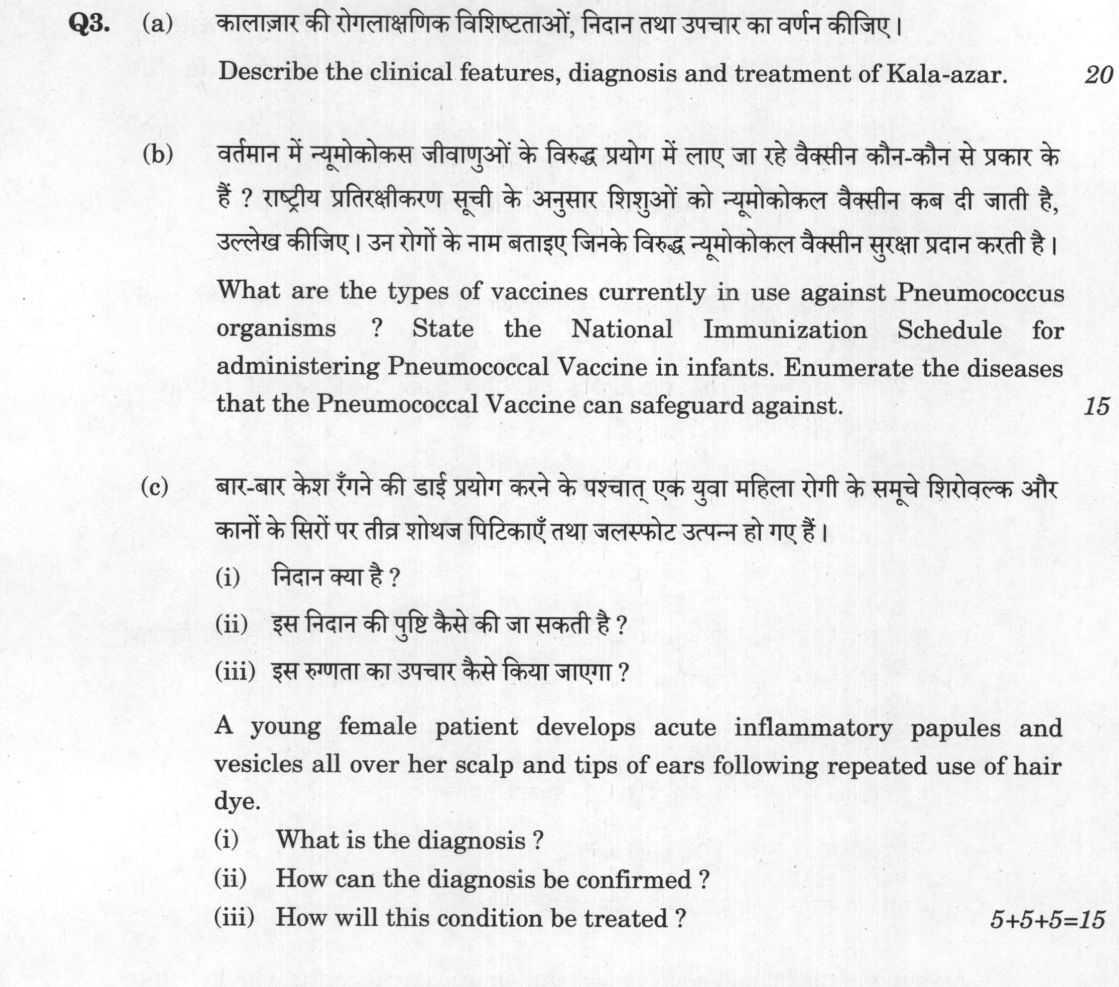
(a) Describe the clinical features, diagnosis and treatment of Kala-azar. 20 marks (b) What are the types of vaccines currently…
Describe the clinical features, diagnosis and treatment of Kala-azar. 20 marks
What are the types of vaccines currently in use against Pneumococcus organisms ? State the National Immunization Schedule for administering Pneumococcal Vaccine in infants. Enumerate the diseases that the Pneumococcal Vaccine can safeguard against. 15 marks
A young female patient develops acute inflammatory papules and vesicles all over her scalp and tips of ears following repeated use of hair dye. What is the diagnosis ?
How can the diagnosis be confirmed ?
How will this condition be treated ? 5+5+5=15 marks
हिंदी में प्रश्न पढ़ें
कालाजार की रोगलाक्षणिक विशिष्टताओं, निदान तथा उपचार का वर्णन कीजिए। 20 अंक
वर्तमान में न्यूमोकोकस जीवाणुओं के विरुद्ध प्रयोग में लाए जा रहे वैक्सीन कौन-कौन से प्रकार के हैं ? राष्ट्रीय प्रतिरक्षीकरण सूची के अनुसार शिशुओं को न्यूमोकोकल वैक्सीन कब दी जाती है, उल्लेख कीजिए। उन रोगों के नाम बताइए जिनके विरुद्ध न्यूमोकोकल वैक्सीन सुरक्षा प्रदान करती है। 15 अंक
बार-बार केश रंगने की डाई प्रयोग करने के पश्चात् एक युवा महिला रोगी के सम्पूर्ण शिरोवल्क और कानों के सिरों पर तीव्र शोथज पिटिकाएँ तथा जलस्फोट उत्पन्न हो गए हैं। निदान क्या है ?
इस निदान की पुष्टि कैसे की जा सकती है ?
इस रुग्णता का उपचार कैसे किया जाएगा ? 5+5+5=15 अंक
Model answer
Written by UPSC Answer Check against this question's marking rubric, to the expected length. UPSC does not publish answers for Mains — this is one way to score well, not an official key.
Kala-azar is a systemic protozoal infection caused by Leishmania donovani, transmitted by Phlebotomus sandflies. It presents after a variable incubation period with prolonged undulant or quotidian fever, often with chills, progressive weakness, weight loss and anorexia. The spleen enlarges massively and is usually larger than the liver; the spleen is firm and tender, while hepatomegaly may also be present. Lymphadenopathy is uncommon, and the spleen is usually the dominant feature. Pancytopenia causes anaemia, easy bruising and recurrent infections; hypergammaglobulinemia and hyperpigmentation are common, giving the disease its name. In advanced cases, oedema, cachexia and secondary infections may occur. India reported elimination of visceral leishmaniasis in 2020, but surveillance and case detection remain important in endemic districts such as Bihar, Jharkhand, Uttar Pradesh and West Bengal.
Diagnosis combines clinical suspicion with laboratory confirmation. The rK39 rapid immunochromatographic test is useful for screening in endemic areas, but rK39 may be false-positive in cross-reactive infections, so aspirate is needed for confirmation. Parasitological demonstration of Leishman-Donovan bodies in splenic, bone-marrow or lymph-node aspirate is the standard. Culture and PCR can support the diagnosis. Treatment follows NVBDCP guidance: liposomal amphotericin B is preferred, commonly a single 5 mg/kg intravenous dose in the Indian subcontinent, with higher or repeated doses for relapse or severe disease. Miltefosine, usually an oral 10-day regimen, or combination therapy may be used where indicated, and antimonials are avoided because of toxicity and resistance. Treatment is curative and reduces transmission; relapse is uncommon after L-AmB but follow-up is advised.
Pneumococcal vaccines. The vaccines in use are pneumococcal conjugate vaccines and pneumococcal polysaccharide vaccine. PCV13 is a 13-valent conjugate vaccine using CRM197 as the protein carrier; PCV10 is a 10-valent conjugate vaccine using protein D, tetanus toxoid and diphtheria toxoid as carriers. PPSV23 is a 23-valent polysaccharide vaccine, mainly for older children, adults and high-risk groups. PCV induces T-cell dependent immunity and is effective in infants; PPSV23 induces T-cell independent antibody responses and is not preferred for young infants. In the National Immunization Schedule, PCV13 is given at 6, 10 and 14 weeks of age with a booster at 9 months under the UIP expansion; PCV10, where procured, follows the same infant schedule, with rollout across states. It safeguards against invasive pneumococcal disease, including bacteraemia and meningitis, pneumonia and otitis media.
Hair-dye dermatitis. The diagnosis is acute allergic contact dermatitis due to paraphenylenediamine (PPD), a primary aromatic amine and primary intermediate in oxidative hair dye, not a coupler. PPD is a potent sensitizer; sensitization may occur after initial exposure, and subsequent reactions appear within 24-48 hours. The history of repeated dye use, with acute inflammatory papules and vesicles on the scalp and ear tips, is characteristic of an acute eczematous reaction in photo-exposed and seborrheic areas. Confirmation is by patch testing with PPD 1% pet, preferably as part of the Indian Standard Series, together with histopathology showing spongiosis and a lymphocytic infiltrate; the temporal relation to repeated exposure supports the diagnosis. Treatment begins with immediate cessation of the dye and avoidance of further contact. Topical corticosteroids such as clobetasone or betamethasone are applied to affected areas, with systemic antihistamines for itching. In severe or widespread cases, a short course of oral corticosteroids may be given. The patient should be educated to avoid PPD-containing products and to use hypoallergenic alternatives, while beauticians should use gloves and patch-test clients, reducing occupational dermatitis burden.
Thus, kala-azar control, pneumococcal immunization and prevention of cosmetic or occupational dermatitis together reflect India’s integrated public-health approach: elimination of visceral leishmaniasis, UIP-based immunization, and early dermatologic management to reduce morbidity.
What "Describe" is asking you to do
Give a full, ordered account of the thing named — its parts, stages or mechanism — in the sequence in which it actually exists or occurs. Most describe questions come from the science optionals, where the marks sit in correct technical detail and, where the stem says so, a labelled diagram.
Structure that answers it
One-line identification of the subject → the parts or stages in their real order, each with its defining detail → labelled diagram where the subject is structural → closing line on function or significance
Where marks are lost
Loose general prose where the examiner is ticking named parts, correct terminology and their sequence; and in the General Studies papers, turning to evaluation before the description is finished.
How this answer will be evaluated
Approach
Framework: Clinical Sequence (Definition > Aetiology > Features > Investigation > Management). (a) describe: define > structure or process in order > labelled diagram > significance | (b) enumerate: list the items in order > one line each > no commentary | (c(i)) define: precise definition > the distinguishing feature > one example | (c(ii)) explain: definition/context > points in order > small example > short close | (c(iii)) suggest: the problem in one line > implementable measures > who acts > conclusion Full marks: Accurate clinical reasoning, correct NKEP/UIP data, and precise management protocols.
Key points expected
- Clinical features: fever, hepatosplenomegaly, pancytopenia, weight loss
- Diagnosis: rK39, rRDT, or bone marrow/splenic aspirate (LD bodies)
- Treatment: Single-dose Liposomal Amphotericin B (10 mg/kg)
- Mention of National Kala-azar Elimination Programme (NKEP)
- Vaccine types: PCV13 (conjugate) and PPSV23 (polysaccharide)
- UIP Schedule: 6 weeks, 14 weeks, and 9 months
- Diseases: Pneumonia, meningitis, sepsis, otitis media
- Distinction between conjugate and polysaccharide vaccines
Evaluation rubric
Each sub-part is marked on its own, against the marks and word limit printed on the paper.
- (a) Systematic clinical profile of Kala-azar (VL) from presentation to cure. 20 marks
describe— define → structure or process in order → labelled diagram → significance
Must cover
- Clinical features: fever, hepatosplenomegaly, pancytopenia, weight loss
- Diagnosis: rK39, rRDT, or bone marrow/splenic aspirate (LD bodies)
- Treatment: Single-dose Liposomal Amphotericin B (10 mg/kg)
- Mention of National Kala-azar Elimination Programme (NKEP)
Loses marks
- Omitting splenomegaly from clinical features
- Listing outdated treatment (Pentavalent antimonials) as first-line
- Confusing diagnosis with Leishmaniasis cutis
Earns more
- Pathophysiology: Leishmania donovani, macrophage invasion
- Complications: Post-Kala-azar Dermal Leishmaniasis (PKDL)
- Differential diagnosis: Malaria, TB, Lymphoma
Extra mark
- Specific NKEP operational guidelines for treatment
- Mention of 'Kala-azar' etymology (black fever)
- (b) Classification of PCV, specific UIP schedule, and list of preventable diseases. 15 marks
enumerate— list the items in order → one line each → no commentary
Must cover
- Vaccine types: PCV13 (conjugate) and PPSV23 (polysaccharide)
- UIP Schedule: 6 weeks, 14 weeks, and 9 months
- Diseases: Pneumonia, meningitis, sepsis, otitis media
- Distinction between conjugate and polysaccharide vaccines
Loses marks
- Incorrect UIP schedule (e.g., 6/10/14 weeks)
- Failing to distinguish PCV from PPSV
- Listing diseases not caused by Pneumococcus
Earns more
- Mention of serotypes covered (13 vs 23)
- Target age for PPSV23 (elderly/comorbid)
Extra mark
- Mention of WHO recommendation for PCV introduction
- Specific serotype numbers (e.g., 1, 3, 4, 5, 6B...)
- (c(i)) Specific diagnosis based on hair dye exposure and scalp/ear vesicles. 5 marks
define— precise definition → the distinguishing feature → one example
Must cover
- Diagnosis: Allergic Contact Dermatitis (ACD)
- Identification of allergen: Hair dye (PPD/Paraphenylenediamine)
- Mention of Type IV hypersensitivity mechanism
Loses marks
- Diagnosing as 'Acne' or 'Folliculitis'
- Failing to link diagnosis to the specific trigger (hair dye)
Earns more
- Specific term: 'Dyebland dermatitis'
- Mention of 'vesicular' nature indicating acute phase
Extra mark
- Mention of 'patch test' as gold standard for confirmation
- (c(ii)) Method to confirm the diagnosis of allergic contact dermatitis. 5 marks
explain— definition/context → points in order → small example → short close
Must cover
- Gold standard: Patch testing
- Procedure: Application of allergen to skin (back)
- Reading time: 48 hours (and 72 hours)
Loses marks
- Suggesting 'Blood test' (IgE) as primary confirmation
- Suggesting 'Biopsy' as first-line confirmation
Earns more
- Mention of 'standard series' vs 'hair dye series'
- Mention of 'prick test' (though less common for ACD)
Extra mark
- Mention of 'open application test' for large areas
- (c(iii)) Management plan for acute allergic contact dermatitis. 5 marks
suggest— the problem in one line → implementable measures → who acts → conclusion
Must cover
- Immediate: Discontinue hair dye use
- Topical: Potent corticosteroids (e.g., Clobetasol)
- Systemic: Oral antihistamines (for itch) or steroids (if severe)
Loses marks
- Suggesting 'Antibiotics' without evidence of infection
- Ignoring the need to stop the causative agent
Earns more
- Wet dressings for acute weeping lesions
- Counseling on reading labels for PPD
Extra mark
- Mention of 'calcineurin inhibitors' for face/ears
Practice this exact question
Write your answer and it is marked point by point against the model answer above — what you covered, what you missed, what you got wrong.
Evaluate my answer →More from Medical Science 2024 Paper II
- Q1 (a) Discuss in short the role of a Chest X-ray in the diagnosis of pulmonary tuberculosis…
- Q2 (a) (i) Discuss in short about the different modalities used in the diagnosis of Extra-Pu…
- Q3 (a) Describe the clinical features, diagnosis and treatment of Kala-azar. 20 marks (b) Wh…
- Q4 (a) A sixty-year-old male develops central chest pain while walking uphill. The pain is s…
- Q5 (a) (i) Enlist conditions having an increased risk of malignant disease in bone and carti…
- Q6 (a) (i) A 22-year-old Unbooked Primigravida at 38 weeks of gestation presents to Emergenc…