Paper II — Q6
(a) (i) A 22-year-old Unbooked Primigravida at 38 weeks of gestation presents to Emergency with labour pains. How would you…
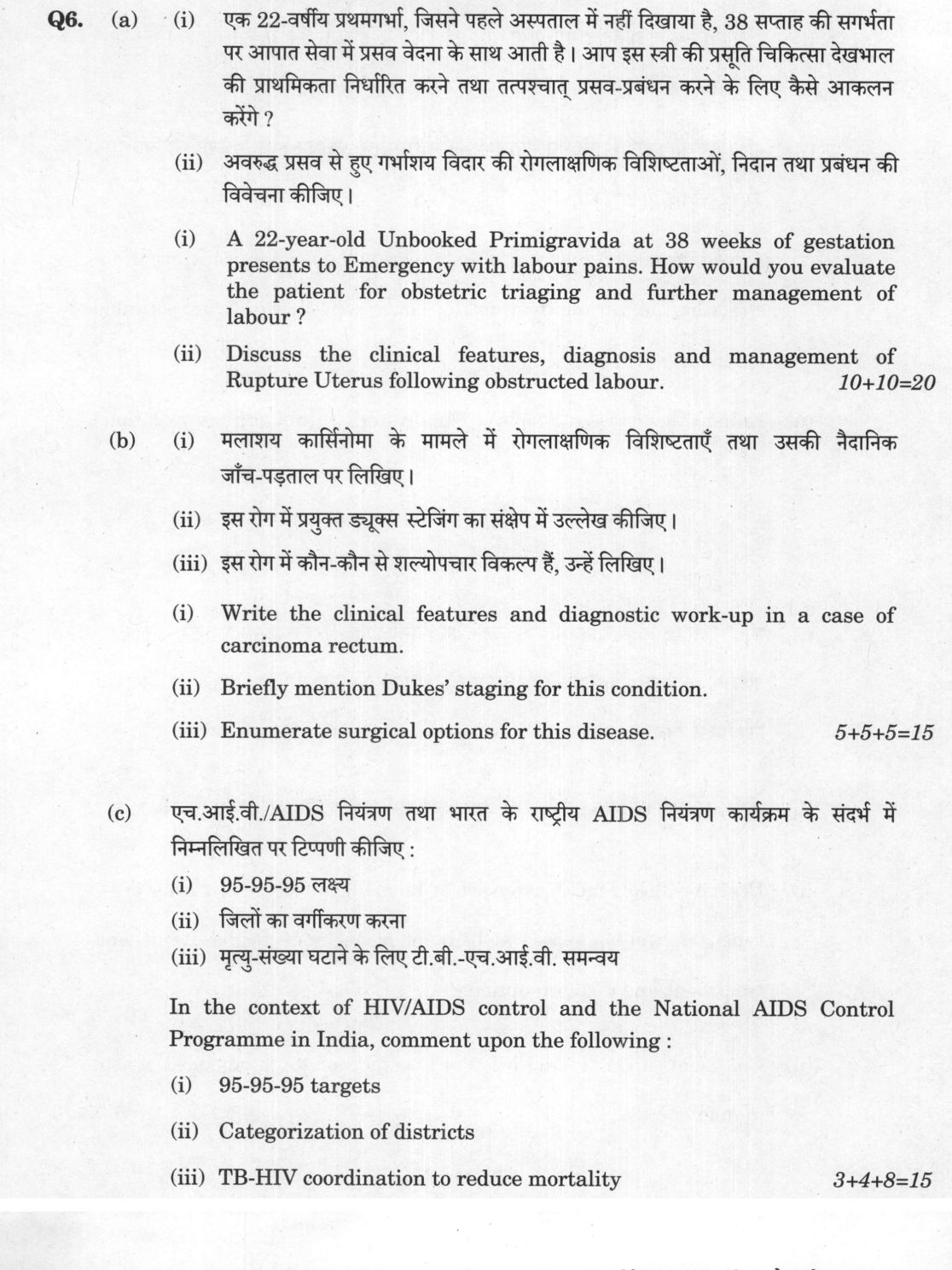
A 22-year-old Unbooked Primigravida at 38 weeks of gestation presents to Emergency with labour pains. How would you evaluate the patient for obstetric triaging and further management of labour ?
Discuss the clinical features, diagnosis and management of Rupture Uterus following obstructed labour. 10+10=20
Write the clinical features and diagnostic work-up in a case of carcinoma rectum.
Briefly mention Dukes' staging for this condition.
Enumerate surgical options for this disease. 5+5+5=15
In the context of HIV/AIDS control and the National AIDS Control Programme in India, comment upon the following :
95-95-95 targets
Categorization of districts
TB-HIV coordination to reduce mortality 3+4+8=15
हिंदी में प्रश्न पढ़ें
एक 22-वर्षीय प्रथमग्राभी, जिसने पहले अस्पताल में नहीं दिखाया है, 38 सप्ताह की गर्भावस्था पर आपात सेवा में प्रसव वेदना के साथ आती है। आप इस स्त्री की प्रसूति चिकित्सा देखभाल की प्राथमिकता निर्धारित करने तथा तत्पश्चात् प्रसव-प्रबंधन करने के लिए कैसे आकलन करेंगे ?
अवरुद्ध प्रसव से हुए गर्भाशय विदार की रोगलाक्षणिक विशिष्टताओं, निदान तथा प्रबंधन की विवेचना कीजिए। 10+10=20
मलाशय कार्सिनोमा के मामले में रोगलाक्षणिक विशिष्टताएं तथा उसकी नैदानिक जाँच-पड़ताल पर लिखिए।
इस रोग में प्रयुक्त ड्यूक्स स्टेजिंग का संक्षेप में उल्लेख कीजिए।
इस रोग में कौन-कौन से शल्योपचार विकल्प हैं, उन्हें लिखिए। 5+5+5=15
एच.आई.वी./AIDS नियंत्रण तथा भारत के राष्ट्रीय AIDS नियंत्रण कार्यक्रम के संदर्भ में निम्नलिखित पर टिप्पणी कीजिए :
95-95-95 लक्ष्य
जिलों का वर्गीकरण करना
मृत्यु-संख्या घटाने के लिए टी.बी.-एच.आई.वी. समन्वय 3+4+8=15
Model answer
Written by UPSC Answer Check against this question's marking rubric, to the expected length. UPSC does not publish answers for Mains — this is one way to score well, not an official key.
An unbooked primigravida presenting in labour represents an obstetric high-risk emergency requiring simultaneous stabilization, assessment, and risk stratification.
Evaluation for Obstetric Triaging and Labour Management Triage begins with a rapid history including gestational age by LMP/EDD, onset and frequency of contractions, leaking or bleeding per vaginum, and pre-existing medical disorders. General physical examination evaluates hemodynamic stability, pallor, pedal edema, and blood pressure to exclude pre-eclampsia. Obstetric examination assesses fundal height, lie, presentation, fetal heart rate (FHR), uterine contraction pattern, and clinical pelvimetry. Per vaginal examination determines cervical dilatation, effacement, station, membrane status, and pelvis adequacy.
Immediate baseline investigations include hemoglobin, ABO/Rh blood grouping, cross-matching, rapid testing for HIV, HBsAg, and VDRL, urine protein/sugar, and Non-Stress Test (NST).
Management comprises securing wide-bore IV access, plotting the WHO Modified Partograph upon entering the active phase (dilatation ≥4 cm) to monitor progress, continuous fetal monitoring, active management of the third stage of labour (AMTSL) using 10 IU intramuscular oxytocin, and prompt identification of cephalopelvic disproportion (CPD) or fetal distress for emergency cesarean section.
Rupture Uterus Following Obstructed Labour Pathophysiology: Prolonged unmanaged obstructed labour causes pathological retraction of the upper uterine segment and extreme stretching and thinning of the lower segment, demarcated by a visible, palpable Bandl’s retraction ring. Clinical Features: Impending rupture features hypertonic contractions and a rising Bandl’s ring. Frank rupture presents with sudden cessation of contractions, acute tearing abdominal pain followed by dull ache, maternal tachycardia, hypotension (hypovolemic shock), hematuria, fetal distress progressing to absent heart sounds, and recession of the presenting part with easily palpable fetal parts under the maternal abdominal wall. Diagnosis: Predominantly clinical, supported by emergency bed-side ultrasonography showing hemoperitoneum and an empty uterine cavity with extraluminal fetal parts. Management: Immediate resuscitation with oxygen, dual large-bore IV access, rapid crystalloid infusion, and uncrossmatched/type-specific blood transfusion, followed by emergency exploratory laparotomy. Surgical choice entails tear debridement and uterine repair with or without bilateral tubal ligation in stable young women with clean linear tears, or subtotal/total hysterectomy for extensive, ragged, or infected uterine lacerations.
Carcinoma Rectum Clinical Features & Diagnostic Work-up: Clinical presentation includes altered bowel habits (spurious diarrhea, tenesmus), rectal bleeding, mucus discharge, sensation of incomplete evacuation, and thin "pencil-like" stools. Work-up involves Digital Rectal Examination (DRE) to evaluate tumor distance from the anal verge, fixity, and sphincter involvement; rigid/flexible proctosigmoidoscopy with biopsy for histopathology; baseline serum Carcinoembryonic Antigen (CEA); pelvic MRI for circumferential resection margin (CRM) and T/N staging; and CECT chest/abdomen or PET-CT to exclude distant metastases.
Dukes' Staging:
- Dukes A: Tumor limited to mucosa/submucosa/muscularis propria without breaching the bowel wall (>90% 5-year survival).
- Dukes B: Extension through the muscularis propria into perirectal fat, nodes negative (65–75% 5-year survival).
- Dukes C: Regional lymph node involvement irrespective of bowel wall depth (30–40% 5-year survival).
- Dukes D (Astler-Coller/Turnbull modification): Distant metastasis (<5% 5-year survival).
Surgical Options: Standardized by Total Mesorectal Excision (TME):
- Low Anterior Resection (LAR) / Ultra-low LAR with coloanal anastomosis for upper and middle-third tumors (sphincter-preserving).
- Abdominoperineal Resection (APR / Miles procedure) with permanent end-colostomy for lower-third tumors involving the sphincter complex.
- Transanal Endoscopic Microsurgery (TEMS) for early, well-differentiated T1N0 lesions.
HIV/AIDS Control: National AIDS Control Programme (NACP) 95-95-95 Targets: Aligned with UNAIDS 2030 and NACP-V goals: 95% of all People Living with HIV (PLHIV) knowing their status; 95% of diagnosed PLHIV initiated on sustained Antiretroviral Therapy (ART); and 95% of those on ART achieving viral suppression.
Categorization of Districts: Differential resource allocation utilizes HIV Sentinel Surveillance:
- Category A: >1% antenatal clinic (ANC) prevalence in any site (high priority).
- Category B: <1% ANC prevalence, but >5% in High-Risk Groups (HRGs: FSW, MSM, IDU).
- Category C: <1% ANC and <5% in HRGs, with high vulnerability factors (e.g., migration).
- Category D: <1% ANC and <5% in HRGs with low vulnerability/poor data.
TB-HIV Coordination to Reduce Mortality: Operationalized via the NACP-NTEP convergence framework:
- Implementation of the "Three I’s": Intensified Case Finding (routine bi-directional screening at all ICTCs, ART, and NTEP centers), Isoniazid Preventive Therapy (IPT) for asymptomatic PLHIV without active TB, and Airborne Infection Control in clinical settings.
- Immediate ART initiation irrespective of CD4 count ("Test and Treat" policy).
- Universal Co-trimoxazole Preventive Therapy (CPT) to reduce opportunistic bacterial infections.
- Upfront molecular diagnostics (CBNAAT/TrueNat) for rapid detection of rifampicin-resistant TB in PLHIV.
Integrated maternal triage, standard surgical protocols for pelvic malignancies, and bi-directional programmatic convergence between NACP and NTEP form the cornerstone of reducing avoidable morbidity and mortality across primary to tertiary levels of healthcare.
What "Discuss" is asking you to do
Lay the issue out from more than one side — how it arose, what is claimed for it, what is held against it, and where it now stands. UPSC attaches discuss to broad topics with several live dimensions, so coverage of the dimensions earns more than the strength of your opinion.
Structure that answers it
Set the issue up → the case as it is made → the case against → the dimension both sides leave out → where the balance now lies
Where marks are lost
Listing facts with no thread between them, or arguing one side throughout and calling it a discussion.
How this answer will be evaluated
Approach
Framework: Clinical Sequence & Management Hierarchy. (a(i)) explain: definition/context > points in order > small example > short close | (a(ii)) discuss: intro > 3-4 dimensions > example > balanced close | (b(i)) explain: definition/context > points in order > small example > short close | (b(ii)) explain: definition/context > points in order > small example > short close | (b(iii)) enumerate: list the items in order > one line each > no commentary | (c(i)) comment: context > arguments both sides > judgment > close | (c(ii)) comment: context > arguments both sides > judgment > close | (c(iii)) comment: context > arguments both sides > judgment > close Full marks: Comprehensive, clinically accurate, follows management hierarchy, references national programs.
Key points expected
- Primary survey: ABCs, vitals, fetal heart rate
- Secondary survey: abdominal palpation, vaginal exam
- Risk stratification: unbooked status, primigravida, 38 weeks
- Management tiers: immediate stabilization, definitive delivery, follow-up
- Clinical features: Bandl's ring, fetal distress, shock
- Diagnosis: Clinical signs, ultrasound, laparotomy findings
- Management: Immediate resuscitation, emergency laparotomy
- Definitive care: Hysterectomy vs. repair, neonatal resuscitation
Evaluation rubric
Each sub-part is marked on its own, against the marks and word limit printed on the paper.
- (a(i)) Systematic obstetric triage and management plan for unbooked primigravida in labour. 10 marks
explain— definition/context → points in order → small example → short close
Must cover
- Primary survey: ABCs, vitals, fetal heart rate
- Secondary survey: abdominal palpation, vaginal exam
- Risk stratification: unbooked status, primigravida, 38 weeks
- Management tiers: immediate stabilization, definitive delivery, follow-up
Loses marks
- Listing symptoms without clinical reasoning
- Management without priority (e.g., surgery before stabilization)
Earns more
- Mention of partograph for labour monitoring
- Specifics of 'unbooked' risk assessment (e.g., anemia, malnutrition)
- Referral criteria for C-section
Extra mark
- Reference to National Health Mission (NHM) protocols
- Mention of specific triage tools (e.g., WHO partograph)
- (a(ii)) Clinical features, diagnosis, and management of uterine rupture from obstructed labour. 10 marks
discuss— intro → 3-4 dimensions → example → balanced close
Must cover
- Clinical features: Bandl's ring, fetal distress, shock
- Diagnosis: Clinical signs, ultrasound, laparotomy findings
- Management: Immediate resuscitation, emergency laparotomy
- Definitive care: Hysterectomy vs. repair, neonatal resuscitation
Loses marks
- Confusing uterine rupture with placental abruption
- Omitting fetal management in the discussion
Earns more
- Differentiation between incomplete and complete rupture
- Mention of specific signs like 'loss of station'
- Post-operative care: antibiotics, blood transfusion
Extra mark
- Reference to specific surgical techniques (e.g., McIndoe's repair)
- Mention of legal/ethical aspects of delayed referral
- (b(i)) Clinical features and diagnostic work-up for carcinoma rectum. 5 marks
explain— definition/context → points in order → small example → short close
Must cover
- Clinical features: rectal bleeding, change in bowel habit, mass
- Diagnostic work-up: DRE, proctoscopy, biopsy
- Staging investigations: CT/MRI, CEA levels
- Distinction from other rectal pathologies
Loses marks
- Omitting digital rectal examination (DRE)
- Listing investigations without clinical context
Earns more
- Mention of specific symptoms like tenesmus
- Role of colonoscopy in ruling out synchronous lesions
Extra mark
- Reference to specific staging protocols (e.g., NCCN guidelines)
- Mention of genetic testing (e.g., Lynch syndrome)
- (b(ii)) Brief description of Dukes' staging for rectal carcinoma. 5 marks
explain— definition/context → points in order → small example → short close
Must cover
- Stage A: Tumor limited to bowel wall
- Stage B: Tumor through bowel wall
- Stage C: Lymph node involvement
- Stage D: Distant metastasis
Loses marks
- Confusing Dukes' staging with TNM staging
- Omitting lymph node status in Stage C
Earns more
- Mention of sub-stages (e.g., C1, C2)
- Clarification of modern TNM correlation
Extra mark
- Reference to specific historical context of Dukes' classification
- Mention of prognostic implications of each stage
- (b(iii)) List of surgical options for rectal carcinoma. 5 marks
enumerate— list the items in order → one line each → no commentary
Must cover
- Low Anterior Resection (LAR)
- Abdominoperineal Resection (APR)
- Local excision (for early stage)
- Palliative surgery (for advanced stage)
Loses marks
- Listing non-surgical options (e.g., chemotherapy)
- Omitting palliative options for advanced disease
Earns more
- Mention of neoadjuvant therapy role
- Specifics of sphincter-sparing techniques
Extra mark
- Reference to specific surgical approaches (e.g., robotic vs. laparoscopic)
- Mention of stoma care and rehabilitation
- (c(i)) Comment on 95-95-95 targets in HIV/AIDS control. 3 marks
comment— context → arguments both sides → judgment → close
Must cover
- Definition: 95% of people with HIV know their status
- 95% of those diagnosed are on treatment
- 95% of those on treatment are virally suppressed
- Context: UNAIDS global targets
Loses marks
- Confusing 95-95-95 with other HIV targets
- Omitting the 'virally suppressed' component
Earns more
- Mention of India's progress towards these targets
- Role of testing and counseling centers
Extra mark
- Reference to specific national data on 95-95-95 achievement
- Mention of specific challenges in achieving these targets
- (c(ii)) Comment on categorization of districts in NACP. 4 marks
comment— context → arguments both sides → judgment → close
Must cover
- Basis: HIV prevalence and incidence
- Categories: High, Medium, Low prevalence
- Implications: Resource allocation, service delivery
- Dynamic nature: Reclassification based on data
Loses marks
- Confusing district categorization with state-level planning
- Omitting the dynamic nature of categorization
Earns more
- Mention of specific districts in each category
- Role of district-level planning in NACP
Extra mark
- Reference to specific NACP guidelines on district categorization
- Mention of specific interventions for high-prevalence districts
- (c(iii)) Comment on TB-HIV coordination to reduce mortality. 8 marks
comment— context → arguments both sides → judgment → close
Must cover
- Rationale: High co-infection rates, increased mortality
- Coordination: Integrated testing, treatment, and care
- Specific interventions: ART for TB patients, TB treatment for HIV patients
- Impact: Reduced transmission, improved survival
Loses marks
- Treating TB and HIV as separate entities
- Omitting the impact of coordination on mortality
Earns more
- Mention of specific programs (e.g., NTEP-NACP integration)
- Role of community-based organizations in coordination
Extra mark
- Reference to specific data on TB-HIV co-infection in India
- Mention of specific challenges in TB-HIV coordination
Practice this exact question
Write your answer and it is marked point by point against the model answer above — what you covered, what you missed, what you got wrong.
Evaluate my answer →More from Medical Science 2024 Paper II
- Q3 (a) Describe the clinical features, diagnosis and treatment of Kala-azar. 20 marks (b) Wh…
- Q4 (a) A sixty-year-old male develops central chest pain while walking uphill. The pain is s…
- Q5 (a) (i) Enlist conditions having an increased risk of malignant disease in bone and carti…
- Q6 (a) (i) A 22-year-old Unbooked Primigravida at 38 weeks of gestation presents to Emergenc…
- Q7 (a) A 50-year-old male presented with a 3 cm nodule in the left lobe of thyroid gland wit…
- Q8 (a) (i) What are the different types of epidemiological studies? (ii) What are the possib…