Paper II — Q2
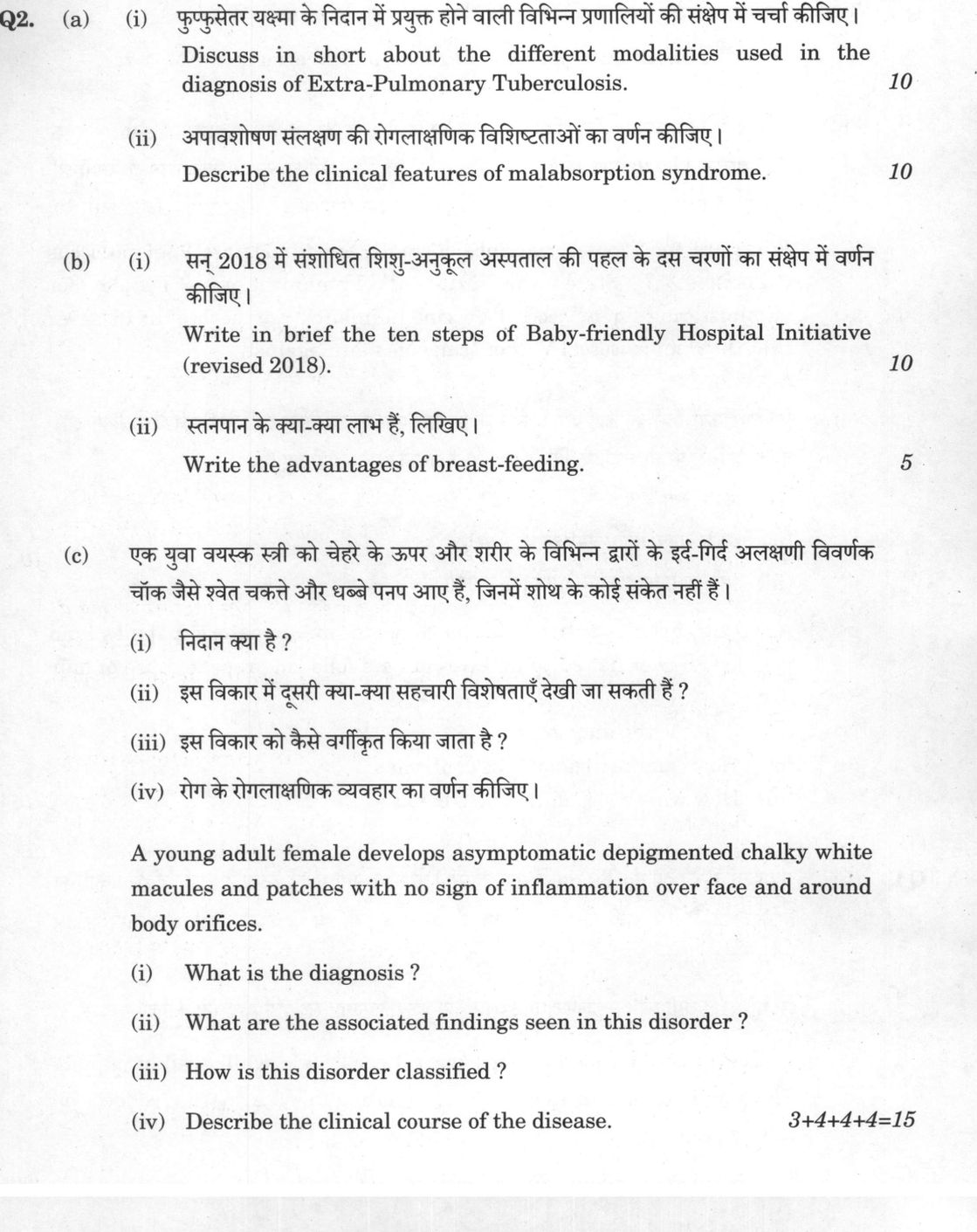
(a) (i) Discuss in short about the different modalities used in the diagnosis of Extra-Pulmonary Tuberculosis. (10 marks) (ii)…
Discuss in short about the different modalities used in the diagnosis of Extra-Pulmonary Tuberculosis. 10 marks
Describe the clinical features of malabsorption syndrome. 10 marks
Write in brief the ten steps of Baby-friendly Hospital Initiative (revised 2018). 10 marks
Write the advantages of breast-feeding. 5 marks
A young adult female develops asymptomatic depigmented chalky white macules and patches with no sign of inflammation over face and around body orifices. What is the diagnosis ?
What are the associated findings seen in this disorder ?
How is this disorder classified ?
Describe the clinical course of the disease. (3+4+4+4=15 marks)
हिंदी में प्रश्न पढ़ें
क्षयरोगेतर यक्ष्मा के निदान में प्रयुक्त होने वाली विभिन्न प्रणालियों की संक्षेप में चर्चा कीजिए। (10 अंक)
अपावशोषण संलक्षण की रोगलाक्षणिक विशिष्टताओं का वर्णन कीजिए। (10 अंक)
सन् 2018 में संशोधित शिशु-अनुकूल अस्पताल की पहल के दस चरणों का संक्षेप में वर्णन कीजिए। (10 अंक)
स्तनपान के क्या-क्या लाभ हैं, लिखिए। (5 अंक)
एक युवा वयस्क स्त्री को चेहरे के ऊपर और शरीर के विभिन्न द्वारों के इर्द-गिर्द अलक्षणी विवर्णक चौक जैसे श्वेत चकत्ते और धब्बे पनप आए हैं, जिनमें शोथ के कोई संकेत नहीं हैं। निदान क्या है ?
इस विकार में दूसरी क्या-क्या सहचारी विशेषताएँ देखी जा सकती हैं ?
इस विकार को कैसे वर्गीकृत किया जाता है ?
रोग के रोगलाक्षणिक व्यवहार का वर्णन कीजिए। (3+4+4+4=15 अंक)
Model answer
Written by UPSC Answer Check against this question's marking rubric, to the expected length. UPSC does not publish answers for Mains — this is one way to score well, not an official key.
EPTB diagnosis. Diagnosis is multimodal because no single test is uniformly confirmatory. Under NTEP, CBNAAT/GeneXpert MTB/RIF is performed on tissue, pleural fluid, CSF, lymph-node aspirate or urine where available, giving rapid detection and rifampicin resistance; CBNAAT is preferred for paucibacillary EPTB, while culture remains reference but slow. Line probe assay is used on smear-positive specimens or culture isolates, not directly on most tissue biopsies, to detect rifampicin and fluoroquinolone resistance. Histopathology showing caseating granulomas supports TB; AFB smear/culture may support the diagnosis but has low sensitivity and is not a confirmatory standard for most EPTB. ADA levels in pleural or CSF fluid aid diagnosis. Imaging is essential: MRI for Pott’s spine and spinal cord compression, CT for abdominal, lymph-node and genitourinary TB; FNAC/cytology is used for lymph-node and soft-tissue disease.
Malabsorption syndrome. It is described by chronic fat-soluble and nutrient malabsorption: steatorrhea, weight loss, anaemia from iron, B12 or folate deficiency, and oedema from hypoproteinaemia. Bloating, flatulence, fatigue, and neuropathy or osteomalacia may accompany the core features. Celiac disease may show dermatitis herpetiformis, anti-tTG positivity and duodenal villous atrophy; tropical sprue occurs after tropical exposure with folate/B12 deficiency and responds to antibiotics; Whipple’s disease gives PAS-positive macrophages, arthralgia and chronic diarrhoea.
BFHI 2018 Ten Steps. The revised framework is: 1. Have a written breastfeeding policy, compliant with the International Code, to routine staff, mothers, and families; 1a. The policy is communicated to all healthcare staff; 1b. The policy is communicated to mothers and families; 1c. Establish ongoing monitoring and data-management systems. 2. Train all healthcare workforce to support the policy. 3. Ensure women pregnant, in labour, and after birth know and understand key aspects of breastfeeding. 4. Help mothers initiate breastfeeding within one hour of birth, with skin-to-skin contact. 5. Show mothers how to breastfeed and how to maintain lactation if separated from infants. 6. No feeding of breastfed newborns any food or liquid other than breast milk unless medically indicated; no pacifiers or artificial teats, ensuring exclusive breastfeeding. 7. Enable mothers and babies to stay together 24 hours a day (rooming-in). 8. Encourage mothers to breastfeed on demand. 9. Advise mothers on feeding and use of expressed breast milk when separated. 10. When discharging mothers and babies, refer to care providers and support groups consistent with the policy. The steps are ordered from policy to discharge.
Advantages of breast-feeding. Breast milk gives optimal nutrition, immunoglobulins and lactoferrin, reduces NEC in preterms, promotes bonding, protects mothers from breast/ovarian cancer, and LAM can be used as temporary contraception.
Vitiligo. The diagnosis is vitiligo. Associated findings include Koebner phenomenon, leukotrichia, bright blue-white fluorescence under Wood’s lamp, and segmental versus non-segmental patterns; lesions are smooth, non-scaly and non-atrophic, and Wood’s lamp enhances contrast. Autoimmune associations such as thyroid disease, type 1 diabetes, alopecia areata, and occasional ocular/auditory involvement may be seen, with ocular associations including uveitis or retinal pigment changes and auditory association possibly sensorineural hearing loss. A distribution diagram would show periorificial and facial patches in non-segmental disease, unilateral dermatomal patches in segmental disease, acral spots, mucosal involvement, and diffuse universal depigmentation. Classification includes focal, segmental, mucosal, acrofacial, vulgaris and universal forms; non-segmental includes focal, acrofacial, vulgaris and mucosal, segmental is unilateral, and universal is extensive. Activity is scored with VASI and VETF. The course is progressive, stable, or spontaneously repigmenting, often from hair follicles; the progressive phase has new lesions, the stable phase has no spread, and repigmentation may be centripetal. Psychological impact is common, and better prognosis is linked to early age, facial lesions and recent onset. Thus, vitiligo is best described as an acquired depigmentation with variable distribution, activity, and prognosis.
What "Describe" is asking you to do
Give a full, ordered account of the thing named — its parts, stages or mechanism — in the sequence in which it actually exists or occurs. Most describe questions come from the science optionals, where the marks sit in correct technical detail and, where the stem says so, a labelled diagram.
Structure that answers it
One-line identification of the subject → the parts or stages in their real order, each with its defining detail → labelled diagram where the subject is structural → closing line on function or significance
Where marks are lost
Loose general prose where the examiner is ticking named parts, correct terminology and their sequence; and in the General Studies papers, turning to evaluation before the description is finished.
How this answer will be evaluated
Approach
Framework: Clinical Sequence (Definition > Aetiology > Features > Investigation/Management). (a(i)) discuss: intro > 3-4 dimensions > example > balanced close | (a(ii)) describe: define > structure or process in order > labelled diagram > significance | (b(i)) explain: definition/context > points in order > small example > short close | (b(ii)) explain: definition/context > points in order > small example > short close | (c(i)) define: precise definition > the distinguishing feature > one example | (c(ii)) describe: define > structure or process in order > labelled diagram > significance | (c(iii)) describe: define > structure or process in order > labelled diagram > significance | (c(iv)) describe: define > structure or process in order > labelled diagram > significance Full marks: Comprehensive, accurate, and well-structured answers with specific examples and references to guidelines.
Key points expected
- Categorize modalities (Clinical, Lab, Imaging, Histopath)
- Mention specific tests (AFB smear, GeneXpert, Culture)
- Link modalities to specific sites (e.g., CSF for CNS)
- Mention role of biopsy/histopathology
- Define malabsorption (failure to absorb nutrients)
- List GI symptoms (steatorrhea, diarrhea, bloating)
- List systemic/nutritional signs (weight loss, edema)
- Mention specific deficiency signs (e.g., glossitis, ecchymosis)
Evaluation rubric
Each sub-part is marked on its own, against the marks and word limit printed on the paper.
- (a(i)) Overview of diagnostic modalities for Extra-Pulmonary Tuberculosis (EPTB). 10 marks
discuss— intro → 3-4 dimensions → example → balanced close
Must cover
- Categorize modalities (Clinical, Lab, Imaging, Histopath)
- Mention specific tests (AFB smear, GeneXpert, Culture)
- Link modalities to specific sites (e.g., CSF for CNS)
- Mention role of biopsy/histopathology
Loses marks
- Listing tests without site-specific context
- Ignoring histopathology (gold standard for some)
- Confusing EPTB with Pulmonary TB diagnostics
Earns more
- Mention GeneXpert MTB/RIF sensitivity
- Reference to NTEP guidelines
- Mention PCR/NAATs
- Mention specific imaging (MRI/CT) for specific sites
Extra mark
- Mention specific sensitivity/specificity stats
- Reference to specific NTEP circular
- (a(ii)) Clinical features of malabsorption syndrome. 10 marks
describe— define → structure or process in order → labelled diagram → significance
Must cover
- Define malabsorption (failure to absorb nutrients)
- List GI symptoms (steatorrhea, diarrhea, bloating)
- List systemic/nutritional signs (weight loss, edema)
- Mention specific deficiency signs (e.g., glossitis, ecchymosis)
Loses marks
- Listing symptoms without linking to mechanism
- Ignoring nutritional consequences
- Confusing with malnutrition without malabsorption
Earns more
- Mention specific vitamin deficiencies (B12, D, K)
- Mention mineral deficiencies (Iron, Calcium)
- Mention chronic vs acute presentation
- Mention specific syndromes (Celiac, Tropical Sprue)
Extra mark
- Mention specific lab markers (e.g., low albumin)
- Mention specific physical exam findings (e.g., angular stomatitis)
- (b(i)) Ten steps of Baby-friendly Hospital Initiative (BFHI) revised 2018. 10 marks
explain— definition/context → points in order → small example → short close
Must cover
- List all 10 steps accurately
- Mention 'Baby-friendly' terminology
- Mention 'exclusive breastfeeding' for 6 months
- Mention 'rooming-in' and 'on-demand' feeding
Loses marks
- Listing fewer than 10 steps
- Using outdated (pre-2018) terminology
- Confusing with general infant care steps
Earns more
- Mention 'no formula feeding' policy
- Mention 'counseling' for working mothers
- Mention 'referral' of mothers who cannot breastfeed
- Mention 'no marketing' of breast-milk substitutes
Extra mark
- Mention specific WHO/UNICEF guidelines
- Mention specific hospital accreditation process
- (b(ii)) Advantages of breast-feeding. 5 marks
explain— definition/context → points in order → small example → short close
Must cover
- Mention nutritional benefits (ideal composition)
- Mention immunological benefits (antibodies, IgA)
- Mention maternal benefits (contraction, spacing)
- Mention infant benefits (reduced infection, bonding)
Loses marks
- Listing only nutritional benefits
- Ignoring maternal benefits
- Confusing with formula feeding advantages
Earns more
- Mention specific antibodies (sIgA)
- Mention reduced risk of SIDS
- Mention cost-effectiveness
- Mention environmental benefits
Extra mark
- Mention specific long-term benefits (e.g., reduced obesity)
- Mention specific maternal long-term benefits (e.g., reduced breast cancer risk)
- (c(i)) Diagnosis of the described condition. 3 marks
define— precise definition → the distinguishing feature → one example
Must cover
- Identify as Vitiligo
- Mention 'depigmented' and 'asymptomatic'
- Mention 'chalky white' and 'macules/patches'
Loses marks
- Misdiagnosing as Pityriasis Alba
- Misdiagnosing as Tinea Versicolor
- Ignoring the 'asymptomatic' and 'depigmented' clues
Earns more
- Mention 'acquired' and 'chronic'
- Mention 'autoimmune' nature
- Mention 'melanocyte destruction'
Extra mark
- Mention specific ICD code
- Mention specific differential diagnosis
- (c(ii)) Associated findings in Vitiligo. 4 marks
describe— define → structure or process in order → labelled diagram → significance
Must cover
- Mention 'leukotrichia' (white hair in patches)
- Mention 'Koebner phenomenon' (trauma triggers)
- Mention 'acropial' or 'segmental' patterns
- Mention 'associated autoimmune conditions' (e.g., thyroid)
Loses marks
- Listing only skin findings
- Ignoring systemic associations
- Confusing with other depigmenting disorders
Earns more
- Mention 'halo nevi'
- Mention 'alopecia areata' association
- Mention 'Addison's disease' association
- Mention 'psychological impact' (stigma)
Extra mark
- Mention specific genetic markers
- Mention specific histopathological findings
- (c(iii)) Classification of Vitiligo. 4 marks
describe— define → structure or process in order → labelled diagram → significance
Must cover
- Mention 'Non-segmental' (generalized, acropial, focal)
- Mention 'Segmental' (unilateral, dermatomal)
- Mention 'Universal' (total body)
- Mention 'Mixed' (segmental + non-segmental)
Loses marks
- Listing only 'generalized' and 'segmental'
- Ignoring 'universal' and 'mixed' types
- Confusing with other skin conditions
Earns more
- Mention 'Truncal' pattern
- Mention 'Mucosal' involvement
- Mention 'Ocular' involvement
- Mention 'Aural' involvement
Extra mark
- Mention specific classification systems (e.g., Vitiligo Global Assessment Scale)
- Mention specific genetic subtypes
- (c(iv)) Clinical course of Vitiligo. 4 marks
describe— define → structure or process in order → labelled diagram → significance
Must cover
- Mention 'chronic' and 'progressive' nature
- Mention 'stabilization' and 'repigmentation' phases
- Mention 'spontaneous remission' (rare)
- Mention 'recurrence' after treatment
Loses marks
- Describing as 'acute' or 'self-limiting'
- Ignoring the 'chronic' nature
- Confusing with other skin conditions
Earns more
- Mention 'Koebner phenomenon' in course
- Mention 'seasonal variation' (worse in summer)
- Mention 'psychological impact' over time
- Mention 'response to treatment' variability
Extra mark
- Mention specific long-term outcomes
- Mention specific quality of life impact
Practice this exact question
Write your answer and it is marked point by point against the model answer above — what you covered, what you missed, what you got wrong.
Evaluate my answer →More from Medical Science 2024 Paper II
- Q1 (a) Discuss in short the role of a Chest X-ray in the diagnosis of pulmonary tuberculosis…
- Q2 (a) (i) Discuss in short about the different modalities used in the diagnosis of Extra-Pu…
- Q3 (a) Describe the clinical features, diagnosis and treatment of Kala-azar. 20 marks (b) Wh…
- Q4 (a) A sixty-year-old male develops central chest pain while walking uphill. The pain is s…
- Q5 (a) (i) Enlist conditions having an increased risk of malignant disease in bone and carti…