Paper II — Q7
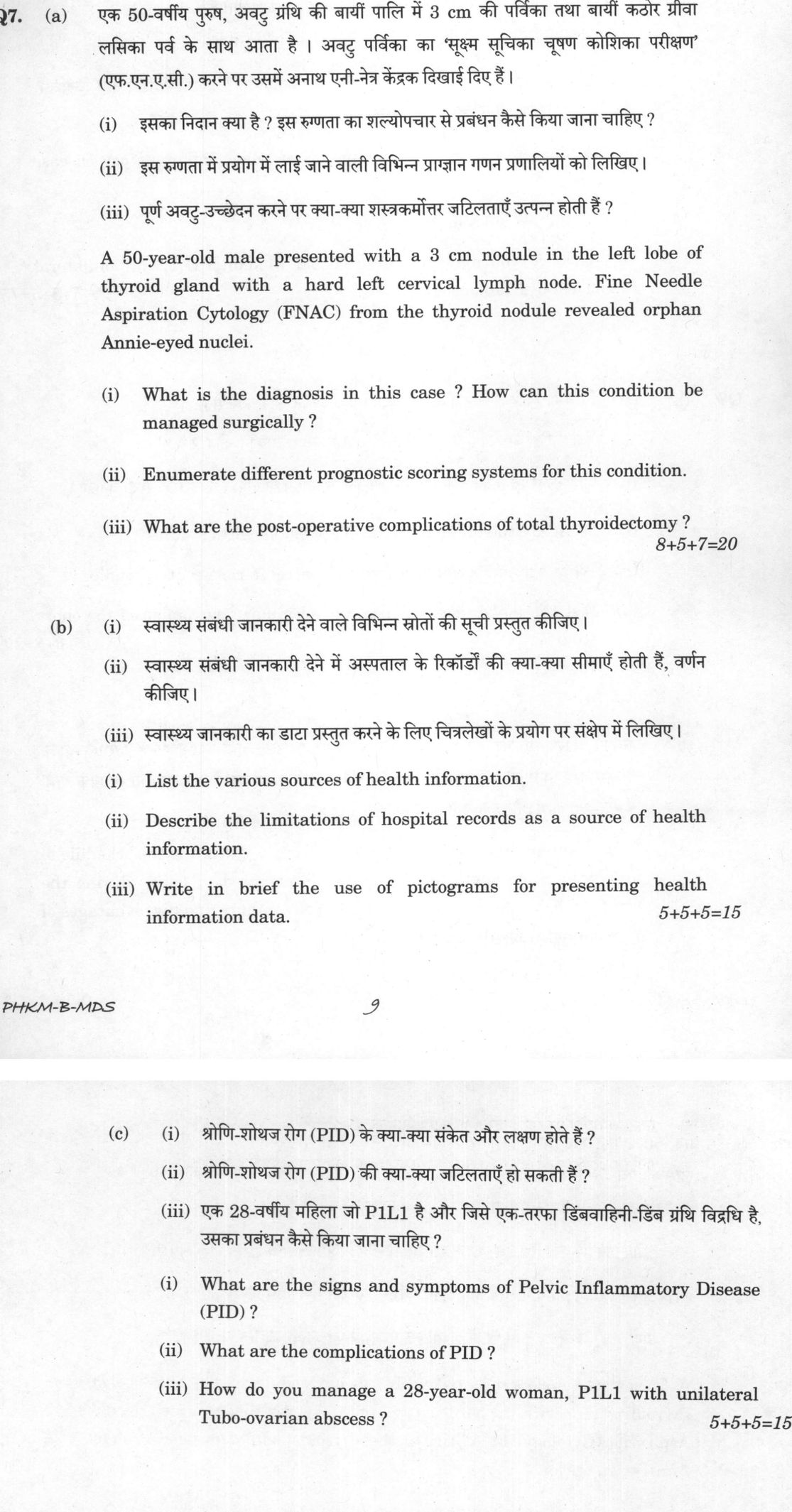
(a) A 50-year-old male presented with a 3 cm nodule in the left lobe of thyroid gland with a hard left cervical lymph node. Fine…
A 50-year-old male presented with a 3 cm nodule in the left lobe of thyroid gland with a hard left cervical lymph node. Fine Needle Aspiration Cytology (FNAC) from the thyroid nodule revealed orphan Annie-eyed nuclei.
What is the diagnosis in this case? How can this condition be managed surgically?
Enumerate different prognostic scoring systems for this condition.
What are the post-operative complications of total thyroidectomy? 8+5+7=20
List the various sources of health information.
Describe the limitations of hospital records as a source of health information.
Write in brief the use of pictograms for presenting health information data. 5+5+5=15
What are the signs and symptoms of Pelvic Inflammatory Disease (PID)?
What are the complications of PID?
How do you manage a 28-year-old woman, P1L1 with unilateral Tubo-ovarian abscess? 5+5+5=15
हिंदी में प्रश्न पढ़ें
एक 50-वर्षीय पुरुष, अवटु ग्रंथि की बायीं पालि में 3 cm की परिवृका तथा बायीं कठोर ग्रीवा लसिका पर्व के साथ आता है। अवटु परिवृका का 'सूक्ष्म सूचिका चूषण कोशिका परीक्षण' (एफ.एन.ए.सी.) करने पर उसमें अनाथ एनी-नेत्र केंद्रक दिखाई दिए हैं।
इसका निदान क्या है? इस रुग्णता का शल्योपचार से प्रबंधन कैसे किया जाना चाहिए?
इस रुग्णता में प्रयोग में लाई जाने वाली विभिन्न प्राज्ञान गणन प्रणालियों को लिखिए।
पूर्ण अवटु-उच्छेदन करने पर क्या-क्या शस्त्रकर्मोत्तर जटिलताएँ उत्पन्न होती हैं? 8+5+7=20
स्वास्थ्य संबंधी जानकारी देने वाले विभिन्न स्रोतों की सूची प्रस्तुत कीजिए।
स्वास्थ्य संबंधी जानकारी देने में अस्पताल के रिकॉर्डों की क्या-क्या सीमाएँ होती हैं, वर्णन कीजिए।
स्वास्थ्य जानकारी का डाटा प्रस्तुत करने के लिए चित्रलेखों के प्रयोग पर संक्षेप में लिखिए। 5+5+5=15
श्रोण-शोथज रोग (PID) के क्या-क्या संकेत और लक्षण होते हैं?
श्रोण-शोथज रोग (PID) की क्या-क्या जटिलताएँ हो सकती हैं?
एक 28-वर्षीय महिला जो P1L1 है और जिसे एक-तरफा डिंबवाहिनी-डिंब ग्रंथि विद्रधि है, उसका प्रबंधन कैसे किया जाना चाहिए? 5+5+5=15
Model answer
Written by UPSC Answer Check against this question's marking rubric, to the expected length. UPSC does not publish answers for Mains — this is one way to score well, not an official key.
(a) The hard thyroid nodule with a hard cervical node and FNAC showing Orphan Annie-eyed nuclei—optically empty, ground-glass nuclei with nuclear grooves and pseudoinclusions—indicates papillary thyroid carcinoma, with cervical metastasis. The hard cervical node is treated as metastatic papillary carcinoma. Surgical management is tailored to tumour size, extrathyroidal extension and nodal status. Total thyroidectomy is chosen when the nodule is larger, there is extrathyroidal extension, bilateral disease, or nodal metastasis; hemithyroidectomy/lobectomy may suffice for small, unilateral, intrathyroidal low-risk lesions. For a 3 cm nodule with a clinically positive cervical node, total thyroidectomy with central compartment neck dissection is preferred. Central compartment neck dissection is added when nodes are clinically or cytologically positive. Total thyroidectomy facilitates radioactive iodine ablation and thyroglobulin surveillance when high-risk features are present, such as extrathyroidal extension, nodal or distant metastasis, or residual disease. It is not required for low-risk intrathyroidal disease.
Prognostic scoring systems include MACIS (Metastasis, Age, Completeness of resection, Invasion, Size), AGES (Age, Grade, Extent, Size), AMES (Age, Metastasis, Extent, Size), TNM staging (AJCC 8th edition), EORTC, and DeGroot classification. MACIS, AGES and AMES are clinical prognostic indices; TNM is anatomic staging; EORTC and DeGroot are risk classifications. AJCC TNM uses tumour size, nodal and distant metastasis. These systems stratify risk, guide post-operative radioiodine and surveillance intensity, and help compare outcomes.
Post-operative complications of total thyroidectomy are recurrent laryngeal nerve injury (unilateral hoarseness or bilateral airway compromise), superior laryngeal nerve injury (voice fatigue/pitch change), hypoparathyroidism/hypocalcaemia, hypothyroidism requiring levothyroxine, thyroid storm, haemorrhage/haematoma, wound infection, and tracheal injury. Hypocalcaemia may be transient or permanent; haematoma may require urgent re-exploration; tracheal injury is rare but serious. Thyroid storm is rare but can occur if the gland is stimulated.
(b) Sources of health information include census, vital registration, hospital records, disease registries, notification systems, sample registration system, NSSO surveys, NFHS, DLHS, ICMR surveys, verbal autopsy, and HMIS. Census and vital registration provide denominators and vital events; HMIS provides facility-based data. Disease registries and notification systems capture notifiable diseases; sample registration system and NSSO, NFHS, DLHS and ICMR surveys provide population-based estimates. Hospital records have limitations: incomplete coverage because domiciliary and rural deaths/cases are missed; selection bias towards hospitalised patients; variable quality of recording; lack of standardization; underreporting; absence of a denominator population; and changing diagnostic criteria. They may also miss community cases and have coding or reporting delays. Hospital records are facility-based, so incidence and mortality rates cannot be calculated without denominators. Pictograms present data using symbols/icons, useful for illiterate populations and mass communication. Their construction principles are simple, culturally appropriate, proportional, labelled, and consistent; one symbol represents a fixed number, captions are short, and comparisons are visually clear. Interpretation is by counting or comparing symbols and reading captions. They are used on posters, wall charts, mobile messages and community health worker materials. Indian IEC examples include family planning, immunization, and COVID-19 campaigns.
(c) PID presents with lower abdominal pain, abnormal vaginal discharge, fever, dyspareunia, menstrual irregularities, cervical motion tenderness, and adnexal tenderness; Fitz-Hugh-Curtis syndrome causes perihepatitis. Complications include infertility, ectopic pregnancy, chronic pelvic pain, tubo-ovarian abscess, perihepatitis, increased HIV transmission, and psychological sequelae. In a 28-year-old P1L1 with unilateral TOA, management is fertility-preserving. Admit for broad-spectrum antibiotics: cefoxitin 2 g IV every 6 hours plus doxycycline, or clindamycin plus gentamicin. Broad-spectrum antibiotics are chosen to cover the usual polymicrobial pathogens. Response is assessed by pain, fever and ultrasound. If no improvement in 48-72 hours, drainage or surgery is considered. Add image-guided percutaneous drainage if abscess is large, persistent, or >8 cm; surgery is indicated for rupture, sepsis, failure of medical/drainage response, or diagnostic uncertainty. Surgery may be laparoscopic drainage or surgical drainage. Follow-up includes clinical review, ultrasound, and hysterosalpingography to assess tubal patency. Fertility counselling is given.
What "Enumerate" is asking you to do
Produce the complete set of items asked for, countable and correctly named. The examiner marks against a checklist, so a missing item costs and an elaborated one gains nothing — where discussion is wanted the stem asks for it as a separate sub-part.
Structure that answers it
One line naming the basis on which the set is drawn → items numbered, each in a phrase or a single line → the discussion sub-part taken up separately, after the list is complete
Where marks are lost
Treating it as an essay. Six items named in six lines score better than three items explained at length.
How this answer will be evaluated
Approach
Framework: Clinical Sequence (Definition > Aetiology > Features > Investigation > Management). (a(i)) explain: definition/context > points in order > small example > short close | (a(ii)) enumerate: list the items in order > one line each > no commentary | (a(iii)) highlight: name the salient points > one line of substance each > close | (b(i)) enumerate: list the items in order > one line each > no commentary | (b(ii)) describe: define > structure or process in order > labelled diagram > significance | (b(iii)) write short notes: define > 3-4 key features > one example > one-line significance | (c(i)) explain: definition/context > points in order > small example > short close | (c(ii)) enumerate: list the items in order > one line each > no commentary | (c(iii)) justify: claim > 3-4 reasons > evidence > conclusion Full marks: Accurate diagnosis, complete management plan, and specific clinical details.
Key points expected
- Diagnosis: Papillary Thyroid Carcinoma
- Significance of Orphan Annie eye nuclei
- Surgery: Total thyroidectomy
- Surgery: Central/Level VI lymph node dissection
- AGES system
- MACIS system
- AMES system
- ATA risk stratification
Evaluation rubric
Each sub-part is marked on its own, against the marks and word limit printed on the paper.
- (a(i)) Diagnosis based on FNAC and surgical management plan. 8 marks
explain— definition/context → points in order → small example → short close
Must cover
- Diagnosis: Papillary Thyroid Carcinoma
- Significance of Orphan Annie eye nuclei
- Surgery: Total thyroidectomy
- Surgery: Central/Level VI lymph node dissection
Loses marks
- Diagnosing as Follicular carcinoma
- Suggesting hemithyroidectomy only
Earns more
- Mention of lateral neck dissection
- Post-op TSH suppression therapy
- Radioactive Iodine (RAI) ablation
Extra mark
- Mention of ATA risk stratification
- (a(ii)) List of prognostic scoring systems for thyroid cancer. 5 marks
enumerate— list the items in order → one line each → no commentary
Must cover
- AGES system
- MACIS system
- AMES system
- ATA risk stratification
Loses marks
- Listing general cancer staging only
- Omitting at least two major systems
Earns more
- Mention of Dukes staging
- TNM staging system
Extra mark
- Brief definition of one system
- (a(iii)) List of post-operative complications of total thyroidectomy. 7 marks
highlight— name the salient points → one line of substance each → close
Must cover
- Hypoparathyroidism (Hypocalcemia)
- Recurrent Laryngeal Nerve (RLN) palsy
- Hemorrhage/Hematoma
- Infection/Wound dehiscence
Loses marks
- Listing complications of other neck surgeries
- Omitting RLN or Parathyroid injury
Earns more
- External Laryngeal Nerve injury
- Chyle leak (if lateral dissection)
- Thyroid storm
Extra mark
- Mention of specific incidence rates
- (b(i)) List of various sources of health information. 5 marks
enumerate— list the items in order → one line each → no commentary
Must cover
- Hospital records
- Vital registration (Birth/Death)
- Surveys (NFHS, ICMR)
- Health Management Information System (HMIS)
Loses marks
- Listing only primary sources
- Vague categorization without examples
Earns more
- Mention of Census data
- Mention of NGO reports
Extra mark
- Mention of specific national databases
- (b(ii)) Limitations of hospital records as a health information source. 5 marks
describe— define → structure or process in order → labelled diagram → significance
Must cover
- Exclusion of home deaths
- Exclusion of home births
- Under-reporting of minor ailments
- Selection bias (only hospitalized cases)
Loses marks
- Listing general data limitations
- Failing to mention home deaths/births
Earns more
- Mention of data quality issues
- Mention of coding errors
Extra mark
- Comparison with community-based data
- (b(iii)) Use of pictograms for presenting health data. 5 marks
write short notes— define → 3-4 key features → one example → one-line significance
Must cover
- Definition of pictogram
- Use for illiterate populations
- Visual representation of data
- Simplicity and clarity
Loses marks
- Confusing with pie charts
- Failing to mention target audience
Earns more
- Example of a health pictogram
- Mention of WHO guidelines
Extra mark
- Mention of specific software used
- (c(i)) Signs and symptoms of Pelvic Inflammatory Disease (PID). 5 marks
explain— definition/context → points in order → small example → short close
Must cover
- Lower abdominal pain
- Cervical motion tenderness (Chandelier sign)
- Fever
- Abnormal vaginal discharge
Loses marks
- Listing only symptoms without signs
- Omitting cervical motion tenderness
Earns more
- Mention of uterine tenderness
- Mention of adnexal tenderness
Extra mark
- Mention of specific pathogens
- (c(ii)) List of complications of PID. 5 marks
enumerate— list the items in order → one line each → no commentary
Must cover
- Infertility
- Ectopic pregnancy
- Chronic pelvic pain
- Tubo-ovarian abscess (TOA)
Loses marks
- Listing causes of PID
- Omitting infertility
Earns more
- Mention of Fitz-Hugh-Curtis syndrome
- Mention of septic shock
Extra mark
- Mention of specific risk percentages
- (c(iii)) Management plan for 28-year-old with unilateral TOA. 5 marks
justify— claim → 3-4 reasons → evidence → conclusion
Must cover
- Broad-spectrum IV antibiotics
- Surgical drainage (Laparoscopy/Laparotomy)
- Preservation of fertility (Oophorectomy avoided)
- Follow-up with ultrasound
Loses marks
- Suggesting hysterectomy
- Omitting antibiotics
Earns more
- Mention of specific antibiotic regimen
- Mention of percutaneous drainage
Extra mark
- Mention of specific surgical technique
Practice this exact question
Write your answer and it is marked point by point against the model answer above — what you covered, what you missed, what you got wrong.
Evaluate my answer →More from Medical Science 2024 Paper II
- Q4 (a) A sixty-year-old male develops central chest pain while walking uphill. The pain is s…
- Q5 (a) (i) Enlist conditions having an increased risk of malignant disease in bone and carti…
- Q6 (a) (i) A 22-year-old Unbooked Primigravida at 38 weeks of gestation presents to Emergenc…
- Q7 (a) A 50-year-old male presented with a 3 cm nodule in the left lobe of thyroid gland wit…
- Q8 (a) (i) What are the different types of epidemiological studies? (ii) What are the possib…