Paper I — Q2
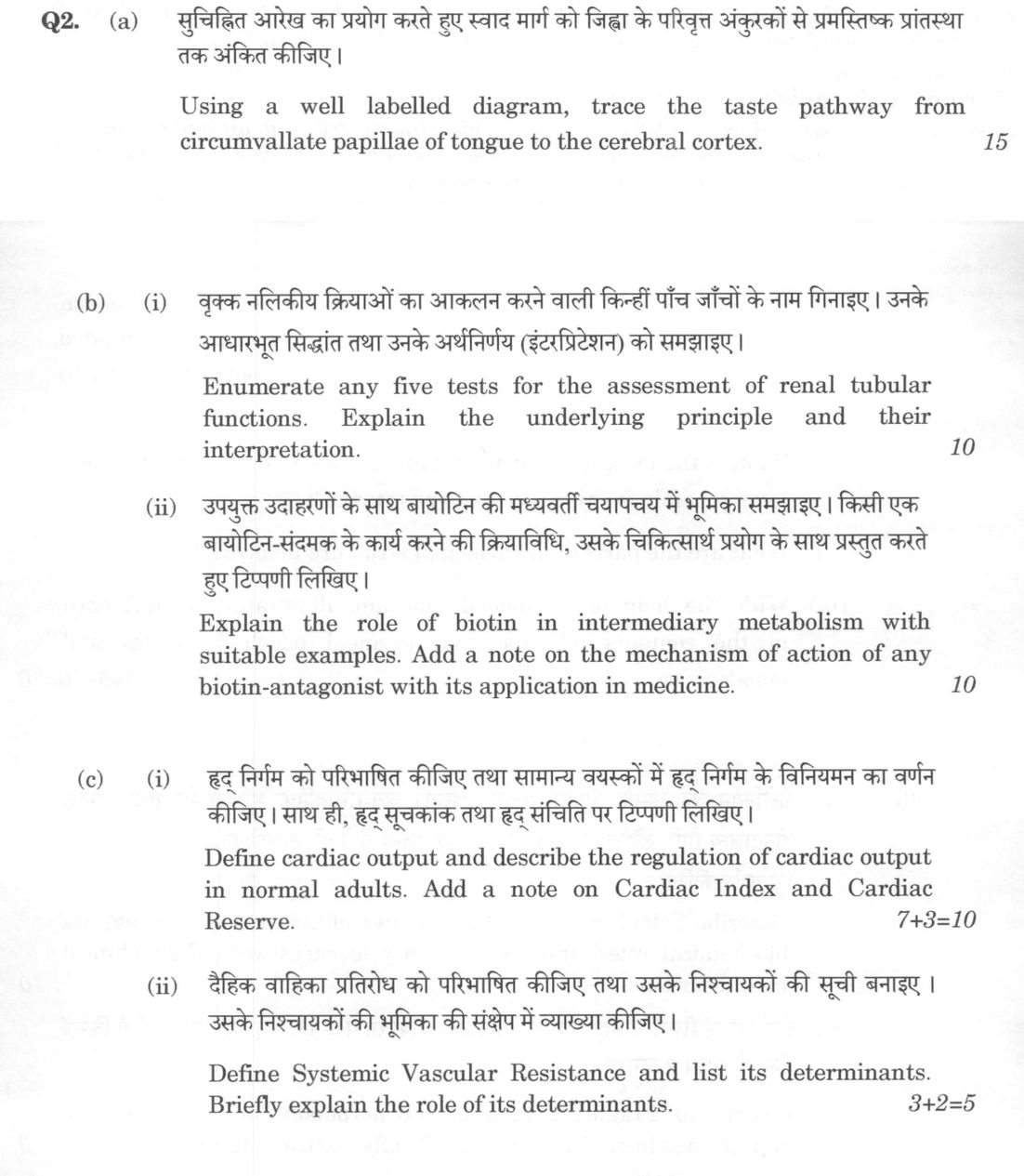
(a) Using a well labelled diagram, trace the taste pathway from circumvallate papillae of tongue to the cerebral cortex. 15…
Using a well labelled diagram, trace the taste pathway from circumvallate papillae of tongue to the cerebral cortex. 15 marks
Enumerate any five tests for the assessment of renal tubular functions. Explain the underlying principle and their interpretation. 10 marks
Explain the role of biotin in intermediary metabolism with suitable examples. Add a note on the mechanism of action of any biotin-antagonist with its application in medicine. 10 marks
Define cardiac output and describe the regulation of cardiac output in normal adults. Add a note on Cardiac Index and Cardiac Reserve. 7+3=10 marks
Define Systemic Vascular Resistance and list its determinants. Briefly explain the role of its determinants. 3+2=5 marks
हिंदी में प्रश्न पढ़ें
सुचिहित आरेख का प्रयोग करते हुए स्वाद मार्ग को जिह्वा के परिवृत्त अनुकुरों से प्रमस्तिष्क प्रांतस्था तक अंकित कीजिए। 15 अंक
वृक्क नलिकीय क्रियाओं का आकलन करने वाली किन्हीं पाँच जाँचों के नाम गिनाइए। उनके आधारभूत सिद्धांत तथा उनके अर्थनिर्णय (इंटरप्रिटेशन) को समझाइए। 10 अंक
उपयुक्त उदाहरणों के साथ बायोटिन की मध्यवर्ती चयापचय में भूमिका समझाइए। किसी एक बायोटिन-संदमक के कार्य करने की क्रियाविधि, उसके चिकित्सार्थ प्रयोग के साथ प्रस्तुत करते हुए टिप्पणी लिखिए। 10 अंक
हृद् निर्गम को परिभाषित कीजिए तथा सामान्य वयस्कों में हृद् निर्गम के विनियमन का वर्णन कीजिए। साथ ही, हृद् सूचकांक तथा हृद् संचिति पर टिप्पणी लिखिए। 7+3=10 अंक
दैहिक वाहिका प्रतिरोध को परिभाषित कीजिए तथा उसके निर्धारकों की सूची बनाइए। उसके निर्धारकों की भूमिका की संक्षेप में व्याख्या कीजिए। 3+2=5 अंक
Model answer
Written by UPSC Answer Check against this question's marking rubric, to the expected length. UPSC does not publish answers for Mains — this is one way to score well, not an official key.
Taste pathway. The taste pathway from circumvallate papillae is a special visceral afferent (SVA) sequence. Taste buds in circumvallate papillae contain type III gustatory receptor cells that transduce sweet, umami, bitter, sour and salty stimuli. Afferent fibres from these buds enter the glossopharyngeal nerve (CN IX), whose cell bodies lie in the petrosal (otic) ganglion. In the medulla, fibres ascend in the solitary tract and synapse in the rostral nucleus solitarius. Second-order neurons decussate in the tegmentum and project to the parvocellular part of the ventral posteromedial (VPM) nucleus of the thalamus. Third-order thalamocortical fibres reach the primary gustatory area in the anterior insular cortex and, for flavour integration, the orbitofrontal cortex. A labelled diagram would show: circumvallate papilla → taste bud → type III cell → CN IX → petrosal ganglion → solitary tract → nucleus solitarius → decussation → VPM → insular cortex → orbitofrontal cortex.
Renal tubular tests. Five tests assess tubular function by measuring what tubules reabsorb, secrete or acidify. (1) Urine pH and PCO2 gap test: acetazolamide causes bicarbonaturia; a fall in urine pH with a widened PCO2 gap indicates intact distal acidification, while a high urine pH and small gap suggest distal tubular acidification failure. (2) Urine concentrating ability: Uosm/Posm and free-water clearance (CH2O) test ADH-dependent water reabsorption in collecting ducts; low Uosm in dehydration indicates impaired aquaporin-2/urea handling. (3) Urinary acidification: NH4+ excretion and titratable acid measure distal H+ secretion and buffer capacity; low NH4+ with metabolic acidosis indicates impaired distal acid secretion. (4) Renal glycosuria/aminoaciduria: glucose or amino acids in urine despite normal plasma levels indicate proximal tubular reabsorptive defects, e.g. SGLT2 or amino acid transporter failure. (5) PAH extraction ratio: assessed with inulin/PAH clearance, it estimates GFR and effective renal plasma flow; a low PAH extraction ratio reflects reduced tubular secretion or renal plasma flow.
Biotin. Biotin is a water-soluble vitamin covalently attached to lysine residues of carboxylases as biocytin; the biotin moiety carries activated CO2. It is essential for pyruvate carboxylase in gluconeogenesis, acetyl-CoA carboxylase in fatty acid synthesis, and propionyl-CoA carboxylase in odd-chain fatty acid/propionate metabolism to succinyl-CoA. Deficiency impairs these pathways. Avidin, a biotin antagonist in raw egg white, binds biotin with Kd ~10^-15 M, outcompetes carboxylase biotin and causes deficiency. The avidin/streptavidin-biotin interaction is used in ELISA, immunohistochemistry and molecular diagnostics; biotinidase deficiency screening uses biotinidase activity and biotin metabolites to detect recycling defects.
Cardiac output. Cardiac output (CO) is the volume of blood pumped by the ventricle per minute, CO = HR × SV. In normal adults it is regulated by intrinsic Frank-Starling mechanism: increased end-diastolic volume/pressure stretches myocardium, increasing stroke volume via length-tension relationship. Extrinsic regulation includes sympathetic and parasympathetic autonomic control via baroreceptors, changes in contractility, heart rate, preload, afterload, and hormones such as angiotensin II, ADH and catecholamines. Cardiac Index is CO divided by body surface area, normally 2.5–4.0 L/min/m². Cardiac Reserve is the ratio of maximum to resting CO, about 4–5 in healthy adults.
Systemic vascular resistance. SVR is the resistance to flow in the systemic circulation, SVR = (MAP − CVP)/CO × 80 dyn·s·cm⁻⁵. Its determinants are vessel radius, vessel length and blood viscosity. Radius is dominant because resistance varies inversely with radius to the fourth power; it is regulated by local metabolites, endothelial factors and sympathetic tone. Length is fixed in adults, while viscosity depends on haematocrit and plasma proteins. Thus, taste is a sequential SVA relay, tubular tests index transport defects, biotin-dependent carboxylation links metabolism, and CO/SVR regulation maintains perfusion.
What "Trace" is asking you to do
Follow a development through in sequence, showing what carried each stage into the next. The sequence may be historical, or in the science papers an anatomical or physiological pathway followed from origin to destination.
Structure that answers it
Point of origin → stage, with what moved it on → next stage → the turning point → where it ends and what it had become
Where marks are lost
Dates or stations listed in order with nothing joining them; the marks are on the connecting steps, not on the sequence itself.
How this answer will be evaluated
Approach
Framework: Clinical Sequence (Definition > Pathophysiology > Features > Investigation > Management). (a) explain: definition/context > points in order > small example > short close | (b) explain: definition/context > points in order > small example > short close | (c) explain: definition/context > points in order > small example > short close Full marks: Complete clinical sequence with diagrams, specific mechanisms, and current guidelines.
Key points expected
- Taste pathway: circumvallate papillae → chorda tympani/glossopharyngeal → nucleus of solitary tract → VPM thalamus → gustatory cortex
- Renal tubular tests: e.g., urine osmolality, specific gravity, electrolyte excretion, acid-base handling, glucose reabsorption
- Biotin: coenzyme for pyruvate carboxylase, acetyl-CoA carboxylase, propionyl-CoA carboxylase, methylcrotonyl-CoA carboxylase
- Biotin-antagonist: avidin binds biotin, preventing enzyme function; used in research, not typically in medicine
- Cardiac output: heart rate × stroke volume; regulated by preload, afterload, contractility, autonomic tone
- Cardiac Index: CO/BSA; Cardiac Reserve: max CO - resting CO
- SVR: (MAP - CVP)/CO; determinants: vessel radius, blood viscosity, vessel length, autonomic tone
Evaluation rubric
Each sub-part is marked on its own, against the marks and word limit printed on the paper.
- (a) Sequential anatomical tracing of the taste pathway from tongue to cortex. 15 marks
explain— definition/context → points in order → small example → short close
Must cover
- Circumvallate papillae and taste buds
- Chorda tympani and glossopharyngeal nerves
- Nucleus of the solitary tract
- VPM of thalamus and gustatory cortex
Loses marks
- Listing nerves without sequential order
- Omitting the thalamic relay station
- Confusing taste with general sensation
Earns more
- Well-labelled diagram of the pathway
- Identification of facial nerve (CN VII)
- Identification of vagus nerve (CN X)
- Specific cortical localization (insula/frontal operculum)
Extra mark
- Mention of central taste processing centers
- Distinction between taste and somatosensory pathways
- (b) Five renal tubular tests with principles and biotin's metabolic role. 10 marks
explain— definition/context → points in order → small example → short close
Must cover
- Five specific tubular function tests
- Principle of each test
- Interpretation of test results
- Biotin as a coenzyme for carboxylases
Loses marks
- Listing tests without explaining principles
- Confusing glomerular with tubular function
- Omitting the biotin-antagonist mechanism
Earns more
- Mention of biotin-antagonist (e.g., avidin)
- Mechanism of biotin-antagonist action
- Medical application of biotin-antagonist
- Specific examples of biotin-dependent reactions
Extra mark
- Reference to biotin deficiency symptoms
- Mention of biotinidase enzyme
- (c) Cardiac output regulation, indices, and systemic vascular resistance determinants. 10 marks
explain— definition/context → points in order → small example → short close
Must cover
- Definition of cardiac output
- Regulation mechanisms in normal adults
- Definition of systemic vascular resistance
- List of SVR determinants
Loses marks
- Defining CO without explaining regulation
- Listing SVR determinants without explaining roles
- Confusing cardiac output with stroke volume
Earns more
- Cardiac Index definition and normal value
- Cardiac Reserve concept
- Role of each SVR determinant
- Flow diagram of CO regulation
Extra mark
- Mention of Frank-Starling mechanism
- Reference to autonomic nervous system role
Practice this exact question
Write your answer and it is marked point by point against the model answer above — what you covered, what you missed, what you got wrong.
Evaluate my answer →More from Medical Science 2025 Paper I
- Q1 (a) Describe the formation, course and branches of ulnar nerve. Which muscles do each of…
- Q2 (a) Using a well labelled diagram, trace the taste pathway from circumvallate papillae of…
- Q3 (a) A 36-year-old cyclist suffered pelvic injury while riding into a pothole on the road.…
- Q4 (a) (i) A 55-year-old lady visits surgery OPD with a three month old history of a painles…
- Q5 (a) (i) Enumerate the topical antifungal drugs along with their indication and side effec…