Paper I — Q6
(a) (i) Describe the approach to laboratory diagnosis of chronic myeloid leukemia – chronic phase. 10 marks (ii) Describe the…
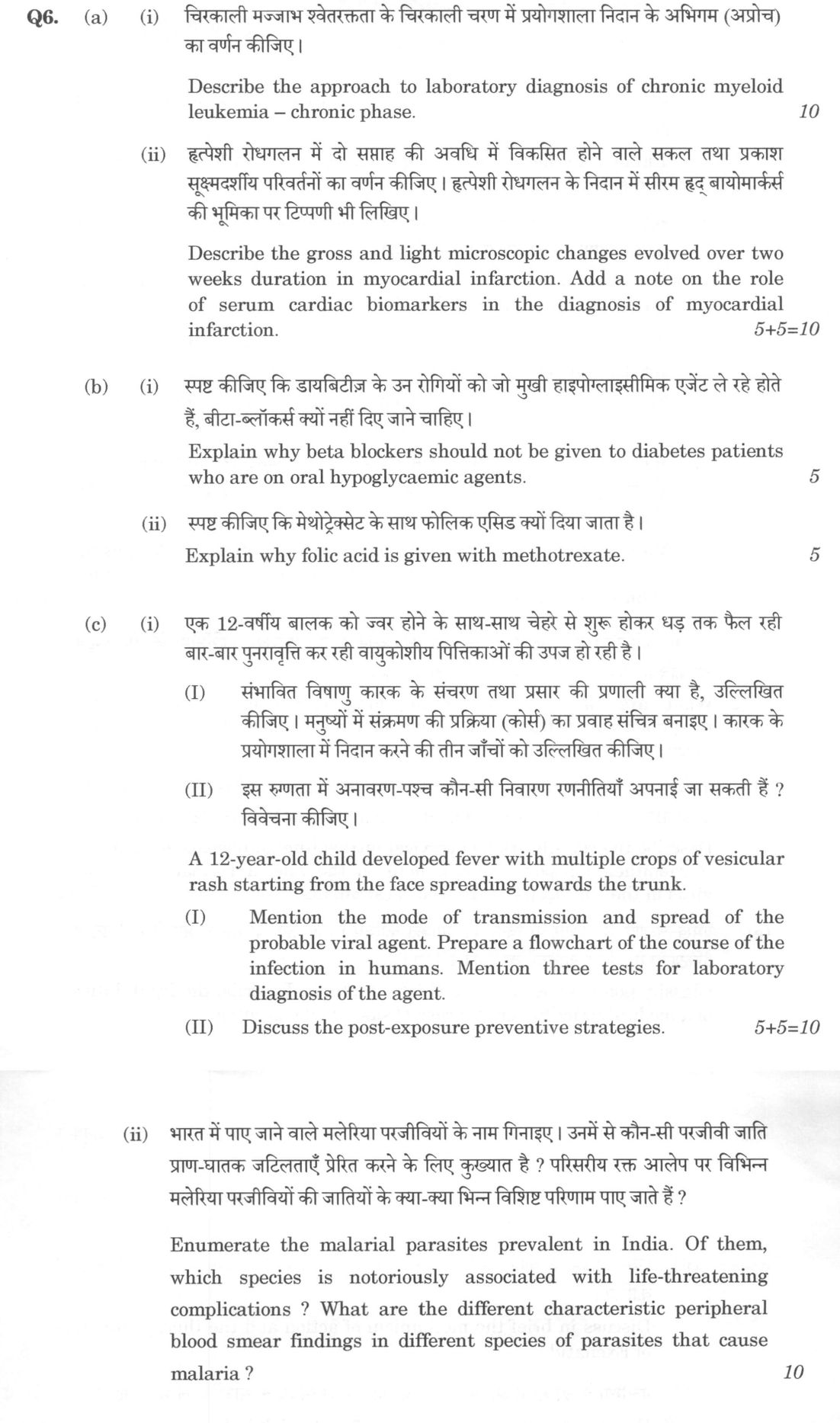
Describe the approach to laboratory diagnosis of chronic myeloid leukemia – chronic phase. 10 marks
Describe the gross and light microscopic changes evolved over two weeks duration in myocardial infarction. Add a note on the role of serum cardiac biomarkers in the diagnosis of myocardial infarction. 5+5=10 marks
Explain why beta blockers should not be given to diabetes patients who are on oral hypoglycaemic agents. 5 marks
Explain why folic acid is given with methotrexate. 5 marks
A 12-year-old child developed fever with multiple crops of vesicular rash starting from the face spreading towards the trunk. (I) Mention the mode of transmission and spread of the probable viral agent. Prepare a flowchart of the course of the infection in humans. Mention three tests for laboratory diagnosis of the agent. (II) Discuss the post-exposure preventive strategies. 5+5=10 marks
Enumerate the malarial parasites prevalent in India. Of them, which species is notoriously associated with life-threatening complications ? What are the different characteristic peripheral blood smear findings in different species of parasites that cause malaria ? 10 marks
हिंदी में प्रश्न पढ़ें
चिरकाली मज्जाम श्वेतरक्तता के चिरकाली चरण में प्रयोगशाला निदान के अभिगम (अप्रोच) का वर्णन कीजिए। 10
हृदपेशी रोधगलन में दो सप्ताह की अवधि में विकसित होने वाले सकल तथा प्रकाश सूक्ष्मदर्शीय परिवर्तनों का वर्णन कीजिए। हृदपेशी रोधगलन के निदान में सीरम हृद बायोमार्कर्स की भूमिका पर टिप्पणी भी लिखिए। 5+5=10
स्पष्ट कीजिए कि डायबिटीज के उन रोगियों को जो मुख्य हाइपोग्लाइसीमिक एजेंट ले रहे होते हैं, बीटा-ब्लॉकर्स क्यों नहीं दिए जाने चाहिए। 5
स्पष्ट कीजिए कि मेथोट्रेक्सेट के साथ फोलिक एसिड क्यों दिया जाता है। 5
एक 12-वर्षीय बालक को ज्वर होने के साथ-साथ चेहरे से शुरू होकर धड़ तक फैल रही बार-बार पुनरावृत्ति कर रही वायुकोशीय पित्तिकाओं की उपज हो रही है। (I) संभावित विषाणु कारक के संचरण तथा प्रसार की प्रणाली क्या है, उल्लिखित कीजिए। मनुष्यों में संक्रमण की प्रक्रिया (कोर्स) का प्रवाह संचित्र बनाइए। कारक के प्रयोगशाला में निदान करने की तीन जाँचों को उल्लिखित कीजिए। (II) इस ऋणता में अनावरण-पश्चात् कौन-सी निवारण रणनीतियाँ अपनाई जा सकती हैं ? विवेचना कीजिए। 5+5=10
भारत में पाए जाने वाले मलेरिया परजीवियों के नाम गिनाइए। उनमें से कौन-सी परजीवी जाति प्राण-घातक जटिलताएँ प्रेरित करने के लिए कुख्यात है ? परिसरिय रक्त आलेप पर विभिन्न मलेरिया परजीवियों की जातियों के क्या-क्या भिन्न विशिष्ट परिणाम पाए जाते हैं ? 10 marks
Model answer
Written by UPSC Answer Check against this question's marking rubric, to the expected length. UPSC does not publish answers for Mains — this is one way to score well, not an official key.
Laboratory Diagnosis of Chronic Myeloid Leukemia (Chronic Phase)
Peripheral blood smear examination reveals marked leukocytosis (typically >100,000/μL) with a complete spectrum of myeloid precursors demonstrating a "left shift" (myelocytes, metamyelocytes, band forms), accompanied by prominent basophilia and eosinophilia. The Leukocyte Alkaline Phosphatase (LAP/NAP) score is characteristically low to absent, differentiating it from a leukemoid reaction. Bone marrow aspirate and biopsy show marked hypercellularity with granulocytic hyperplasia (elevated M:E ratio), dwarf megakaryocytes, and sea-blue histiocytes. Definitive cytogenetic and molecular confirmation relies on identifying the Philadelphia chromosome t(9;22)(q34;q11) via conventional karyotyping or Fluorescent In Situ Hybridization (FISH), and detecting the BCR-ABL1 fusion transcript using quantitative Reverse Transcriptase-Polymerase Chain Reaction (RT-PCR).
Evolution of Myocardial Infarction and Cardiac Biomarkers
Gross and microscopic evolution over two weeks follows a defined timeline:
- 0 to 24 Hours: Grossly, dark mottling appears after 12 hours. Light microscopy demonstrates early coagulative necrosis, wavy myocardial fibers, hypereosinophilia, and marginal contraction band necrosis.
- 1 to 3 Days: Grossly exhibits a central yellow-tan softening with a hyperemic border. Microscopy shows total loss of nuclei and striations, with dense neutrophilic infiltration.
- 3 to 7 Days: Grossly, marked central softening with depressed hyperemic margins is visible. Microscopy demonstrates disintegration of dead myofibers and early phagocytosis by abundant macrophages.
- 7 to 14 Days: Grossly, the infarct border appears depressed and gelatinous red-purple. Microscopy reveals prominent vascularized granulation tissue with active fibroblastic proliferation and early collagen deposition.
Serum cardiac biomarkers confirm the diagnosis:
- Cardiac Troponins (cTnI and cTnT): Highly cardiospecific; levels rise within 2–4 hours, peak at 24–48 hours, and persist for 7–14 days.
- Creatine Kinase-MB (CK-MB): Rises within 4–6 hours, peaks at 18–24 hours, and normalizes within 48–72 hours, making it the diagnostic marker of choice for detecting early re-infarction.
Pharmacology Considerations
Beta-Blockers in Diabetics on OHAs: Non-selective beta-blockers impair counter-regulatory glycogenolysis and gluconeogenesis by blocking hepatic beta-2 receptors, thereby worsening hypoglycemia and delaying recovery. Concurrently, blockade of peripheral beta-1 receptors masks sympathoadrenal warning signs such as tachycardia, palpitations, and tremors, leaving diaphoresis (sympathetic cholinergic) as the sole, often overlooked indicator of life-threatening hypoglycemia.
Folic Acid with Methotrexate: Methotrexate competitively inhibits dihydrofolate reductase (DHFR), halting tetrahydrofolate generation. Supplementation with folic acid (or folinic acid/leucovorin rescue in high-dose chemotherapy) restores intracellular folate pools in normal tissues, preventing dose-limiting toxicities such as stomatitis, mucosal ulcerations, hepatotoxicity, and myelosuppression, while preserving the therapeutic response.
Varicella Infection and Post-Exposure Prophylaxis
The patient has Varicella (chickenpox). Transmission occurs via airborne respiratory droplets or direct contact with infectious vesicular fluid.
Pathogenesis and Course: Inhalation/Contact → Primary replication in upper respiratory tract mucosa and local lymphoid tissue → Primary viremia (days 4–6) with reticuloendothelial dissemination → Secondary viremia (days 10–14) → Fever and prodrome → Centripetal vesicular eruption in successive crops ("dewdrops on a rose petal") → Pustulation, umbilication, and crusting/scabbing.
Laboratory Diagnosis:
- Tzanck smear demonstrating multinucleated giant cells and Cowdry A inclusion bodies.
- Real-time PCR detecting Varicella Zoster Virus (VZV) DNA in vesicular scrapings.
- Direct Fluorescent Antibody (DFA) staining of vesicular base exudates.
Post-Exposure Strategies:
- Active Immunization: Live attenuated varicella vaccine administered within 3 to 5 days of exposure to susceptible, immunocompetent individuals.
- Passive Immunization: Varicella-Zoster Immune Globulin (VZIG) administered intramuscularly within 96 hours (effective up to 10 days) for high-risk individuals, including immunocompromised patients, non-immune pregnant women, and neonates whose mothers contracted varicella peripartum.
Malarial Parasites in India and Smear Findings
The species prevalent in India are Plasmodium vivax (most common), Plasmodium falciparum, Plasmodium malariae, and the zoonotic Plasmodium knowlesi.
Plasmodium falciparum is notoriously responsible for life-threatening complications, including cerebral malaria, acute tubular necrosis ("blackwater fever"), non-cardiogenic pulmonary edema, severe lactic acidosis, and disseminated intravascular coagulation, mediated by cytoadherence and sequestration of parasitized RBCs via PfEMP-1.
Peripheral Blood Smear Characteristics:
- Plasmodium vivax: Parasitizes enlarged, pale reticulocytes containing fine, eosinophilic stippling (Schüffner's dots), highly amoeboid trophozoites, and compact, spherical gametocytes.
- Plasmodium falciparum: Parasitizes normal-sized red blood cells; shows high parasitemia, delicate multiple ring forms per RBC, appliqué/accole forms, double chromatin dots, and diagnostic crescent/banana-shaped gametocytes; late schizonts are rarely seen in peripheral blood due to deep vascular sequestration.
- Plasmodium malariae: Parasitizes mature, normal-to-small RBCs, featuring characteristic ribbon or rectangular "band-form" trophozoites, coarse Ziemann’s dots, and symmetrical "daisy-head" rosette schizonts containing 6 to 12 merozoites.
A systematic approach combining microscopic morphology, targeted molecular assays, and pathophysiology-driven therapeutics is vital for accurate differential diagnosis and effective clinical intervention across these conditions.
What "Describe" is asking you to do
Give a full, ordered account of the thing named — its parts, stages or mechanism — in the sequence in which it actually exists or occurs. Most describe questions come from the science optionals, where the marks sit in correct technical detail and, where the stem says so, a labelled diagram.
Structure that answers it
One-line identification of the subject → the parts or stages in their real order, each with its defining detail → labelled diagram where the subject is structural → closing line on function or significance
Where marks are lost
Loose general prose where the examiner is ticking named parts, correct terminology and their sequence; and in the General Studies papers, turning to evaluation before the description is finished.
How this answer will be evaluated
Approach
Framework: Clinical Pathology & Pharmacology. (a) describe: define > structure or process in order > labelled diagram > significance | (b) explain: definition/context > points in order > small example > short close | (c) describe: define > structure or process in order > labelled diagram > significance Full marks: Precise clinical details, correct timeframes, and clear diagrams.
Key points expected
- Philadelphia chromosome
- Troponin I
- Dihydrofolate reductase
- Varicella Zoster Virus
- Plasmodium falciparum
Evaluation rubric
Each sub-part is marked on its own, against the marks and word limit printed on the paper.
- (a) Systematic lab diagnosis of CML and time-bound MI pathology. 10 marks
describe— define → structure or process in order → labelled diagram → significance
Must cover
- CML: Philadelphia chromosome (t(9;22)) and BCR-ABL fusion
- CML: Peripheral smear (leukocytosis, basophilia) and bone marrow findings
- MI: Gross/LM changes at 24-48h, 3-7 days, and 7-14 days
- MI: Role of Troponin (I/T) and CK-MB in diagnosis
Loses marks
- Listing MI changes without timeframes
- Omitting Philadelphia chromosome in CML diagnosis
Earns more
- CML: Mention of JAK2 or other molecular markers
- MI: Specificity of Troponin vs sensitivity of CK-MB
- MI: Mention of neutrophil infiltration in LM changes
- CML: Differentiation from leukemoid reaction
Extra mark
- Flowchart of CML diagnostic workup
- Table of MI biomarker kinetics
- (b) Mechanisms of beta-blocker masking and methotrexate toxicity. 10 marks
explain— definition/context → points in order → small example → short close
Must cover
- Beta-blockers: Masking of adrenergic hypoglycemic symptoms (tachycardia)
- Beta-blockers: Inhibition of hepatic glycogenolysis/gluconeogenesis
- Methotrexate: Inhibition of dihydrofolate reductase (DHFR)
- Folic acid: Bypassing DHFR block to prevent toxicity
Loses marks
- Vague statements without biochemical mechanism
- Confusing folic acid with folate metabolism
Earns more
- Mention of 'Leucovorin rescue' for methotrexate
- Specific mention of non-selective beta-blockers
- Mention of megaloblastic anemia risk with MTX
- Mention of lactic acidosis risk in diabetics
Extra mark
- Chemical structure of Folic acid vs MTX
- Mechanism of action diagram for DHFR
- (c) Viral exanthem diagnosis and Malaria species identification. 10 marks
describe— define → structure or process in order → labelled diagram → significance
Must cover
- Viral: Identify as Varicella (Chickenpox) based on vesicular rash
- Viral: Flowchart of infection course (Incubation to Scabbing)
- Viral: Three lab tests (PCR, Tzanck smear, Serology)
- Malaria: List P. vivax, P. falciparum, P. malariae, P. ovale
Loses marks
- Confusing Varicella with Herpes Zoster
- Failing to distinguish P. falciparum from other species
Earns more
- Malaria: P. falciparum as life-threatening species
- Malaria: Specific smear findings (e.g., Schüffner's dots for Vivax)
- Viral: Mention of post-exposure prophylaxis (VZIG)
- Malaria: Mention of 'Crescent shaped' gametocytes for Falciparum
Extra mark
- Diagram of Varicella virus replication cycle
- Table of Malaria species smear characteristics
Practice this exact question
Write your answer and it is marked point by point against the model answer above — what you covered, what you missed, what you got wrong.
Evaluate my answer →More from Medical Science 2025 Paper I
- Q3 (a) A 36-year-old cyclist suffered pelvic injury while riding into a pothole on the road.…
- Q4 (a) (i) A 55-year-old lady visits surgery OPD with a three month old history of a painles…
- Q5 (a) (i) Enumerate the topical antifungal drugs along with their indication and side effec…
- Q6 (a) (i) Describe the approach to laboratory diagnosis of chronic myeloid leukemia – chron…
- Q7 (a) (i) Define 'drowning'. Enumerate the different modes of death in a case of drowning.…
- Q8 (a) (i) Describe the challenges of circulating Vaccine-Derived Poliovirus (VDPV). Add a n…