Paper I — Q7
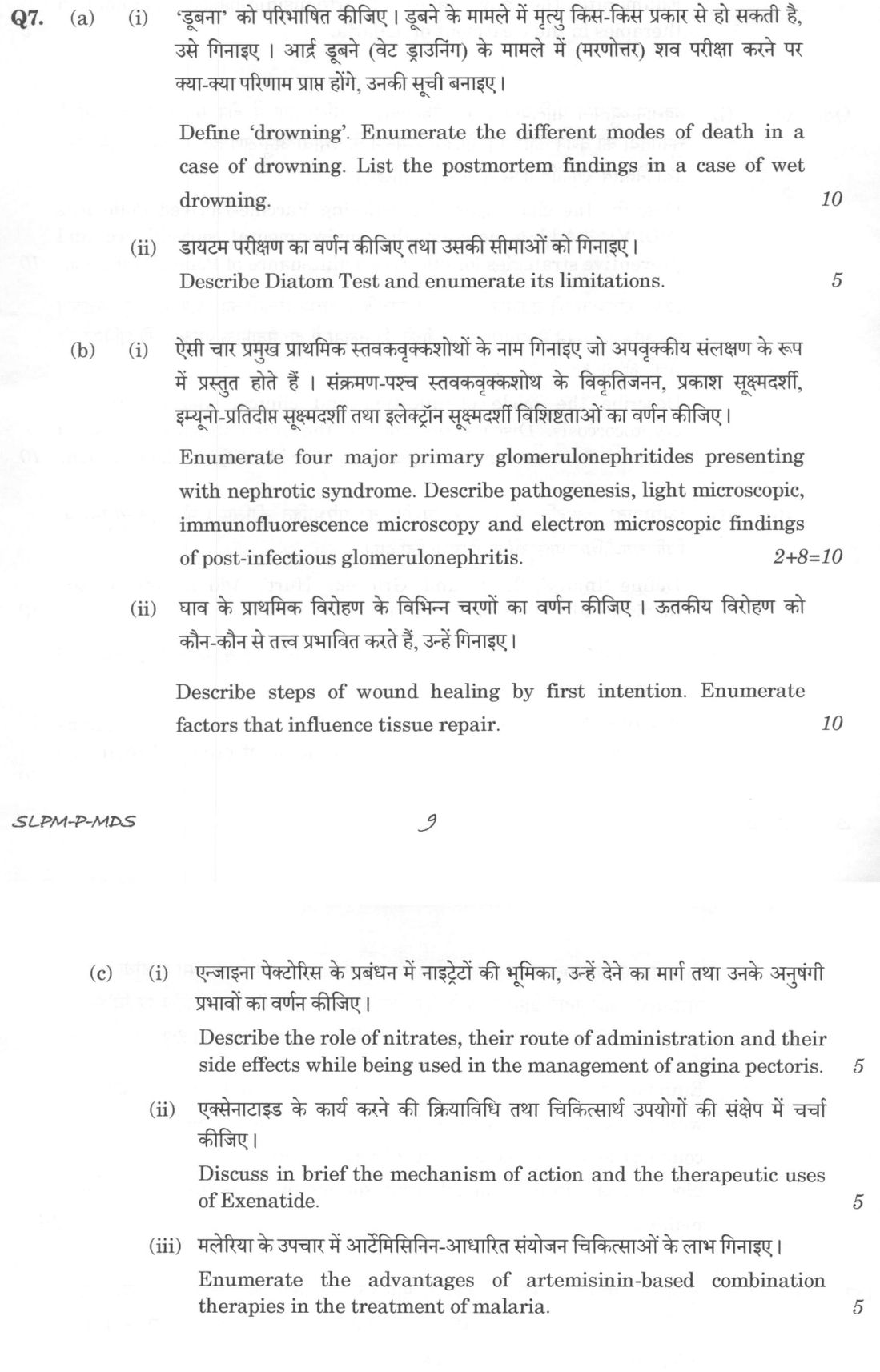
(a) (i) Define 'drowning'. Enumerate the different modes of death in a case of drowning. List the postmortem findings in a case…
Define 'drowning'. Enumerate the different modes of death in a case of drowning. List the postmortem findings in a case of wet drowning. 10 marks
Describe Diatom Test and enumerate its limitations. 5 marks
Enumerate four major primary glomerulonephritides presenting with nephrotic syndrome. Describe pathogenesis, light microscopic, immunofluorescence microscopy and electron microscopic findings of post-infectious glomerulonephritis. 2+8=10 marks
Describe steps of wound healing by first intention. Enumerate factors that influence tissue repair. 10 marks
Describe the role of nitrates, their route of administration and their side effects while being used in the management of angina pectoris. 5 marks
Discuss in brief the mechanism of action and the therapeutic uses of Exenatide. 5 marks
Enumerate the advantages of artemisinin-based combination therapies in the treatment of malaria. 5 marks
हिंदी में प्रश्न पढ़ें
'डूबना' को परिभाषित कीजिए। डूबने के मामले में मृत्यु किस-किस प्रकार से हो सकती है, उसे गिनाइए। आर्द्र डूबने (वेट ड्राउनिंग) के मामले में (मरणोत्तर) शव परीक्षा करने पर क्या-क्या परिणाम प्राप्त होंगे, उनकी सूची बनाइए। 10
डायटम परीक्षण का वर्णन कीजिए तथा उसकी सीमाओं को गिनाइए। 5
ऐसी चार प्रमुख प्राथमिक स्तवकुंकुक्षोथों के नाम गिनाइए जो अपवृक्कीय संलक्षण के रूप में प्रस्तुत होते हैं। संक्रमण-पश्च स्तवकुंकुक्षोथ के विकृतिजनन, प्रकाश सूक्ष्मदर्शी, इम्यूनो-प्रतिदीप सूक्ष्मदर्शी तथा इलेक्ट्रॉन सूक्ष्मदर्शी विशिष्टताओं का वर्णन कीजिए। 2+8=10
घाव के प्राथमिक विरोहण के विभिन्न चरणों का वर्णन कीजिए। उतकीय विरोहण को कौन-कौन से तत्व प्रभावित करते हैं, उन्हें गिनाइए। 10
एंजाइना पेक्टोरिस के प्रबंधन में नाइट्रेटों की भूमिका, उन्हें देने का मार्ग तथा उनके अनुषंगी प्रभावों का वर्णन कीजिए। 5
एक्सेनाटाइड के कार्य करने की क्रियाविधि तथा चिकित्सार्थ उपयोगों की संक्षेप में चर्चा कीजिए। 5
मलेरिया के उपचार में आर्टेमिसिनिन-आधारित संयोजन चिकित्साओं के लाभ गिनाइए। 5
Model answer
Written by UPSC Answer Check against this question's marking rubric, to the expected length. UPSC does not publish answers for Mains — this is one way to score well, not an official key.
Drowning is death from asphyxiation due to submersion in liquid, in which water or airway obstruction prevents adequate gas exchange. The liquid may be fresh or salt water, but the essential mechanism is airway obstruction and hypoxia. The modes of death are asphyxia from laryngospasm or water inhalation, syncope from hypoxia, vagal inhibition, and exhaustion. In wet drowning, water enters the airways and lungs. Postmortem findings include fine froth in the mouth and airways, heavy oedematous and emphysematous lungs, water in the stomach, silt or sand in the gastric contents, washerwoman’s hands, cadaveric spasm, and possible diatoms in tissues.
Diatom test. The diatom test is based on acid digestion of lung, liver, bone marrow or other tissues, followed by microscopic identification of siliceous diatoms. The acid digestion dissolves organic tissue and leaves the siliceous shells, which are counted in lung, liver, bone marrow or other organs. Their presence in appropriate organs supports antemortem inhalation of water. Its limitations are contamination, false positives from postmortem putrefaction or water entry, false positives from water ingestion, false negatives in dry drowning, seasonal variation, and the need for quantitative analysis.
Glomerulonephritis. Four major primary glomerulonephritides presenting with nephrotic syndrome are minimal change disease, membranous nephropathy, focal segmental glomerulosclerosis, and membranoproliferative glomerulonephritis. Post-infectious glomerulonephritis usually follows streptococcal infection. Immune complexes deposit in the glomeruli, activate complement, recruit neutrophils, and cause mesangial and endothelial proliferation. Circulating or in situ immune complexes fix complement, causing neutrophilic infiltration and capillary loop obstruction. Light microscopy shows enlarged, hypercellular glomeruli with neutrophils and endocapillary proliferation. Immunofluorescence shows granular “starry sky” deposits of IgG and C3 along capillary loops and in the mesangium. Electron microscopy shows subepithelial electron-dense “humps” and mesangial deposits.
Wound healing by first intention. In clean, well-approximated wounds, the edges are closely held together, so tissue loss is minimal and granulation tissue is scant. Haemostasis is followed by an inflammatory phase with neutrophils and macrophages. The inflammatory phase lasts about 1–3 days, proliferation 3–14 days, and remodelling continues for weeks to months. Epithelial cells migrate from the wound margins within the first 24 hours. Granulation tissue forms around days 3–5, followed by collagen deposition, remodelling, and scar formation. A labelled diagram would show wound edges, migrating epithelium, granulation tissue, and collagen. Factors influencing repair include local infection, foreign body, blood supply, wound tension, age, nutrition, diabetes, steroids, and smoking. Infection and foreign bodies prolong inflammation, poor blood supply delays repair, age reduces fibroblast activity, protein deficiency impairs collagen, diabetes impairs microcirculation, steroids inhibit fibroblasts, and smoking reduces oxygen delivery.
Nitrates in angina. Nitrates are converted to nitric oxide, increase cGMP, and cause venodilation, reducing preload; coronary vasodilation relieves angina. They reduce myocardial oxygen demand by reducing preload and wall stress, while coronary vasodilation improves blood flow to ischaemic areas. Routes include sublingual, buccal, oral, transdermal, and intravenous. Sublingual nitrate is used for acute attacks, oral and transdermal forms for prophylaxis, and intravenous nitrate in hospital. Side effects include headache due to cerebral vasodilation, hypotension, reflex tachycardia, and tolerance with continuous use.
Exenatide. Exenatide is a GLP-1 receptor agonist. It enhances glucose-dependent insulin secretion, suppresses glucagon, delays gastric emptying, and promotes satiety. It is used in type 2 diabetes mellitus and for weight reduction; cardiovascular safety/non-inferiority data are available, but reduction in long-term cardiovascular mortality is not proven.
Artemisinin-based combination therapies. ACTs offer rapid parasite clearance, reduced gametocyte carriage, delayed resistance emergence, shorter treatment courses, and efficacy against multidrug-resistant Plasmodium falciparum. Artemisinin rapidly clears asexual parasites, while the partner drug suppresses residual parasites and prevents resistance. This reduces transmission by reducing gametocyte carriage, shortens treatment, improves compliance, and is effective against multidrug-resistant P. falciparum. Thus, the described mechanisms, findings and clinical applications establish the diagnostic, pathological and therapeutic principles asked.
What "Describe" is asking you to do
Give a full, ordered account of the thing named — its parts, stages or mechanism — in the sequence in which it actually exists or occurs. Most describe questions come from the science optionals, where the marks sit in correct technical detail and, where the stem says so, a labelled diagram.
Structure that answers it
One-line identification of the subject → the parts or stages in their real order, each with its defining detail → labelled diagram where the subject is structural → closing line on function or significance
Where marks are lost
Loose general prose where the examiner is ticking named parts, correct terminology and their sequence; and in the General Studies papers, turning to evaluation before the description is finished.
How this answer will be evaluated
Approach
Framework: Forensic Pathology & Clinical Pathology. (a) describe: definition > modes of death > postmortem findings | (b) describe: list of 4 GNs > pathogenesis > microscopic findings | (c) describe: role of nitrates > route of administration > side effects Full marks: Precise clinical sequence, correct microscopy, and specific drug mechanisms.
Key points expected
- Wet drowning: froth, oedema, emphysema
- Diatom test: lung vs bone marrow
- PIGN: starry sky IF, humps on EM
- Wound healing: 4 stages
- Nitrates: venodilation
- Exenatide: GLP-1 agonist
- ACT: rapid clearance
Evaluation rubric
Each sub-part is marked on its own, against the marks and word limit printed on the paper.
- (a) Define drowning, list death modes, and detail wet drowning findings plus diatom test.
describe— definition → modes of death → postmortem findings
Must cover
- Definition of drowning (asphyxia by submersion)
- Modes: wet, dry, atypical, secondary
- Wet drowning: froth, oedema, emphysema
- Diatom test: method and limitations
Loses marks
- Listing symptoms without mechanism
- Omitting the diatom test limitations
Earns more
- Mention of 'universal foam'
- Diatom test: lung vs bone marrow
- Distinction between primary and secondary drowning
Extra mark
- Reference to specific diatom species (e.g., Navicula)
- (b) List 4 nephrotic GNs and detail post-infectious GN findings; describe wound healing.
describe— list of 4 GNs → pathogenesis → microscopic findings
Must cover
- 4 GNs: Minimal Change, FSGS, Membranous, Diabetic
- PIGN: immune complex deposition
- PIGN: LM (hypercellular), IF (starry sky), EM (humps)
- Wound healing: hemostasis, inflammation, proliferation, remodeling
Loses marks
- Listing symptoms without mechanism
- Management without priority
Earns more
- Mention of 'lumpy-bumpy' IF pattern
- Factors: age, nutrition, infection, steroids
- Distinction between first and second intention
Extra mark
- Mention of 'mesangial hypercellularity' in PIGN
- (c) Explain nitrates in angina, Exenatide mechanism, and ACT advantages.
describe— role of nitrates → route of administration → side effects
Must cover
- Nitrates: venodilation, preload reduction
- Nitrates: sublingual, oral, IV
- Exenatide: GLP-1 agonist, glucose-dependent insulin
- ACT: rapid parasite clearance, resistance prevention
Loses marks
- Listing symptoms without mechanism
- Management without priority
Earns more
- Nitrates: tolerance and methemoglobinemia
- Exenatide: weight loss benefit
- ACT: specific drugs (Artemether-Lumefantrine)
Extra mark
- Mention of 'WHO guidelines' for ACT
Practice this exact question
Write your answer and it is marked point by point against the model answer above — what you covered, what you missed, what you got wrong.
Evaluate my answer →More from Medical Science 2025 Paper I
- Q4 (a) (i) A 55-year-old lady visits surgery OPD with a three month old history of a painles…
- Q5 (a) (i) Enumerate the topical antifungal drugs along with their indication and side effec…
- Q6 (a) (i) Describe the approach to laboratory diagnosis of chronic myeloid leukemia – chron…
- Q7 (a) (i) Define 'drowning'. Enumerate the different modes of death in a case of drowning.…
- Q8 (a) (i) Describe the challenges of circulating Vaccine-Derived Poliovirus (VDPV). Add a n…