Paper I — Q8
(a) (i) Describe the challenges of circulating Vaccine-Derived Poliovirus (VDPV). Add a note on the environmental surveillance…
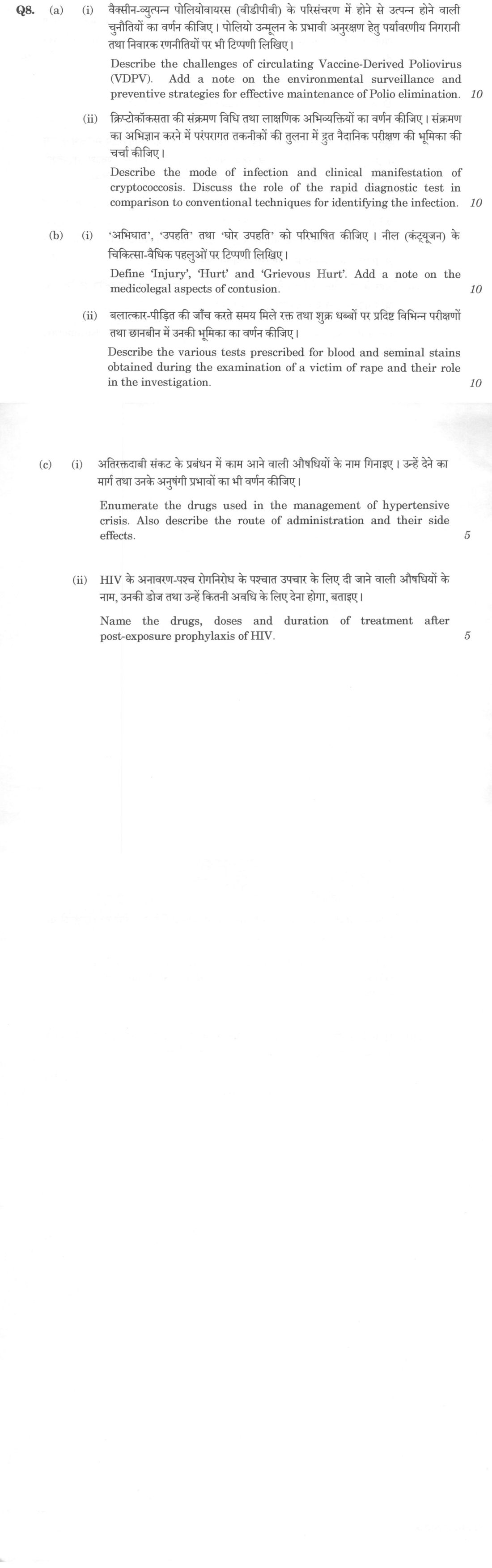
Describe the challenges of circulating Vaccine-Derived Poliovirus (VDPV). Add a note on the environmental surveillance and preventive strategies for effective maintenance of Polio elimination. 10 marks
Describe the mode of infection and clinical manifestation of cryptococcosis. Discuss the role of the rapid diagnostic test in comparison to conventional techniques for identifying the infection. 10 marks
Define 'Injury', 'Hurt' and 'Grievous Hurt'. Add a note on the medicolegal aspects of contusion. 10 marks
Describe the various tests prescribed for blood and seminal stains obtained during the examination of a victim of rape and their role in the investigation. 10 marks
Enumerate the drugs used in the management of hypertensive crisis. Also describe the route of administration and their side effects. 5 marks
Name the drugs, doses and duration of treatment after post-exposure prophylaxis of HIV. 5 marks
हिंदी में प्रश्न पढ़ें
वैक्सीन-व्युत्पन्न पोलियोवायरस (वीडीपीवी) के परिसंचरण में होने से उत्पन्न होने वाली चुनौतियों का वर्णन कीजिए। पोलियो उन्मूलन के प्रभावी अनुसंधान हेतु पर्यावरणीय निगरानी तथा निवारक रणनीतियों पर भी टिप्पणी लिखिए। 10
क्रिप्टोकोक्सोसिस की संक्रमण विधि तथा लाक्षणिक अभिव्यक्तियों का वर्णन कीजिए। संक्रमण का अभिज्ञान करने में परंपरागत तकनीकों की तुलना में द्रुत नैदानिक परीक्षण की भूमिका की चर्चा कीजिए। 10
'अभिघात', 'उपहति' तथा 'घोर उपहति' को परिभाषित कीजिए। नील (कंट्यूजन) के चिकित्सा-वैधिक पहलुओं पर टिप्पणी लिखिए। 10
बलात्कार-पीड़ित की जाँच करते समय मिले रक्त तथा शुक्र धब्बों पर प्रदिष्ट विभिन्न परीक्षणों तथा छानबीन में उनकी भूमिका का वर्णन कीजिए। 10
अतिरक्तदाबी संकट के प्रबंधन में काम आने वाली औषधियों के नाम गिनाइए। उन्हें देने का मार्ग तथा उनके अनुषंगी प्रभावों का भी वर्णन कीजिए। 5
HIV के अनावरण-पश्च रोगनिरोध के पश्चात उपचार के लिए दी जाने वाली औषधियों के नाम, उनकी डोज तथा उन्हें कितनी अवधि के लिए देना होगा, बताइए। 5
Model answer
Written by UPSC Answer Check against this question's marking rubric, to the expected length. UPSC does not publish answers for Mains — this is one way to score well, not an official key.
VDPV. Circulating vaccine-derived poliovirus (cVDPV) emerges when oral polio vaccine (OPV) strains replicate in under-immunized populations and revert neurovirulently; it can spread person-to-person and cause paralysis. Immune-derived VDPV (iVDPV) arises in immunodeficient individuals, while attenuated VDPV (aVDPV) is less virulent and usually detected in sewage. The challenge is that OPV remains essential for mucosal immunity, but low coverage creates reservoirs for reversion. Environmental surveillance under India’s polio eradication programme uses regular sewage sampling around AFP cases to detect poliovirus before paralysis, complementing AFP surveillance. Prevention requires high routine immunization coverage (≥90%) with OPV/nOPV for intestinal protection, introduction of IPV in the routine schedule to provide systemic humoral immunity and reduce VAPP; IPV does not prevent intestinal OPV replication or mucosal reversion, so OPV/nOPV remains needed for mucosal protection. Outbreak response uses monovalent or bivalent OPV and rapid containment to interrupt transmission.
Cryptococcosis. Cryptococcus neoformans and C. gattii are inhaled from pigeon/bird droppings. In immunocompromised hosts, especially HIV with CD4 <100 cells/µL, it causes meningoencephalitis with headache, fever, altered sensorium, papilledema and “soap-bubble” lesions in basal ganglia. Conventional diagnosis includes India ink, culture and histopathology; India ink is quick but insensitive, while culture remains the reference standard. CSF CrAg is more sensitive than India ink. Rapid diagnostic tests detect cryptococcal antigen (CrAg) in serum or CSF; lateral flow assay gives point-of-care results in about 15 minutes, while ELISA is laboratory-based and more quantitative. CrAg screening allows early treatment, triage and monitoring in resource-limited settings, reducing mortality.
Injury, hurt and grievous hurt. Section 44 IPC defines injury as any harm illegally caused to a person in body, mind, reputation or property. Hurt is a lesser form of injury; Section 319 defines it as causing bodily pain, disease or infirmity. Section 320 defines grievous hurt as emasculation; permanent privation of sight of either eye, hearing of either ear, any joint, or the power of any joint; permanent disfiguration of head or face; fracture or dislocation (fracture of a tooth may be recorded as a clinically significant example of severe hurt); hurt endangering life; and severe bodily pain for 20 days. Contusion is subcutaneous haemorrhage from blunt trauma without breach of skin. Medicolegally, its shape, size and distribution can match the weapon, its colour changes (red-purple, blue-black, green, yellow) help estimate age, and it must be differentiated from post-mortem lividity by location, pressure blanching and tissue changes.
Blood and seminal stains. Blood stains are screened by benzidine test (presumptive) and confirmed by Takayama test; benzidine may give false positives, so confirmation is essential. Precipitin test determines human origin, and blood grouping helps link victim or assailant. Seminal stains are detected by Florence test for choline crystals, acid phosphatase test, microscopic examination for spermatozoa, and DNA profiling, which can identify the assailant even when spermatozoa are absent. These tests establish sexual contact, identify the perpetrator through DNA, corroborate the victim’s account, and support medico-legal evidence collected during examination.
Hypertensive crisis. Drugs include sodium nitroprusside (IV infusion; cyanide/thiocyanate toxicity), labetalol (IV bolus/infusion; bronchospasm, bradycardia), nicardipine (IV infusion; reflex tachycardia, flushing), esmolol (IV infusion; ultra-short acting, bradycardia), hydralazine (IM/IV; reflex tachycardia, headache), and nitroglycerin (IV infusion; headache, tolerance). For less severe cases, oral nifedipine or captopril may be used.
HIV PEP. Post-exposure prophylaxis should start within 72 hours. Regimen: tenofovir 300 mg + emtricitabine 200 mg (or lamivudine 300 mg) + raltegravir 400 mg twice daily (or dolutegravir 50 mg once daily) for 28 days. An alternative integrase-sparing option is lopinavir/ritonavir. Baseline HIV test is done, with follow-up testing at 6 weeks, 3 months and 6 months.
Thus, effective control depends on timely surveillance, accurate diagnosis, reliable medico-legal evidence and correct drug use.
What "Describe" is asking you to do
Give a full, ordered account of the thing named — its parts, stages or mechanism — in the sequence in which it actually exists or occurs. Most describe questions come from the science optionals, where the marks sit in correct technical detail and, where the stem says so, a labelled diagram.
Structure that answers it
One-line identification of the subject → the parts or stages in their real order, each with its defining detail → labelled diagram where the subject is structural → closing line on function or significance
Where marks are lost
Loose general prose where the examiner is ticking named parts, correct terminology and their sequence; and in the General Studies papers, turning to evaluation before the description is finished.
How this answer will be evaluated
Approach
Framework: Clinical Sequence (Definition > Aetiology > Features > Management). (a(i)) challenges: 3-4 challenges > solutions mapped to them > conclusion | (a(ii)) describe: define > structure or process in order > labelled diagram > significance | (b(i)) define: precise definition > the distinguishing feature > one example | (b(ii)) describe: define > structure or process in order > labelled diagram > significance | (c(i)) enumerate: list the items in order > one line each > no commentary | (c(ii)) enumerate: list the items in order > one line each > no commentary Full marks: Comprehensive clinical sequence with specific guidelines and medicolegal precision.
Key points expected
- Define VDPV (cVDPV) and its origin from OPV
- Explain challenge of reversion to neurovirulence
- Describe environmental surveillance (sewage sampling) role
- List preventive strategies (iOPV, high coverage)
- Identify Cryptococcus neoformans as the causative agent
- Describe inhalation route and CNS tropism
- List clinical manifestations (meningitis, headache)
- Compare rapid tests (CrAg) vs culture/India ink
Evaluation rubric
Each sub-part is marked on its own, against the marks and word limit printed on the paper.
- (a(i)) Challenges of VDPV circulation and environmental surveillance strategies. 10 marks
challenges— 3-4 challenges → solutions mapped to them → conclusion
Must cover
- Define VDPV (cVDPV) and its origin from OPV
- Explain challenge of reversion to neurovirulence
- Describe environmental surveillance (sewage sampling) role
- List preventive strategies (iOPV, high coverage)
Loses marks
- Confusing VDPV with wild poliovirus
- Omitting the role of sewage surveillance
Earns more
- Mention WHO Polio Eradication Initiative
- Differentiate cVDPV from sVDPV
- Reference specific surveillance indicators
Extra mark
- Mention specific country examples of cVDPV outbreaks
- (a(ii)) Mode of infection, clinical features, and rapid diagnostic tests for cryptococcosis. 10 marks
describe— define → structure or process in order → labelled diagram → significance
Must cover
- Identify Cryptococcus neoformans as the causative agent
- Describe inhalation route and CNS tropism
- List clinical manifestations (meningitis, headache)
- Compare rapid tests (CrAg) vs culture/India ink
Loses marks
- Failing to distinguish rapid test from conventional culture
- Omitting the primary site of infection (lungs)
Earns more
- Mention immunocompromised status (HIV) as risk factor
- Detail sensitivity/specificity of CrAg lateral flow assay
- Mention CSF pressure management
Extra mark
- Mention specific antifungal regimen (Amphotericin B + Flucytosine)
- (b(i)) Definitions of Injury, Hurt, Grievous Hurt and medicolegal aspects of contusion. 10 marks
define— precise definition → the distinguishing feature → one example
Must cover
- Define 'Injury' (IPC Section 319)
- Define 'Hurt' (IPC Section 320)
- Define 'Grievous Hurt' (IPC Section 320)
- Describe medicolegal aspects of contusion (bruise)
Loses marks
- Confusing 'Injury' with 'Hurt' definitions
- Omitting the legal distinction of Grievous Hurt
Earns more
- Mention specific IPC sections for definitions
- List types of contusion (abrasion, laceration)
- Discuss age of injury estimation
Extra mark
- Mention specific forensic tests for age of bruise
- (b(ii)) Tests for blood and seminal stains in rape investigation. 10 marks
describe— define → structure or process in order → labelled diagram → significance
Must cover
- List presumptive tests for blood (Kastle-Meyer)
- List confirmatory tests for blood (Luminol, DNA)
- List tests for seminal stains (Acid Phosphatase)
- Explain role in investigation (identification)
Loses marks
- Confusing presumptive and confirmatory tests
- Omitting the role of DNA in identification
Earns more
- Mention specific reagents for each test
- Discuss DNA profiling (STR analysis)
- Mention collection techniques (swabs)
Extra mark
- Mention specific kits used in forensic labs
- (c(i)) Drugs, routes, and side effects for hypertensive crisis. 5 marks
enumerate— list the items in order → one line each → no commentary
Must cover
- List drugs (e.g., Nitroprusside, Labetalol)
- Specify route of administration (IV)
- List side effects (e.g., cyanide toxicity)
- Mention specific drug classes
Loses marks
- Listing oral drugs for acute crisis
- Omitting side effects
Earns more
- Mention specific dosages
- Differentiate emergency vs non-emergency drugs
- Mention monitoring requirements
Extra mark
- Mention specific guidelines (e.g., JNC 7)
- (c(ii)) Drugs, doses, and duration for HIV post-exposure prophylaxis. 5 marks
enumerate— list the items in order → one line each → no commentary
Must cover
- Name drugs (e.g., Tenofovir, Emtricitabine)
- Specify doses (e.g., 300mg)
- State duration (28 days)
- Mention timing (within 72 hours)
Loses marks
- Omitting the 28-day duration
- Confusing PEP with PrEP
Earns more
- Mention specific regimen (e.g., TDF/FTC + DTG)
- Discuss side effects of PEP
- Mention follow-up testing schedule
Extra mark
- Mention specific guidelines (e.g., CDC)
Practice this exact question
Write your answer and it is marked point by point against the model answer above — what you covered, what you missed, what you got wrong.
Evaluate my answer →More from Medical Science 2025 Paper I
- Q5 (a) (i) Enumerate the topical antifungal drugs along with their indication and side effec…
- Q6 (a) (i) Describe the approach to laboratory diagnosis of chronic myeloid leukemia – chron…
- Q7 (a) (i) Define 'drowning'. Enumerate the different modes of death in a case of drowning.…
- Q8 (a) (i) Describe the challenges of circulating Vaccine-Derived Poliovirus (VDPV). Add a n…