Paper I — Q3
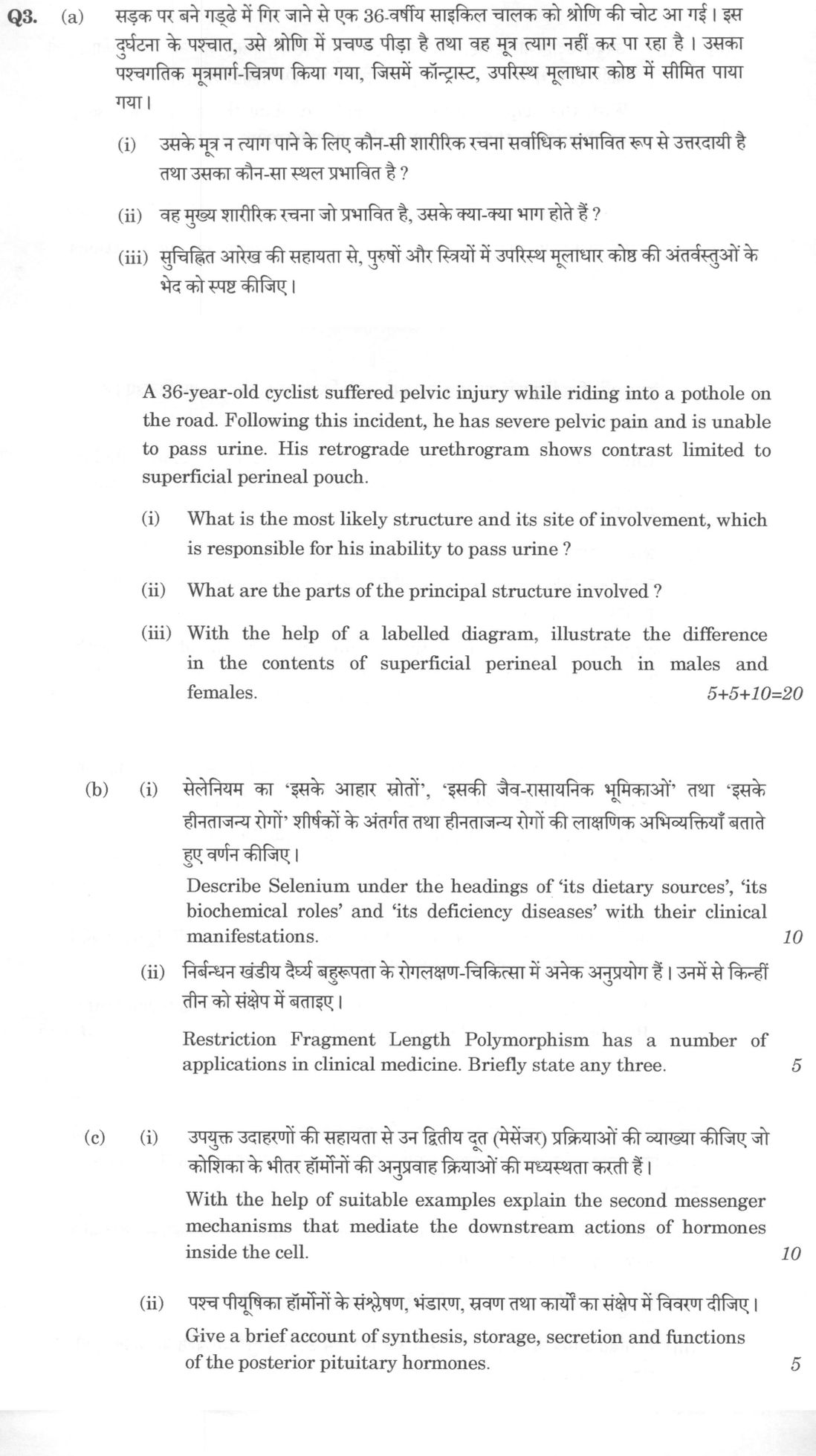
(a) A 36-year-old cyclist suffered pelvic injury while riding into a pothole on the road. Following this incident, he has severe…
A 36-year-old cyclist suffered pelvic injury while riding into a pothole on the road. Following this incident, he has severe pelvic pain and is unable to pass urine. His retrograde urethrogram shows contrast limited to superficial perineal pouch.
What is the most likely structure and its site of involvement, which is responsible for his inability to pass urine ? 5 marks
What are the parts of the principal structure involved ? 5 marks
With the help of a labelled diagram, illustrate the difference in the contents of superficial perineal pouch in males and females. 10 marks
Describe Selenium under the headings of 'its dietary sources', 'its biochemical roles' and 'its deficiency diseases' with their clinical manifestations. 10 marks
Restriction Fragment Length Polymorphism has a number of applications in clinical medicine. Briefly state any three. 5 marks
With the help of suitable examples explain the second messenger mechanisms that mediate the downstream actions of hormones inside the cell. 10 marks
Give a brief account of synthesis, storage, secretion and functions of the posterior pituitary hormones. 5 marks
हिंदी में प्रश्न पढ़ें
सड़क पर बने गड्ढे में गिर जाने से एक 36-वर्षीय साइकिल चालक को श्रोणी की चोट आ गई। इस दुर्घटना के पश्चात्, उसे श्रोणी में प्रचंड पीड़ा है तथा वह मूत्र त्याग नहीं कर पा रहा है। उसका परचगातिक मूत्रमार्ग-चित्रण किया गया, जिसमें कॉन्ट्रास्ट, उपरिष्ठ मूलाधार कोष्ठ में सीमित पाया गया।
उसके मूत्र न त्याग पाने के लिए कौन-सी शारीरिक रचना सर्वाधिक संभावित रूप से उत्तरदायी है तथा उसका कौन-सा स्थल प्रभावित है? (5 अंक)
वह मुख्य शारीरिक रचना जो प्रभावित है, उसके क्या-क्या भाग होते हैं? (5 अंक)
सूचिहित आरेख की सहायता से, पुरुषों और स्त्रियों में उपरिष्ठ मूलाधार कोष्ठ की अंतर्वस्तुओं के भेद को स्पष्ट कीजिए। (10 अंक)
सेलेनियम का 'इसके आहार स्रोतों', 'इसकी जैव-रासायनिक भूमिकाओं' तथा 'इसके हीनताजन्य रोगों' शीर्षकों के अंतर्गत तथा हीनताजन्य रोगों की लाक्षणिक अभिव्यक्तियों बताते हुए वर्णन कीजिए। (10 अंक)
निर्बंधन खंडीय दैर्घ्य बहुरूपता के रोगलक्षण-चिकित्सा में अनेक अनुप्रयोग हैं। उनमें से किन्हीं तीन को संक्षेप में बताइए। (5 अंक)
उपयुक्त उदाहरणों की सहायता से उन द्वितीय दूत (मैसेंजर) प्रक्रियाओं की व्याख्या कीजिए जो कोशिका के भीतर हार्मोनों की अनुप्रवाह क्रियाओं की मध्यस्थता करती हैं। (10 अंक)
पश्च पीयूषिका हार्मोनों के संश्लेषण, भंडारण, स्रवण तथा कार्यों का संक्षेप में विवरण दीजिए। (5 अंक)
Model answer
Written by UPSC Answer Check against this question's marking rubric, to the expected length. UPSC does not publish answers for Mains — this is one way to score well, not an official key.
The case combines pelvic trauma, perineal anatomy, trace-element biochemistry and endocrine signalling.
Urethral injury. The most likely injured structure is the bulbous (spongy) urethra in the bulb of the penis, lying in the superficial perineal pouch. A pelvic or perineal impact can distract the urethra at the bulb; rupture disrupts urethral continuity and allows urine or contrast to leak into the superficial perineal pouch, explaining urinary retention and a retrograde urethrogram with contrast limited to that pouch. Although pelvic fractures often injure the membranous urethra, the contrast pattern here localises the lesion to the bulbous urethra.
Parts of the urethra. The principal structure, the male urethra, has prostatic, membranous and spongy parts. The prostatic part traverses the prostate from the bladder to the apex of the prostate; the short membranous part crosses the urogenital diaphragm/perineal membrane; the spongy or penile part runs through the corpus spongiosum from the urogenital diaphragm to the external urethral orifice and includes the bulbous, pendulous/penile and fossa navicularis portions.
Superficial perineal pouch. In a labelled diagram, both pouches are bounded above by the perineal membrane and below by Colles fascia. The male pouch contains the bulb of the penis, crura of the penis, ischiocavernosus, bulbospongiosus and superficial transverse perineal muscles, with superficial external pudendal vessels and the dorsal nerve of the penis. The female pouch contains the bulbs and crura of the clitoris, ischiocavernosus, bulbospongiosus and superficial transverse perineal muscles, greater vestibular (Bartholin) glands, and superficial external pudendal vessels and perineal nerves. The key difference is penile bulb and crura in males versus clitoral bulbs and crura, and greater vestibular glands, in females.
Selenium. Dietary sources include Brazil nuts, seafood, organ meats, eggs, meat and cereals grown on selenium-rich soil; soil selenium determines cereal selenium, and Brazil nuts are the richest single food. Biochemically, selenium is incorporated as selenocysteine into selenoproteins: glutathione peroxidases and thioredoxin reductases protect against oxidative stress; iodothyronine deiodinases regulate thyroid hormone activation and inactivation; selenoprotein P transports selenium in plasma. Deficiency causes Keshan disease, a congestive cardiomyopathy with dyspnoea, oedema and heart failure; Kashin-Beck disease, an osteochondrosis with joint pain, deformity and short stature; and myxoedematous cretinism, with hypothyroidism and developmental delay.
RFLP applications. RFLP, using restriction enzymes and DNA probes, detects restriction-site changes linked to disease alleles. It is used in prenatal diagnosis of genetic disorders such as sickle-cell disease or thalassaemia, DNA fingerprinting for forensic identification or paternity testing, and carrier detection for autosomal recessive conditions such as thalassaemia or cystic fibrosis.
Second messengers. Hormones acting through GPCRs use second messengers. Glucagon and β-adrenergic hormones activate Gs, adenylyl cyclase, cAMP and PKA, causing hepatic glycogenolysis and lipolysis; cAMP can also activate EPAC and ion channels. α1-adrenergic, GnRH and vasopressin V1 receptors activate Gq, phospholipase C, IP3 and DAG; IP3 releases Ca2+ from the endoplasmic reticulum, Ca2+ activates calmodulin, and DAG activates PKC, producing smooth-muscle contraction or secretion. Insulin uses a receptor tyrosine kinase: dimerisation, autophosphorylation, IRS, PI3K/Akt and MAPK increase GLUT4 glucose uptake, glycogenesis and protein synthesis.
Posterior pituitary hormones. The posterior pituitary does not synthesize these hormones; it stores and releases hypothalamic neurohormones. ADH and oxytocin are synthesised in supraoptic and paraventricular hypothalamic neurons, transported down the hypothalamohypophyseal tract, stored in Herring bodies and secreted into capillaries. ADH is released by hyperosmolarity or hypovolaemia and increases water reabsorption in collecting ducts via aquaporin-2, with vasoconstriction at high levels; oxytocin is released by cervical stretch or suckling and stimulates uterine contraction and milk ejection.
Thus the clinical picture localises the lesion to the bulbous urethra, while the biochemical and endocrine parts show how trace elements and second messengers integrate metabolic and reproductive control.
What "Describe" is asking you to do
Give a full, ordered account of the thing named — its parts, stages or mechanism — in the sequence in which it actually exists or occurs. Most describe questions come from the science optionals, where the marks sit in correct technical detail and, where the stem says so, a labelled diagram.
Structure that answers it
One-line identification of the subject → the parts or stages in their real order, each with its defining detail → labelled diagram where the subject is structural → closing line on function or significance
Where marks are lost
Loose general prose where the examiner is ticking named parts, correct terminology and their sequence; and in the General Studies papers, turning to evaluation before the description is finished.
How this answer will be evaluated
Approach
Framework: Clinical Anatomy & Biochemistry. (a) explain: Identification of structure > Anatomical parts > Comparative diagram | (b) describe: Dietary sources > Biochemical roles > Deficiency diseases | (c) explain: Mechanism definition > Examples (cAMP, IP3) > Posterior pituitary account Full marks: Precise anatomical identification and clear biochemical mechanisms.
Key points expected
- Anterior urethra injury
- Superficial perineal pouch contents
- Selenium in glutathione peroxidase
- Keshan disease
- RFLP applications
- cAMP and IP3 pathways
- Posterior pituitary hormones (ADH, Oxytocin)
Evaluation rubric
Each sub-part is marked on its own, against the marks and word limit printed on the paper.
- (a) Identify the injured urethral segment and compare perineal pouch contents. 20 marks
explain— Identification of structure → Anatomical parts → Comparative diagram
Must cover
- Identify anterior (membranous) urethra as the site
- List parts: preprostatic, membranous, spongy
- Diagram: Male (bulbocavernosus, ischiocavernosus, bulb)
- Diagram: Female (bulbocavernosus, ischiocavernosus, bulb)
Loses marks
- Listing deep pouch contents (bulbourethral glands)
- Missing the comparative aspect of the diagram
Earns more
- Mention of superficial transverse perineal muscle
- Note on absence of urethra in female pouch
Extra mark
- Labeling of perineal membrane in diagram
- (b) Detail Selenium's sources, roles, and deficiency, plus RFLP uses. 15 marks
describe— Dietary sources → Biochemical roles → Deficiency diseases
Must cover
- Sources: Brazil nuts, seafood, meat
- Roles: Glutathione peroxidase, selenoproteins
- Deficiency: Keshan disease, cardiomyopathy
- RFLP: Paternity, genetic disease diagnosis
Loses marks
- Vague description of 'antioxidant' without enzyme names
- Listing more than three RFLP applications
Earns more
- Mention of thyroid hormone metabolism
- RFLP use in forensic identification
Extra mark
- Specific enzyme names (e.g., thioredoxin reductase)
- (c) Explain second messenger pathways and posterior pituitary physiology. 15 marks
explain— Mechanism definition → Examples (cAMP, IP3) → Posterior pituitary account
Must cover
- cAMP pathway (G-protein, Adenylyl cyclase)
- IP3/DAG pathway (Phospholipase C)
- Synthesis in hypothalamus (paraventricular/supraoptic)
- Transport via axons to posterior pituitary
Loses marks
- Describing steroid hormone nuclear receptors
- Confusing anterior and posterior pituitary hormones
Earns more
- Mention of cGMP pathway
- Specific functions of Oxytocin and ADH
Extra mark
- Diagram of the HPA axis for ADH
Practice this exact question
Write your answer and it is marked point by point against the model answer above — what you covered, what you missed, what you got wrong.
Evaluate my answer →More from Medical Science 2025 Paper I
- Q1 (a) Describe the formation, course and branches of ulnar nerve. Which muscles do each of…
- Q2 (a) Using a well labelled diagram, trace the taste pathway from circumvallate papillae of…
- Q3 (a) A 36-year-old cyclist suffered pelvic injury while riding into a pothole on the road.…
- Q4 (a) (i) A 55-year-old lady visits surgery OPD with a three month old history of a painles…
- Q5 (a) (i) Enumerate the topical antifungal drugs along with their indication and side effec…
- Q6 (a) (i) Describe the approach to laboratory diagnosis of chronic myeloid leukemia – chron…