Paper I — Q4
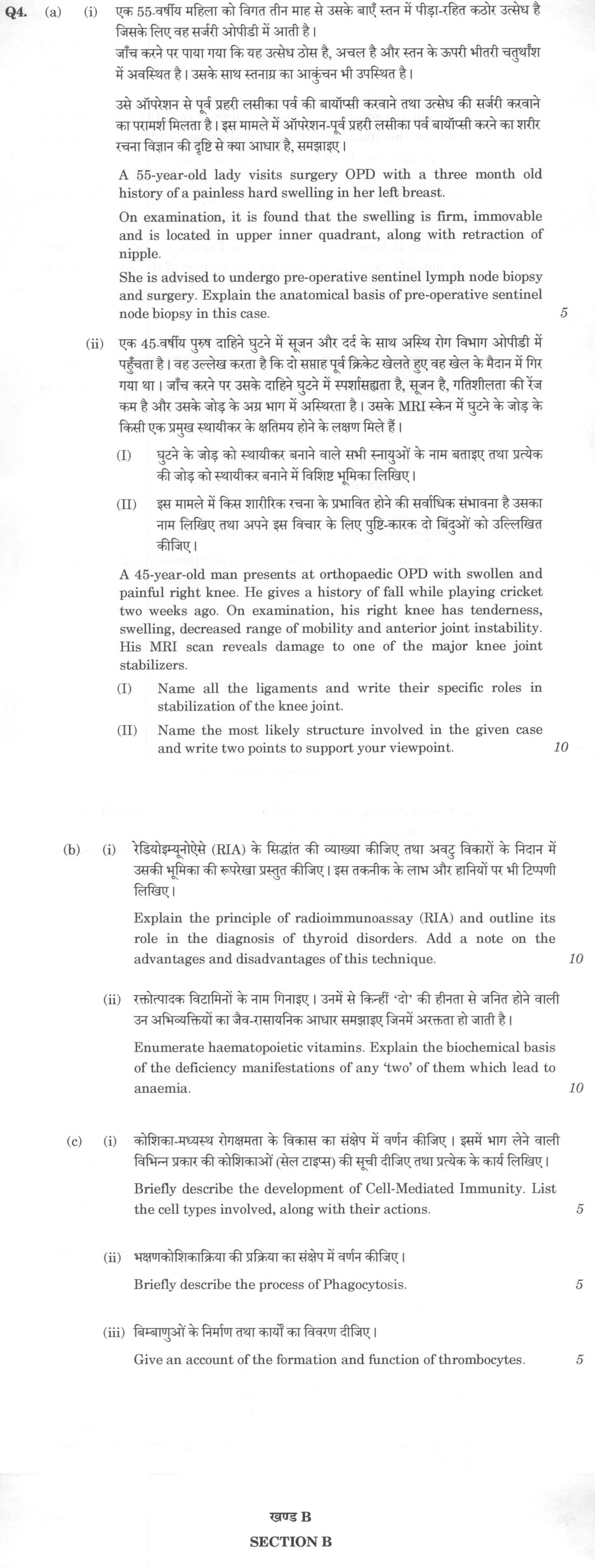
(a) (i) A 55-year-old lady visits surgery OPD with a three month old history of a painless hard swelling in her left breast. On…
A 55-year-old lady visits surgery OPD with a three month old history of a painless hard swelling in her left breast.
On examination, it is found that the swelling is firm, immovable and is located in upper inner quadrant, along with retraction of nipple.
She is advised to undergo pre-operative sentinel lymph node biopsy and surgery. Explain the anatomical basis of pre-operative sentinel node biopsy in this case. 5 marks
A 45-year-old man presents at orthopaedic OPD with swollen and painful right knee. He gives a history of fall while playing cricket two weeks ago. On examination, his right knee has tenderness, swelling, decreased range of mobility and anterior joint instability. His MRI scan reveals damage to one of the major knee joint stabilizers.
(I) Name all the ligaments and write their specific roles in stabilization of the knee joint. 5 marks
(II) Name the most likely structure involved in the given case and write two points to support your viewpoint. 5 marks
Explain the principle of radioimmunoassay (RIA) and outline its role in the diagnosis of thyroid disorders. Add a note on the advantages and disadvantages of this technique. 10 marks
Enumerate haematopoietic vitamins. Explain the biochemical basis of the deficiency manifestations of any 'two' of them which lead to anaemia. 10 marks
Briefly describe the development of Cell-Mediated Immunity. List the cell types involved, along with their actions. 5 marks
Briefly describe the process of Phagocytosis. 5 marks
Give an account of the formation and function of thrombocytes. 5 marks
हिंदी में प्रश्न पढ़ें
एक 55-वर्षीय महिला को विगत तीन माह से उसके बाएं स्तन में पीड़ा-रहित कठोर उत्सेध है जिसके लिए वह सर्जरी ओपीडी में आती है।
जांच करने पर पाया गया कि यह उत्सेध ठोस है, अचल है और स्तन के ऊपरी भीतरी चतुर्थांश में अवस्थित है। उसके साथ स्तनाग्र का आकुंचन भी उपस्थित है।
उसे ऑपरेशन से पूर्व प्रहरी लसीका पर्व की बायोप्सी करवाने तथा उत्सेध की सर्जरी करवाने का परामर्श मिलता है। इस मामले में ऑपरेशन-पूर्व प्रहरी लसीका पर्व बायोप्सी करने का शरीर रचना विज्ञान की दृष्टि से क्या आधार है, समझाइए। (5 अंक)
एक 45-वर्षीय पुरुष दाहिने घुटने में सूजन और दर्द के साथ अस्थि रोग विभाग ओपीडी में पहुंचता है। वह उल्लेख करता है कि दो सप्ताह पूर्व क्रिकेट खेलते हुए वह खेल के मैदान में गिर गया था। जांच करने पर उसके दाहिने घुटने में स्पर्शसंवेदनशीलता है, सूजन है, गतिशीलता की रेंज कम है और उसके जोड़ के अग्र भाग में अस्थिरता है। उसके MRI स्कैन में घुटने के जोड़ के किसी एक प्रमुख स्थायीकर के क्षतिग्रस्त होने के लक्षण मिले हैं।
(I) घुटने के जोड़ को स्थायीकर बनाने वाले सभी स्नायुओं के नाम बताइए तथा प्रत्येक की जोड़ को स्थायीकर बनाने में विशिष्ट भूमिका लिखिए। (5 अंक)
(II) इस मामले में किस शारीरिक रचना के प्रभावित होने की सर्वाधिक संभावना है उसका नाम लिखिए तथा अपने इस विचार के लिए पृष्ठ-कारक दो बिंदुओं को उल्लिखित कीजिए। (5 अंक)
रेडियोइम्यूनोएसे (RIA) के सिद्धांत की व्याख्या कीजिए तथा अवटु विकारों के निदान में उसकी भूमिका की रूपरेखा प्रस्तुत कीजिए। इस तकनीक के लाभ और हानियों पर भी टिप्पणी लिखिए। (10 अंक)
रक्तोत्पादक विटामिनों के नाम गिनाइए। उनमें से किन्हीं 'दो' की हीनता से जनित होने वाली उन अभिव्यक्तियों का जैव-रासायनिक आधार समझाइए जिनमें अरक्तता हो जाती है। (10 अंक)
कोशिका-मध्यस्थ रोगक्षमता के विकास का संक्षेप में वर्णन कीजिए। इसमें भाग लेने वाली विभिन्न प्रकार की कोशिकाओं (सेल टाइप्स) की सूची दीजिए तथा प्रत्येक के कार्य लिखिए। (5 अंक)
भक्षणकोशिकाक्रिया की प्रक्रिया का संक्षेप में वर्णन कीजिए। (5 अंक)
बिम्बाणुओं के निर्माण तथा कार्यों का विवरण दीजिए। (5 अंक)
Model answer
Written by UPSC Answer Check against this question's marking rubric, to the expected length. UPSC does not publish answers for Mains — this is one way to score well, not an official key.
Breast sentinel node biopsy. The breast drains via Sappey’s plexus; about 75% of lymph reaches axillary nodes and 25% internal mammary nodes. In an upper inner quadrant tumour, first drainage may be to axillary level I/II nodes, but the medial position makes internal mammary nodes a significant sentinel site. Sentinel node biopsy is anatomically justified because tumour cells usually enter lymphatics and the sentinel node is the first filter; although skip metastasis is uncommon, the false-negative rate is about 5–10%. Pre-operative mapping is done by radiocolloid lymphoscintigraphy, and the node is confirmed intra-operatively with blue dye or a gamma probe. A negative sentinel node avoids unnecessary axillary lymph node dissection and guides axillary staging.
Knee ligaments and likely injury. The knee is stabilised by the ACL, preventing anterior tibial translation and rotational instability; PCL, preventing posterior tibial translation; MCL, resisting valgus stress; LCL, resisting varus stress; oblique popliteal, reinforcing posterior capsule and limiting hyperextension/external rotation; arcuate popliteal, limiting varus/external rotation; patellar ligament, transmitting quadriceps force and stabilising patella; and transverse ligament, connecting MCL to arcuate popliteal. The case most likely shows an ACL tear. Anterior joint instability indicates loss of the main restraint to anterior tibial translation, and the cricket fall/twist mechanism is typical for a pivot-shift or non-contact ACL injury; Lachman/anterior drawer would be positive.
RIA and thyroid diagnosis. RIA is a competitive immunoassay: patient antigen competes with a fixed amount of radiolabelled antigen for limited antibody-binding sites; bound radioactivity is measured and compared with standards to quantify antigen. It is used for serum T3/T4, and related radioimmunoassay methods for TSH, to diagnose hyperthyroidism, hypothyroidism, subclinical disease and monitor treatment. Advantages are high sensitivity (pg/mL), specificity, small sample size and quantitative results. Disadvantages include radioactive waste, short shelf-life, expensive equipment, radiation safety concerns and limited use for large proteins.
Haematopoietic vitamins. The principal haematopoietic vitamins are cobalamin (B12) and folate (B9); pyridoxine (B6) also supports erythropoiesis. B12 is absorbed in the terminal ileum with intrinsic factor; it is a cofactor for methionine synthase and methylmalonyl-CoA mutase. Folate, as N5,N10-methylene-THF, is needed for thymidylate synthesis; B12-dependent methionine synthase regenerates THF. Deficiency of either impairs DNA synthesis in rapidly dividing erythroid precursors, causing megaloblastic anaemia and hypersegmented neutrophils. B12 deficiency also causes subacute combined degeneration because impaired methylmalonyl-CoA metabolism and methionine/SAM pathways damage myelin; folate deficiency usually does not.
Cell-mediated immunity. CMI develops when APCs (dendritic cells, macrophages, B cells) process antigen and present it on MHC II to CD4+ T cells or MHC I to CD8+ T cells; TCR-MHC recognition plus co-stimulation activates T cells. CD4+ Th1 cells secrete IL-2 and IFN-γ, activating macrophages; CD8+ CTLs kill infected or malignant cells by perforin-granzyme and Fas-FasL pathways; Th17 cells recruit neutrophils in mucosal defence, and Treg cells limit excessive responses. Clonal expansion and memory T cells provide long-term protection.
Phagocytosis. Phagocytosis begins with chemotaxis of neutrophils/macrophages toward cytokines and complement. PRRs and opsonin receptors recognise opsonised microbes (IgG, C3b), attachment occurs, the cell engulfs the particle to form a phagosome. The phagosome fuses with lysosomes to form a phagolysosome, where ROS, NO and lysosomal enzymes kill the microbe; degraded antigen may be presented to T cells.
Thrombocytes. Thrombocytes are formed by cytoplasmic fragmentation of megakaryocytes in bone marrow, aided by thrombopoietin; they circulate for 8–10 days. In haemostasis they adhere to exposed subendothelium via vWF, aggregate through ADP and TXA2, release granule contents, and form the primary platelet plug. They also support clot retraction and provide a phospholipid surface for coagulation.
Thus, anatomical drainage, ligamentous restraint, immunoassay chemistry, vitamin-dependent erythropoiesis, and immune mechanisms explain the clinical findings.
What "Explain" is asking you to do
Make the working of something clear — what sets it off, what follows from what, and what it produces. Explain is the Commission's mechanism word: it dominates the technical papers and the “explain why” stems, where the marks sit in the causal chain and not in the label.
Structure that answers it
State what it is → the initiating condition → the chain of cause, step by step → an instance where it plays out → what the chain produces
Where marks are lost
Describing what something looks like instead of why it works that way. Naming the stages without linking them reads as description too.
How this answer will be evaluated
Approach
Framework: Clinical Anatomy & Pathophysiology. (a) explain: Anatomical basis of lymphatic drainage > Identification of sentinel node > Clinical significance in staging | (b) explain: Principle of RIA (competitive binding) > Application to thyroid (T3, T4, TSH) > Advantages and disadvantages | (c) describe: Cell-Mediated Immunity (CMI) development > Cell types and actions > Phagocytosis process > Thrombocyte formation and function Full marks: Accurate anatomical/physiological details, clear clinical correlation, and correct biochemical mechanisms.
Key points expected
- Sentinel node biopsy: Axillary drainage
- Knee ligaments: ACL, PCL, MCL, LCL
- RIA: Competitive binding, T3/T4/TSH
- Haematopoietic vitamins: B12, Folate, B6, Iron
- CMI: T-cells, Th1, Th2, CTL, NK
- Phagocytosis: Chemotaxis, engulfment, digestion
- Thrombocytes: Thrombopoiesis, clotting
Evaluation rubric
Each sub-part is marked on its own, against the marks and word limit printed on the paper.
- (a) Explain the anatomical basis of sentinel node biopsy and identify the damaged knee ligament.
explain— Anatomical basis of lymphatic drainage → Identification of sentinel node → Clinical significance in staging
Must cover
- Breast: Lymphatic drainage to axillary nodes
- Breast: Sentinel node as first filter
- Knee: List ligaments (ACL, PCL, MCL, LCL)
- Knee: Identify ACL as damaged structure
Loses marks
- Listing ligaments without specific roles
- Confusing ACL with PCL function
Earns more
- Mention of axillary levels (I, II, III)
- Mechanism of anterior instability (Lachman test)
- Role of MRI in diagnosis
Extra mark
- Diagram of breast lymphatic drainage
- Diagram of knee ligaments
- (b) Explain RIA principle, its role in thyroid diagnosis, and the biochemical basis of anaemia from vitamin deficiency.
explain— Principle of RIA (competitive binding) → Application to thyroid (T3, T4, TSH) → Advantages and disadvantages
Must cover
- RIA: Competitive binding of labeled/unlabeled antigen
- Thyroid: Measurement of T3, T4, TSH
- Vitamins: List B12, Folate, B6, Iron
- Anaemia: Biochemical basis of B12/Folate deficiency
Loses marks
- Confusing RIA with ELISA
- Listing vitamins without biochemical basis
Earns more
- Mention of radioisotopes (I-125)
- Megaloblastic vs Microcytic anaemia
- Role of intrinsic factor in B12 absorption
Extra mark
- Diagram of RIA principle
- Table of haematopoietic vitamins
- (c) Describe CMI development, phagocytosis, and thrombocyte formation/function.
describe— Cell-Mediated Immunity (CMI) development → Cell types and actions → Phagocytosis process → Thrombocyte formation and function
Must cover
- CMI: T-cell activation and differentiation
- CMI: List cell types (Th1, Th2, CTL, NK)
- Phagocytosis: Steps (chemotaxis, engulfment, digestion)
- Thrombocytes: Formation (thrombopoiesis) and function (clotting)
Loses marks
- Confusing CMI with humoral immunity
- Describing phagocytosis without steps
Earns more
- Mention of MHC class I/II in CMI
- Role of platelet plug in haemostasis
- Mention of thrombopoietin in thrombopoiesis
Extra mark
- Diagram of phagocytosis
- Diagram of thrombopoiesis
Practice this exact question
Write your answer and it is marked point by point against the model answer above — what you covered, what you missed, what you got wrong.
Evaluate my answer →More from Medical Science 2025 Paper I
- Q1 (a) Describe the formation, course and branches of ulnar nerve. Which muscles do each of…
- Q2 (a) Using a well labelled diagram, trace the taste pathway from circumvallate papillae of…
- Q3 (a) A 36-year-old cyclist suffered pelvic injury while riding into a pothole on the road.…
- Q4 (a) (i) A 55-year-old lady visits surgery OPD with a three month old history of a painles…
- Q5 (a) (i) Enumerate the topical antifungal drugs along with their indication and side effec…
- Q6 (a) (i) Describe the approach to laboratory diagnosis of chronic myeloid leukemia – chron…
- Q7 (a) (i) Define 'drowning'. Enumerate the different modes of death in a case of drowning.…