Paper I — Q5
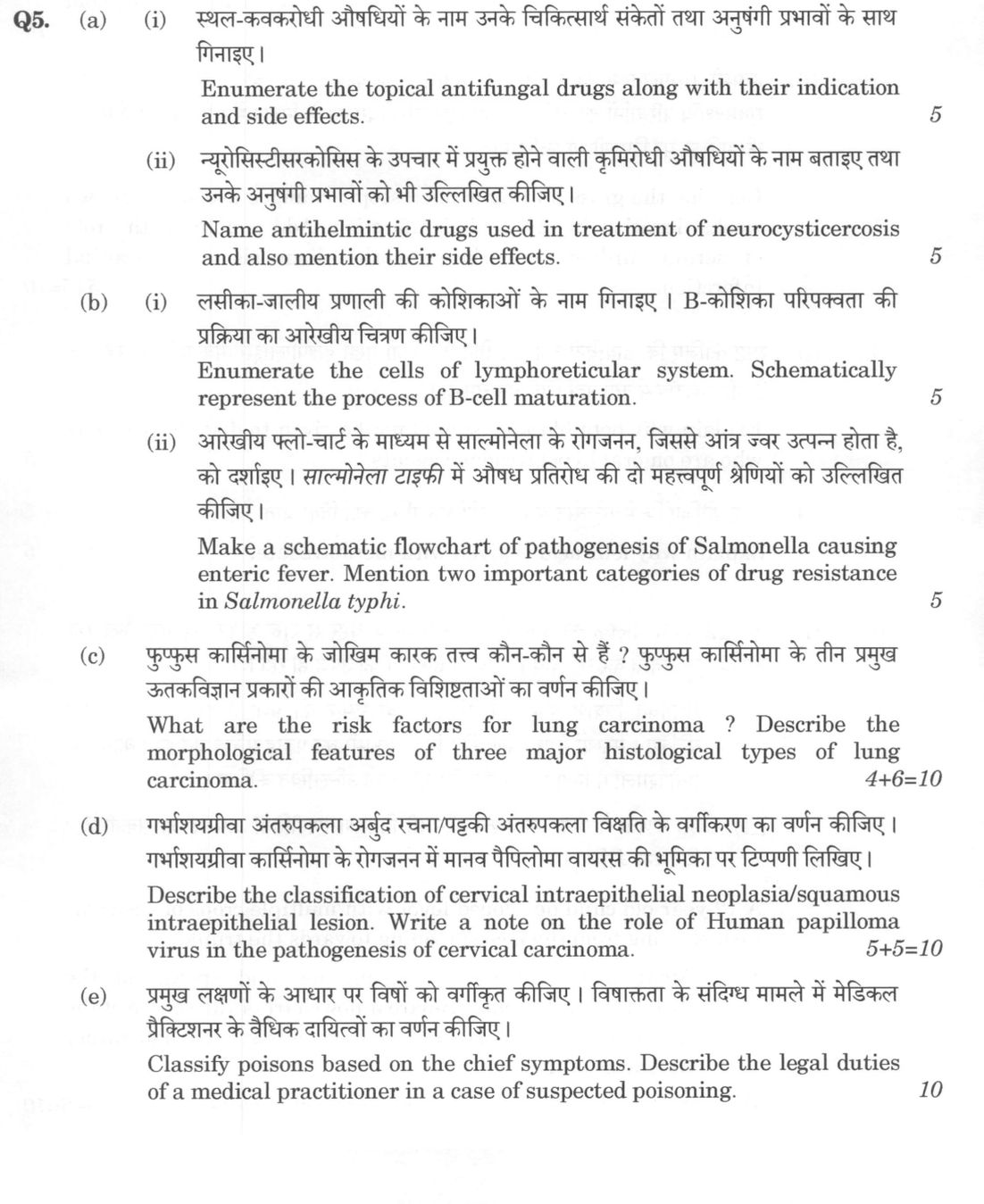
(a) (i) Enumerate the topical antifungal drugs along with their indication and side effects. 5 marks (ii) Name antihelminitic…
Enumerate the topical antifungal drugs along with their indication and side effects. 5 marks
Name antihelminitic drugs used in treatment of neurocysticercosis and also mention their side effects. 5 marks
Enumerate the cells of lymphoreticular system. Schematically represent the process of B-cell maturation. 5 marks
Make a schematic flowchart of pathogenesis of Salmonella causing enteric fever. Mention two important categories of drug resistance in Salmonella typhi. 5 marks
What are the risk factors for lung carcinoma ? Describe the morphological features of three major histological types of lung carcinoma. 4+6=10 marks
Describe the classification of cervical intraepithelial neoplasia/squamous intraepithelial lesion. Write a note on the role of Human papilloma virus in the pathogenesis of cervical carcinoma. 5+5=10 marks
Classify poisons based on the chief symptoms. Describe the legal duties of a medical practitioner in a case of suspected poisoning. 10 marks
हिंदी में प्रश्न पढ़ें
स्थल-कवकरोधी औषधियों के नाम उनके चिकित्सार्थ संकेतों तथा अनुषंगी प्रभावों के साथ गिनाइए। 5
न्यूरोसिस्टिसर्कोसिस के उपचार में प्रयुक्त होने वाली कृमिरोधी औषधियों के नाम बताइए तथा उनके अनुषंगी प्रभावों को भी उल्लिखित कीजिए। 5
लसीका-जालीय प्रणाली की कोशिकाओं के नाम गिनाइए। B-कोशिका परिपक्वता की प्रक्रिया का आरेखीय चित्रण कीजिए। 5
आरेखीय फ्लो-चार्ट के माध्यम से साल्मोनेला के रोगजनन, जिससे आंत्र ज्वर उत्पन्न होता है, को दर्शाइए। साल्मोनेला टाइफी में औषध प्रतिरोध की दो महत्वपूर्ण श्रेणियों को उल्लिखित कीजिए। 5
फुप्फुस कार्सिनोमा के जोखिम कारक तत्व कौन-कौन से हैं ? फुप्फुस कार्सिनोमा के तीन प्रमुख उतकविज्ञान प्रकारों की आकृतिक विशिष्टताओं का वर्णन कीजिए। 4+6=10
गर्भाशयप्रिवा अंतरपकला अबृंद रचना/पड़की अंतरपकला विधति के वर्गीकरण का वर्णन कीजिए। गर्भाशयप्रिवा कार्सिनोमा के रोगजनन में मानव पैपिलोमा वायरस की भूमिका पर टिप्पणी लिखिए। 5+5=10
प्रमुख लक्षणों के आधार पर विषों को वर्गीकृत कीजिए। विषाक्तता के संदिग्ध मामले में मैडिकल प्रैक्टिशनर के वैधिक दायित्वों का वर्णन कीजिए। 10
Model answer
Written by UPSC Answer Check against this question's marking rubric, to the expected length. UPSC does not publish answers for Mains — this is one way to score well, not an official key.
(a)(i) Topical antifungals
The topical antifungals, with indications and side effects, are enumerated below:
Imidazoles — clotrimazole, miconazole, ketoconazole, econazole: indicated in dermatophytosis (tinea corporis, cruris, pedis), cutaneous candidiasis and tinea versicolor; side effects are local burning, itching, erythema and rarely contact dermatitis.
Allylamines — terbinafine, naftifine: indicated in dermatophytosis and tinea versicolor; side effects include local irritation, burning and rarely taste disturbance.
Polyenes — nystatin, amphotericin B: nystatin is indicated in oral and cutaneous candidiasis; amphotericin B topically for candidiasis and keratomycosis. Side effects are local irritation; systemic absorption is negligible from intact skin.
Ciclopirox olamine: indicated in tinea versicolor, dermatophytosis and cutaneous candidiasis; side effects are local irritation and burning.
Others — Whitfield's ointment (benzoic acid plus salicylic acid) for dermatophytosis, selenium sulfide and sodium thiosulfate for tinea versicolor, and griseofulvin (oral, not topical) is excluded. Rarely, systemic absorption from large eroded areas may cause systemic toxicity.
(a)(ii) Antihelminthics in neurocysticercosis
Albendazole (15 mg/kg/day in two divided doses for 28 days) and praziquantel (50 mg/kg/day in three divided doses for 15 days) are the first-line drugs; combination therapy is used in some cases. Corticosteroids are co-administered to control the inflammatory reaction to dying cysts. Side effects: headache, seizures, raised intracranial pressure, nausea, alopecia, hepatotoxicity (albendazole), and dizziness, drowsiness, abdominal pain and raised transaminases (praziquantel).
(b)(i) Cells of the lymphoreticular system
The cells are: lymphocytes (T cells, B cells, natural killer cells), plasma cells, macrophages, dendritic cells (including Langerhans cells and follicular dendritic cells), reticular cells and sinusoidal lining cells of lymphoid organs.
B-cell maturation, schematically:
Bone marrow: stem cell → pro-B cell (Ig gene rearrangement begins) → pre-B cell (cytoplasmic μ chain) → immature B cell (surface IgM) → exit to periphery.
Peripheral lymphoid organ: naive B cell → follicular mantle zone → antigen encounter in germinal centre → somatic hypermutation and class switching → memory B cell or plasma cell (antibody secretion).
(b)(ii) Pathogenesis of enteric fever
Schematic flowchart:
Ingestion of contaminated food/water → bacilli survive gastric acid → invade M cells of Peyer's patches → multiply in lamina propria and mesenteric lymph nodes → primary bacteraemia (asymptomatic) → seeding of gallbladder, liver, spleen, bone marrow → multiplication in gallbladder → secondary bacteraemia → systemic illness with fever, rose spots, splenomegaly, relative bradycardia → ileal Peyer's patch ulceration (third week) with risk of perforation and haemorrhage.
Two important categories of drug resistance in Salmonella typhi: chromosomal resistance — mutations in gyrA and parC (fluoroquinolone resistance) and decreased outer membrane permeability; and plasmid-mediated resistance — extended-spectrum β-lactamases, AmpC β-lactamases and NDM-1 carbapenemase, besides the classic multidrug resistance to chloramphenicol, ampicillin and cotrimoxazole.
(c) Risk factors for lung carcinoma
Smoking is the dominant risk factor, accounting for about 90% of cases, with risk proportional to pack-years; passive smoking adds risk. Radon exposure, asbestos, arsenic, chromium, nickel, silica and polycyclic aromatic hydrocarbons are occupational carcinogens. Air pollution, including biomass fuel and chulha smoke in Indian households, is an important India-specific factor. Genetic susceptibility, EGFR and ALK alterations in never-smokers, and chronic scarring (tuberculosis, interstitial fibrosis) contribute.
Morphological features of three major histological types:
Squamous cell carcinoma: typically central, arising from main or lobar bronchi; shows keratin pearls, intercellular bridges, squamous differentiation, cavitation and local invasion; strong association with smoking.
Adenocarcinoma: typically peripheral; shows glandular or lepidic patterns, mucin production, and is the commonest type in non-smokers and women; EGFR mutations are frequent in Asian populations.
Small cell carcinoma: central, arising from neuroendocrine cells; shows small cells with scant cytoplasm, hyperchromatic nuclei, nuclear moulding, crush artefact and high mitotic rate; strongly associated with smoking and paraneoplastic syndromes.
(d) Classification of CIN/SIL
Cervical intraepithelial neoplasia is classified as CIN 1 (dysplasia confined to the lower one-third of epithelium; Bethesda: low-grade squamous intraepithelial lesion, LSIL), CIN 2 (lower two-thirds; HSIL) and CIN 3 (full thickness, including carcinoma in situ; HSIL). The Bethesda system groups CIN 1 as LSIL and CIN 2 with CIN 3 as HSIL, reflecting the biological behaviour and management.
Role of HPV in pathogenesis: high-risk HPV types 16 and 18 cause about 70% of cervical cancers. Viral E6 oncoprotein binds and degrades p53, and E7 inactivates pRb, releasing E2F and driving uncontrolled proliferation. Integration of viral DNA into the host genome, with loss of E2 repression, leads to persistent E6/E7 expression, genomic instability, accumulation of mutations and progression from LSIL to HSIL to invasive carcinoma. Co-factors include early age at first intercourse, multiple partners, multiparity, smoking, immunosuppression and long-term oral contraceptive use.
(e) Classification of poisons by chief symptoms
Corrosives — strong acids and alkalis: cause burning pain in mouth, throat and stomach, with haematemesis and stricture formation.
Irritants — metallic salts, phosphorus, arsenic: cause vomiting, diarrhoea, abdominal pain and dehydration.
Neurotics — CNS depressants (barbiturates, alcohol, opioids) cause coma and respiratory depression; CNS stimulants (strychnine, organophosphates) cause convulsions and fasciculations.
Asphyxiants — carbon monoxide, cyanide, hydrogen sulphide: cause cyanosis, hypoxia and respiratory failure.
Cardiac poisons — aconite, digitalis, oleander: cause arrhythmias, bradycardia and cardiac arrest.
Miscellaneous — drugs, food poisons, snake and scorpion venom, and pesticides.
Legal duties of a medical practitioner in suspected poisoning, under Indian law: inform the police immediately (Section 39 CrPC, now Section 40 BNSS), preserve the stomach wash, vomitus, urine and blood for chemical analysis, maintain detailed and legible records of history, treatment and findings, record a dying declaration if the patient's condition is critical, and attend court as a witness when summoned. The doctor must not refuse treatment, must report suspected homicide or suicide, and must be aware of Section 304B IPC (dowry death) and Section 302 IPC where poisoning is suspected to be homicidal.
What "Enumerate" is asking you to do
Produce the complete set of items asked for, countable and correctly named. The examiner marks against a checklist, so a missing item costs and an elaborated one gains nothing — where discussion is wanted the stem asks for it as a separate sub-part.
Structure that answers it
One line naming the basis on which the set is drawn → items numbered, each in a phrase or a single line → the discussion sub-part taken up separately, after the list is complete
Where marks are lost
Treating it as an essay. Six items named in six lines score better than three items explained at length.
How this answer will be evaluated
Approach
Framework: Clinical sequence: Definition > Aetiology/Pathophysiology > Features > Investigation/Management. (a) describe: define > structure or process in order > labelled diagram > significance | (b) describe: define > structure or process in order > labelled diagram > significance | (c) describe: define > structure or process in order > labelled diagram > significance | (d) describe: define > structure or process in order > labelled diagram > significance | (e) describe: define > structure or process in order > labelled diagram > significance Full marks: Comprehensive, clinically accurate, with clear diagrams and legal precision.
Key points expected
- Topical antifungals: Azoles, Allylamines, Polyenes
- Antihelminthics: Albendazole, Praziquantel
- B-cell maturation: Bone marrow to spleen
- Salmonella pathogenesis: Ingestion to bacteremia
- Lung carcinoma: Squamous, Adenocarcinoma, Small cell
- CIN/SIL: CIN 1-3, LSIL/HSIL
- HPV: Types 16/18, E6/E7 oncoproteins
- Poison classification: CNS, CV, GI, Hemolytic
- Legal duties: Inform police, preserve samples
Evaluation rubric
Each sub-part is marked on its own, against the marks and word limit printed on the paper.
- (a) List topical antifungals and antihelminthics with specific indications and side effects.
describe— define → structure or process in order → labelled diagram → significance
Must cover
- Topical antifungals: Azoles, Allylamines, Polyenes
- Indications: Dermatophytosis, Candidiasis, Onychomycosis
- Antihelminthics: Albendazole, Praziquantel, Dexamethasone
- Side effects: GI upset, hepatotoxicity, seizures
Loses marks
- Listing drugs without specific indications
- Vague side effects (e.g., 'allergic reaction')
Earns more
- Mentioning specific drug names (e.g., Clotrimazole)
- Distinguishing between systemic and topical use
Extra mark
- Mentioning WHO guidelines for NCC treatment
- (b) List lymphoreticular cells and provide flowcharts for B-cell maturation and Salmonella pathogenesis.
describe— define → structure or process in order → labelled diagram → significance
Must cover
- Cells: B, T, NK, Macrophages, Dendritic
- B-cell maturation: Bone marrow to spleen
- Salmonella flowchart: Ingestion to bacteremia
- Resistance: MDR, Fluoroquinolone resistance
Loses marks
- Missing the schematic flowchart
- Listing cells without functional context
Earns more
- Labelled diagram of B-cell maturation
- Specific mention of MDR Salmonella typhi
Extra mark
- Mentioning specific resistance genes (e.g., gyrA)
- (c) List lung carcinoma risk factors and describe morphology of three major histological types. 10 marks
describe— define → structure or process in order → labelled diagram → significance
Must cover
- Risk factors: Smoking, Asbestos, Radon
- Squamous cell: Keratin pearls, intercellular bridges
- Adenocarcinoma: Glandular formation, mucin
- Small cell: Neuroendocrine, salt-and-pepper chromatin
Loses marks
- Confusing small cell with non-small cell
- Listing risk factors without mechanism
Earns more
- Mentioning paraneoplastic syndromes
- Linking specific risk factors to types
Extra mark
- Mentioning specific molecular markers (e.g., EGFR)
- (d) Classify CIN/SIL and explain HPV's role in cervical carcinoma pathogenesis. 10 marks
describe— define → structure or process in order → labelled diagram → significance
Must cover
- CIN 1, 2, 3 classification
- SIL: LSIL, HSIL
- HPV types: 16, 18 (high risk)
- Pathogenesis: E6/E7 oncoproteins, p53/Rb
Loses marks
- Confusing CIN grades with SIL grades
- Omitting specific HPV oncoproteins
Earns more
- Mentioning koilocytosis
- Linking HPV to specific histological changes
Extra mark
- Mentioning HPV vaccination (Gardasil/Cervarix)
- (e) Classify poisons by symptoms and detail legal duties of a medical practitioner. 10 marks
describe— define → structure or process in order → labelled diagram → significance
Must cover
- Classification: CNS, Cardiovascular, GI, Hemolytic
- Legal duty: Inform police (Section 176 IPC)
- Preserve samples: Stomach contents, urine, blood
- Forensic report: FIR, chain of custody
Loses marks
- Listing symptoms without classification
- Omitting the legal duty to inform police
Earns more
- Mentioning specific poisons for each class
- Detailing the 'chain of custody' process
Extra mark
- Mentioning specific legal sections (e.g., 176 IPC)
Practice this exact question
Write your answer and it is marked point by point against the model answer above — what you covered, what you missed, what you got wrong.
Evaluate my answer →More from Medical Science 2025 Paper I
- Q2 (a) Using a well labelled diagram, trace the taste pathway from circumvallate papillae of…
- Q3 (a) A 36-year-old cyclist suffered pelvic injury while riding into a pothole on the road.…
- Q4 (a) (i) A 55-year-old lady visits surgery OPD with a three month old history of a painles…
- Q5 (a) (i) Enumerate the topical antifungal drugs along with their indication and side effec…
- Q6 (a) (i) Describe the approach to laboratory diagnosis of chronic myeloid leukemia – chron…
- Q7 (a) (i) Define 'drowning'. Enumerate the different modes of death in a case of drowning.…
- Q8 (a) (i) Describe the challenges of circulating Vaccine-Derived Poliovirus (VDPV). Add a n…