Paper I — Q2
(a) A 32-year-old male is brought to the emergency department following a road traffic accident. His clinical examination shows…
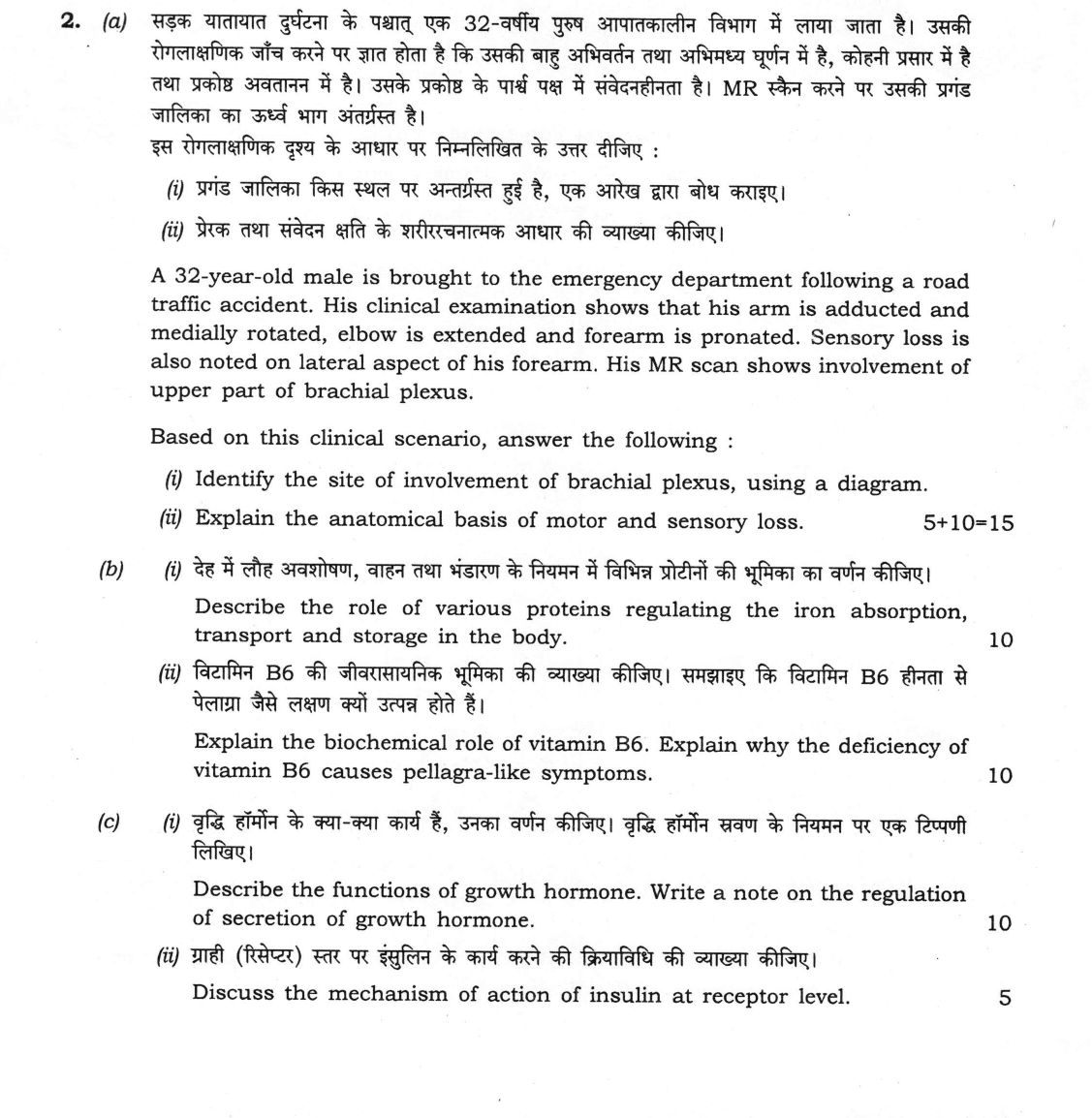
A 32-year-old male is brought to the emergency department following a road traffic accident. His clinical examination shows that his arm is adducted and medially rotated, elbow is extended and forearm is pronated. Sensory loss is also noted on lateral aspect of his forearm. His MR scan shows involvement of upper part of brachial plexus. Based on this clinical scenario, answer the following : Identify the site of involvement of brachial plexus, using a diagram.
Explain the anatomical basis of motor and sensory loss. 15 marks
Describe the role of various proteins regulating the iron absorption, transport and storage in the body. 10 marks
Explain the biochemical role of vitamin B6. Explain why the deficiency of vitamin B6 causes pellagra-like symptoms. 10 marks
Describe the functions of growth hormone. Write a note on the regulation of secretion of growth hormone. 10 marks
Discuss the mechanism of action of insulin at receptor level. 5 marks
हिंदी में प्रश्न पढ़ें
सड़क यातायात दुर्घटना के पश्चात् एक 32-वर्षीय पुरुष आपातकालीन विभाग में लाया जाता है। उसकी रोगलाक्षणिक जाँच करने पर ज्ञात होता है कि उसकी बाहु अभिवर्तन तथा अभिमध्य घूर्णन में है, कोहनी प्रसार में है तथा प्रकोष्ठ अवतानन में है। उसके प्रकोष्ठ के पार्श्व पक्ष में संवेदनहीनता है। MR स्कैन करने पर उसकी प्रगंड जालिका का ऊर्ध्व भाग अंतर्ग्रस्त है। इस रोगलाक्षणिक दृश्य के आधार पर निम्नलिखित के उत्तर दीजिए : प्रगंड जालिका किस स्थल पर अन्तर्ग्रस्त हुई है, एक आरेख द्वारा बोध कराइए।
प्रेरक तथा संवेदन क्षति के शारीरचनात्मक आधार की व्याख्या कीजिए। (15 अंक)
देह में लौह अवशोषण, वाहन तथा भंडारण के नियमन में विभिन्न प्रोटीनों की भूमिका का वर्णन कीजिए। (10 अंक)
विटामिन B6 की जीवरासायनिक भूमिका की व्याख्या कीजिए। समझाइए कि विटामिन B6 हीनता से पेलाग्रा जैसे लक्षण क्यों उत्पन्न होते हैं। (10 अंक)
वृद्धि हार्मोन के क्या-क्या कार्य हैं, उनका वर्णन कीजिए। वृद्धि हार्मोन स्रवण के नियमन पर एक टिप्पणी लिखिए। (10 अंक)
ग्राही (रिसेप्टर) स्तर पर इंसुलिन के कार्य करने की क्रियाविधि की व्याख्या कीजिए। (5 अंक)
Model answer
Drafted with AI by UPSC Answer Check against this question's marking rubric, to the expected length. UPSC does not publish answers for Mains — this is one way to score well, not an official key. How we build rubrics and answers.
(a) Erb–Duchenne palsy after a road traffic accident (15 marks)
(i) Site of the lesion (5 marks). The signs (adducted, medially rotated arm, extended elbow, pronated forearm, and sensory loss on the lateral forearm) and the MR finding of an upper plexus injury point to the upper trunk of the brachial plexus (roots C5 and C6), at Erb's point, 2–3 cm above the clavicle behind the posterior border of sternocleidomastoid, where the two roots unite. It is injured by a forced downward traction of the shoulder with the head bent to the opposite side, as when a motorcyclist lands on the shoulder. The diagram marks the lesion.

(ii) Anatomical basis of the motor and sensory loss (10 marks). C5 and C6 supply the shoulder abductors and lateral rotators and the elbow flexors and supinators, mainly through the axillary, suprascapular, musculocutaneous and radial nerves.
- Arm adducted: deltoid and supraspinatus (abduction) are paralysed, so the adductors (pectoralis major, latissimus dorsi, teres major), which are supplied from lower roots, act unopposed.
- Arm medially rotated: infraspinatus and teres minor (lateral rotators) are paralysed, so the medial rotators (subscapularis, pectoralis major, latissimus dorsi) win.
- Elbow extended: biceps, brachialis and coracobrachialis (musculocutaneous, C5–C6) are paralysed, so triceps (radial nerve, C6–C8) extends the elbow without opposition.
- Forearm pronated: biceps and supinator (the supinators) are paralysed, so pronator teres and pronator quadratus (median nerve, C6–C7 and C8–T1) are unopposed. Brachioradialis is also paralysed. The limb takes the "waiter's tip" position.
- Sensory loss: the C5 and C6 dermatomes. The lateral forearm is supplied by the lateral cutaneous nerve of the forearm, the continuation of the musculocutaneous nerve (C5–C6), and there is also loss over the lateral arm (upper lateral cutaneous nerve of the arm from the axillary nerve, C5) and the thumb and index finger (C6).
- The biceps and brachioradialis reflexes are lost, while hand function (C8, T1) is preserved.
(b)(i) Proteins regulating iron absorption, transport and storage (10 marks)
Absorption. Dietary non-haem iron (Fe³⁺) is reduced to Fe²⁺ by duodenal cytochrome b (Dcytb) with vitamin C, and enters the duodenal enterocyte through the divalent metal transporter 1 (DMT1) at the apical membrane. Haem enters by the haem carrier protein or endocytosis, and haem oxygenase releases its iron. The iron leaves the cell across the basolateral membrane through ferroportin, the only known cellular iron exporter, and is oxidised to Fe³⁺ by hephaestin (ceruloplasmin in plasma).
Transport. Transferrin carries Fe³⁺ in plasma (two sites per molecule, about 30% saturated). The transferrin receptor 1 (TfR1) on cells binds the diferric transferrin, and the complex is taken up by receptor-mediated endocytosis. In the acidified endosome the iron is released, reduced by STEAP3 and taken to the cytosol by DMT1, and the receptor and apotransferrin are recycled.
Storage. Ferritin, a shell of 24 H and L subunits, stores iron as Fe³⁺ (the H chain has ferroxidase activity), which makes it non-toxic, and its plasma level reflects the stores. Haemosiderin is a partly degraded, insoluble form stored in macrophages in iron overload.
Regulation.
- Hepcidin: the liver peptide hormone, made in response to iron and inflammation (IL-6), and suppressed by iron deficiency, hypoxia and erythropoietic drive (erythroferrone). It binds ferroportin and causes its internalisation and degradation, so intestinal absorption and macrophage iron release fall. Deficiency of hepcidin (or the HFE/TfR2/hemojuvelin signals that raise it) causes haemochromatosis; excess in chronic disease causes anaemia of chronic disease.
- IRE–IRP system (post-transcriptional): in iron deficiency, the iron regulatory proteins bind the iron-responsive elements of mRNA. At the 5′ UTR of ferritin (and ferroportin) mRNA this blocks translation, and at the 3′ UTR of TfR1 and DMT1 mRNA it stabilises the message. Iron loading reverses this, so there is more ferritin and fewer receptors.
(b)(ii) Biochemical role of vitamin B6 and the pellagra-like state in its deficiency (10 marks)
Role. Vitamin B6 (pyridoxine, pyridoxal, pyridoxamine) is converted by pyridoxal kinase to its active coenzyme, pyridoxal phosphate (PLP), which forms a Schiff base with the substrate amino group and acts as an electron sink. It is needed for:
- Transamination: alanine and aspartate aminotransferases (ALT, AST).
- Decarboxylation: formation of GABA from glutamate, dopamine from DOPA, serotonin from 5-hydroxytryptophan, histamine from histidine.
- The first step of haem synthesis (ALA synthase) from glycine and succinyl-CoA.
- Trans-sulfuration (cystathionine β-synthase and γ-lyase), converting homocysteine into cysteine.
- Glycogen phosphorylase, sphingolipid synthesis (serine palmitoyltransferase), and dehydratases and racemases.
- Tryptophan metabolism, through kynureninase (explained below).
Deficiency (isoniazid or long-term drugs, alcoholism) causes convulsions (less GABA), sideroblastic anaemia, peripheral neuropathy, dermatitis and homocysteinaemia.
Why B6 deficiency resembles pellagra. Niacin, and hence NAD, is made in the body from tryptophan by the kynurenine pathway: tryptophan → kynurenine → 3-hydroxykynurenine → 3-hydroxyanthranilate → quinolinate → nicotinate mononucleotide → NAD. The step that cleaves 3-hydroxykynurenine to 3-hydroxyanthranilate is done by kynureninase, a PLP-dependent enzyme. In B6 deficiency the enzyme is inactive, so 3-hydroxykynurenine builds up and is diverted to xanthurenic acid (excreted in urine, the basis of the tryptophan-load test), and too little niacin and NAD is formed. The patient therefore develops niacin deficiency, the dermatitis, diarrhoea and dementia of pellagra, though the diet contains niacin and tryptophan.
(c)(i) Functions and regulation of growth hormone (10 marks)
Functions. GH (191 amino acids, from the somatotrophs of the anterior pituitary) acts directly and through insulin-like growth factor 1 (IGF-1, made mainly in the liver under GH control).
- Growth-promoting (mainly through IGF-1): proliferation of chondrocytes at the epiphyseal plates and longitudinal bone growth; growth of muscle and viscera; protein synthesis with amino-acid uptake, nitrogen retention and less urea formation.
- Metabolic (mainly direct): lipolysis, with more free fatty acids and ketogenesis (fat-sparing); an anti-insulin (diabetogenic) effect, with less glucose uptake by muscle and fat, insulin resistance and more hepatic glucose output; retention of sodium, potassium and phosphate, and more calcium absorption.
Regulation of secretion. Secretion is pulsatile (every 3–4 hours) and is highest during the first slow-wave sleep of the night.
- Hypothalamic GHRH stimulates the somatotrophs (Gs, cAMP), and somatostatin inhibits them. The gastric peptide ghrelin stimulates release (GH secretagogue receptor).
- Feedback: IGF-1 inhibits the pituitary and stimulates somatostatin, and GH itself has a short-loop feedback on the hypothalamus.
- Stimuli: hypoglycaemia, fasting, amino acids (arginine), exercise, stress, deep sleep, puberty (sex steroids), L-dopa, clonidine and glucagon.
- Inhibitors: hyperglycaemia and raised free fatty acids, obesity, excess glucocorticoids, hypothyroidism, ageing, REM sleep.
(c)(ii) Insulin action at the receptor level (5 marks)
The insulin receptor is a heterotetramer of two extracellular α subunits, which bind insulin, and two transmembrane β subunits with intrinsic tyrosine kinase activity, held together by disulfide bonds. It is a receptor tyrosine kinase.
- Insulin binds the α subunits, changes the conformation, and the β subunits autophosphorylate each other on tyrosine residues, which activates the kinase.
- The kinase phosphorylates the insulin receptor substrates (IRS-1 and IRS-2) and Shc, which act as docking sites.
- PI3-kinase–Akt (PKB) pathway (metabolic effects): translocation of GLUT4 to the membrane in muscle and fat, activation of glycogen synthase (through inhibition of GSK-3), protein synthesis (mTOR), and inhibition of lipolysis and gluconeogenesis.
- Ras–MAPK pathway (growth and gene expression).
- Termination: the insulin–receptor complex is internalised by endocytosis, insulin is degraded in the endosome, and the receptor is recycled or degraded (down-regulation). Phosphatases such as PTP1B dephosphorylate it, and serine phosphorylation of IRS causes insulin resistance.
How this answer will be evaluated
Evaluation rubric
Each sub-part is marked on its own, against the marks and word limit printed on the paper.
- (a) 32-year-old after a road traffic accident with adducted, medially rotated arm, extended elbow, pronated forearm and lateral forearm sensory loss, upper brachial plexus involved: (i) site of lesion with a diagram; (ii) anatomical basis of the motor and sensory loss (5 + 10 = 15 marks). 15 marks
Must cover
- Site: upper trunk (C5, C6) at Erb's point, shown on a plexus diagram
- Motor: deltoid, supraspinatus, infraspinatus and teres minor paralysed, giving adducted and medially rotated arm
- Biceps, brachialis and supinators paralysed with unopposed triceps and pronators, giving extended elbow and pronated forearm (waiter's tip)
- Sensory: C5–C6 dermatomes, with lateral forearm supplied by the lateral cutaneous nerve of the forearm (musculocutaneous)
Loses marks
- Placing the lesion at the lower trunk or medial cord.
- No diagram.
- Explaining the posture without naming the unopposed muscles.
Earns more
- Nerves named for each muscle group (axillary, suprascapular, musculocutaneous, radial).
- Mechanism of injury and reflex loss (biceps, brachioradialis) given.
Extra mark
- Klumpke's palsy contrasted (lower trunk C8–T1)
- (b)(i) Describe the role of various proteins regulating the absorption, transport and storage of iron in the body (10 marks). 10 marks
Must cover
- Absorption: Dcytb, DMT1, haem carrier protein and ferroportin with hephaestin
- Transport: transferrin and transferrin receptor 1 with endosomal release
- Storage: ferritin and haemosiderin
- Regulation: hepcidin–ferroportin axis and the IRE–IRP system
Loses marks
- Naming lactoferrin as the main transport protein.
- Leaving out hepcidin.
- Confusing ferritin with transferrin.
Earns more
- Each of absorption, transport and storage covered.
- Direction of hepcidin and IRP effects correct in iron deficiency and overload.
Extra mark
- Disorders: haemochromatosis, anaemia of chronic disease
- (b)(ii) Explain the biochemical role of vitamin B6 and why its deficiency causes pellagra-like symptoms (10 marks). 10 marks
Must cover
- PLP as the active coenzyme, with a Schiff base mechanism
- Reactions: transamination, decarboxylation (GABA, dopamine, serotonin, histamine), ALA synthase, trans-sulfuration, glycogen phosphorylase
- Kynureninase (PLP-dependent) converts 3-hydroxykynurenine to 3-hydroxyanthranilate in the tryptophan-to-niacin pathway
- Deficiency causes accumulation of 3-hydroxykynurenine and xanthurenic acid, less niacin and NAD, and so pellagra-like features
Loses marks
- Stating that B6 is a component of NAD.
- Giving the wrong enzyme in the tryptophan pathway.
- Listing reactions without linking them to the pellagra effect.
Earns more
- Causal chain in the second half explained step by step.
- Clinical features of B6 deficiency (convulsions, sideroblastic anaemia, neuropathy).
Extra mark
- Tryptophan-load test
- (c)(i) Describe the functions of growth hormone and write a note on the regulation of its secretion (10 marks). 10 marks
Must cover
- Growth-promoting actions through IGF-1: bone, cartilage, muscle, protein anabolism
- Metabolic actions: lipolysis, anti-insulin (diabetogenic) effect, electrolyte retention
- Regulation: GHRH stimulation, somatostatin inhibition, ghrelin, IGF-1 feedback
- Stimuli (hypoglycaemia, sleep, exercise, stress, amino acids) and inhibitors (hyperglycaemia, obesity, glucocorticoids, REM sleep)
Loses marks
- Attributing all growth effects to GH directly.
- Hyperglycaemia as a stimulus of secretion.
- Omitting somatostatin.
Earns more
- Direct against IGF-1-mediated effects distinguished.
- Pulsatile secretion with a sleep peak.
Extra mark
- Clinical correlates: gigantism, acromegaly, dwarfism
- (c)(ii) Discuss the mechanism of action of insulin at the receptor level (5 marks). 5 marks
Must cover
- Heterotetramer with extracellular α subunits that bind insulin and β subunits with tyrosine kinase activity
- Autophosphorylation of β subunits and phosphorylation of IRS proteins
- PI3K–Akt pathway with GLUT4 translocation and glycogen synthesis; Ras–MAPK pathway for growth
- Termination by internalisation, phosphatases and receptor down-regulation
Loses marks
- Describing a G-protein-coupled or cAMP mechanism.
- Omitting the tyrosine kinase step.
Earns more
- Statement that the receptor is a receptor tyrosine kinase.
- Downstream metabolic effects linked to the pathways.
Extra mark
- Insulin resistance from serine phosphorylation of IRS
What "Discuss" is asking you to do
Lay the issue out from more than one side — how it arose, what is claimed for it, what is held against it, and where it now stands. UPSC attaches discuss to broad topics with several live dimensions, so coverage of the dimensions earns more than the strength of your opinion.
Structure that answers it
Set the issue up → the case as it is made → the case against → the dimension both sides leave out → where the balance now lies
Where marks are lost
Listing facts with no thread between them, or arguing one side throughout and calling it a discussion.
Practice this exact question
Write your answer and it is marked point by point against the model answer above — what you covered, what you missed, what you got wrong.
Evaluate my answer →More from Medical Science 2026 Paper I
- Q1 (a) Describe the hip joint under the following headings : (i) Factors responsible for its…
- Q2 (a) A 32-year-old male is brought to the emergency department following a road traffic ac…
- Q3 (a) (i) 1. Name the ligaments of ovary and their role in ovarian torsion and its complica…
- Q4 (a) (i) Describe the cerebrospinal fluid (CSF) flow from site of production to its absorp…
- Q5 (a) (i) State the therapeutic indications, drug interactions and side effects of Methotre…