Paper I — Q5
(a) (i) State the therapeutic indications, drug interactions and side effects of Methotrexate. (5 marks) (ii) State the…
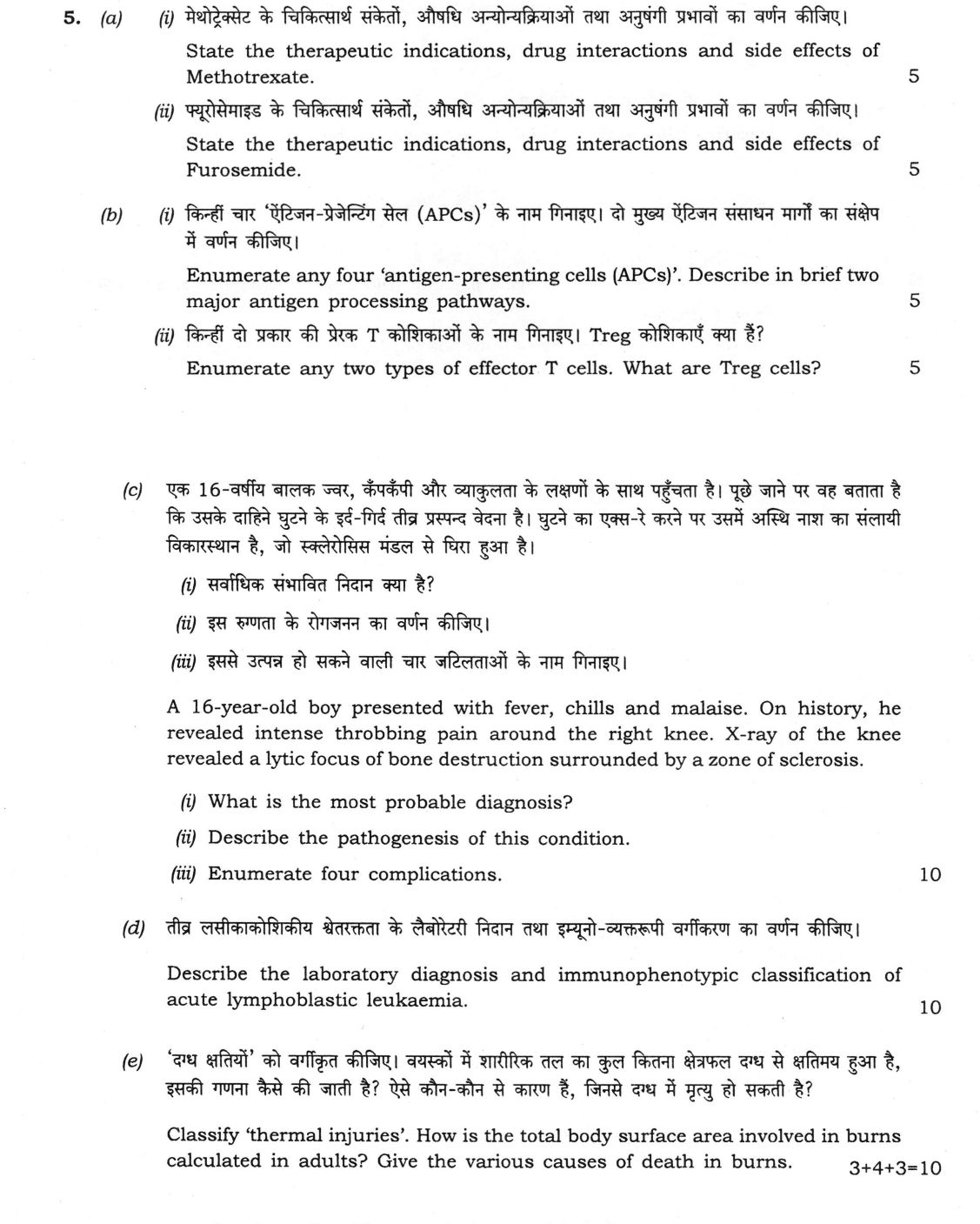
State the therapeutic indications, drug interactions and side effects of Methotrexate. 5 marks
State the therapeutic indications, drug interactions and side effects of Furosemide. 5 marks
Enumerate any four ‘antigen-presenting cells (APCs)’. Describe in brief two major antigen processing pathways. 5 marks
Enumerate any two types of effector T cells. What are Treg cells? 5 marks
A 16-year-old boy presented with fever, chills and malaise. On history, he revealed intense throbbing pain around the right knee. X-ray of the knee revealed a lytic focus of bone destruction surrounded by a zone of sclerosis.
What is the most probable diagnosis?
Describe the pathogenesis of this condition.
Enumerate four complications. 10 marks
Describe the laboratory diagnosis and immunophenotypic classification of acute lymphoblastic leukaemia. 10 marks
Classify 'thermal injuries'. How is the total body surface area involved in burns calculated in adults? Give the various causes of death in burns. 10 marks
हिंदी में प्रश्न पढ़ें
मेथोट्रेक्सेट के चिकित्सार्थ संकेतों, औषधि अन्योन्यक्रियाओं तथा अनुषंगी प्रभावों का वर्णन कीजिए। (5 अंक)
फ़्यूरोसेमाइड के चिकित्सार्थ संकेतों, औषधि अन्योन्यक्रियाओं तथा अनुषंगी प्रभावों का वर्णन कीजिए। (5 अंक)
किन्हीं चार ‘ऐंटिजन-प्रेजेन्टिंग सेल (APCs)’ के नाम गिनाइए। दो मुख्य ऐंटिजन संसाधन मार्गों का संक्षेप में वर्णन कीजिए। (5 अंक)
किन्हीं दो प्रकार की प्रेरक T कोशिकाओं के नाम गिनाइए। Treg कोशिकाएँ क्या हैं? (5 अंक)
एक 16-वर्षीय बालक ज्वर, कँपकँपी और व्याकुलता के लक्षणों के साथ पहुँचता है। पूछे जाने पर वह बताता है कि उसके दाहिने घुटने के इर्द-गिर्द तीव्र प्रस्पंद वेदना है। घुटने का एक्स-रे करने पर उसमें अस्थि नाश का संलयी विकारस्थान है, जो स्क्लेरोटिस मंडल से घिरा हुआ है।
सर्वाधिक संभावित निदान क्या है?
इस रुग्णता के रोगजनन का वर्णन कीजिए।
इससे उत्पन्न हो सकने वाली चार जटिलताओं के नाम गिनाइए। (10 अंक)
तीव्र लसीकाकोशिकीय श्वेतरक्तता के लैबोरेटरी निदान तथा इम्यूनो-व्यक्तरूपी वर्गीकरण का वर्णन कीजिए। (10 अंक)
'दग्ध क्षतियों' को वर्गीकृत कीजिए। वयस्कों में शारीरिक तल का कुल कितना क्षेत्रफल दग्ध से क्षतिग्रस्त हुआ है, इसकी गणना कैसे की जाती है? ऐसे कौन-कौन से कारण हैं, जिनसे दग्ध में मृत्यु हो सकती है? (10 अंक)
Model answer
Drafted with AI by UPSC Answer Check against this question's marking rubric, to the expected length. UPSC does not publish answers for Mains — this is one way to score well, not an official key. How we build rubrics and answers.
(a)(i) Methotrexate (5 marks)
Methotrexate is an antimetabolite that inhibits dihydrofolate reductase, so tetrahydrofolate is depleted and the synthesis of thymidylate and purines (DNA synthesis, S phase) is blocked.
Therapeutic indications.
- Malignant: acute lymphoblastic leukaemia (including intrathecal prophylaxis), choriocarcinoma and gestational trophoblastic disease, osteosarcoma (high dose with leucovorin rescue), non-Hodgkin lymphoma including CNS lymphoma, and cancers of the breast, head and neck, and bladder.
- Non-malignant: rheumatoid arthritis (weekly low dose, the standard DMARD), psoriasis and psoriatic arthritis, ectopic pregnancy, medical termination of pregnancy (with misoprostol), Crohn's disease, and vasculitis or lupus as an immunosuppressant.
Drug interactions.
- NSAIDs, salicylates, penicillins and probenecid reduce renal tubular secretion of methotrexate, so its level and toxicity rise.
- Co-trimoxazole and trimethoprim add antifolate action and cause pancytopenia.
- Proton-pump inhibitors reduce its renal clearance; nephrotoxic drugs such as cisplatin reduce its excretion.
- Alcohol, leflunomide and other hepatotoxic drugs add to liver damage. Live vaccines should not be given.
Side effects. Bone marrow suppression (megaloblastic anaemia, leucopenia, thrombocytopenia), mucositis and stomatitis, nausea and diarrhoea, hepatotoxicity (fibrosis and cirrhosis), pneumonitis, nephrotoxicity (high dose), neurotoxicity (arachnoiditis with the intrathecal route), alopecia and skin rash, and teratogenicity (contraindicated in pregnancy). The toxicity is reduced by folic acid supplements, and severe toxicity is treated with leucovorin (folinic acid).
(a)(ii) Furosemide (5 marks)
Furosemide is a high-ceiling loop diuretic. It inhibits the Na⁺–K⁺–2Cl⁻ cotransporter (NKCC2) in the thick ascending limb of the loop of Henle, blocking reabsorption of about 25% of the filtered sodium.
Therapeutic indications. Acute pulmonary oedema and left ventricular failure, congestive heart failure, cirrhotic ascites, nephrotic and renal oedema, oliguria in acute and chronic kidney disease, hypertension with renal impairment, hypercalcaemia and hyperkalaemia, and forced diuresis in poisoning. It is also used with other measures in cerebral oedema.
Drug interactions.
- Aminoglycosides and cisplatin add to ototoxicity and nephrotoxicity.
- NSAIDs blunt its diuretic effect (prostaglandin inhibition) and add to nephrotoxicity.
- Digoxin toxicity is provoked by the hypokalaemia it causes. Corticosteroids, amphotericin B and laxatives add to potassium loss.
- It raises lithium levels, and adds to the effect of antihypertensives (with ACE inhibitors, first-dose hypotension). Probenecid reduces its tubular secretion and action.
- Thiazides give a synergistic sequential nephron block, with severe electrolyte loss.
Side effects. Hypovolaemia and hypotension, hypokalaemia, hyponatraemia, hypomagnesaemia and hypocalcaemia, metabolic alkalosis, ototoxicity (tinnitus and deafness, with high dose or rapid intravenous injection), hyperuricaemia (gout), hyperglycaemia, allergic reactions (it is a sulphonamide), interstitial nephritis and pancreatitis.
(b)(i) Antigen-presenting cells and antigen processing pathways (5 marks)
Antigen-presenting cells. Dendritic cells (the most potent professional APC), macrophages, B lymphocytes and Langerhans cells of the skin (a dendritic cell type), and Kupffer cells (macrophages). All express MHC class II and costimulatory molecules.
Antigen processing pathways.
- Endogenous (cytosolic) pathway, MHC class I: endogenous antigens (viral or tumour proteins made inside any nucleated cell) are tagged with ubiquitin and cut into peptides by the proteasome. The peptides are carried into the endoplasmic reticulum by the transporter TAP, loaded on MHC class I with β₂-microglobulin (with tapasin and calreticulin), and the complex reaches the surface through the Golgi. It is recognised by CD8⁺ cytotoxic T cells.
- Exogenous (endocytic) pathway, MHC class II: extracellular antigen is taken up by phagocytosis or endocytosis into endosomes and lysosomes and is broken into peptides by proteases. MHC class II, made in the endoplasmic reticulum with the invariant chain, reaches the endosome, where the invariant chain is cut to CLIP and HLA-DM exchanges CLIP for the antigen peptide. The complex goes to the surface, and is recognised by CD4⁺ helper T cells.
- Cross-presentation allows dendritic cells to present exogenous antigen on MHC class I as well.
(b)(ii) Effector T cells and Treg cells (5 marks)
Effector T cells (any two).
- CD4⁺ Th1 cells (transcription factor T-bet) secrete IFN-γ, activate macrophages against intracellular microbes and mediate delayed hypersensitivity.
- CD4⁺ Th2 cells (GATA3) secrete IL-4, IL-5 and IL-13, and defend against helminths and mediate allergy.
- CD4⁺ Th17 cells (RORγt) secrete IL-17, and recruit neutrophils against extracellular bacteria and fungi.
- CD8⁺ cytotoxic T lymphocytes kill virus-infected and tumour cells with perforin and granzymes and Fas ligand.
Treg cells. Regulatory T cells are CD4⁺ CD25⁺ cells that carry the transcription factor FOXP3. They arise in the thymus (natural Tregs), or in the periphery under TGF-β and IL-2 (induced Tregs). They suppress immune responses by secreting IL-10, TGF-β and IL-35, by CTLA-4 blocking the costimulatory signal, and by consuming IL-2 through CD25. They maintain self-tolerance and prevent autoimmunity, and FOXP3 mutation causes the IPEX syndrome.
(c) Sixteen-year-old boy with fever and a lytic bone lesion with sclerosis (10 marks)
(i) Diagnosis. The most probable diagnosis is haematogenous pyogenic osteomyelitis of the lower femoral (or upper tibial) metaphysis, presenting as a subacute Brodie's abscess (Staphylococcus aureus), seen as a lytic focus with a sclerotic rim, with fever and chills.
(ii) Pathogenesis.
- Bacteria (most often Staphylococcus aureus) reach the bone by the blood from a distant focus, and they settle in the metaphysis of the long bones near the knee in children. There the terminal vessels form sluggish hairpin loops and the phagocytic cover is poor.
- Suppurative inflammation and pus form. Since bone is rigid, the pressure of pus rises and causes severe throbbing pain, and pus spreads through the Haversian and Volkmann canals to the medulla and under the periosteum.
- The subperiosteal abscess strips the periosteum, cutting off the blood supply, and a piece of bone dies (sequestrum). The periosteum lays down new bone around it (involucrum), and pus may discharge through openings (cloacae) and skin sinuses.
- If the organism has low virulence or host resistance is good, the abscess is walled off by reactive sclerotic bone (Brodie's abscess), which explains the lytic focus with a sclerotic rim.
(iii) Complications (any four). Septicaemia with metastatic abscesses, septic arthritis (through the epiphysis), chronic osteomyelitis with sequestrum, involucrum and discharging sinus, pathological fracture, growth disturbance of the limb, secondary amyloidosis, and squamous carcinoma in a long-standing sinus (Marjolin's ulcer).
(d) Acute lymphoblastic leukaemia: laboratory diagnosis and immunophenotypic classification (10 marks)
Laboratory diagnosis.
- Blood count: anaemia (normocytic, normochromic), thrombocytopenia, and a total white count that may be raised, normal or low, with neutropenia.
- Peripheral smear: circulating lymphoblasts, small to medium cells with a high nuclear-cytoplasmic ratio, scant basophilic agranular cytoplasm, fine chromatin and inconspicuous nucleoli. In the FAB system L1 (small, uniform), L2 (larger, heterogeneous) and L3 (vacuolated, deeply basophilic, Burkitt type) are recognised.
- Bone marrow aspirate and biopsy: hypercellular, replaced by lymphoblasts, with 20% or more lymphoblasts required for diagnosis (WHO), and reduced normal haematopoiesis.
- Cytochemistry: myeloperoxidase and Sudan black B are negative (which separates it from AML), PAS gives coarse block positivity, and TdT is positive. Acid phosphatase is focally positive in T-ALL.
- Ancillary tests: flow cytometry (immunophenotyping), cytogenetics and molecular tests (t(12;21) ETV6-RUNX1 and hyperdiploidy are favourable, t(9;22) BCR-ABL1, t(4;11) KMT2A rearrangement and hypodiploidy are unfavourable), CSF examination for blasts, chest X-ray for a mediastinal mass (T-ALL), and biochemistry (raised LDH, uric acid).
Immunophenotypic classification.
- B-lineage ALL (about 85% of childhood cases): TdT⁺, CD19⁺, CD22⁺, CD79a⁺, HLA-DR⁺. The subtypes are pro-B (CD10⁻), common (CD10⁺, CALLA), pre-B (cytoplasmic μ chain⁺) and mature B (surface immunoglobulin⁺, Burkitt type).
- T-lineage ALL: TdT⁺, cytoplasmic CD3⁺, CD7⁺, CD2⁺ and CD5⁺. The subtypes are pro-T (CD7 and cytoplasmic CD3 only), pre-T (CD2, CD5, CD8), cortical T (CD1a⁺, CD4⁺ CD8⁺) and mature T (surface CD3⁺, CD4 or CD8).
(e) Thermal injuries and burns (10 marks)
Classification of thermal injuries (3 marks).
- By agent: injuries due to heat (dry heat burns from flame, radiant heat and hot metal, and moist heat scalds from hot liquids and steam) and injuries due to cold (frostbite, trench foot and hypothermia). Systemic heat effects (heat stroke, heat exhaustion, heat cramps) also belong here.
- By depth (Dupuytren's six degrees): first, erythema; second, vesicles (blisters); third, destruction of the epidermis and the superficial part of the dermis; fourth, destruction of the whole thickness of the skin; fifth, involvement of the deep fascia and muscle; sixth, charring of bone. In the modern scheme these are superficial, partial-thickness and full-thickness burns.
Estimating the body surface area burnt in an adult (4 marks). Wallace's rule of nines is used. The area burnt is the sum of the regions affected:
- Head and neck 9%.
- Each upper limb 9% (18% for both).
- Front of the trunk 18% and back of the trunk 18%.
- Each lower limb 18% (36% for both).
- Perineum and genitalia 1%.
The total is 100%. Only second-degree and deeper burns are counted. For small or scattered burns the patient's palm (about 1%) is used, and the Lund and Browder chart is used in children, because their head is proportionately larger.
Causes of death in burns (3 marks).
- Immediate (first 24 hours): neurogenic shock from severe pain and fright, asphyxia from smoke and carbon monoxide poisoning or laryngeal oedema in inhalation burns, and hypovolaemic (burn) shock from loss of plasma into the burn.
- Early (2 to 7 days): continued burn shock, acute renal failure, toxaemia and early infection, acute respiratory distress syndrome, and stress (Curling's) ulcer with gastrointestinal bleeding.
- Delayed (after a week): septicaemia (often Pseudomonas or staphylococcal), pneumonia, renal failure, pulmonary embolism, tetanus, and malnutrition and exhaustion, with contractures and Marjolin's ulcer as late complications.
How this answer will be evaluated
Evaluation rubric
Each sub-part is marked on its own, against the marks and word limit printed on the paper.
- (a)(i) (a)(i) State the therapeutic indications, drug interactions and side effects of methotrexate (5 marks). 5 marks
Must cover
- Mechanism: dihydrofolate reductase inhibition (antifolate)
- Indications: ALL, choriocarcinoma, osteosarcoma, plus rheumatoid arthritis, psoriasis and ectopic pregnancy
- Interactions: NSAIDs, penicillins and probenecid (reduced excretion), co-trimoxazole (additive antifolate)
- Adverse effects: myelosuppression, mucositis, hepatotoxicity, pneumonitis, teratogenicity; leucovorin rescue
Loses marks
- Omitting either malignant or non-malignant indications.
- Leaving out interactions.
- Calling it an alkylating agent.
Earns more
- All three headings covered.
- Mechanism of each key interaction given.
Extra mark
- Folic acid supplementation and monitoring
- (a)(ii) (a)(ii) State the therapeutic indications, drug interactions and side effects of furosemide (5 marks). 5 marks
Must cover
- Action: NKCC2 inhibition in the thick ascending limb
- Indications: pulmonary oedema, heart failure, ascites and oedema, renal failure, hypertension, hypercalcaemia
- Interactions: aminoglycosides and cisplatin (ototoxicity), NSAIDs (blunted effect), digoxin (hypokalaemia), lithium
- Adverse effects: hypovolaemia, hypokalaemia, hyponatraemia, metabolic alkalosis, ototoxicity, hyperuricaemia
Loses marks
- Calling it a potassium-sparing diuretic.
- Omitting ototoxicity.
- Leaving out interactions.
Earns more
- All three headings covered.
- Mechanism of each key interaction stated.
Extra mark
- Synergy with thiazides
- (b)(i) (b)(i) Enumerate four antigen-presenting cells and describe in brief two major antigen processing pathways (5 marks). 5 marks
Must cover
- APCs: dendritic cells, macrophages, B cells, and Langerhans or Kupffer cells
- Endogenous pathway: proteasome, TAP, MHC class I to CD8+ T cells
- Exogenous pathway: endosome, MHC class II with CLIP and HLA-DM to CD4+ T cells
- Both pathways with their T-cell partner
Loses marks
- Swapping MHC I and II with their T cells.
- Naming T cells as APCs.
- Describing only one pathway.
Earns more
- Four cells named.
- Key molecules in each pathway named (proteasome, TAP, invariant chain).
Extra mark
- Cross-presentation
- (b)(ii) (b)(ii) Enumerate any two types of effector T cells; what are Treg cells? (5 marks). 5 marks
Must cover
- Two effector T cells with cytokines or function (Th1, Th2, Th17 or CD8+ CTL)
- Treg phenotype: CD4+ CD25+ FOXP3+
- Origin: thymic (natural) and peripheral (induced)
- Suppression by IL-10, TGF-β, CTLA-4 and IL-2 consumption; role in self-tolerance
Loses marks
- Describing Tregs as cytotoxic cells.
- Naming a B-cell subset as a T-cell type.
- Omitting the suppressive mechanism.
Earns more
- Lineage transcription factors mentioned.
- Both parts covered.
Extra mark
- IPEX syndrome from FOXP3 mutation
- (c) A 16-year-old boy with fever, chills and knee pain, with a lytic focus surrounded by sclerosis on X-ray: (i) diagnosis; (ii) pathogenesis; (iii) four complications (10 marks). 10 marks
Must cover
- Diagnosis committed to: haematogenous pyogenic osteomyelitis (Brodie's abscess, S. aureus) of the metaphysis
- Pathogenesis: haematogenous seeding of the metaphysis, suppuration, raised pressure, subperiosteal spread
- Sequestrum, involucrum and cloacae; reactive sclerosis from a low-virulence infection explains the rim
- Four complications: septicaemia, septic arthritis, chronic osteomyelitis, pathological fracture, amyloidosis or Marjolin's ulcer
Loses marks
- Hedging the diagnosis between several conditions.
- Naming osteosarcoma as the diagnosis.
- Fewer than four complications.
Earns more
- Explanation why the metaphysis is the site.
- All three sub-parts answered.
Extra mark
- Differentials: osteoid osteoma and Ewing sarcoma
- (d) Describe the laboratory diagnosis and the immunophenotypic classification of acute lymphoblastic leukaemia (10 marks). 10 marks
Must cover
- Blood count and smear: anaemia, thrombocytopenia, lymphoblasts
- Marrow: 20% or more lymphoblasts; FAB L1, L2, L3
- Cytochemistry: MPO and Sudan black negative, PAS positive, TdT positive; flow cytometry, cytogenetics, CSF examination
- Classification: B-lineage (CD19, CD22, CD79a, CD10) with pro-B, common, pre-B and mature B; T-lineage (cytoplasmic CD3, CD7, CD2, CD5, CD1a) with pro-T to mature T
Loses marks
- MPO positivity for ALL.
- Mixing myeloid markers into the lymphoid classification.
- Omitting the immunophenotype.
Earns more
- Defining markers for each subtype.
- Cytogenetic prognostic markers named (t(12;21), t(9;22)).
Extra mark
- WHO and EGIL classification
- (e) Classify thermal injuries; how is the burnt body surface area calculated in adults; give the causes of death in burns (3 + 4 + 3 = 10 marks). 10 marks
Must cover
- Classification by agent (dry heat, moist heat, cold) and by depth (Dupuytren's six degrees)
- Rule of nines: head and neck 9%, each upper limb 9%, trunk front 18% and back 18%, each lower limb 18%, perineum 1%
- Immediate causes of death: neurogenic shock, asphyxia and burn shock
- Early and delayed causes: renal failure, toxaemia, septicaemia, pneumonia, embolism, tetanus, contractures
Loses marks
- Rule of nines percentages wrong.
- Omitting the classification by depth.
- Causes of death not grouped by time.
Earns more
- All six degrees named with their features.
- Totals adding up to 100% and mention of the Lund and Browder chart.
Extra mark
- Palm method
What "State" is asking you to do
Give the formulation itself — the theorem, rule, statutory provision or position — worded accurately. Precision of wording is the whole of the mark; no background or justification is being asked for.
Structure that answers it
The statement in full, complete in itself → the conditions under which it holds → an illustration only where the stem asks for one
Where marks are lost
Approximating the wording. A theorem or a provision stated loosely forfeits the mark that exact statement would have carried.
Practice this exact question
Write your answer and it is marked point by point against the model answer above — what you covered, what you missed, what you got wrong.
Evaluate my answer →More from Medical Science 2026 Paper I
- Q2 (a) A 32-year-old male is brought to the emergency department following a road traffic ac…
- Q3 (a) (i) 1. Name the ligaments of ovary and their role in ovarian torsion and its complica…
- Q4 (a) (i) Describe the cerebrospinal fluid (CSF) flow from site of production to its absorp…
- Q5 (a) (i) State the therapeutic indications, drug interactions and side effects of Methotre…
- Q6 (a) (i) Define inflammation. Describe the cardinal features of acute inflammation. (10 ma…
- Q7 (a) (i) Classify neurotoxic poisons. Discuss in brief the clinical features, treatment an…
- Q8 (a) (i) 1. Enumerate five agents of malaria in humans. 2. Describe in brief rapid diagnos…