Paper I — Q8
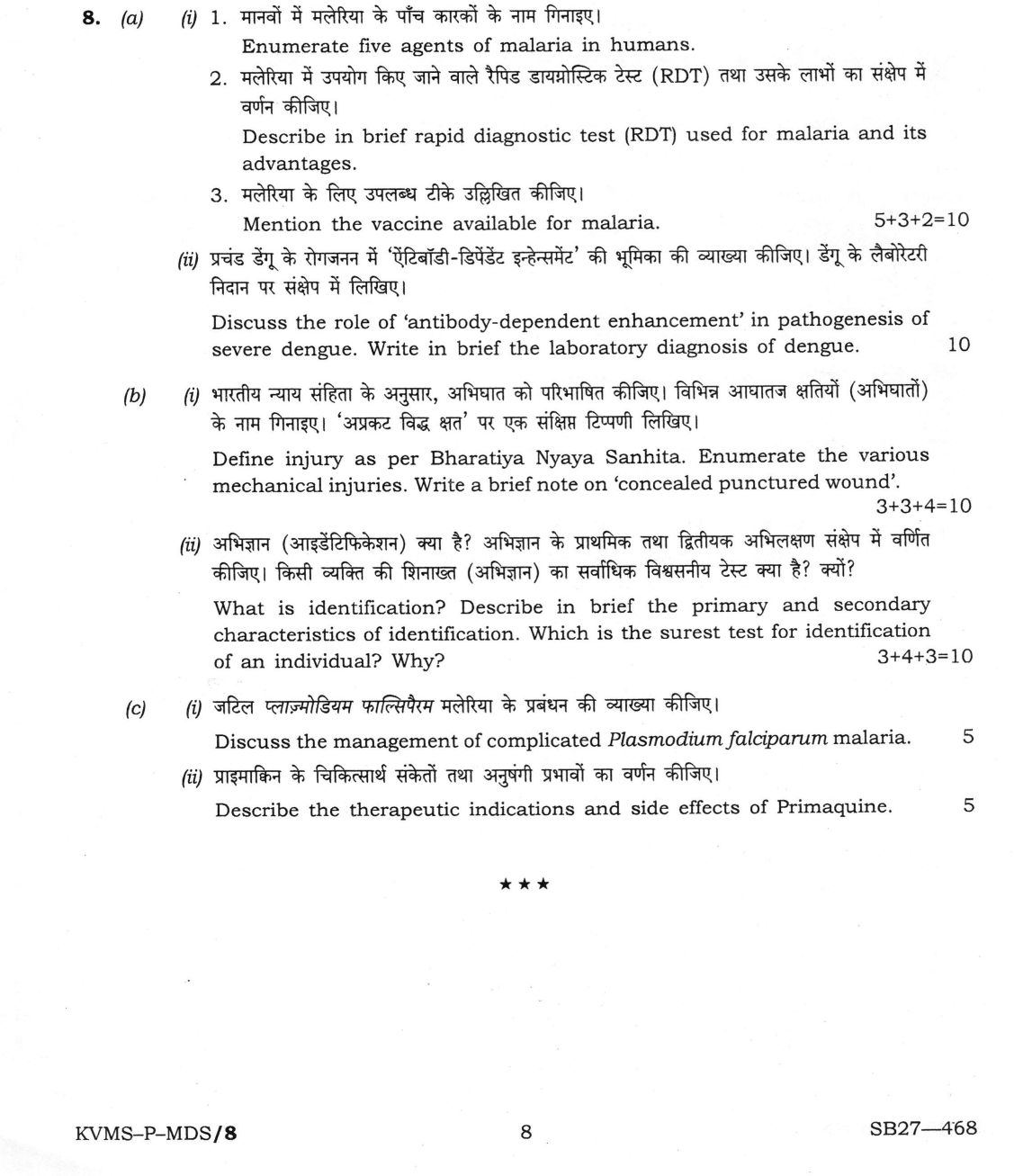
(a) (i) 1. Enumerate five agents of malaria in humans. 2. Describe in brief rapid diagnostic test (RDT) used for malaria and its…
1. Enumerate five agents of malaria in humans. 2. Describe in brief rapid diagnostic test (RDT) used for malaria and its advantages. 3. Mention the vaccine available for malaria. 10 marks
Discuss the role of ‘antibody-dependent enhancement’ in pathogenesis of severe dengue. Write in brief the laboratory diagnosis of dengue. 10 marks
Define injury as per Bharatiya Nyaya Sanhita. Enumerate the various mechanical injuries. Write a brief note on ‘concealed punctured wound’. 10 marks
What is identification? Describe in brief the primary and secondary characteristics of identification. Which is the surest test for identification of an individual? Why? 10 marks
Discuss the management of complicated Plasmodium falciparum malaria. 5 marks
Describe the therapeutic indications and side effects of Primaquine. 5 marks
हिंदी में प्रश्न पढ़ें
1. मानवों में मलेरिया के पाँच कारकों के नाम गिनाइए। 2. मलेरिया में उपयोग किए जाने वाले रैपिड डायग्नोस्टिक टेस्ट (RDT) तथा उसके लाभों का संक्षेप में वर्णन कीजिए। 3. मलेरिया के लिए उपलब्ध टीके उल्लिखित कीजिए। (10 अंक)
प्रचंड डेंगू के रोगजनन में ‘ऐंटीबॉडी-डिपेंडेंट इन्हैन्समेंट’ की भूमिका की व्याख्या कीजिए। डेंगू के लैबोरेटरी निदान पर संक्षेप में लिखिए। (10 अंक)
भारतीय न्याय संहिता के अनुसार, अभिघात को परिभाषित कीजिए। विभिन्न आघातज क्षतियों (अभिघातों) के नाम गिनाइए। ‘अप्रकट विद्ध क्षत’ पर एक संक्षिप्त टिप्पणी लिखिए। (10 अंक)
अभिज्ञान (आइडेंटिफिकेशन) क्या है? अभिज्ञान के प्राथमिक तथा द्वितीयक अभिलक्षण संक्षेप में वर्णित कीजिए। किसी व्यक्ति की शिनाख्त (अभिज्ञान) का सर्वाधिक विश्वसनीय टेस्ट क्या है? क्यों? (10 अंक)
जटिल प्लाज्मोडियम फाल्सीपैरम मलेरिया के प्रबंधन की व्याख्या कीजिए। (5 अंक)
प्राइमाक्विन के चिकित्सार्थ संकेतों तथा अनुषंगी प्रभावों का वर्णन कीजिए। (5 अंक)
Model answer
Drafted with AI by UPSC Answer Check against this question's marking rubric, to the expected length. UPSC does not publish answers for Mains — this is one way to score well, not an official key. How we build rubrics and answers.
(a)(i) Malaria: agents, rapid diagnostic test and vaccines (5 + 3 + 2 = 10 marks)
1. Five agents of human malaria. These are protozoa of the genus Plasmodium, spread by the female Anopheles mosquito:
- Plasmodium falciparum, which causes the most severe (malignant tertian) malaria.
- Plasmodium vivax, benign tertian malaria, with relapses from hypnozoites.
- Plasmodium ovale, a mild tertian malaria that also relapses.
- Plasmodium malariae, quartan malaria.
- Plasmodium knowlesi, a zoonotic parasite of macaques in South-East Asia (a 24-hour cycle, which can cause severe disease).
2. Rapid diagnostic test (RDT). It is an immunochromatographic (lateral-flow) test on a drop of finger-prick blood, which detects parasite antigens with monoclonal antibodies on a nitrocellulose strip. A coloured line appears in 15–20 minutes.
- Target antigens: histidine-rich protein-2 (HRP-2), specific to P. falciparum; parasite lactate dehydrogenase (pLDH), either pan-specific or specific to P. vivax; and aldolase (pan-malarial). In India the bivalent RDT (HRP-2 for P. falciparum and pLDH for P. vivax) is used.
- Advantages: rapid results (within 20 minutes), no microscope, electricity or trained microscopist needed, simple to perform, so it is suitable for remote and peripheral areas. It can detect P. falciparum even when the parasites are sequestered, and gives a species result. It is stable in field conditions and is used for early treatment.
- Limitations: it cannot quantify parasite density, HRP-2 stays positive for weeks after cure, and false negatives occur with HRP-2 gene deletion, so microscopy remains the reference.
3. Malaria vaccines. Two vaccines against P. falciparum are recommended by the WHO for children in endemic areas: RTS,S/AS01 (Mosquirix), recommended in 2021, and R21/Matrix-M, recommended in 2023. Both target the circumsporozoite protein of the sporozoite and are given as four doses to young children, and they give partial protection. They do not protect against P. vivax.
(a)(ii) Antibody-dependent enhancement in severe dengue; laboratory diagnosis (10 marks)
Antibody-dependent enhancement (ADE). Dengue has four serotypes (DENV-1 to DENV-4). Infection by one serotype gives lifelong immunity to that serotype only, and only short protection against the others. The severe forms (dengue haemorrhagic fever and dengue shock syndrome) occur mainly in a second infection by a different serotype, or in an infant with maternal antibody.
- The antibodies of the first infection cross-react with the new serotype but are poorly neutralising at low concentrations.
- They bind the virus, and the virus-antibody complexes attach to the Fcγ receptors of monocytes and macrophages, which take up the virus by receptor-mediated uptake. This gives a much higher rate of infection of these cells and a higher viral load.
- The cross-reactive memory T cells (original antigenic sin) respond with a large release of cytokines (TNF-α, IL-6, IL-8, IFN-γ), with complement activation and NS1 antigen effects.
- The result is endothelial dysfunction with plasma leakage, haemoconcentration (haematocrit rise of 20% or more), thrombocytopenia, bleeding and shock. This explains why severe disease appears around days 3–7, when the fever falls and viraemia is decreasing.
Laboratory diagnosis, by day of illness.
- Days 1–5 (febrile phase): detection of the virus and its products: NS1 antigen (ELISA or rapid card), RT-PCR for viral RNA (also for serotyping), and virus isolation in C6/36 mosquito cell lines (mainly for research).
- From day 5 onwards (convalescent phase): antibody detection: IgM capture ELISA (MAC-ELISA), which is positive from day 4–5 and persists 2–3 months; and IgG, which rises in paired sera four-fold or more, and is high early in a secondary infection.
- Supportive tests: leukopenia, falling platelets (below 100,000/mm³), a rising haematocrit, and a positive tourniquet test.
(b)(i) Injury, mechanical injuries and concealed punctured wound (3 + 3 + 4 = 10 marks)
Definition. Under Section 2(14) of the Bharatiya Nyaya Sanhita, 2023 (Section 44 of the old IPC), "injury" means any harm whatever illegally caused to any person, in body, mind, reputation or property.
Mechanical injuries. Injuries caused by mechanical force are classified as:
- Abrasions (scratch, graze, pressure and impact abrasions).
- Contusions (bruises).
- Lacerations.
- Incised wounds (including chop wounds).
- Punctured (stab) wounds, penetrating or perforating.
- Firearm wounds.
- Injuries of bones and joints (fractures and dislocations) are also included in some classifications.
Concealed punctured wound. A punctured wound made by a thin, sharp-pointed instrument (a needle, hatpin, knitting needle, ice pick, stiletto or thin knife) may leave only a tiny external opening, which is hidden in a natural site or is easily overlooked, although a deep organ is injured.
- Sites: scalp under the hair, axilla, umbilicus, skin folds, natural orifices (ear, nostril, mouth, anus, vagina), the anterior fontanelle, under the tongue, the back of the neck (into the medulla), between the ribs and the eyeball.
- Medico-legal importance: the wound may be missed at an external examination and the death be labelled natural. It can be fatal by internal haemorrhage, injury to the heart, brain or spinal cord, or by infection. It may be used in homicide, in infanticide (a needle through the fontanelle) and for poisoning-type concealment. Careful examination (shaving the scalp, examining orifices), radiography and a full dissection are needed to find the track.
(b)(ii) Identification (3 + 4 + 3 = 10 marks)
Identification. Identification is the determination of the individual identity of a person, living or dead, or of remains: the establishment that a person is the same as the one claimed. It may be complete (absolute individuality) or partial (only some features).
Primary characteristics. These are the basic, fixed and most reliable characteristics: the biological profile of age, sex, stature and race, and the permanent personal identifiers that are unique to an individual: fingerprints, dental records (odontology) and DNA profile. They do not change (or change in a predictable way) and give the highest certainty.
Secondary characteristics. These help to individualise but may be altered or are not unique: complexion, colour of hair and eyes, build, scars, moles, birthmarks, tattoos, deformities and anomalies, occupational marks, healed fractures and surgical implants, handwriting, voice and gait, and clothing and personal effects.
Surest test. DNA fingerprinting (DNA profiling) by STR analysis is the surest test.
- The DNA profile is unique to an individual (except monozygotic twins) and is the same in every nucleated cell for life.
- A minute sample of blood, semen, hair root, saliva, bone or tooth is enough, and DNA remains stable after death and in decomposed, burnt or skeletal remains, when fingerprints and features are lost.
- It can also establish relationships (paternity, maternity, and matching of a body with relatives), and it is accepted as expert evidence in court (Section 39, Bharatiya Sakshya Adhiniyam, 2023).
- Fingerprints are also unique, even in identical twins, but need earlier records and are destroyed by decomposition.
(c)(i) Management of complicated Plasmodium falciparum malaria (5 marks)
Severe (complicated) malaria is a medical emergency, defined by the presence of P. falciparum asexual parasites with one or more features such as cerebral malaria (coma), severe anaemia (Hb below 5 g/dL), acute kidney injury (creatinine above 3 mg/dL), pulmonary oedema or ARDS, hypoglycaemia (below 40 mg/dL), shock, spontaneous bleeding or DIC, metabolic acidosis, jaundice and hyperparasitaemia (above 5%). It should be treated in hospital, in a high-dependency or intensive-care unit.
- Specific treatment: intravenous artesunate 2.4 mg/kg at 0, 12 and 24 hours, then once daily. If it is not available, give artemether IM (3.2 mg/kg on day 1, then 1.6 mg/kg daily) or IV quinine (20 mg salt/kg loading dose over 4 hours, then 10 mg/kg every 8 hours), with doxycycline or clindamycin.
- Completion: parenteral treatment is given for at least 24 hours (and until the patient can take oral drugs); then a full 3-day course of an oral artemisinin combination therapy (ACT) is given (artesunate + sulfadoxine-pyrimethamine, or artemether-lumefantrine in the north-east). A single dose of primaquine is added for gametocyte clearance.
- Supportive care: airway and oxygen; anticonvulsants for fits (IV benzodiazepine); frequent blood glucose checks and dextrose for hypoglycaemia; antipyretics and tepid sponging; packed-cell transfusion for severe anaemia; dialysis for renal failure; ventilation for ARDS; broad-spectrum antibiotics if sepsis is suspected; and careful fluid balance.
- To avoid: fluid overload (risk of pulmonary oedema), and the routine use of corticosteroids, heparin, mannitol and dextran, which are harmful.
(c)(ii) Primaquine (5 marks)
Primaquine is an 8-aminoquinoline that acts on the tissue stages of the parasite (the hypnozoites and the gametocytes).
Therapeutic indications.
- Radical cure of P. vivax and P. ovale malaria, to kill the liver hypnozoites and prevent relapse: 0.25 mg/kg daily for 14 days (adult 15 mg), given with the blood-stage drug (chloroquine).
- Gametocidal action in P. falciparum malaria: a single dose (0.75 mg/kg in India; 0.25 mg/kg advised by the WHO) with the ACT, to stop transmission.
- Terminal and causal prophylaxis in travellers, and in Pneumocystis jirovecii pneumonia with clindamycin.
Adverse effects.
- Haemolysis in G6PD deficiency, the main toxicity, with haemoglobinuria and jaundice (so the G6PD status should be checked before use).
- Methaemoglobinaemia, nausea, vomiting, abdominal cramps (reduced by taking it with food), headache, and rarely leukopenia or agranulocytosis and QT prolongation.
- It is contraindicated in G6PD deficiency (or modified weekly dosing is used), in pregnancy, and in infants under 6 months.
How this answer will be evaluated
Evaluation rubric
Each sub-part is marked on its own, against the marks and word limit printed on the paper.
- (a)(i) (a)(i) Enumerate five agents of human malaria; describe the rapid diagnostic test and its advantages; mention the malaria vaccine available (5 + 3 + 2 = 10 marks). 10 marks
Must cover
- Five species: P. falciparum, P. vivax, P. ovale, P. malariae, P. knowlesi
- RDT: immunochromatographic lateral-flow test on finger-prick blood, result in 15–20 minutes
- Antigens HRP-2 (P. falciparum), pLDH and aldolase; advantages of speed, no microscope or electricity, suitability for remote areas
- Vaccines: RTS,S/AS01 and R21/Matrix-M against P. falciparum circumsporozoite protein
Loses marks
- Listing fewer than five species or naming a vector as an agent.
- Giving microscopy as the RDT.
- Stating that a vaccine protects against P. vivax.
Earns more
- Vector named (female Anopheles).
- Limitations of RDT stated (HRP-2 deletion, no quantification).
Extra mark
- WHO recommendation years (2021 and 2023) and four-dose schedule
- (a)(ii) (a)(ii) Discuss the role of antibody-dependent enhancement in the pathogenesis of severe dengue; write in brief the laboratory diagnosis of dengue (10 marks). 10 marks
Must cover
- ADE: secondary infection with a different serotype, or infant with maternal antibody
- Cross-reactive non-neutralising antibody, Fcγ-receptor uptake by monocytes and macrophages, higher viral load
- Cytokine release, plasma leakage, thrombocytopenia, DHF and DSS
- Diagnosis by day: NS1 antigen and RT-PCR in days 1–5; IgM ELISA and IgG from day 5
Loses marks
- Describing ADE as a protective mechanism.
- Giving IgM as the test for the first days.
- Omitting the laboratory diagnosis.
Earns more
- Four serotypes and lifelong homotypic immunity stated.
- Timing of severe disease at the fall of fever.
Extra mark
- Original antigenic sin and complement activation
- (b)(i) (b)(i) Define injury as per Bharatiya Nyaya Sanhita; enumerate mechanical injuries; write a brief note on concealed punctured wound (3 + 3 + 4 = 10 marks). 10 marks
Must cover
- Definition: any harm illegally caused to any person in body, mind, reputation or property (BNS section 2(14))
- Classification: abrasion, contusion, laceration, incised, punctured, firearm wounds (and chop wounds or fractures)
- Concealed punctured wound: thin sharp instrument, tiny opening in a hidden site
- Sites and medico-legal significance: scalp, axilla, orifices, fontanelle, nape; missed injury, natural-death label, deep organ injury
Loses marks
- Defining injury as only bodily hurt.
- Omitting sites of concealment.
- Confusing it with a lacerated wound.
Earns more
- Old IPC section 44 mentioned.
- Examples of instruments (needle, hatpin, ice pick).
Extra mark
- Use in homicide, infanticide, and detection by shaving and radiography
- (b)(ii) (b)(ii) Define identification; describe primary and secondary characteristics; state the surest test for identification and why (3 + 4 + 3 = 10 marks). 10 marks
Must cover
- Definition: determination of individual identity of a person or remains
- Primary: age, sex, stature, race; fingerprints, dental records, DNA
- Secondary: scars, moles, tattoos, deformities, hair and eye colour, handwriting, clothing and effects
- Surest test: DNA fingerprinting, with reasons of uniqueness, stability, tiny sample, use on decomposed remains
Loses marks
- Naming fingerprints alone without noting the case for DNA.
- Giving no reason for the surest test.
- Placing DNA among secondary features.
Earns more
- Complete versus partial identification.
- Exception of monozygotic twins stated.
Extra mark
- Admissibility as expert evidence (BSA section 39) and role in relationships
- (c)(i) (c)(i) Discuss the management of complicated Plasmodium falciparum malaria (5 marks). 5 marks
Must cover
- Recognition of severe malaria: cerebral malaria, severe anaemia, renal failure, pulmonary oedema, hypoglycaemia, shock
- IV artesunate 2.4 mg/kg at 0, 12, 24 h then daily; alternatives artemether IM or quinine with doxycycline
- Completion with a full 3-day oral ACT after at least 24 h of parenteral treatment
- Supportive care: glucose, anticonvulsants, transfusion, dialysis, ventilation; avoid fluid overload and steroids
Loses marks
- Oral chloroquine as treatment.
- Giving steroids or mannitol routinely.
- Omitting completion with ACT.
Earns more
- Single dose of primaquine for gametocytes.
- Treatment in a high-dependency unit.
Extra mark
- Loading dose of quinine (20 mg/kg)
- (c)(ii) (c)(ii) Describe the therapeutic indications and side effects of primaquine (5 marks). 5 marks
Must cover
- Radical cure of P. vivax and P. ovale (hypnozoites): 0.25 mg/kg for 14 days
- Gametocidal single dose in P. falciparum
- Adverse effects: haemolysis in G6PD deficiency, methaemoglobinaemia, GI upset
- Contraindications: G6PD deficiency, pregnancy, infants under 6 months
Loses marks
- Stating it acts on the erythrocytic stage of P. falciparum as the treatment.
- Omitting G6PD deficiency.
- Giving a schizonticidal role only.
Earns more
- G6PD testing before use.
- Taking with food to reduce GI upset.
Extra mark
- Prophylaxis and Pneumocystis pneumonia use
What "Enumerate" is asking you to do
Produce the complete set of items asked for, countable and correctly named. The examiner marks against a checklist, so a missing item costs and an elaborated one gains nothing — where discussion is wanted the stem asks for it as a separate sub-part.
Structure that answers it
One line naming the basis on which the set is drawn → items numbered, each in a phrase or a single line → the discussion sub-part taken up separately, after the list is complete
Where marks are lost
Treating it as an essay. Six items named in six lines score better than three items explained at length.
Practice this exact question
Write your answer and it is marked point by point against the model answer above — what you covered, what you missed, what you got wrong.
Evaluate my answer →More from Medical Science 2026 Paper I
- Q5 (a) (i) State the therapeutic indications, drug interactions and side effects of Methotre…
- Q6 (a) (i) Define inflammation. Describe the cardinal features of acute inflammation. (10 ma…
- Q7 (a) (i) Classify neurotoxic poisons. Discuss in brief the clinical features, treatment an…
- Q8 (a) (i) 1. Enumerate five agents of malaria in humans. 2. Describe in brief rapid diagnos…