Paper I — Q7
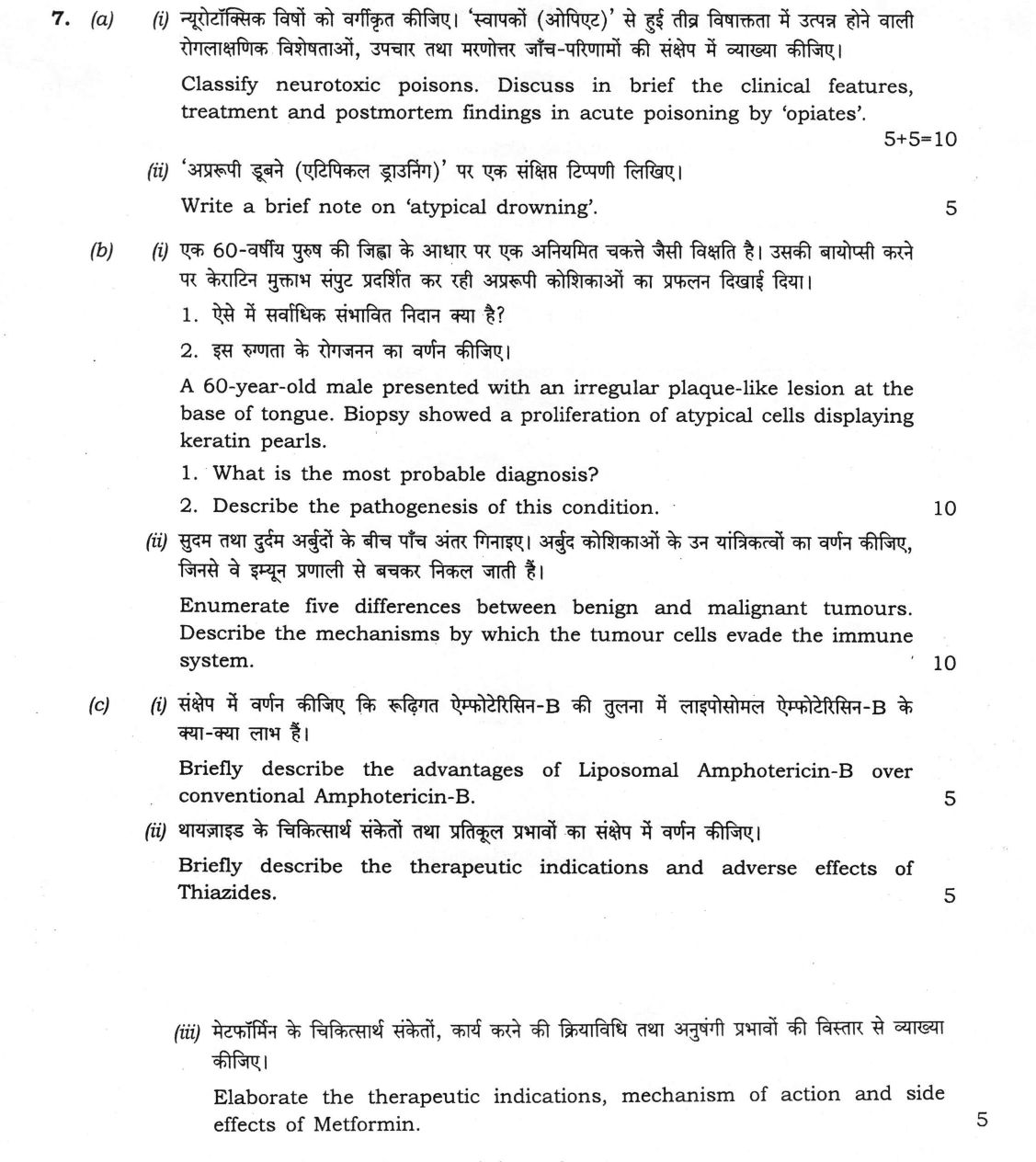
(a) (i) Classify neurotoxic poisons. Discuss in brief the clinical features, treatment and postmortem findings in acute poisoning…
Classify neurotoxic poisons. Discuss in brief the clinical features, treatment and postmortem findings in acute poisoning by 'opiates'. 10 marks
Write a brief note on 'atypical drowning'. 5 marks
A 60-year-old male presented with an irregular plaque-like lesion at the base of tongue. Biopsy showed a proliferation of atypical cells displaying keratin pearls. 1. What is the most probable diagnosis? 2. Describe the pathogenesis of this condition. 10 marks
Enumerate five differences between benign and malignant tumours. Describe the mechanisms by which the tumour cells evade the immune system. 10 marks
Briefly describe the advantages of Liposomal Amphotericin-B over conventional Amphotericin-B. 5 marks
Briefly describe the therapeutic indications and adverse effects of Thiazides. 5 marks
Elaborate the therapeutic indications, mechanism of action and side effects of Metformin. 5 marks
हिंदी में प्रश्न पढ़ें
न्यूरोटॉक्सिक विषों को वर्गीकृत कीजिए। ‘स्वापकों (ओपिएट)’ से हुई तीव्र विषाक्तता में उत्पन्न होने वाली रोगलाक्षणिक विशेषताओं, उपचार तथा मरणोत्तर जाँच-परिणामों की संक्षेप में व्याख्या कीजिए। (10 अंक)
‘अप्रूपी डूबने (एटिपिकल ड्राउनिंग)’ पर एक संक्षिप्त टिप्पणी लिखिए। (5 अंक)
एक 60-वर्षीय पुरुष की जिह्वा के आधार पर एक अनियमित चकत्ते जैसी विक्षति है। उसकी बायोप्सी करने पर केराटिन मुक्ताभ संपुट प्रदर्शित कर रही अप्रूपी कोशिकाओं का प्रफलन दिखाई दिया। 1. ऐसे में सर्वाधिक संभावित निदान क्या है? 2. इस रुग्णता के रोगजनन का वर्णन कीजिए। (10 अंक)
सुदम तथा दुर्दम अर्बुदों के बीच पाँच अंतर गिनाइए। अर्बुद कोशिकाओं के उन यांत्रिकत्वों का वर्णन कीजिए, जिनसे वे इम्यून प्रणाली से बचकर निकल जाती हैं। (10 अंक)
संक्षेप में वर्णन कीजिए कि रूढ़िगत एम्फोटेरिसिन-B की तुलना में लाइपोसोमल एम्फोटेरिसिन-B के क्या-क्या लाभ हैं। (5 अंक)
थायाज़ाइड के चिकित्सार्थ संकेतों तथा प्रतिकूल प्रभावों का संक्षेप में वर्णन कीजिए। (5 अंक)
मेटफॉर्मिन के चिकित्सार्थ संकेतों, कार्य करने की क्रियाविधि तथा अनुषंगी प्रभावों की विस्तार से व्याख्या कीजिए। (5 अंक)
Model answer
Drafted with AI by UPSC Answer Check against this question's marking rubric, to the expected length. UPSC does not publish answers for Mains — this is one way to score well, not an official key. How we build rubrics and answers.
(a)(i) Neurotoxic poisons and acute opiate poisoning (5 + 5 = 10 marks)
Classification of neurotoxic poisons. They act on the nervous system and are grouped by the site of action.
- Cerebral poisons: somniferous (opium and its alkaloids morphine and heroin, barbiturates, benzodiazepines, chloral hydrate); inebriants (alcohol, ether, chloroform); and deliriants (dhatura, belladonna, hyoscyamus, cannabis, cocaine).
- Spinal poisons: strychnine (nux vomica) and gelsemium, which act mainly on the spinal cord and cause convulsions or paralysis.
- Peripheral poisons: curare and conium (hemlock), which block the neuromuscular junction or peripheral nerves and cause paralysis.
Acute poisoning by opiates.
- Clinical features: the classic triad of pinpoint pupils, coma and respiratory depression (slow, shallow breathing with cyanosis). The skin is cold and clammy, muscles are flaccid, and there are hypotension, bradycardia and hypothermia. Pupils dilate late, when asphyxia sets in. Death is from respiratory failure, and pulmonary oedema may develop. In an addict, needle (track) marks are seen.
- Treatment: secure the airway and give oxygen and assisted ventilation. Give the specific antidote naloxone intravenously (0.4–2 mg, repeated or as an infusion, since its action is shorter than that of morphine). If the poison was swallowed, do gastric lavage with potassium permanganate (1 in 5000) even after absorption (morphine is excreted into the stomach), give activated charcoal, and keep the patient warm and observed. Treat pulmonary oedema and hypotension.
- Postmortem findings: no specific findings. There are cyanosis, congestion of the brain, lungs and other viscera, pulmonary oedema with froth at the mouth and nose, and pinpoint pupils may persist. Needle marks of addicts, and the smell of opium in the stomach contents, help. The diagnosis is confirmed by chemical analysis of the stomach contents, urine, bile, blood and liver for morphine.
(a)(ii) Atypical drowning (5 marks)
Drowning is death from asphyxia due to submersion in a liquid, or its aspiration. In typical drowning the classical findings (froth in the air passages, water in the lungs and stomach, and diatoms) are present. In atypical drowning they are absent or minimal.
- Dry drowning (10–15% of cases): laryngeal spasm caused by the first contact of water with the larynx closes the airway, so no water enters the lungs. Death is from asphyxia, and there is no froth or water in the lungs.
- Immersion syndrome (hydrocution): sudden death from cardiac arrest through vagal inhibition, on sudden immersion in cold water, after jumping or diving, or after a blow to the abdomen. Alcohol and a full stomach predispose. No water is found in the lungs.
- Submersion of an unconscious person: a person who has fainted or had an epileptic fit, a heart attack or a stroke, and falls into water, has little or no water in the lungs.
- Secondary (delayed) drowning: a survivor rescued from the water dies within hours to days from complications such as aspiration pneumonitis, pulmonary oedema, ARDS or infection.
- Shallow-water drowning: a person, often drunk or epileptic, falls face down into a few centimetres of water and cannot rise.
Medico-legal importance. The diagnosis rests on the circumstances and on exclusion of other causes, because the classical signs are missing. The manner of death (accident, suicide or homicide) must be judged from the scene and the injuries, and the possibility of the body being thrown in after death must be excluded.
(b)(i) Lesion at the base of the tongue with keratin pearls (10 marks)
1. Diagnosis. The most probable diagnosis is squamous cell carcinoma (well-differentiated, keratinising) of the base of the tongue. The keratin pearls, formed by atypical squamous cells, are typical.
2. Pathogenesis. Two pathways are recognised. Both begin with the accumulation of genetic changes in the squamous epithelium, which are shown as dysplasia, carcinoma in situ and then invasive carcinoma.
- Tobacco and alcohol pathway: carcinogens (nitrosamines and polycyclic hydrocarbons from tobacco, betel quid and areca nut, and alcohol as a solvent and through acetaldehyde) cause a "field" of injured mucosa. Mutations accumulate in TP53 (loss of the guardian of the genome), inactivation of CDKN2A (p16), amplification of cyclin D1 and overexpression of EGFR. This gives leukoplakia and erythroplakia, then dysplasia and carcinoma. It occurs mostly in older men, is keratinising, and is HPV-negative.
- HPV pathway: high-risk human papillomavirus (mainly type 16, and 18) infects the epithelium of the crypts of the tonsil and base of the tongue (oropharynx). The E6 protein degrades p53, and the E7 protein inactivates the Rb protein, which frees the cell cycle. Loss of Rb causes p16 to accumulate, and p16 overexpression is a marker. It occurs in younger, non-smoking patients, is often non-keratinising, and responds better to treatment.
- Other factors are poor oral hygiene, chronic irritation, and immunosuppression. The tumour spreads to the cervical (level II) lymph nodes.
(b)(ii) Benign and malignant tumours; escape from immune surveillance (10 marks)
Five differences.
- Growth rate: slow, and may stop, in benign; rapid and irregular in malignant.
- Growth pattern: benign tumours expand and are encapsulated, with a clear margin; malignant tumours infiltrate the surrounding tissue with no capsule, so they recur after excision.
- Differentiation: benign cells are well differentiated and resemble the tissue of origin; malignant cells show anaplasia, pleomorphism, hyperchromatic nuclei and a high nuclear-cytoplasmic ratio.
- Mitoses: few and normal in benign; many and atypical in malignant.
- Metastasis: absent in benign; frequent in malignant (through lymph, blood and body cavities). The effect on the host is also different: benign tumours act locally, and malignant tumours cause cachexia and death.
Mechanisms of escape from immune surveillance.
- Selection of tumour cells that lack antigens (immunoediting), and loss or reduced expression of MHC class I and antigen-processing molecules (TAP), so cytotoxic T cells cannot recognise them.
- Lack of costimulatory molecules (B7), which causes T-cell anergy.
- Expression of checkpoint ligands (PD-L1 binding PD-1, and CTLA-4 signalling), which exhausts T cells.
- Secretion of immunosuppressive factors (TGF-β, IL-10, VEGF, and IDO), and recruitment of regulatory T cells, myeloid-derived suppressor cells and tumour-associated macrophages.
- Expression of Fas ligand, which kills the attacking lymphocytes, and masking of antigens by a coat of sialic acid or dense stroma.
(c)(i) Advantages of liposomal amphotericin B over conventional amphotericin B (5 marks)
Liposomal amphotericin B encloses the drug in a lipid bilayer, in place of the deoxycholate of the conventional formulation.
- Much less nephrotoxicity, the main dose-limiting toxicity of the conventional drug, since the drug binds poorly to mammalian (cholesterol) membranes.
- Fewer infusion reactions (fever, chills, rigors and hypotension), and less hypokalaemia, hypomagnesaemia and anaemia.
- Higher doses can be given (3–5 mg/kg/day, and up to 10 mg/kg for some infections) against 0.5–1 mg/kg for the conventional drug, so it is more effective.
- Better pharmacokinetics: the liposomes are taken up by the macrophages of the liver, spleen and lung (the reticuloendothelial system), so tissue levels are high and kidney levels are low, and single or short-course regimens are possible (for example a single dose for visceral leishmaniasis).
- It is useful in patients with renal impairment, in mucormycosis, invasive aspergillosis, cryptococcal meningitis and febrile neutropenia. Its drawback is its high cost.
(c)(ii) Thiazides (5 marks)
Therapeutic indications. Hydrochlorothiazide, chlorthalidone, indapamide and metolazone are used for:
- Hypertension (a first-line drug).
- Oedema of cardiac, hepatic and renal origin.
- Idiopathic hypercalciuria and calcium stones, because they reduce urinary calcium; also osteoporosis.
- Nephrogenic diabetes insipidus (they reduce urine volume).
Adverse effects.
- Hypokalaemia, hyponatraemia, hypomagnesaemia and hypochloraemic alkalosis; hypercalcaemia.
- Hyperuricaemia (precipitating gout), hyperglycaemia (impaired glucose tolerance), and raised LDL cholesterol and triglycerides.
- Hypovolaemia and postural hypotension, erectile dysfunction, photosensitivity, and rare pancreatitis, blood dyscrasias and sulphonamide allergy.
- The hypokalaemia can provoke digoxin toxicity and arrhythmias. They are ineffective when the GFR falls below about 30 mL/min.
(c)(iii) Metformin (5 marks)
Therapeutic indications. Type 2 diabetes mellitus (first-line, particularly in the obese), prediabetes (to prevent progression), polycystic ovary syndrome (to improve insulin resistance and ovulation), gestational diabetes (an alternative) and as an adjunct to insulin.
Mechanism of action. Metformin is a biguanide. It inhibits mitochondrial complex I and activates AMP-activated protein kinase (AMPK). The main effect is to reduce hepatic gluconeogenesis. It also increases insulin sensitivity and glucose uptake in muscle and fat (GLUT4), reduces intestinal absorption of glucose, and increases GLP-1. It does not stimulate insulin secretion, so hypoglycaemia is rare when it is used alone, and body weight is stable or falls.
Side effects. Gastrointestinal upset (metallic taste, anorexia, nausea, abdominal discomfort and diarrhoea, reduced by taking it with meals), vitamin B₁₂ deficiency on long-term use, and rarely lactic acidosis. It is contraindicated in renal impairment (eGFR below 30), hepatic failure, heart failure with hypoxia, and alcoholism, and it is stopped before iodinated contrast studies.
How this answer will be evaluated
Evaluation rubric
Each sub-part is marked on its own, against the marks and word limit printed on the paper.
- (a)(i) (a)(i) Classify neurotoxic poisons and discuss briefly the clinical features, treatment and postmortem findings of acute opiate poisoning (5 + 5 = 10 marks). 10 marks
Must cover
- Classification: cerebral (somniferous, inebriant, deliriant), spinal (strychnine, gelsemium) and peripheral (curare, conium)
- Clinical features: pinpoint pupils, coma and respiratory depression
- Treatment: airway and ventilation, naloxone, gastric lavage with potassium permanganate, charcoal
- Postmortem: non-specific cyanosis, visceral congestion, pulmonary oedema, needle marks; chemical analysis
Loses marks
- Placing opium among spinal poisons.
- Naming atropine as the antidote.
- Omitting the postmortem findings.
Earns more
- Examples given under each class.
- All three heads (features, treatment, postmortem) covered.
Extra mark
- Fatal dose and period of morphine
- (a)(ii) (a)(ii) Write a brief note on atypical drowning (5 marks). 5 marks
Must cover
- Definition of drowning as asphyxia from submersion in liquid
- Dry drowning through laryngeal spasm with no water in the lungs
- Immersion syndrome by vagal inhibition; submersion of an unconscious person
- Secondary (delayed) drowning and shallow-water drowning, with medico-legal importance
Loses marks
- Describing only typical drowning.
- Giving dry drowning as water in the lungs.
- Omitting the medico-legal note.
Earns more
- Mechanism of each type given.
- Absence of classical findings and diagnosis by exclusion.
Extra mark
- Percentages (dry drowning about 10–15%)
- (b)(i) (b)(i) A 60-year-old man with a plaque at the base of the tongue and keratin pearls on biopsy: most probable diagnosis and pathogenesis (10 marks). 10 marks
Must cover
- Diagnosis committed to: squamous cell carcinoma of the base of the tongue
- Tobacco and alcohol pathway: carcinogens, field change, TP53, CDKN2A and cyclin D1 changes
- HPV pathway: types 16 and 18, E6 degrading p53 and E7 inactivating Rb, p16 overexpression
- Progression from dysplasia to carcinoma in situ and invasion, with nodal spread
Loses marks
- Naming adenocarcinoma or basal cell carcinoma.
- Describing only one pathway.
- Hedging the diagnosis.
Earns more
- Both pathways described with the molecular events.
- Risk factors such as betel quid and areca nut.
Extra mark
- Prognostic difference between HPV-positive and negative disease
- (b)(ii) (b)(ii) Enumerate five differences between benign and malignant tumours; describe the mechanisms by which tumour cells evade the immune system (10 marks). 10 marks
Must cover
- Five differences: growth rate, growth pattern and capsule, differentiation, mitoses, metastasis
- Loss of MHC class I and antigen loss (immunoediting)
- Checkpoint ligands (PD-L1, CTLA-4), lack of costimulation
- Immunosuppressive factors and cells (TGF-β, IL-10, Tregs, MDSCs) and Fas ligand
Loses marks
- Fewer than five differences.
- Listing evasion without a mechanism.
- Attributing metastasis to benign tumours.
Earns more
- Five clearly paired differences.
- Four or more evasion mechanisms explained.
Extra mark
- IDO and tumour-associated macrophages
- (c)(i) (c)(i) Briefly describe the advantages of liposomal amphotericin B over conventional amphotericin B (5 marks). 5 marks
Must cover
- Much less nephrotoxicity
- Fewer infusion reactions and less hypokalaemia
- Higher doses (3–5 mg/kg/day) and single or short-course regimens
- Better tissue distribution through the reticuloendothelial system; high cost as the drawback
Loses marks
- Stating that it is more nephrotoxic.
- No mention of the drawback.
- Describing only the mechanism of action.
Earns more
- Comparison with the conventional formulation made explicit.
- Uses in renal impairment or visceral leishmaniasis.
Extra mark
- Mucormycosis and cryptococcal meningitis
- (c)(ii) (c)(ii) Briefly describe the therapeutic indications and adverse effects of thiazides (5 marks). 5 marks
Must cover
- Indications: hypertension, oedema, hypercalciuria and calcium stones, nephrogenic diabetes insipidus
- Electrolyte effects: hypokalaemia, hyponatraemia, hypomagnesaemia, hypercalcaemia
- Metabolic effects: hyperuricaemia, hyperglycaemia, dyslipidaemia
- Other effects: hypovolaemia, sulphonamide allergy, digoxin toxicity, ineffective when GFR is low
Loses marks
- Stating hypocalcaemia as an effect.
- Stating that they are effective in severe renal failure.
- Omitting the metabolic effects.
Earns more
- Both indications and adverse effects covered.
- Example drugs named.
Extra mark
- Osteoporosis benefit
- (c)(iii) (c)(iii) Elaborate the therapeutic indications, mechanism of action and side effects of metformin (5 marks). 5 marks
Must cover
- Indications: type 2 diabetes (first line), prediabetes, PCOS
- Mechanism: AMPK activation and mitochondrial complex I inhibition, reduced hepatic gluconeogenesis
- Increased peripheral insulin sensitivity and reduced intestinal glucose absorption, without insulin secretion
- Side effects: gastrointestinal upset, lactic acidosis, vitamin B12 deficiency, and contraindications (renal impairment)
Loses marks
- Stating that it stimulates insulin release.
- Omitting lactic acidosis.
- Wrong drug class.
Earns more
- All three heads covered.
- Reason why hypoglycaemia is rare.
Extra mark
- GLP-1 increase and weight neutrality
What "Classify" is asking you to do
Sort into categories on a stated basis, and make the basis explicit before you sort. A classification is judged on whether the categories are exhaustive, mutually exclusive and drawn on a single consistent principle.
Structure that answers it
State the basis of classification → category one with its members → category two → category three → note the overlaps and borderline cases
Where marks are lost
Categories that are not mutually exclusive, or a basis of division left unstated.
Practice this exact question
Write your answer and it is marked point by point against the model answer above — what you covered, what you missed, what you got wrong.
Evaluate my answer →More from Medical Science 2026 Paper I
- Q4 (a) (i) Describe the cerebrospinal fluid (CSF) flow from site of production to its absorp…
- Q5 (a) (i) State the therapeutic indications, drug interactions and side effects of Methotre…
- Q6 (a) (i) Define inflammation. Describe the cardinal features of acute inflammation. (10 ma…
- Q7 (a) (i) Classify neurotoxic poisons. Discuss in brief the clinical features, treatment an…
- Q8 (a) (i) 1. Enumerate five agents of malaria in humans. 2. Describe in brief rapid diagnos…