Paper II — Q1
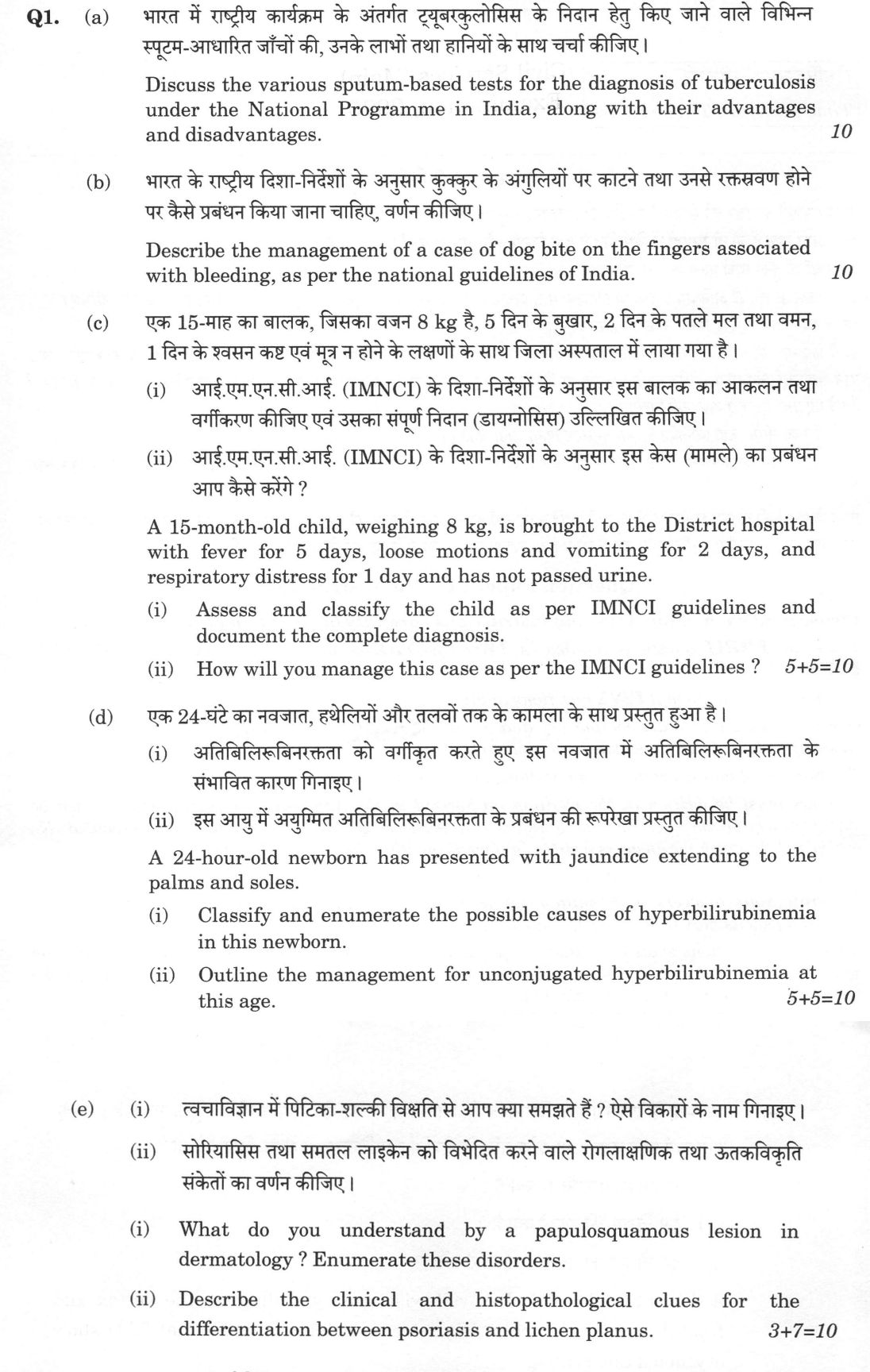
(a) Discuss the various sputum-based tests for the diagnosis of tuberculosis under the National Programme in India, along with…
Discuss the various sputum-based tests for the diagnosis of tuberculosis under the National Programme in India, along with their advantages and disadvantages. 10 marks
Describe the management of a case of dog bite on the fingers associated with bleeding, as per the national guidelines of India. 10 marks
A 15-month-old child, weighing 8 kg, is brought to the District hospital with fever for 5 days, loose motions and vomiting for 2 days, and respiratory distress for 1 day and has not passed urine. Assess and classify the child as per IMNCI guidelines and document the complete diagnosis.
How will you manage this case as per the IMNCI guidelines ? 10 marks
A 24-hour-old newborn has presented with jaundice extending to the palms and soles. Classify and enumerate the possible causes of hyperbilirubinemia in this newborn.
Outline the management for unconjugated hyperbilirubinemia at this age. 10 marks
What do you understand by a papulosquamous lesion in dermatology ? Enumerate these disorders.
Describe the clinical and histopathological clues for the differentiation between psoriasis and lichen planus. 10 marks
हिंदी में प्रश्न पढ़ें
भारत में राष्ट्रीय कार्यक्रम के अंतर्गत ट्यूबरकुलोसिस के निदान हेतु किए जाने वाले विभिन्न स्पूटम-आधारित जाँचों की, उनके लाभों तथा हानियों के साथ चर्चा कीजिए। (10 अंक)
भारत के राष्ट्रीय दिशा-निर्देशों के अनुसार कुक्कुर के अंगुलियों पर काटने तथा उनसे रक्तस्रावण होने पर कैसे प्रबंधन किया जाना चाहिए, वर्णन कीजिए। (10 अंक)
एक 15-माह का बालक, जिसका वजन 8 kg है, 5 दिन के बुखार, 2 दिन के पतले मल तथा वमन, 1 दिन के श्वसन कष्ट एवं मूत्र न होने के लक्षणों के साथ जिला अस्पताल में लाया गया है। आई.एम.एन.सी.आई. (IMNCI) के दिशा-निर्देशों के अनुसार इस बालक का आकलन तथा वर्गीकरण कीजिए एवं उसका संपूर्ण निदान (डायग्नोसिस) उल्लिखित कीजिए।
आई.एम.एन.सी.आई. (IMNCI) के दिशा-निर्देशों के अनुसार इस केस (मामले) का प्रबंधन आप कैसे करेंगे ? (10 अंक)
एक 24-घंटे का नवजात, हथेलियों और तलवों तक के कामला के साथ प्रस्तुत हुआ है। अतिबिलिरुबिनरक्तता को वर्गीकृत करते हुए इस नवजात में अतिबिलिरुबिनरक्तता के संभावित कारण गिनाइए।
इस आयु में अयुग्मित अतिबिलिरुबिनरक्तता के प्रबंधन की रूपरेखा प्रस्तुत कीजिए। (10 अंक)
त्वचाविज्ञान में पिटिका-शल्की विक्षति से आप क्या समझते हैं? ऐसे विकारों के नाम गिनाइए।
सोरियासिस तथा समतल लाइकेन को विभेदित करने वाले रोगलाक्षणिक तथा ऊतकविकृति संकेतों का वर्णन कीजिए। (10 अंक)
Model answer
Drafted with AI by UPSC Answer Check against this question's marking rubric, to the expected length. UPSC does not publish answers for Mains — this is one way to score well, not an official key. How we build rubrics and answers.
(a) Sputum-based tests for tuberculosis under the National TB Elimination Programme (10 marks)
Under the NTEP, every presumptive TB patient gives two sputum samples (a spot sample and an early-morning sample). A molecular test is now the initial test, and smear microscopy is kept mainly for follow-up.
- Sputum smear microscopy (Ziehl-Neelsen or fluorescent LED microscopy). Acid-fast bacilli are seen in a stained smear.
- Advantages: cheap, rapid (the same day), simple, available at every microscopy centre, identifies the infectious (smear-positive) patients, and is used to monitor treatment response.
- Disadvantages: low sensitivity (needs about 10,000 bacilli/mL, so 50–60% of culture-positive cases are missed, especially in children, HIV and extrapulmonary disease), cannot separate M. tuberculosis from non-tuberculous mycobacteria, and gives no information on drug resistance.
- Cartridge-based nucleic acid amplification test (CBNAAT, Xpert MTB/RIF). A real-time PCR that detects M. tuberculosis DNA and the rpoB mutation for rifampicin resistance in about 2 hours.
- Advantages: high sensitivity (about 85–90% in sputum) and specificity, rapid, detects rifampicin resistance (a marker of MDR-TB) at the same time, needs little training, and the closed cartridge reduces contamination and biosafety risk.
- Disadvantages: expensive equipment and cartridges, needs a stable power supply, temperature control and annual calibration, detects only rifampicin (not isoniazid) resistance, can be positive from dead bacilli (so it is not used for follow-up), and may give false rifampicin-resistant results at low bacillary load.
- Truenat (chip-based micro-PCR). A battery-operated, portable real-time PCR that detects M. tuberculosis and, on a second chip, rifampicin resistance in about 1 hour.
- Advantages: can be placed at peripheral level (primary health centres), and needs no cold chain or air conditioning.
- Disadvantages: two-step procedure, so more handling, and the resistance test is done only on positive samples.
- Line probe assay (LPA). A PCR followed by reverse hybridisation of the product to probes on a strip. The first-line LPA (GenoType MTBDRplus) detects rifampicin and isoniazid resistance, and the second-line LPA (MTBDRsl) detects fluoroquinolone and injectable-drug resistance. It is used on smear-positive sputum or on culture isolates.
- Advantages: results in 1–2 days, detects both drugs for MDR-TB, and can be used for second-line drugs.
- Disadvantages: needs a well-equipped laboratory with separate rooms and trained staff, has a limited set of mutations, and is not sensitive on smear-negative samples.
- Culture and drug-susceptibility testing. Solid Löwenstein-Jensen medium (4–8 weeks) or liquid MGIT 960 (1–6 weeks).
- Advantages: the gold standard, the most sensitive method (detects 10–100 bacilli/mL), identifies the species, and allows full phenotypic drug-susceptibility testing.
- Disadvantages: slow (especially on solid medium), needs a biosafety level 3 laboratory, expensive, and is prone to contamination.
(b) Management of a dog bite on the fingers with bleeding (10 marks)
Under the national guidelines (National Rabies Control Programme, NCDC), a bite that breaks the skin and bleeds is a Category III exposure, so both wound care, passive immunisation (rabies immunoglobulin) and an active vaccine course are needed. The fingers are richly supplied with nerves and lie close to the central nervous system, so the incubation may be short, and treatment must start at once.
- Wound care (immediate). Wash the wound with running water and soap (liquid soap preferred) for at least 15 minutes, then apply an antiseptic (povidone-iodine or alcohol). Do not suture the wound, and do not apply chilli, turmeric, oil or any irritant. If suturing is unavoidable, do it loosely, after rabies immunoglobulin infiltration.
- Rabies immunoglobulin (RIG). Give it on day 0 (it can be given up to day 7 of the first vaccine dose, not later). The dose is human RIG 20 IU/kg, or equine RIG 40 IU/kg (after a skin test), or rabies monoclonal antibody 3.33 IU/kg. Infiltrate the whole dose into and around the wound as far as anatomically possible (for finger wounds, small volumes are given into the tissue around the wound), and give any remainder by deep intramuscular injection at a site away from the vaccine, using a separate syringe.
- Cell-culture anti-rabies vaccine. Started the same day, in either schedule:
- Intradermal (updated Thai Red Cross): 0.1 mL at two sites on days 0, 3, 7 and 28.
- Intramuscular (Essen): 1 mL in the deltoid on days 0, 3, 7, 14 and 28.
- Other measures. Tetanus toxoid; an antibiotic such as amoxicillin-clavulanate for a deep or contaminated wound; analgesia. Do not wait for observation of the dog before starting treatment; the vaccine may be stopped if a domestic dog remains healthy for 10 days. Counsel the patient to complete the schedule, and identify the dog's vaccination status and location.
(c) A 15-month-old child, 8 kg, with fever, loose motions, vomiting, respiratory distress and no urine (5 + 5 = 10 marks)
(i) Assessment and classification (5 marks). In IMNCI a child aged 2 months to 5 years is assessed first for general danger signs (unable to drink, vomiting everything, convulsions, lethargy or unconsciousness), then for the main symptoms and for nutrition, anaemia and immunisation.
- Cough or difficult breathing: count the breathing rate (fast breathing is 40 or more per minute at 12 months to 5 years) and look for chest indrawing and stridor.
- Diarrhoea: look for lethargy, sunken eyes, inability to drink or drinking poorly, and a skin pinch that goes back very slowly (2 seconds or more). The absent urine output is a further sign of severe fluid loss.
- Fever: 5 days of fever, so check for stiff neck, malaria (blood smear or RDT in a malaria area), dengue and measles.
- Nutrition: the weight of 8 kg is low for 15 months, so check for visible severe wasting, oedema, MUAC and weight for age.
Complete diagnosis (classification). On these features the child earns more than one classification:
- Severe dehydration (diarrhoea with lethargy or sunken eyes or slow skin pinch, and no urine).
- Severe pneumonia or very severe disease (respiratory distress with chest indrawing, or any danger sign). Note that the fast, deep breathing may also be acidotic breathing from dehydration and shock, but pneumonia must be treated until excluded.
- Very severe febrile disease (fever with a danger sign such as lethargy), with malaria or dengue to be excluded.
- The nutritional status is graded separately (very low weight or severe acute malnutrition if the signs are present).
Beyond IMNCI, the anuria suggests pre-renal acute kidney injury from dehydration and possible sepsis.
(ii) Management (5 marks). This child needs urgent inpatient care, and treatment starts at once, before the tests.
- Plan C (intravenous rehydration). For a child aged 12 months or more, give 100 mL/kg of Ringer's lactate (or normal saline): 30 mL/kg in the first 30 minutes and 70 mL/kg in the next 2½ hours. For 8 kg this is a total of 800 mL: 240 mL in 30 minutes and 560 mL in 2½ hours. Reassess every 15–30 minutes, repeat the 30 mL/kg if the radial pulse is still weak, and give ORS (5 mL/kg/hour) as soon as the child can drink.
- Because of the respiratory distress and the absent urine output, watch closely for fluid overload (crepitations, tender enlarged liver, rising breathing rate), and record the urine output.
- Treat the other classifications: give oxygen if SpO₂ is below 90%; give the first dose of an injectable antibiotic (for example ceftriaxone 80–100 mg/kg, or ampicillin with gentamicin); paracetamol for fever; prevent hypoglycaemia; start zinc 20 mg daily for 14 days when the child is stable.
- Investigate and refer. Blood glucose, complete blood count, malaria and dengue tests, urea, creatinine and electrolytes, chest X-ray and cultures. If the child stays anuric after rehydration, involve a paediatric nephrologist for kidney injury. Keep the child warm, keep the mother with the child, continue breastfeeding, and refer urgently to a higher centre if the facility cannot provide this care.
(d) A 24-hour-old newborn with jaundice extending to the palms and soles (5 + 5 = 10 marks)
(i) Classification and causes (5 marks). Hyperbilirubinaemia in the newborn is classified as:
- Unconjugated (indirect): physiological jaundice (appears after 24 hours, peaks on day 3–5) or pathological (appearing in the first 24 hours, a rise of more than 5 mg/dL/day, a total serum bilirubin above 15 mg/dL, or persisting beyond 2 weeks).
- Conjugated (direct): direct bilirubin above 1 mg/dL when the total is below 5 mg/dL, or above 20% of the total. It always needs investigation.
Jaundice in the first 24 hours is always pathological, and extension to the palms and soles (Kramer zone 5) indicates a bilirubin above about 15 mg/dL, so it is an emergency. The likely causes are:
- Haemolytic disease: Rh isoimmunisation (the most severe), ABO incompatibility (O mother, A or B baby), minor blood-group incompatibility (Kell, Duffy), G6PD deficiency, hereditary spherocytosis and pyruvate kinase deficiency.
- Infection: congenital (TORCH) infection and early-onset neonatal sepsis.
- Others: concealed haemorrhage (cephalohaematoma, subgaleal or intracranial), polycythaemia, and rarely inherited conjugation defects (Crigler-Najjar) or drugs. Conjugated causes (neonatal hepatitis, biliary atresia, galactosaemia) rarely present so early.
(ii) Management of unconjugated hyperbilirubinaemia (5 marks).
- Immediate work-up: serum total and direct bilirubin, the baby's and mother's blood group and Rh, direct Coombs test, haemoglobin and reticulocyte count, peripheral smear, G6PD assay, and a sepsis screen.
- Phototherapy: start intensive phototherapy immediately, with blue-green light (460–490 nm) of irradiance 30 µW/cm²/nm or more, the baby undressed with eyes covered, and the maximum skin area exposed, continuously. Continue breastfeeding or increase feeds, and check bilirubin every 4–6 hours. Stop when the level falls well below the threshold.
- Exchange transfusion: a double-volume exchange (about 160 mL/kg) with blood typed and cross-matched to the mother (O Rh-negative in Rh disease, fresh under 5 days), if the bilirubin reaches the exchange level for age and gestation (using the standard charts), if it rises by more than 0.5 mg/dL per hour, if phototherapy fails, or at any sign of bilirubin encephalopathy (lethargy, hypertonia, arching, high-pitched cry).
- Intravenous immunoglobulin (IVIG): 0.5–1 g/kg over 2 hours in isoimmune haemolytic disease (Rh or ABO), when the bilirubin is near the exchange level, and it can be repeated after 12 hours.
- Treat the cause and prevent complications: antibiotics for sepsis, stop oxidant drugs in G6PD deficiency, keep the baby hydrated and warm, and monitor for kernicterus, with a neurological and hearing follow-up.
(e) Papulosquamous disorders; psoriasis versus lichen planus (3 + 7 = 10 marks)
(i) Papulosquamous lesion and its disorders (3 marks). A papulosquamous lesion is a raised lesion (a papule or plaque) that is red or violaceous and covered with scale. The disorders in this group are psoriasis, lichen planus, pityriasis rosea, pityriasis rubra pilaris, seborrhoeic dermatitis, secondary syphilis, tinea corporis, parapsoriasis, pityriasis lichenoides chronica, discoid lupus erythematosus, and mycosis fungoides.
(ii) Psoriasis versus lichen planus (7 marks).
Clinical clues.
- Lesion and colour: psoriasis has well-defined erythematous plaques covered with thick silvery-white (micaceous) scale; lichen planus has flat-topped, shiny, violaceous (purple) polygonal papules and plaques.
- Signs: psoriasis shows the Auspitz sign (pinpoint bleeding on scraping the scale) and the candle-grease sign; lichen planus shows fine white lines on the surface (Wickham's striae). The Koebner phenomenon occurs in both.
- Sites: psoriasis affects extensor surfaces (elbows, knees), the scalp and the sacrum; lichen planus affects the flexor surfaces of the wrists, forearms, ankles and lower back, and the oral mucosa (a white lacy pattern).
- Nails and itch: psoriatic nails show pitting, oil-drop spots and onycholysis; lichen planus nails show longitudinal ridging and pterygium. Itch is mild in psoriasis and severe in lichen planus. Healed lichen planus leaves post-inflammatory hyperpigmentation, and psoriasis may involve joints.
Histopathological clues.
- Psoriasis: parakeratosis, loss of the granular layer, regular (club-shaped) elongation of rete ridges with thinning of the epidermis over the dermal papillae (suprapapillary plates), dilated tortuous capillaries in the papillae, and collections of neutrophils in the stratum corneum (Munro microabscesses) and in the spinous layer (spongiform pustules of Kogoj).
- Lichen planus: orthokeratosis, wedge-shaped hypergranulosis, irregular "saw-tooth" acanthosis, liquefactive degeneration of the basal layer, a dense band-like lymphocytic infiltrate hugging the dermo-epidermal junction, colloid (Civatte) bodies, and pigment incontinence (melanophages) in the upper dermis.
How this answer will be evaluated
Evaluation rubric
Each sub-part is marked on its own, against the marks and word limit printed on the paper.
- (a) (a) Discuss the sputum-based tests for diagnosis of tuberculosis under the national programme, with their advantages and disadvantages (10 marks). 10 marks
Must cover
- Smear microscopy: cheap and rapid; low sensitivity, no species or resistance information
- CBNAAT (Xpert MTB/RIF): high sensitivity, rifampicin resistance in about 2 hours; costly, power needed, no isoniazid result
- Truenat and line probe assay with their merits and demerits
- Culture (LJ and MGIT) as gold standard with DST; slow, biosafety and cost limits
Loses marks
- Listing tests without advantages or disadvantages.
- Including chest X-ray or Mantoux as sputum tests.
- Stating that smear detects drug resistance.
Earns more
- Advantage and disadvantage stated for each test.
- Molecular test as the initial test under NTEP.
Extra mark
- Second-line LPA and fluorescence microscopy
- (b) (b) Describe the management of a dog bite on the fingers with bleeding as per the national guidelines of India (10 marks). 10 marks
Must cover
- Category III exposure identified
- Immediate wound washing with soap and running water for 15 minutes, antiseptic, no suturing or irritants
- RIG on day 0: human 20 IU/kg or equine 40 IU/kg or monoclonal 3.33 IU/kg, infiltrated into and around the wound
- Cell-culture vaccine: intradermal 0.1 mL two sites on days 0, 3, 7, 28 or intramuscular Essen; tetanus and antibiotics
Loses marks
- Classifying it as Category II.
- Suturing the wound at once or applying chilli or turmeric.
- Giving vaccine alone without RIG.
Earns more
- Remainder of RIG given at a distant site with a separate syringe.
- Observation of the dog for 10 days without delaying treatment.
Extra mark
- Reason why finger bites are high risk
- (c) (c) A 15-month-old child, 8 kg, with fever for 5 days, loose motions and vomiting for 2 days, respiratory distress for 1 day and no urine: assess, classify and diagnose per IMNCI; state the management (5 + 5 = 10 marks). 10 marks
Must cover
- Assessment: danger signs, breathing rate and chest indrawing, dehydration signs, fever work-up, nutrition
- Complete classification: severe dehydration, severe pneumonia or very severe disease, very severe febrile disease
- Plan C: 100 mL/kg, that is 800 mL (240 mL in 30 minutes, 560 mL in 2½ hours) with reassessment
- Pre-referral or first-line drugs: oxygen, injectable antibiotic, paracetamol, glucose, zinc; watch for fluid overload and refer urgently
Loses marks
- Giving a single label only.
- Using Plan B (oral ORS) for severe dehydration.
- Wrong volumes for 8 kg or the infant schedule.
Earns more
- Fast breathing threshold of 40 per minute at 12 months to 5 years.
- Anuria linked to acute kidney injury.
Extra mark
- Malaria and dengue testing and fluid-overload precautions
- (d) (d) A 24-hour-old newborn with jaundice to the palms and soles: classify and enumerate the causes of hyperbilirubinaemia; outline management of unconjugated hyperbilirubinaemia (5 + 5 = 10 marks). 10 marks
Must cover
- Classification into unconjugated and conjugated; jaundice in the first 24 hours is always pathological (Kramer zone 5)
- Causes: Rh and ABO incompatibility, G6PD deficiency, sepsis or TORCH, concealed haemorrhage, polycythaemia
- Investigations and intensive phototherapy at once with 4–6 hourly bilirubin
- Exchange transfusion (double volume, indications) and IVIG 0.5–1 g/kg; treat the cause, watch for kernicterus
Loses marks
- Calling the jaundice physiological.
- Omitting exchange transfusion or IVIG.
- Listing only conjugated causes.
Earns more
- Physiological jaundice contrasted with pathological criteria.
- Blue-green light with irradiance of 30 µW/cm²/nm or more.
Extra mark
- Coombs test, and G6PD and reticulocyte assays
- (e) (e) Define the papulosquamous lesion and enumerate the disorders; describe the clinical and histopathological clues differentiating psoriasis from lichen planus (3 + 7 = 10 marks). 10 marks
Must cover
- Definition: raised scaly papules or plaques
- Enumeration: psoriasis, lichen planus, pityriasis rosea, secondary syphilis, seborrhoeic dermatitis, tinea, pityriasis rubra pilaris
- Clinical: silvery scale, Auspitz sign, extensor sites, nail pitting against violaceous polygonal papules, Wickham striae, flexor and mucosal sites, severe itch
- Histology: psoriasis with parakeratosis, absent granular layer, Munro abscesses, club-shaped rete ridges; lichen planus with hypergranulosis, saw-tooth acanthosis, basal liquefaction, band-like infiltrate, Civatte bodies
Loses marks
- Giving only a clinical comparison.
- Assigning Munro microabscesses to lichen planus.
- Naming fewer than four disorders.
Earns more
- Both clinical and histological sets given side by side.
- Koebner phenomenon noted in both.
Extra mark
- Nail changes and mucosal disease
What "Discuss" is asking you to do
Lay the issue out from more than one side — how it arose, what is claimed for it, what is held against it, and where it now stands. UPSC attaches discuss to broad topics with several live dimensions, so coverage of the dimensions earns more than the strength of your opinion.
Structure that answers it
Set the issue up → the case as it is made → the case against → the dimension both sides leave out → where the balance now lies
Where marks are lost
Listing facts with no thread between them, or arguing one side throughout and calling it a discussion.
Practice this exact question
Write your answer and it is marked point by point against the model answer above — what you covered, what you missed, what you got wrong.
Evaluate my answer →More from Medical Science 2026 Paper II
- Q1 (a) Discuss the various sputum-based tests for the diagnosis of tuberculosis under the Na…
- Q2 (a) A 20-year-old medical student presents with fever, dry cough, and right-sided chest p…
- Q3 (a) An 18-year-old girl presents with episodic breathlessness, cough with sputum, chest t…
- Q4 (a) A 45-year-old hepatitis-C positive patient presents with icterus, oliguria, abdominal…