Paper II — Q2
(a) A 20-year-old medical student presents with fever, dry cough, and right-sided chest pain. She also has loss of weight and…
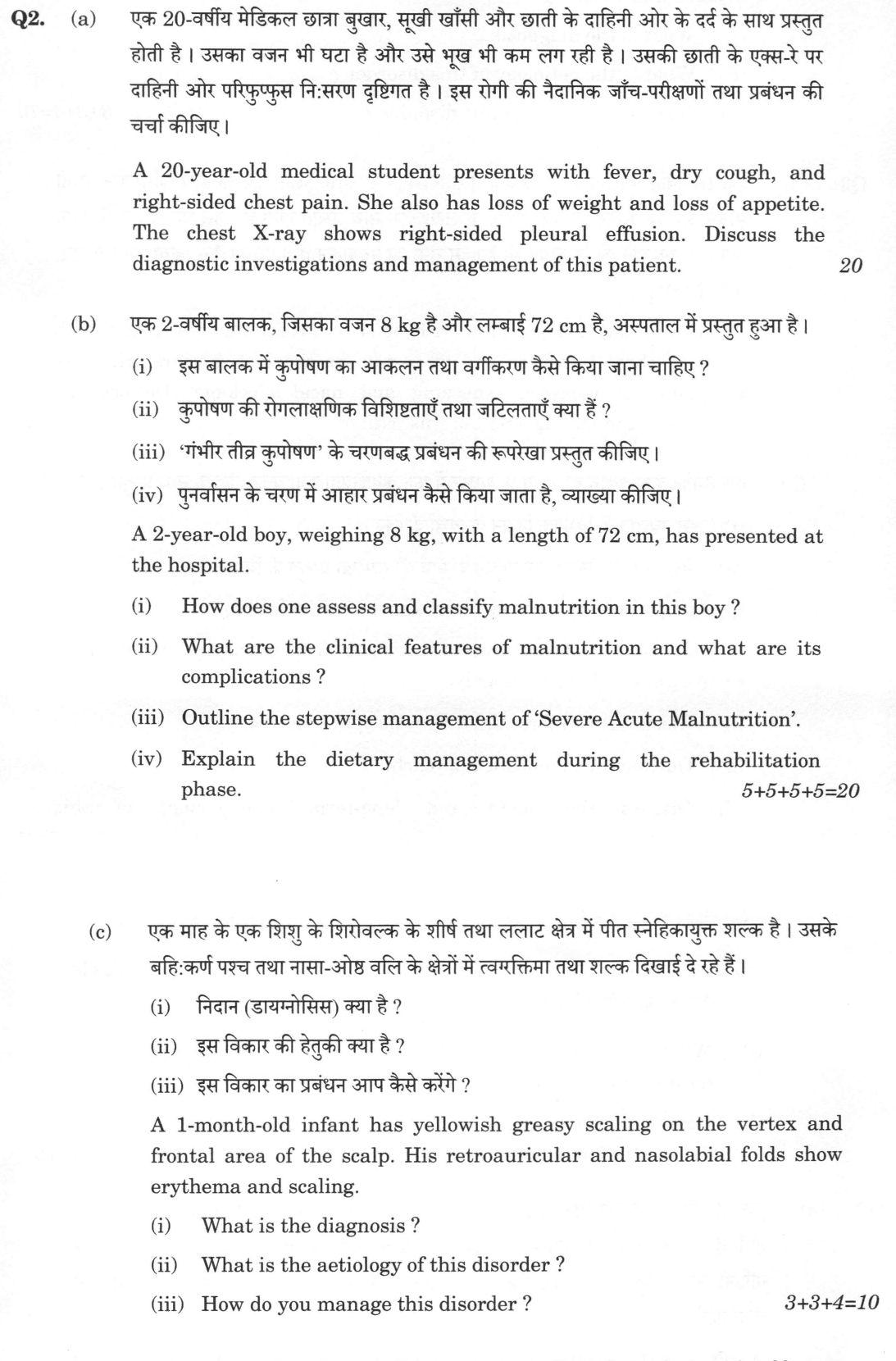
A 20-year-old medical student presents with fever, dry cough, and right-sided chest pain. She also has loss of weight and loss of appetite. The chest X-ray shows right-sided pleural effusion. Discuss the diagnostic investigations and management of this patient. 20 marks
A 2-year-old boy, weighing 8 kg, with a length of 72 cm, has presented at the hospital. How does one assess and classify malnutrition in this boy ?
What are the clinical features of malnutrition and what are its complications ?
Outline the stepwise management of ‘Severe Acute Malnutrition’.
Explain the dietary management during the rehabilitation phase. 20 marks
A 1-month-old infant has yellowish greasy scaling on the vertex and frontal area of the scalp. His retroauricular and nasolabial folds show erythema and scaling. What is the diagnosis?
What is the aetiology of this disorder?
How do you manage this disorder? 10 marks
हिंदी में प्रश्न पढ़ें
एक 20-वर्षीय मेडिकल छात्रा बुखार, सूखी खाँसी और छाती के दाहिनी ओर के दर्द के साथ प्रस्तुत होती है। उसका वजन भी घटा है और उसे भूख भी कम लग रही है। उसकी छाती के एक्स-रे पर दाहिनी ओर परिफुप्फुस निःसरण दृष्टिगत है। इस रोगी की नैदानिक जाँच-परीक्षणों तथा प्रबंधन की चर्चा कीजिए। (20 अंक)
एक 2-वर्षीय बालक, जिसका वजन 8 kg है और लम्बाई 72 cm है, अस्पताल में प्रस्तुत हुआ है। इस बालक में कुपोषण का आकलन तथा वर्गीकरण कैसे किया जाना चाहिए?
कुपोषण की रोगलाक्षणिक विशिष्टताएँ तथा जटिलताएँ क्या हैं?
‘गंभीर तीव्र कुपोषण’ के चरणबद्ध प्रबंधन की रूपरेखा प्रस्तुत कीजिए।
पुनर्वासन के चरण में आहार प्रबंधन कैसे किया जाता है, व्याख्या कीजिए। (20 अंक)
एक माह के एक शिशु के शिरोवल्क के शीर्ष तथा ललाट क्षेत्र में पीत स्नेहिकायुक्त शल्क है। उसके बहिःकर्ण पश्च तथा नासा-ओष्ठ वलि के क्षेत्रों में त्वग्क्षिमा तथा शल्क दिखाई दे रहे हैं। निदान (डायग्नोसिस) क्या है?
इस विकार की हेतुकी क्या है?
इस विकार का प्रबंधन आप कैसे करेंगे? (10 अंक)
Model answer
Drafted with AI by UPSC Answer Check against this question's marking rubric, to the expected length. UPSC does not publish answers for Mains — this is one way to score well, not an official key. How we build rubrics and answers.
(a) A 20-year-old with fever, dry cough, chest pain, weight loss and right pleural effusion (20 marks)
Working diagnosis. In India, a unilateral pleural effusion with fever, weight loss and anorexia in a young adult is a tubercular pleural effusion until proved otherwise. It is a delayed hypersensitivity response to mycobacterial antigens in the pleura, and it usually clears without treatment, but most untreated patients (up to about two-thirds) develop active TB within 5 years, so treatment is always given. The differential diagnosis includes parapneumonic effusion, malignancy (lymphoma), connective tissue disease (SLE), pulmonary embolism and a viral pleurisy.
Diagnostic investigations.
- History and examination: contact history (she is a medical student, so hospital exposure), HIV risk. Signs: a stony dull percussion note, reduced breath sounds and vocal resonance, and a shifted trachea and mediastinum if the effusion is massive.
- Imaging: the chest X-ray shows blunting of the costophrenic angle and a meniscus sign (at least 200–300 mL of fluid), and may show a parenchymal lesion. Ultrasound confirms the fluid, shows septation or loculation, and marks the site for a tap. CT is used when the diagnosis is unclear.
- Diagnostic thoracentesis (the key test). The fluid is straw-coloured, and is an exudate by Light's criteria (any one of: pleural fluid protein/serum protein above 0.5; pleural fluid LDH/serum LDH above 0.6; pleural fluid LDH above two-thirds of the upper normal limit of serum). Typical findings are a lymphocyte-predominant cell count (above 50% lymphocytes), few mesothelial cells (under 5%), a low or normal glucose, and a pH usually above 7.3.
- Adenosine deaminase (ADA): a level above 40 U/L in a lymphocytic exudate strongly supports TB (high sensitivity and specificity in a high-prevalence setting). Interferon-gamma is an alternative.
- Microbiology: AFB smear (rarely positive, below 10%), CBNAAT on the fluid (low sensitivity, about 30–50%, but specific) and liquid culture (MGIT), which give a definite diagnosis. Sputum, if produced (or induced), is sent for CBNAAT and culture, as the lung may be involved. Cytology excludes malignancy.
- Pleural biopsy: if fluid tests are inconclusive, a closed needle (Abram's or Cope's) biopsy shows caseating granulomas (yield 60–80%), and medical thoracoscopy with directed biopsy gives 90% or more.
- Supporting tests: Mantoux test or interferon-gamma release assay (supportive only), HIV test, complete blood count, ESR, liver and kidney function, and blood sugar (baseline before treatment). ANA is added if SLE is suspected.
Management (as per the National TB Elimination Programme).
- Anti-tubercular treatment: a drug-sensitive regimen of 2 months of isoniazid, rifampicin, pyrazinamide and ethambutol (2HRZE) followed by 4 months of isoniazid, rifampicin and ethambutol (4HRE), all given daily as fixed-dose combinations by weight band. The doses are isoniazid 5 mg/kg, rifampicin 10 mg/kg, pyrazinamide 25 mg/kg and ethambutol 15 mg/kg. Add pyridoxine (10 mg daily) if risk factors for neuropathy exist. Before starting, check baseline liver function and follow up for hepatotoxicity.
- Fluid drainage: therapeutic thoracentesis is done for a large effusion causing breathlessness, removing not more than 1–1.5 L at a time to avoid re-expansion pulmonary oedema. If the fluid is turbid or pus (empyema, pH below 7.2), an intercostal drain is placed. Chest physiotherapy helps to reduce pleural thickening. Corticosteroids are not used routinely.
- Monitoring: clinical response (fever settles in 2–4 weeks), chest X-ray at 2 months and at the end of treatment, monitoring for residual pleural thickening, and sputum follow-up if it was positive. Watch for drug-induced hepatitis.
- Programme measures: notify the case on the Nikshay portal, provide a treatment supporter and the Nikshay Poshan Yojana nutrition support (₹1000 a month), screen household contacts and give them TB preventive treatment where indicated, counsel on adherence to prevent drug resistance, and check the HIV status.
(b) A 2-year-old boy, weight 8 kg, length 72 cm (5 + 5 + 5 + 5 = 20 marks)
(b)(i) Assessment and classification (5 marks)
Malnutrition is assessed with the WHO child growth standards, using weight-for-age, length/height-for-age, weight-for-length/height, mid-upper-arm circumference (MUAC), and a check for bilateral pitting oedema, along with a dietary, immunisation and socio-economic history.
- Weight-for-age: the WHO median for a boy of 24 months is 12.2 kg and the −3 SD value is 8.6 kg. His 8 kg is below −3 SD, so he is severely underweight.
- Length-for-age: 72 cm is far below the −3 SD value for 24 months (about 77 cm), so he is severely stunted, which indicates chronic malnutrition.
- Weight-for-length: at 72 cm the WHO values are median 8.9 kg, −2 SD 7.6 kg and −3 SD 7.0 kg. His 8 kg lies between −1 and −2 SD, so he is not wasted by this index.
- SAM: severe acute malnutrition is defined by weight-for-length below −3 SD, or MUAC below 11.5 cm, or bilateral pitting oedema, and moderate acute malnutrition by weight-for-length between −3 and −2 SD or MUAC of 11.5–12.5 cm. This boy meets the criteria for severe stunting and severe underweight; he is classed as SAM only if the MUAC is below 11.5 cm or oedema is present, which must be examined at once. Other classifications (Gomez, Waterlow and IAP) also grade him as severely malnourished, with chronic malnutrition.
(b)(ii) Clinical features and complications (5 marks)
Clinical features. Severe malnutrition presents as one of three forms.
- Marasmus: severe wasting with loss of subcutaneous fat and muscle, an "old man" face, prominent ribs and baggy skin folds, an alert, irritable and hungry child, without oedema.
- Kwashiorkor: bilateral pitting oedema (the feet first), a moon face, apathy and misery, flaky-paint dermatosis, sparse light "flag sign" hair, and an enlarged fatty liver.
- Marasmic kwashiorkor: wasting with oedema.
- Signs of micronutrient deficiency: pallor, angular stomatitis and glossitis, Bitot's spots (vitamin A), rickets and scurvy.
Complications.
- Hypoglycaemia, hypothermia, dehydration with electrolyte imbalance (low potassium and magnesium, high total body sodium), and shock.
- Infections that show few signs: pneumonia, diarrhoea, sepsis, urinary tract infection and tuberculosis.
- Severe anaemia, heart failure (especially with fluid overload) and refeeding problems, and vitamin A deficiency with corneal ulceration.
- Long-term: impaired growth, immunity and intellectual development, and a high mortality.
(b)(iii) Stepwise management of severe acute malnutrition (5 marks)
The WHO 10-step approach is followed in two phases, initial stabilisation (days 1–7) and rehabilitation.
- Step 1, hypoglycaemia: feed immediately, or give 10% glucose (5 mL/kg) by mouth or nasogastric tube, or IV if unconscious; then feed 2-hourly.
- Step 2, hypothermia: keep warm (skin-to-skin, blankets), and treat if temperature is below 35.5 °C.
- Step 3, dehydration: use low-sodium ReSoMal (5 mL/kg every 30 minutes for 2 hours, then 5–10 mL/kg/hour); IV fluid only for shock, slowly. Avoid standard ORS and overhydration.
- Step 4, electrolytes: give potassium (3–4 mmol/kg/day) and magnesium for 2 weeks, and prepare food without added salt.
- Step 5, infection: give routine antibiotics (oral amoxicillin for 5 days, or ampicillin with gentamicin, or ceftriaxone if complicated), and treat any tuberculosis, malaria or HIV.
- Step 6, micronutrients: vitamin A on day 1, folic acid, zinc (2 mg/kg/day), copper and multivitamins; no iron until the child is gaining weight.
- Step 7, cautious feeding: F-75 (75 kcal and 0.9 g protein per 100 mL), about 130 mL/kg/day (100 kcal/kg/day), which is about 1040 mL a day for 8 kg, in 8–12 small feeds.
- Step 8, catch-up growth: see the rehabilitation phase below.
- Step 9, sensory stimulation and emotional support: play, and the mother's involvement.
- Step 10, prepare for follow-up: immunisation, counselling of the mother on feeding, treatment of the underlying illness, and discharge when weight-for-length is above −2 SD (or as per the local criterion), with home follow-up.
(b)(iv) Dietary management in the rehabilitation phase (5 marks)
The rehabilitation phase begins when the appetite returns, the child has no oedema or complications, and he is alert (usually from the end of the first week).
- Transition: replace F-75 with F-100 (100 kcal and 2.9 g protein per 100 mL) or ready-to-use therapeutic food (RUTF) in the same volume for 2 days, to avoid heart failure.
- Catch-up feeding: increase the intake to F-100 of 150–220 mL/kg/day (150–220 kcal/kg/day and 4–6 g protein/kg/day, which is about 1200–1760 mL a day for 8 kg), in 5–6 feeds. RUTF at about 200 kcal/kg/day can be used, with clean water to drink.
- Family food: introduce energy-dense, locally available foods (khichdi with oil, milk-based preparations, mashed fruits and pulses), continue breastfeeding, and add iron (3 mg/kg/day) once he is gaining weight.
- Monitoring: weigh daily and target a gain of at least 10 g/kg/day; if the gain is below 5 g/kg/day, look for infection, inadequate intake or an underlying disease (tuberculosis, HIV).
- Stimulation and counselling: continue play and emotional support, and counsel the mother on complementary feeding, hygiene and immunisation.
(c) A 1-month-old infant with greasy yellow scaling of the scalp and erythema of the folds (3 + 3 + 4 = 10 marks)
(i) Diagnosis (3 marks). Infantile seborrhoeic dermatitis: cradle cap of the vertex and frontal scalp, with a flexural rash (retroauricular and nasolabial folds). It is common in the first 3 months and is usually not itchy.
(ii) Aetiology (3 marks). The cause is not fully known. The contributing factors are:
- Overactivity of the sebaceous glands in early life, driven by maternal and neonatal androgens.
- The lipophilic yeast Malassezia (formerly Pityrosporum), which lives on the skin and provokes an inflammatory response through its metabolism of the sebum lipids.
- An altered skin barrier and local immune response. It is not an infection or an allergy, and it is not caused by poor hygiene.
(iii) Management (4 marks). The disorder is self-limiting, and usually clears by 6–12 months.
- Reassure the parents, and explain that it is harmless and does not itch.
- Scalp: soften the scales with a bland oil (olive or mineral oil) for a few hours, then wash with a mild baby shampoo and remove the loosened scales gently with a soft brush. For thick or persistent scale, use 2% ketoconazole shampoo two or three times a week.
- Folds and face: keep them clean and dry, and apply a topical antifungal such as 2% ketoconazole or ciclopirox cream; a short course (3–5 days) of a mild steroid such as 1% hydrocortisone is used only for marked inflammation. Avoid potent steroids and occlusion.
- Follow up, and look for other causes if the rash is extensive, resistant or associated with failure to thrive, diarrhoea or recurrent infection (atopic dermatitis, Langerhans cell histiocytosis, immunodeficiency and Leiner's disease).
How this answer will be evaluated
Evaluation rubric
Each sub-part is marked on its own, against the marks and word limit printed on the paper.
- (a) (a) A 20-year-old medical student with fever, dry cough, right chest pain, weight loss, anorexia and right pleural effusion: discuss the diagnostic investigations and management (20 marks). 20 marks
Must cover
- Working diagnosis of tubercular pleural effusion with differentials (parapneumonic, malignancy, SLE, pulmonary embolism)
- Imaging and diagnostic thoracentesis: exudate by Light's criteria, lymphocytic, ADA above 40 U/L, low-yield smear and CBNAAT, culture
- Pleural biopsy or medical thoracoscopy for granulomas; HIV test and sputum studies
- NTEP regimen 2HRZE + 4HRE with weight-band doses, therapeutic drainage, monitoring, Nikshay notification and nutrition support
Loses marks
- Treating as transudate.
- Giving a 6-month regimen without pyrazinamide or with wrong drugs.
- No investigations of pleural fluid.
Earns more
- Light's criteria stated with the three ratios.
- Steroids not routine and the volume limit for tapping.
Extra mark
- Residual pleural thickening and contact screening
- (b) (b) A 2-year-old boy, 8 kg, length 72 cm: (i) assess and classify malnutrition; (ii) clinical features and complications; (iii) stepwise management of SAM; (iv) dietary management in rehabilitation (5 + 5 + 5 + 5 = 20 marks). 20 marks
Must cover
- Indices: weight-for-age, length-for-age, weight-for-length, MUAC and oedema; boy is below −3 SD for weight and length, so severely underweight and stunted; weight-for-length about −1 to −2 SD
- Features of marasmus and kwashiorkor, with complications: hypoglycaemia, hypothermia, dehydration, infection, anaemia, heart failure
- WHO 10 steps: glucose, warmth, ReSoMal, electrolytes, antibiotics, micronutrients without iron, F-75 cautious feeding
- Rehabilitation: F-100 or RUTF at 150–220 kcal/kg/day, transition of 2 days, family foods, weight gain target, stimulation and follow-up
Loses marks
- Calling him wasted on weight-for-length without checking.
- Giving standard ORS and iron in the first phase.
- Omitting one of the four sub-parts.
Earns more
- Numerical SD values from the WHO tables.
- Volumes for 8 kg.
- SAM criteria (WFL below −3 SD, MUAC below 11.5 cm, oedema) stated.
Extra mark
- Refeeding problems and discharge criteria
- (c) (c) A 1-month-old infant with greasy yellow scaling of the vertex and frontal scalp and erythema of the retroauricular and nasolabial folds: diagnosis, aetiology, management (3 + 3 + 4 = 10 marks). 10 marks
Must cover
- Diagnosis: infantile seborrhoeic dermatitis (cradle cap)
- Aetiology: sebaceous gland activity from maternal androgens, Malassezia yeast, skin barrier and immune response
- Management: reassurance, oil to soften scales, mild shampoo and soft brush
- Ketoconazole 2% shampoo or cream, short mild steroid for inflammation, follow up for other causes
Loses marks
- Labelling as an infection or poor hygiene.
- Using potent steroids or oral antifungals.
- Diagnosing psoriasis or tinea.
Earns more
- Self-limiting course by 6–12 months.
- Avoiding potent steroids.
Extra mark
- Differentials such as atopic dermatitis and Leiner disease
What "Discuss" is asking you to do
Lay the issue out from more than one side — how it arose, what is claimed for it, what is held against it, and where it now stands. UPSC attaches discuss to broad topics with several live dimensions, so coverage of the dimensions earns more than the strength of your opinion.
Structure that answers it
Set the issue up → the case as it is made → the case against → the dimension both sides leave out → where the balance now lies
Where marks are lost
Listing facts with no thread between them, or arguing one side throughout and calling it a discussion.
Practice this exact question
Write your answer and it is marked point by point against the model answer above — what you covered, what you missed, what you got wrong.
Evaluate my answer →More from Medical Science 2026 Paper II
- Q1 (a) Discuss the various sputum-based tests for the diagnosis of tuberculosis under the Na…
- Q2 (a) A 20-year-old medical student presents with fever, dry cough, and right-sided chest p…
- Q3 (a) An 18-year-old girl presents with episodic breathlessness, cough with sputum, chest t…
- Q4 (a) A 45-year-old hepatitis-C positive patient presents with icterus, oliguria, abdominal…
- Q5 (a) Enumerate the causes of lower gastrointestinal bleeding in an adult. Discuss the mana…