Paper II — Q5
(a) Enumerate the causes of lower gastrointestinal bleeding in an adult. Discuss the management of actively bleeding…
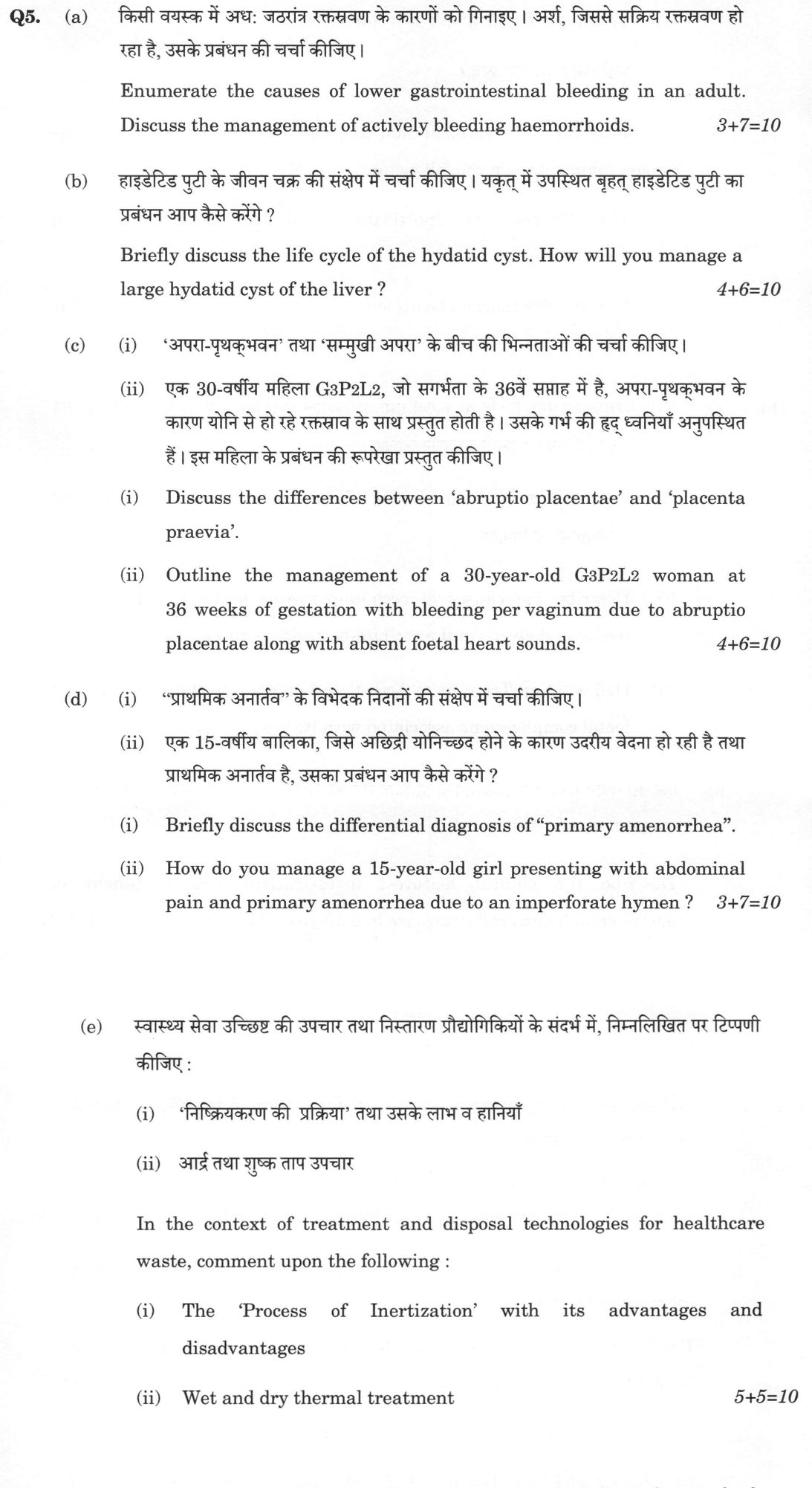
Enumerate the causes of lower gastrointestinal bleeding in an adult. Discuss the management of actively bleeding haemorrhoids. 10 marks
Briefly discuss the life cycle of the hydatid cyst. How will you manage a large hydatid cyst of the liver ? 10 marks
Discuss the differences between 'abruptio placentae' and 'placenta praevia'.
Outline the management of a 30-year-old G3P2L2 woman at 36 weeks of gestation with bleeding per vaginum due to abruptio placentae along with absent foetal heart sounds. 10 marks
Briefly discuss the differential diagnosis of "primary amenorrhea".
How do you manage a 15-year-old girl presenting with abdominal pain and primary amenorrhea due to an imperforate hymen ? 10 marks
In the context of treatment and disposal technologies for healthcare waste, comment upon the following : The ‘Process of Inertization’ with its advantages and disadvantages
Wet and dry thermal treatment 10 marks
हिंदी में प्रश्न पढ़ें
किसी वयस्क में अध: जठरांत्र रक्तस्रावण के कारणों को गिनाइए। अर्श, जिससे सक्रिय रक्तस्रावण हो रहा है, उसके प्रबंधन की चर्चा कीजिए। (10 अंक)
हाइडेटिड पुटी के जीवन चक्र की संक्षेप में चर्चा कीजिए। यकृत् में उपस्थित बृहत् हाइडेटिड पुटी का प्रबंधन आप कैसे करेंगे ? (10 अंक)
'अपरा-पृथक्भवन' तथा 'सम्मुखी अपरा' के बीच की भिन्नताओं की चर्चा कीजिए।
एक 30-वर्षीय महिला G3P2L2, जो सगर्भता के 36वें सप्ताह में है, अपरा-पृथक्भवन के कारण योनि से हो रहे रक्तस्राव के साथ प्रस्तुत होती है। उसके गर्भ की हृद् ध्वनियाँ अनुपस्थित हैं। इस महिला के प्रबंधन की रूपरेखा प्रस्तुत कीजिए। (10 अंक)
"प्राथमिक अनार्तव" के विभेदक निदानों की संक्षेप में चर्चा कीजिए।
एक 15-वर्षीय बालिका, जिसे अछिद्री योनिच्छद होने के कारण उदरीय वेदना हो रही है तथा प्राथमिक अनार्तव है, उसका प्रबंधन आप कैसे करेंगे ? (10 अंक)
स्वास्थ्य सेवा उच्छिष्ट की उपचार तथा निस्तारण प्रौद्योगिकियों के संदर्भ में, निम्नलिखित पर टिप्पणी कीजिए : ‘निष्क्रियकरण की प्रक्रिया’ तथा उसके लाभ व हानियाँ
आर्द्र तथा शुष्क ताप उपचार (10 अंक)
Model answer
Drafted with AI by UPSC Answer Check against this question's marking rubric, to the expected length. UPSC does not publish answers for Mains — this is one way to score well, not an official key. How we build rubrics and answers.
(a) Lower gastrointestinal bleeding and bleeding haemorrhoids (3 + 7 = 10 marks)
Causes of lower gastrointestinal bleeding in an adult (3 marks).
- Anorectal: haemorrhoids (the commonest cause of bright-red bleeding), anal fissure, fistula, solitary rectal ulcer, rectal varices and anorectal cancer.
- Colonic: diverticular disease (the commonest cause of major bleeding), angiodysplasia, colorectal cancer and polyps, colitis (ulcerative colitis, Crohn's disease, infective, ischaemic and radiation colitis) and post-polypectomy bleeding.
- Small bowel: Meckel's diverticulum (in the young), tumours, Crohn's disease, NSAID enteropathy and intestinal tuberculosis.
- Other: a brisk upper gastrointestinal bleed, and coagulopathy or anticoagulant drugs.
Management of actively bleeding haemorrhoids (7 marks).
- Assess and resuscitate: bleeding from haemorrhoids is rarely massive, but check the pulse, blood pressure and haemoglobin. Give intravenous fluids and blood if there is shock or anaemia, correct any coagulopathy, and stop anticoagulants and NSAIDs.
- Confirm the source: digital rectal examination and proctoscopy (anoscopy) show the bleeding internal haemorrhoids. Do not assume that piles are the only cause: perform a colonoscopy in a patient over 45 years or with a change in bowel habit, anaemia or family history, to exclude cancer, colitis or polyps.
- Grade the haemorrhoids (Goligher): grade I bleed without prolapse, grade II prolapse and reduce spontaneously, grade III need manual reduction, and grade IV are irreducible.
- Conservative treatment: a high-fibre diet, plenty of fluids, bulk laxatives or stool softeners (ispaghula, lactulose), avoiding straining, warm sitz baths, and topical anaesthetic or steroid preparations for short periods. Oral flavonoids (micronised purified flavonoid fraction) reduce bleeding.
- Office (out-patient) procedures for grades I–III: rubber band ligation (the most effective for grades II–III), injection sclerotherapy (5% phenol in almond oil, for grades I–II), and infrared coagulation.
- Surgery for grade III–IV, for bleeding that fails these measures, and for thrombosed or strangulated piles: excisional haemorrhoidectomy (Milligan-Morgan open or Ferguson closed), Doppler-guided haemorrhoidal artery ligation, or stapled haemorrhoidopexy for prolapsing piles. In brisk active bleeding, suture ligation of the bleeding pile under anaesthesia stops it at once.
- After treatment: analgesia, stool softeners, and advice on diet and bowel habit to prevent recurrence. Complications to watch for are bleeding, urinary retention, infection, stenosis and incontinence.
(b) Hydatid cyst (4 + 6 = 10 marks)
Life cycle of the hydatid cyst (4 marks). The parasite is Echinococcus granulosus.
- The definitive host is the dog (and other canines), which carries the adult tapeworm, 3–6 mm long, in the small intestine and passes eggs in its faeces.
- The intermediate hosts are sheep, cattle, pigs and camels, and man is an accidental, dead-end intermediate host. Man is infected by swallowing eggs from contaminated food, water, or the fur and hands after contact with dogs.
- In the intestine the egg hatches and the six-hooked embryo (oncosphere) penetrates the wall, enters the portal vein and reaches the liver (about 60–70%), the lungs (20–25%) or other organs (spleen, kidney, brain, bone). There it grows into a unilocular hydatid cyst: an outer host-derived fibrous pericyst, a laminated ectocyst, and an inner germinal layer that produces brood capsules, daughter cysts and scolices (hydatid sand).
- The cycle closes when a dog eats infected offal containing the cysts; each scolex develops into an adult worm in the dog's intestine in about 6–7 weeks.
Management of a large hydatid cyst of the liver (6 marks). The diagnosis is made by ultrasound (staged by the WHO classification CE1–CE5), CT or MRI, and serology (ELISA or indirect haemagglutination). The Casoni test is obsolete.
- Albendazole (10–15 mg/kg/day in two doses) is used with every intervention: from 1 week before to 1–3 months after surgery, and from before to 1 month after PAIR.
- Surgery is the treatment of choice for a large cyst (above about 10 cm), a cyst with many daughter cysts, a cyst communicating with the bile ducts, or an infected or superficial cyst at risk of rupture. Steps: pack the operative field with gauze soaked in hypertonic (20%) saline to protect the peritoneum from spillage; puncture and aspirate the cyst; inject a scolicidal agent (20% hypertonic saline, or 95% ethanol; formalin is avoided because it causes sclerosing cholangitis) and re-aspirate; open the cyst and remove the daughter cysts and the germinal membrane; close any cystobiliary communication; and deal with the residual cavity by partial cystopericystectomy, omentoplasty or, in a peripheral cyst, total pericystectomy or liver resection. It can be done open or laparoscopically.
- PAIR (puncture, aspiration, injection of a scolicidal agent and re-aspiration) under ultrasound guidance with albendazole cover is an alternative for uncomplicated unilocular cysts (CE1 and CE3a). It is contraindicated with biliary communication, and for superficial cysts or multiseptated cysts.
- Precautions: have adrenaline, hydrocortisone and antihistamine ready, because spillage may cause anaphylaxis, and avoid peritoneal contamination, which causes secondary echinococcosis.
- Inactive cysts (CE4, CE5) are only observed.
(c) Abruptio placentae and placenta praevia (4 + 6 = 10 marks)
(i) Differences between abruptio placentae and placenta praevia (4 marks).
- Bleeding: abruption has painful, dark bleeding, often concealed and out of proportion to the visible loss; placenta praevia has painless, recurrent, bright-red, revealed bleeding.
- Pain and uterus: in abruption there is constant abdominal pain, and the uterus is hard (woody), tender and may be larger than the dates; in placenta praevia the uterus is soft, relaxed and non-tender.
- Foetus: in abruption the foetal parts are difficult to feel and foetal heart sounds are often absent (the foetus may be dead); in placenta praevia the foetus is alive, with a normal heart rate, and the lie is often abnormal (breech, transverse) with a high presenting part.
- Risk factors: abruption is associated with hypertension and pre-eclampsia, trauma, smoking, cocaine and a previous abruption; placenta praevia with a previous caesarean section, multiparity, advanced age and multiple pregnancy.
- Shock and coagulopathy: in abruption the shock is out of proportion to the visible bleeding and DIC and renal failure are common; in praevia the shock corresponds to the visible bleeding and coagulopathy is rare.
- Ultrasound: a retroplacental clot with a normally sited placenta in abruption; a placenta covering or near the internal os in praevia. A vaginal examination is dangerous in praevia.
(ii) Management of a severe abruption with foetal death at 36 weeks (6 marks). This is a grade 3 (Page) abruption with intrauterine death, and management centres on the mother.
- Resuscitate: oxygen, two large-bore intravenous lines, urgent blood tests (blood count, coagulation profile and fibrinogen, renal function, cross-match), and rapid replacement with crystalloid and blood. Follow the massive obstetric haemorrhage protocol: red cells, fresh frozen plasma, cryoprecipitate (if fibrinogen is low) and platelets. Monitor pulse, blood pressure, central venous pressure and urine output (catheter, aim for 30 mL/hour or more).
- Confirm the foetal death by ultrasound, and involve the senior obstetrician, anaesthetist and haematologist.
- Deliver promptly and vaginally if the mother's condition allows, because labour is usually rapid: artificial rupture of the membranes (which reduces intrauterine pressure and the release of thromboplastin) and an oxytocin infusion. Caesarean section is done only for maternal deterioration, an obstetric indication, or failure to progress, after correcting the coagulopathy.
- Prevent postpartum haemorrhage: uterotonics (oxytocin, then carboprost or misoprostol), tranexamic acid, uterine massage, and, in a Couvelaire uterus with atony, compression sutures, uterine artery embolisation or hysterectomy.
- After delivery: watch for acute kidney injury and DIC; give anti-D immunoglobulin if Rh-negative (with a Kleihauer test); suppress lactation; and give compassionate bereavement counselling, contraceptive advice, and a plan for close monitoring in a future pregnancy (the recurrence risk is significant).
(d) Primary amenorrhoea and imperforate hymen (3 + 7 = 10 marks)
(i) Differential diagnosis of primary amenorrhoea (3 marks). Primary amenorrhoea is the absence of menstruation by 15 years with normal secondary sexual characters, or by 13 years without breast development. It is best organised by the presence of breasts and uterus:
- Breasts present, uterus present: outflow-tract obstruction (imperforate hymen, transverse vaginal septum), constitutional delay, hypothalamic causes (weight loss, stress, athletes), polycystic ovary syndrome, hyperprolactinaemia and thyroid disease.
- Breasts present, uterus absent: Müllerian agenesis (Mayer-Rokitansky-Küster-Hauser syndrome) and complete androgen insensitivity syndrome (46,XY).
- Breasts absent, uterus present: hypergonadotropic hypogonadism (Turner syndrome 45,X, pure gonadal dysgenesis, ovarian failure) or hypogonadotropic hypogonadism (constitutional delay, Kallmann syndrome, pituitary tumours, craniopharyngioma, chronic illness).
- Investigation guides the diagnosis: pregnancy test, FSH, LH, prolactin, TSH, pelvic ultrasound, and karyotype.
(ii) A 15-year-old girl with abdominal pain and primary amenorrhoea due to imperforate hymen (7 marks). The diagnosis is cryptomenorrhoea (menstrual blood retained behind the hymen: haematocolpos and later haematometra).
- Clinical features: cyclical lower abdominal pain, a lower abdominal (suprapubic) mass, urinary retention or frequency, back pain, normal secondary sexual characters, and on inspection a bluish, bulging hymen at the introitus; there is no visible vaginal opening.
- Investigations: pelvic and renal ultrasound (a distended vagina with fluid and internal echoes, and an assessment of the uterus), MRI if a transverse vaginal septum is suspected, and a urine test.
- Treatment is surgical: hymenotomy (a cruciate, or X-shaped, incision) under anaesthesia, which is done as soon as the diagnosis is made, allowing the old blood to drain. Excise the redundant flaps and suture the edges with fine absorbable sutures to prevent re-adhesion. Avoid needle aspiration, which risks infection and haemorrhage.
- Catheterise if there is urinary retention, give antibiotic cover, and give analgesia. Follow up after the next menstruation, and counsel the girl and her parents. Look for associated anomalies (renal) and exclude a transverse vaginal septum, in which no bulging hymen is seen.
(e) Healthcare waste treatment: inertization and thermal treatment (5 + 5 = 10 marks)
(i) Inertization (5 marks). Inertization is a process of mixing waste with cement and other substances before its disposal, to minimise the risk of toxic substances migrating (leaching) into ground water. It is suitable for pharmaceutical waste (non-cytotoxic, with the packaging removed), incinerator ash and heavy-metal-containing waste.
- Process: remove the packaging, grind the pharmaceuticals to a powder, and mix them with cement, lime and water in the usual proportions of about 65% waste, 15% lime, 15% cement and 5% or more of water (by weight). The homogeneous paste is poured into moulds or drums and left to set into solid cubes or blocks (usually in 28 days), which are then landfilled.
- Advantages: simple, low cost, needs little equipment and can be done in the hospital, the solid block prevents leaching and access to the drugs, there are no atmospheric emissions, and it is safe for staff and the public.
- Disadvantages: not suitable for infectious waste, and not for cytotoxic drugs or large volumes (which need high-temperature incineration above 1200 °C); it adds weight and volume; it produces dust and needs protective equipment (mask, gloves); there is no volume reduction and it depends on a secure landfill; and poorly made blocks may leach.
(ii) Wet and dry thermal treatment (5 marks). These are non-burning methods that disinfect biomedical waste, and they are contrasted below.
- Wet thermal treatment uses steam (moist heat) in a closed pressure chamber: autoclave, hydroclave or microwave. Under the Bio-Medical Waste Management Rules, 2016, an autoclave must run at not less than 121 °C and 15 psi for 60 minutes (or 135 °C and 31 psi for 45 minutes, or 149 °C and 52 psi for 30 minutes). Microwave treatment uses steam at about 95–100 °C for at least 20 minutes. The waste is then shredded so that it cannot be reused. It is used for infected plastics, tubing, bottles, syringes without needles, and soiled waste, and the efficacy is checked with biological indicators (Bacillus stearothermophilus) and chemical indicators. Advantages: a low cost, no toxic emissions (unlike incineration), and effective sterilisation. Disadvantages: not suitable for anatomical, cytotoxic or chemical waste, an odour, and it needs shredding afterwards.
- Dry thermal treatment uses heat without steam, at higher temperature. It includes incineration (with a primary chamber at 800 ± 50 °C and a secondary chamber at 1050 ± 50 °C with a residence time of at least 2 seconds, for anatomical, soiled and cytotoxic waste and expired drugs), pyrolysis and plasma pyrolysis, and dry-heat sterilisation (a hot-air oven at about 160–170 °C for 1–2 hours), used for sharps before mutilation. Advantages: it reduces the volume of waste by 90% and destroys it, and can treat all infectious, anatomical and pharmaceutical waste. Disadvantages: high cost, air pollution (dioxins and furans, so a stack of adequate height and gas scrubbing are needed), residual ash to be landfilled, and a high energy need.
How this answer will be evaluated
Evaluation rubric
Each sub-part is marked on its own, against the marks and word limit printed on the paper.
- (a) (a) Enumerate the causes of lower gastrointestinal bleeding in an adult; discuss the management of actively bleeding haemorrhoids (3 + 7 = 10 marks). 10 marks
Must cover
- Causes: haemorrhoids, fissure, diverticular disease, colorectal cancer and polyps, angiodysplasia, colitis, Meckel's diverticulum
- Assessment and resuscitation; proctoscopy and colonoscopy to exclude other lesions
- Goligher grading with conservative measures: fibre, laxatives, flavonoids
- Rubber band ligation, sclerotherapy, haemorrhoidectomy, stapled or Doppler-guided procedures, and suture ligation for active bleeding
Loses marks
- Listing upper gastrointestinal causes only.
- Assuming piles without excluding cancer.
- Recommending surgery for all grades.
Earns more
- Grade-wise choice of treatment.
- Age-based indication for colonoscopy.
Extra mark
- Complications of haemorrhoidectomy
- (b) (b) Briefly discuss the life cycle of the hydatid cyst; how will you manage a large hydatid cyst of the liver (4 + 6 = 10 marks). 10 marks
Must cover
- Life cycle: Echinococcus granulosus, dog as definitive host, sheep as intermediate host, man as accidental dead-end host, egg ingestion
- Cyst spread by portal vein to the liver (60–70%) and lungs; structure of pericyst, ectocyst and germinal layer
- Albendazole 10–15 mg/kg/day before and after any intervention
- Surgery for large cyst with scolicidal precautions, or PAIR for selected cysts, with anaphylaxis precautions
Loses marks
- Naming man as the definitive host.
- Aspirating the cyst without albendazole or scolicidal precautions.
- Using formalin as the scolicidal agent.
Earns more
- Scolicidal agents named and formalin avoided.
- Indications of PAIR and its contraindications.
Extra mark
- WHO CE1–CE5 staging and observation of inactive cysts
- (c) (c) Differences between abruptio placentae and placenta praevia; management of a 30-year-old G3P2L2 at 36 weeks with abruption and absent foetal heart sounds (4 + 6 = 10 marks). 10 marks
Must cover
- Differences: painful concealed versus painless revealed bleeding, hard tender versus soft uterus, foetal state, risk factors, DIC
- Resuscitation with blood and coagulation factors and monitoring of urine output
- Prompt vaginal delivery with amniotomy and oxytocin; caesarean only for maternal indication
- Prevention and treatment of postpartum haemorrhage, anti-D, and counselling
Loses marks
- Doing vaginal examination in placenta praevia.
- Delaying delivery or ignoring coagulopathy.
- Routine caesarean for a dead foetus.
Earns more
- At least four paired differences.
- Recognition as grade 3 abruption with intrauterine death.
Extra mark
- Couvelaire uterus and Kleihauer test
- (d) (d) Briefly discuss the differential diagnosis of primary amenorrhoea; manage a 15-year-old with abdominal pain and primary amenorrhoea due to imperforate hymen (3 + 7 = 10 marks). 10 marks
Must cover
- Differential organised by breasts and uterus: outflow obstruction, Turner syndrome, MRKH, androgen insensitivity, hypothalamic and pituitary causes
- Diagnosis of cryptomenorrhoea with haematocolpos: bulging bluish hymen, suprapubic mass, ultrasound
- Hymenotomy with a cruciate incision and drainage under anaesthesia
- Avoid needle aspiration; excise flaps and suture edges; follow-up and exclusion of transverse vaginal septum
Loses marks
- Managing with needle aspiration or expectantly.
- Giving hormone therapy for imperforate hymen.
- Confusing with vaginal agenesis.
Earns more
- Definition with ages (15 years, or 13 years without breasts).
- Investigations: hormones, ultrasound, karyotype.
Extra mark
- Associated renal anomalies
- (e) (e) Comment upon the process of inertization with its advantages and disadvantages; and wet and dry thermal treatment of healthcare waste (5 + 5 = 10 marks). 10 marks
Must cover
- Inertization: mixing with cement, lime and water (about 65:15:15:5) to solid blocks for pharmaceutical waste and ash
- Advantages and disadvantages of inertization stated
- Wet thermal: steam autoclave at 121 °C, 15 psi, 60 minutes (or 135 °C, 31 psi, 45 minutes), microwave and hydroclave, followed by shredding
- Dry thermal: incineration at 800 and 1050 °C, plasma pyrolysis and dry-heat sterilisation, with merits and demerits
Loses marks
- Generic waste-management prose without figures.
- Recommending inertization for infectious waste.
- Giving no disadvantages.
Earns more
- Specific temperatures, times and proportions.
- Contrast of wet and dry methods.
Extra mark
- Bio-Medical Waste Management Rules 2016 and biological indicators
What "Enumerate" is asking you to do
Produce the complete set of items asked for, countable and correctly named. The examiner marks against a checklist, so a missing item costs and an elaborated one gains nothing — where discussion is wanted the stem asks for it as a separate sub-part.
Structure that answers it
One line naming the basis on which the set is drawn → items numbered, each in a phrase or a single line → the discussion sub-part taken up separately, after the list is complete
Where marks are lost
Treating it as an essay. Six items named in six lines score better than three items explained at length.
Practice this exact question
Write your answer and it is marked point by point against the model answer above — what you covered, what you missed, what you got wrong.
Evaluate my answer →More from Medical Science 2026 Paper II
- Q2 (a) A 20-year-old medical student presents with fever, dry cough, and right-sided chest p…
- Q3 (a) An 18-year-old girl presents with episodic breathlessness, cough with sputum, chest t…
- Q4 (a) A 45-year-old hepatitis-C positive patient presents with icterus, oliguria, abdominal…
- Q5 (a) Enumerate the causes of lower gastrointestinal bleeding in an adult. Discuss the mana…
- Q6 (a) (i) Describe the causes of occipito-posterior position and different modes of deliver…
- Q7 (a) Describe the various complications of acute pancreatitis. Discuss the role of surgery…
- Q8 (a) (i) What are the main objectives and key strategies of the National Strategic Plan (N…