Paper II — Q8
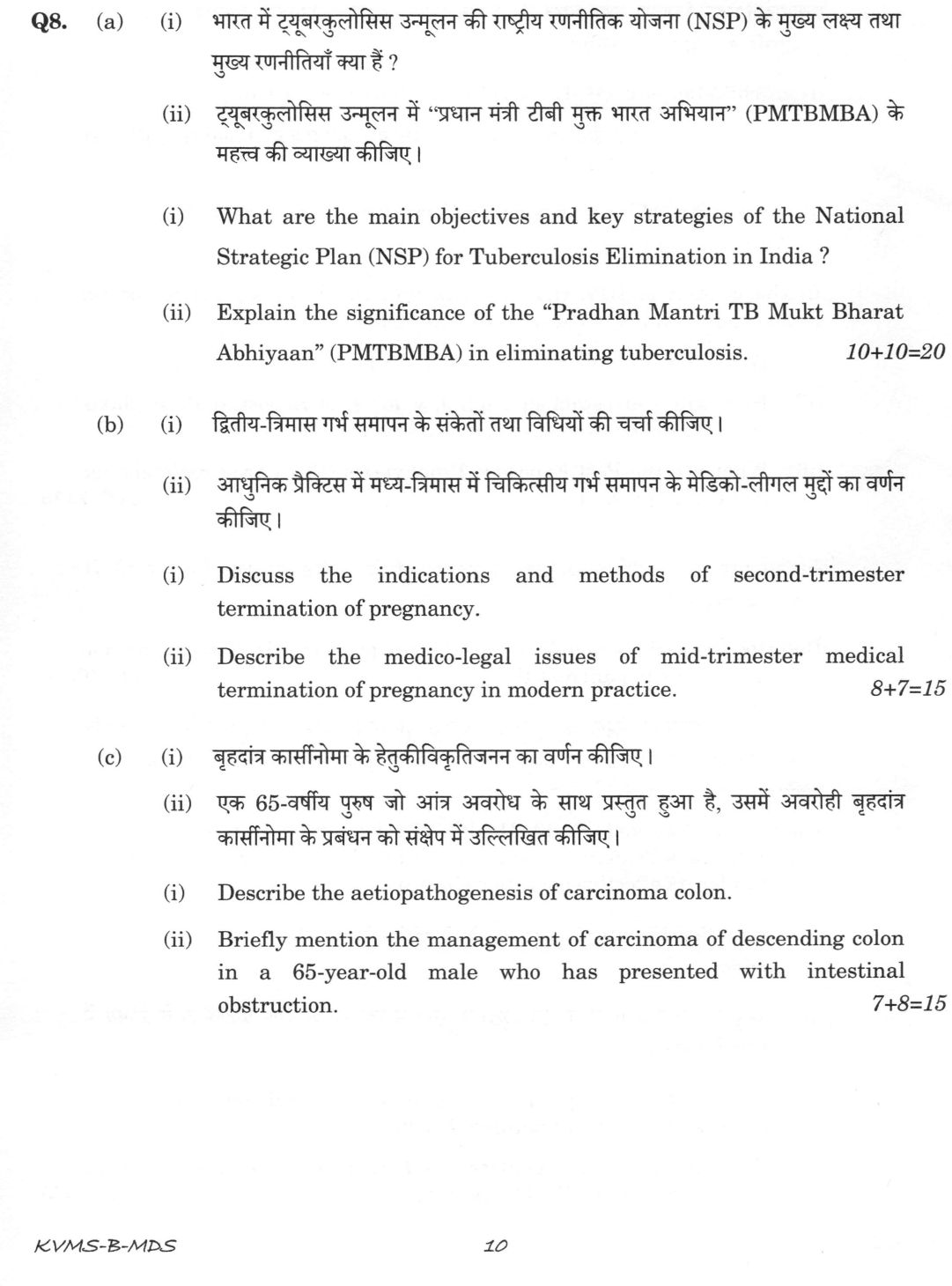
(a) (i) What are the main objectives and key strategies of the National Strategic Plan (NSP) for Tuberculosis Elimination in…
What are the main objectives and key strategies of the National Strategic Plan (NSP) for Tuberculosis Elimination in India ?
Explain the significance of the “Pradhan Mantri TB Mukt Bharat Abhiyaan” (PMTBMBA) in eliminating tuberculosis. 20 marks
Discuss the indications and methods of second-trimester termination of pregnancy.
Describe the medico-legal issues of mid-trimester medical termination of pregnancy in modern practice. 15 marks
Describe the aetiopathogenesis of carcinoma colon.
Briefly mention the management of carcinoma of descending colon in a 65-year-old male who has presented with intestinal obstruction. 15 marks
हिंदी में प्रश्न पढ़ें
भारत में ट्यूबरकुलोसिस उन्मूलन की राष्ट्रीय रणनीतिक योजना (NSP) के मुख्य लक्ष्य तथा मुख्य रणनीतियाँ क्या हैं ?
ट्यूबरकुलोसिस उन्मूलन में “प्रधान मंत्री टीबी मुक्त भारत अभियान” (PMTBMBA) के महत्व की व्याख्या कीजिए। (20 अंक)
द्वितीय-त्रिमास गर्भ समापन के संकेतों तथा विधियों की चर्चा कीजिए।
आधुनिक प्रैक्टिस में मध्य-त्रिमास में चिकित्सीय गर्भ समापन के मेडिको-लीगल मुद्दों का वर्णन कीजिए। (15 अंक)
बृहदांत्र कार्सिनोमा के हेतुकीविकृतिजनन का वर्णन कीजिए।
एक 65-वर्षीय पुरुष जो आंत्र अवरोध के साथ प्रस्तुत हुआ है, उसमें अवरोही बृहदांत्र कार्सिनोमा के प्रबंधन को संक्षेप में उल्लिखित कीजिए। (15 अंक)
Model answer
Drafted with AI by UPSC Answer Check against this question's marking rubric, to the expected length. UPSC does not publish answers for Mains — this is one way to score well, not an official key. How we build rubrics and answers.
(a) National Strategic Plan for TB Elimination and the Pradhan Mantri TB Mukt Bharat Abhiyaan (10 + 10 = 20 marks)
(a)(i) Objectives and key strategies of the National Strategic Plan (10 marks)
The National Strategic Plan (NSP) for Tuberculosis Elimination (2017–2025) aims to end the TB epidemic in India by 2025, five years ahead of the global Sustainable Development Goal target of 2030.
Objectives and targets (by 2025).
- Reduce the incidence of TB to about 44 per lakh population, the prevalence to about 65 per lakh, and the mortality to about 3 per lakh, from the 2015 baseline (an incidence of about 217 per lakh).
- Achieve zero catastrophic costs for TB-affected families (no family should face catastrophic expenses because of TB).
- Provide universal access to quality diagnosis and treatment (universal drug-susceptibility testing) and to social support.
Key strategies: the four pillars "Detect - Treat - Prevent - Build".
- Detect: find the missing cases early and completely. Active case finding in vulnerable and high-risk groups (contacts, people living with HIV, diabetics, undernourished, slum and tribal populations, prisoners); engaging the private sector, with compulsory notification through the Nikshay portal; upfront molecular testing (CBNAAT/Truenat), universal drug-susceptibility testing, and improved diagnosis of childhood and extra-pulmonary TB.
- Treat: treat all, with assured quality. Daily fixed-dose-combination regimens for drug-sensitive TB, shorter all-oral regimens for drug-resistant TB, patient-centric care with adherence support (treatment supporters, digital adherence tools), direct benefit transfer (Nikshay Poshan Yojana) and counselling, and management of co-morbidities (HIV, diabetes).
- Prevent: TB preventive treatment for household contacts and high-risk groups (people living with HIV), airborne infection control in health facilities and congregate settings, vaccination (BCG), and action on the social determinants (nutrition, tobacco, alcohol, air pollution).
- Build: strengthen the systems: human resources and their capacity; an information system (Nikshay); a robust laboratory network; a strong research and development effort; multi-sectoral collaboration (with other ministries and departments), community engagement, sufficient funding, and a stronger public health system.
(a)(ii) Significance of the Pradhan Mantri TB Mukt Bharat Abhiyaan (10 marks)
The Pradhan Mantri TB Mukt Bharat Abhiyaan (PMTBMBA), launched in September 2022, is a community-support and social-mobilisation campaign that moves the programme from a purely medical response to a whole-of-society one, so that India can reach the 2025 target.
- Ni-kshay Mitra (the core component): individuals, communities, organisations, elected representatives and corporate donors voluntarily "adopt" TB patients or villages for at least a year, and supply nutritional (food-basket) support, diagnostic support and vocational support, in addition to the government's monthly Nikshay Poshan Yojana cash transfer.
- Nutrition: undernutrition is the largest risk factor for TB in India (the population attributable fraction is the highest), and it worsens outcomes. Extra food support reduces the risk of unfavourable outcomes, deaths and (in contacts) the risk of disease, as shown by the RATIONS trial. The campaign therefore addresses a social determinant that drugs cannot.
- Community ownership (Jan Bhagidari): it involves panchayats, local leaders and civil society in finding and supporting patients, reduces stigma and discrimination, improves adherence and treatment completion, and gives patients a sense of support.
- Better outcomes and lower costs: nutritional and social support helps to avert catastrophic expenditure, retain patients in treatment, prevent loss to follow-up, and lower the mortality.
- Complementary to the health system: it strengthens the other elements of the NSP (case finding, adherence, TB preventive treatment) and supports the "TB Mukt Panchayat" goal, with monitoring through the Nikshay portal.
- Impact: India's TB incidence has declined by about 18% between 2015 and 2023 (WHO), and the campaign is meant to accelerate this decline and to make the elimination target feasible.
(b) Second-trimester termination of pregnancy (8 + 7 = 15 marks)
(b)(i) Indications and methods (8 marks)
Legal indications (the Medical Termination of Pregnancy Act 1971, as amended in 2021).
- Up to 20 weeks: on the opinion of one registered medical practitioner (RMP), when continuing the pregnancy would risk the woman's life or cause grave injury to her physical or mental health, when there is a substantial risk of serious foetal abnormality, when the pregnancy is due to rape, or for failure of a contraceptive method or device used by the woman or her partner.
- 20 to 24 weeks: on the opinion of two RMPs, for special categories of women: survivors of rape or sexual assault, minors, women whose marital status has changed during the pregnancy (widowhood or divorce), physically disabled women (as defined in the Rights of Persons with Disabilities Act), women with mental illness or intellectual disability, and women in disaster or humanitarian settings.
- Beyond 24 weeks: only for substantial foetal abnormalities, diagnosed by a State-level Medical Board, with no upper gestational limit. An immediate termination is also allowed to save the woman's life, without limit.
Clinical indications. Foetal (anomalies found at the anomaly scan at 18–20 weeks, such as neural-tube defects, severe structural anomalies and chromosomal or genetic disease), maternal (severe heart or kidney disease, severe pre-eclampsia, cancer needing treatment, severe psychiatric illness) and obstetric (pre-viable rupture of membranes with infection, and failed first-trimester termination), and social or legal grounds (rape, incest, minors).
Methods.
- Medical method (the method of choice): mifepristone 200 mg orally, followed 24–48 hours later by misoprostol 400 µg vaginally, sublingually or buccally every 3 hours (up to 5 doses). The interval is short and the success is about 95% within 24 hours. Misoprostol alone (400 µg every 3 hours) is less effective. Oxytocin infusion or carboprost (a prostaglandin F2α analogue, 250 µg intramuscularly) may be used as adjuncts; extra-amniotic ethacridine lactate or a Foley balloon are older alternatives, and intra-amniotic hypertonic saline or urea are obsolete.
- Surgical method: dilatation and evacuation (D&E) by a skilled operator, after cervical preparation (misoprostol 400 µg 3–4 hours before, or osmotic dilators, or mifepristone). It is quicker and has fewer complications than induction, and is safe up to 24 weeks.
- Hysterotomy (mini-caesarean section) and hysterectomy are rarely used now (for failure, a scarred uterus or another indication).
- Feticide (intracardiac potassium chloride or digoxin) before induction beyond 22 weeks, to prevent a live birth.
- Care: antibiotic prophylaxis, analgesia, anti-D immunoglobulin for Rh-negative women, checking that the evacuation is complete, contraceptive counselling, and follow-up. Complications: haemorrhage, incomplete abortion, cervical injury, uterine perforation or rupture (especially with a previous scar), infection, retained placenta and DIC.
(b)(ii) Medico-legal issues (7 marks)
- Consent: the woman's own informed consent is required (Section 3(4) of the Act). A guardian's consent is needed only for a minor or a woman with mental illness. The consent of the husband or partner is not required. The Supreme Court (2022) has held that unmarried women are also entitled to termination up to 24 weeks, and that a forced marital sexual act counts as rape for this purpose.
- Provider and place: the procedure must be done by a registered medical practitioner with prescribed training in obstetrics and gynaecology, in a government hospital or a facility approved (certified) for MTP. The gestational limits and the requirement of one, two or a Medical Board's opinion are as above. The Board (a gynaecologist, paediatrician or neonatologist, a radiologist or sonologist, and others notified by the State) must decide within 3 days of referral, and the termination is done within 5 days.
- Confidentiality: under Section 5A, the woman's name and particulars must not be disclosed to anyone except a person authorised by law, and disclosure is punishable (up to one year's imprisonment). A record of every MTP is kept in a register (admission register), kept for 5 years, and is not open to public inspection.
- POCSO and rape cases: when the woman is a minor or pregnant by rape, the medical practitioner must report the offence under the Protection of Children from Sexual Offences Act 2012 (Sections 19 and 21). The Supreme Court (2022) has held that the practitioner need not reveal the identity of the minor in the report to the police if she and her guardian do not wish it. Preserve the foetal tissue as DNA evidence for the investigation.
- PCPNDT Act 1994: the foetal sex must not be determined or disclosed, and a sex-selective abortion is an offence; ultrasound is done only at a registered centre, with the prescribed Form F.
- Live birth: a foetus that shows any sign of life after a mid-trimester termination is a live birth. It must be resuscitated and cared for as a neonate (there is a duty of care), and the birth and death must be registered. Feticide before induction beyond 22 weeks, and counselling on the possibility of live birth, help to avoid this.
- Illegal abortion: an abortion done by an unqualified person or at an unapproved place, or without a lawful ground, is an offence under the Bharatiya Nyaya Sanhita, 2023 (Sections 88–92, formerly IPC 312–316). Section 88 (voluntarily causing miscarriage) carries up to 3 years' imprisonment, or up to 7 years with a fine if the woman is quick with child, and covers a woman who induces her own miscarriage; Section 89 (without her consent) carries life imprisonment or up to 10 years; Section 90 (death caused by the act) up to 10 years, or life if without consent; Section 91 (preventing a child from being born alive) up to 10 years; and Section 92 (death of a quick unborn child) up to 10 years. Doctors acting in good faith under the Act are protected.
(c) Carcinoma of the colon (7 + 8 = 15 marks)
(c)(i) Aetiopathogenesis (7 marks)
Risk factors.
- Age above 50 years (the incidence rises steeply with age), and male sex.
- Diet and lifestyle: red and processed meat, a diet low in fibre and high in fat, obesity, physical inactivity, smoking, heavy alcohol use, and diabetes (insulin resistance).
- Colonic disease: adenomatous polyps (the main precursor; the risk is highest with a size above 1 cm, a villous pattern and high-grade dysplasia), and long-standing extensive ulcerative colitis (over 8–10 years) or Crohn's colitis.
- Personal or family history of colorectal cancer, and pelvic irradiation.
- Protective factors: fibre, calcium, regular exercise, and aspirin.
Hereditary syndromes (5–10% of cases).
- Familial adenomatous polyposis: germline APC mutation (chromosome 5q), with hundreds to thousands of adenomas and an almost 100% cancer risk by about 40 years.
- Lynch syndrome (hereditary non-polyposis colorectal cancer): germline mutation of a DNA mismatch-repair gene (MLH1, MSH2, MSH6, PMS2), with microsatellite instability, early-onset and proximal cancers, and other cancers (endometrium, ovary).
- Others: MUTYH-associated polyposis, Peutz-Jeghers syndrome (STK11), juvenile polyposis (SMAD4, BMPR1A) and serrated polyposis.
Molecular pathogenesis: three pathways.
- Chromosomal instability pathway (the adenoma-carcinoma sequence, about 80%). Loss of the APC tumour suppressor (which activates the Wnt/β-catenin pathway) starts an adenoma; a KRAS activating mutation causes the adenoma to grow; loss of 18q (SMAD4, DCC) follows; and loss of TP53 (17p) converts the adenoma into an invasive carcinoma. The sequence takes about 10 years.
- Microsatellite instability (mismatch-repair deficiency) pathway (about 15%). Loss of the mismatch-repair function, germline in Lynch syndrome or by MLH1 promoter hypermethylation in sporadic cases, leads to frameshift mutations in genes with repeat sequences (TGFBR2, BAX).
- Serrated pathway (CpG island methylator phenotype). A BRAF V600E mutation and widespread promoter methylation give sessile serrated polyps and carcinoma, mostly in the right colon.
(c)(ii) Carcinoma of the descending colon with intestinal obstruction in a 65-year-old man (8 marks)
- Resuscitation and diagnosis: admit, keep nil by mouth, and place a nasogastric tube and urinary catheter; correct fluid and electrolyte loss with intravenous fluids; give analgesia and antibiotics; and optimise co-morbidities. Confirm the diagnosis with an abdominal X-ray (dilated colon proximal to a cut-off, and check for caecal distension, because a competent ileocaecal valve creates a closed loop with a risk of caecal perforation) and a contrast CT of the abdomen and pelvis (level and cause of obstruction, perforation, and staging of the liver, nodes and chest). Measure CEA, and perform colonoscopy with biopsy later if it is not possible now.
- Choice of treatment (a reasoned decision by the patient's fitness, stability and the surgeon's experience):
- Self-expanding metallic stent as a bridge to surgery (endoscopic and fluoroscopic placement): it relieves the obstruction, allows resuscitation and optimisation, and permits an elective one-stage resection with primary anastomosis after about 1–2 weeks, avoiding a stoma. It is recommended for potentially curable left-sided obstructing cancer in high-risk patients (ASA III or above, or over 70 years) and as palliation in metastatic disease. Risks: perforation, migration and re-obstruction.
- Emergency resection when stenting is not available, has failed, or there is perforation or peritonitis.
- Hartmann's procedure (resection of the tumour-bearing segment, an end colostomy and closure of the rectal stump) is the safest choice for the unstable, high-risk patient, for faecal loading, perforation or peritonitis. The colostomy is reversed later.
- Primary resection with anastomosis (with or without on-table colonic lavage, and with a protective loop ileostomy) in a stable, fit patient with an experienced surgeon.
- Subtotal colectomy with ileosigmoid or ileorectal anastomosis for caecal perforation or ischaemia, or synchronous proximal lesions.
- A defunctioning loop transverse colostomy, then resection and closure (the three-stage approach) is used in a frail patient in whom no other option is suitable.
- Oncological principles: a wide resection with 5 cm margins, high ligation of the inferior mesenteric (or left colic) pedicle, and clearance of at least 12 lymph nodes.
- After surgery: histology and staging, microsatellite instability testing, adjuvant chemotherapy (FOLFOX or CAPOX) for stage III or high-risk stage II disease, and follow-up with CEA, CT and colonoscopy.
How this answer will be evaluated
Evaluation rubric
Each sub-part is marked on its own, against the marks and word limit printed on the paper.
- (a) (a) (i) Main objectives and key strategies of the National Strategic Plan for TB elimination; (ii) significance of the Pradhan Mantri TB Mukt Bharat Abhiyaan (10 + 10 = 20 marks). 20 marks
Must cover
- Goal of ending TB by 2025 with targets of incidence 44, prevalence 65 and mortality 3 per lakh, and zero catastrophic costs
- Four pillars Detect, Treat, Prevent, Build, each described with specifics (private-sector notification, universal DST, daily FDC, TPT, Nikshay)
- PMTBMBA: launched 2022, Ni-kshay Mitra community adoption with nutritional, diagnostic and vocational support
- Significance: undernutrition as risk factor (RATIONS), community ownership, adherence, reduced catastrophic costs, contribution to elimination
Loses marks
- Giving 2030 as the national target.
- Omitting the four pillars.
- Describing the abhiyaan as a drug programme.
Earns more
- Timeline of 2025 against global 2030.
- Nikshay Poshan Yojana linked to Ni-kshay Mitra.
Extra mark
- Decline in incidence and TB Mukt Panchayat
- (b) (b) (i) Indications and methods of second-trimester termination of pregnancy; (ii) medico-legal issues of mid-trimester medical termination (8 + 7 = 15 marks). 15 marks
Must cover
- Legal grounds and gestational limits under MTP Act 2021: 20 weeks one RMP, 20–24 weeks two RMPs for special categories, Medical Board beyond 24 weeks for foetal abnormality
- Clinical indications: foetal anomaly, maternal disease, rape and minors
- Methods with doses: mifepristone 200 mg then misoprostol 400 µg 3-hourly, D&E with cervical priming, feticide beyond 22 weeks
- Medico-legal: woman's own consent, approved facility and trained RMP, confidentiality (section 5A), POCSO reporting, PCPNDT, live birth and illegal abortion under the BNS
Loses marks
- Requiring spousal consent.
- Giving 24 weeks as the limit for all women.
- Omitting the live-birth issue.
Earns more
- Special categories listed.
- Husband's consent not required.
Extra mark
- Supreme Court 2022 judgments on unmarried women and minors' identity
- (c) (c) (i) Describe the aetiopathogenesis of carcinoma colon; (ii) briefly outline management of carcinoma of the descending colon with intestinal obstruction in a 65-year-old man (7 + 8 = 15 marks). 15 marks
Must cover
- Risk factors: age, diet, obesity, polyps, ulcerative colitis, family history
- Hereditary syndromes FAP (APC) and Lynch (mismatch-repair genes)
- Molecular pathways: adenoma-carcinoma sequence (APC, KRAS, SMAD4, TP53), microsatellite instability, serrated (BRAF, CIMP)
- Management: resuscitation and CT, and choice among stent as bridge to surgery, Hartmann's, primary anastomosis and subtotal colectomy, with oncological principles and adjuvant chemotherapy
Loses marks
- Advising primary anastomosis in an unstable patient with perforation.
- Omitting resuscitation and staging.
- Wrong order of the adenoma-carcinoma genes.
Earns more
- Reasoned choice by fitness and stability.
- Stent indications and risks.
Extra mark
- Microsatellite instability testing and CEA follow-up
What "Explain" is asking you to do
Make the working of something clear — what sets it off, what follows from what, and what it produces. Explain is the Commission's mechanism word: it dominates the technical papers and the “explain why” stems, where the marks sit in the causal chain and not in the label.
Structure that answers it
State what it is → the initiating condition → the chain of cause, step by step → an instance where it plays out → what the chain produces
Where marks are lost
Describing what something looks like instead of why it works that way. Naming the stages without linking them reads as description too.
Practice this exact question
Write your answer and it is marked point by point against the model answer above — what you covered, what you missed, what you got wrong.
Evaluate my answer →More from Medical Science 2026 Paper II
- Q5 (a) Enumerate the causes of lower gastrointestinal bleeding in an adult. Discuss the mana…
- Q6 (a) (i) Describe the causes of occipito-posterior position and different modes of deliver…
- Q7 (a) Describe the various complications of acute pancreatitis. Discuss the role of surgery…
- Q8 (a) (i) What are the main objectives and key strategies of the National Strategic Plan (N…