Paper II — Q6
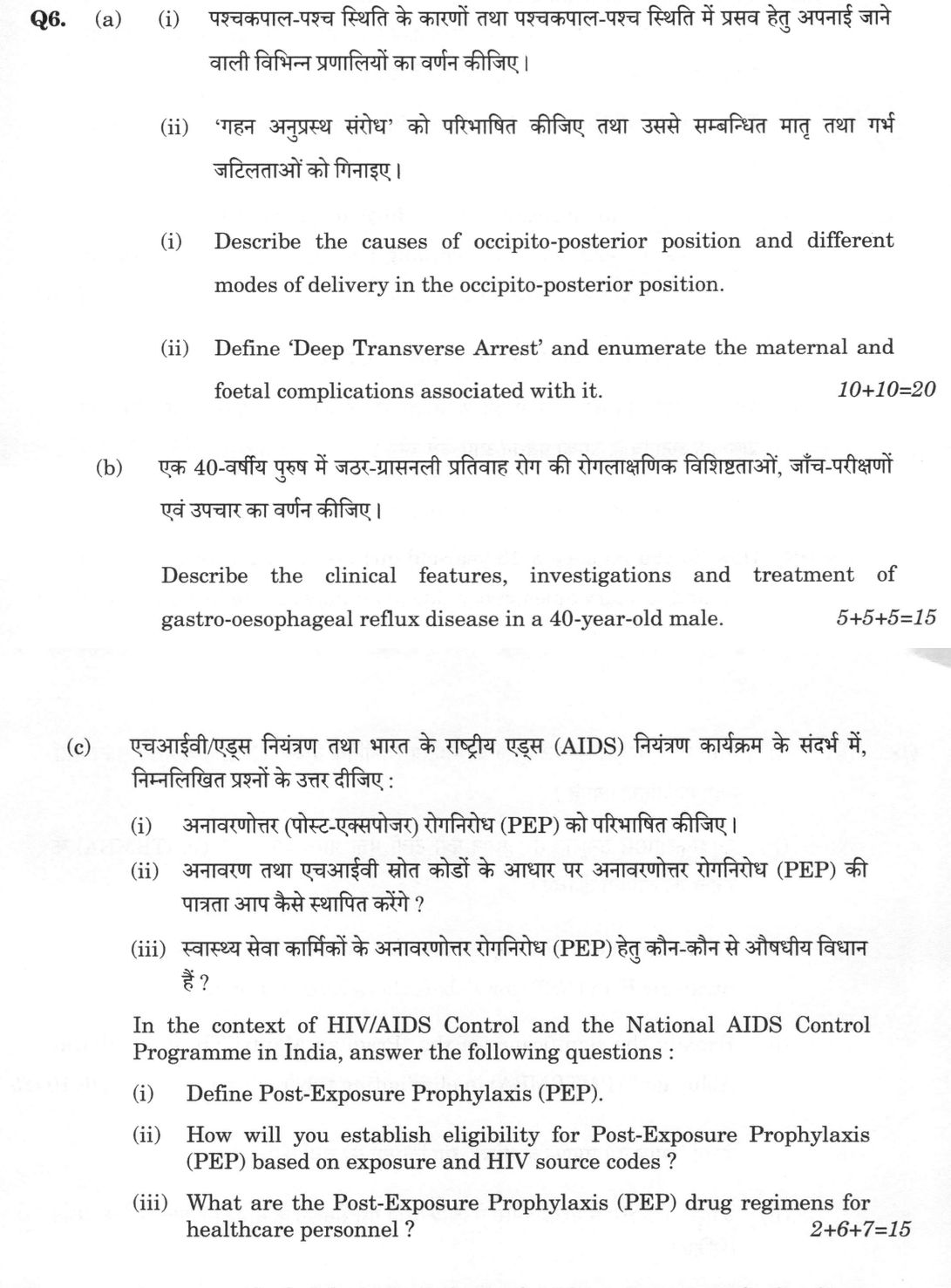
(a) (i) Describe the causes of occipito-posterior position and different modes of delivery in the occipito-posterior…
Describe the causes of occipito-posterior position and different modes of delivery in the occipito-posterior position.
Define ‘Deep Transverse Arrest’ and enumerate the maternal and foetal complications associated with it. 20 marks
Describe the clinical features, investigations and treatment of gastro-oesophageal reflux disease in a 40-year-old male. 15 marks
In the context of HIV/AIDS Control and the National AIDS Control Programme in India, answer the following questions : Define Post-Exposure Prophylaxis (PEP).
How will you establish eligibility for Post-Exposure Prophylaxis (PEP) based on exposure and HIV source codes ?
What are the Post-Exposure Prophylaxis (PEP) drug regimens for healthcare personnel ? 15 marks
हिंदी में प्रश्न पढ़ें
पश्चकपाल-पश्च स्थिति के कारणों तथा पश्चकपाल-पश्च स्थिति में प्रसव हेतु अपनाई जाने वाली विभिन्न प्रणालियों का वर्णन कीजिए।
‘गहन अनुप्रस्थ संरोध’ को परिभाषित कीजिए तथा उससे सम्बन्धित मातृ तथा गर्भ जटिलताओं को गिनाइए। (20 अंक)
एक 40-वर्षीय पुरुष में जठर-ग्रासनली प्रतिवाह रोग की रोगलाक्षणिक विशिष्टताओं, जाँच-परीक्षणों एवं उपचार का वर्णन कीजिए। (15 अंक)
एचआईवी/एड्स नियंत्रण तथा भारत के राष्ट्रीय एड्स (AIDS) नियंत्रण कार्यक्रम के सदर्भ में, निम्नलिखित प्रश्नों के उत्तर दीजिए : अनावरणोत्तर (पोस्ट-एक्सपोजर) रोगनिरोध (PEP) को परिभाषित कीजिए।
अनावरण तथा एचआईवी स्रोत कोडों के आधार पर अनावरणोत्तर रोगनिरोध (PEP) की पात्रता आप कैसे स्थापित करेंगे ?
स्वास्थ्य सेवा कार्मिकों के अनावरणोत्तर रोगनिरोध (PEP) हेतु कौन-कौन से औषधीय विधान हैं ? (15 अंक)
Model answer
Drafted with AI by UPSC Answer Check against this question's marking rubric, to the expected length. UPSC does not publish answers for Mains — this is one way to score well, not an official key. How we build rubrics and answers.
(a) Occipito-posterior position and deep transverse arrest (10 + 10 = 20 marks)
(a)(i) Causes of occipito-posterior position and modes of delivery (10 marks)
In the occipito-posterior (OP) position the foetal occiput lies towards the sacro-iliac joint or the sacrum. It is present in about 10–20% of labours at the onset and in about 5% at delivery.
Causes.
- Pelvic shape: an anthropoid or android pelvis (a long anteroposterior diameter with a narrow forepelvis), a flat sacrum, and a contracted mid-pelvis.
- Foetal factors: a deflexed head or an extended attitude, a large baby, an anterior placenta, polyhydramnios, multiple pregnancy and congenital anomalies.
- Uterine and maternal factors: a pendulous abdomen or lax abdominal wall in a multipara, uterine anomalies or a fibroid, a full bladder or rectum, and epidural analgesia which relaxes the pelvic floor.
- Often no cause is found. A posterior position may be diagnosed on clinical examination (a flat or dented lower abdomen, foetal limbs felt anteriorly, heart sounds heard in the flank), on vaginal examination (the posterior fontanelle felt posteriorly, and the anterior fontanelle felt easily), and by ultrasound.
Modes of delivery. The course of labour follows one of three mechanisms:
- Long anterior rotation (in about 90%). With good contractions and a flexed head, the occiput rotates forwards through 135° to the front (OA position) and the head is delivered as in a normal occipito-anterior labour. The labour is longer, with a prolonged first and second stage and a backache.
- Short posterior rotation (persistent OP, face-to-pubis delivery). The occiput rotates backwards through 45° into the hollow of the sacrum. The head then presents its larger occipito-frontal diameter (11.5 cm). The head flexes until the root of the nose lies under the symphysis pubis and the occiput is born over the perineum, then it extends to deliver the face, so the baby is born "face to pubis". It gives a large perineal stretch and a high risk of tears (third and fourth degree).
- Non-rotation and deep transverse arrest. The head stays in the transverse position at the ischial spines (see below) and cannot be delivered by natural forces.
Management and operative options.
- Conservative: good analgesia (epidural), hydration, encouraging maternal upright and hands-and-knees positions, oxytocin for poor contractions once cephalopelvic disproportion has been excluded, and allowing an extra hour for the second stage before intervention, while monitoring the foetus.
- Instrumental delivery: manual rotation to occipito-anterior followed by forceps or ventouse; Kielland's rotational forceps (by an expert); ventouse (a posterior cup); or direct forceps delivery as an OP with a generous episiotomy.
- Caesarean section for cephalopelvic disproportion, a failure of instrumental delivery, foetal distress, or a contracted pelvis.
(a)(ii) Deep transverse arrest and its complications (10 marks)
Definition. Deep transverse arrest is the arrest of the foetal head, in the occipito-transverse position, at the level of the ischial spines (in the mid-pelvis), with the sagittal suture lying in the transverse diameter, despite good uterine contractions and full dilatation of the cervix. The head has failed to rotate to the occipito-anterior position, usually because of a platypelloid or android pelvis with prominent ischial spines and a narrow mid-pelvis, a deflexed head, or poor contractions. It is a cause of obstructed labour, and it needs an operative delivery (manual rotation with forceps or ventouse, Kielland's rotational forceps, or caesarean section).
Maternal complications.
- Prolonged labour with maternal exhaustion, dehydration and ketoacidosis.
- Infection (chorioamnionitis, puerperal sepsis, and wound infection).
- Postpartum haemorrhage (from atony and from genital tract tears).
- Perineal, vaginal and cervical tears (third and fourth degree tears); trauma from instrumental delivery.
- Pressure necrosis of the bladder and vagina, causing vesicovaginal or rectovaginal fistulae; urinary retention.
- Uterine rupture (rare), and later pelvic floor damage with prolapse and incontinence.
- Increased risk of caesarean section, thromboembolism and psychological trauma.
Foetal complications.
- Foetal hypoxia and acidosis (foetal distress), leading to low Apgar scores, meconium aspiration and perinatal death.
- Excessive caput and moulding, cephalhaematoma, subgaleal haemorrhage and intracranial haemorrhage.
- Birth injuries from instrumental delivery (facial nerve palsy, skull fracture, scalp lacerations, brachial plexus injury).
- Infection (neonatal sepsis) and long-term neurological impairment (cerebral palsy).
(b) Gastro-oesophageal reflux disease in a 40-year-old man (5 + 5 + 5 = 15 marks)
Gastro-oesophageal reflux disease (GERD) is a condition in which the reflux of stomach contents causes troublesome symptoms or complications. It results from a weak lower oesophageal sphincter (transient relaxations), a hiatus hernia and impaired oesophageal clearance. Risk factors are obesity, smoking, alcohol, large late meals, pregnancy, and drugs (calcium-channel blockers, nitrates, anticholinergics, NSAIDs).
(b)(i) Clinical features (5 marks)
- Typical symptoms: heartburn (a retrosternal burning that rises towards the throat, after meals, on bending or lying down, and relieved by antacids) and regurgitation (a sour or bitter taste in the mouth).
- Atypical (extra-oesophageal) symptoms: non-cardiac chest pain, chronic cough, hoarseness or laryngitis (laryngopharyngeal reflux), asthma, dental erosion, a globus sensation, and sleep disturbance from nocturnal symptoms.
- Alarm features: dysphagia, odynophagia, weight loss, iron-deficiency anaemia or gastrointestinal bleeding (haematemesis or melaena), persistent vomiting, a palpable mass, and a family history of upper gastrointestinal cancer. They call for early endoscopy.
- Complications: erosive oesophagitis, peptic stricture, Barrett's oesophagus (with a risk of adenocarcinoma) and bleeding.
- Examination is often normal; look for obesity and signs of scleroderma.
(b)(ii) Investigations (5 marks)
- Clinical diagnosis: in a patient with typical symptoms and no alarm features, a trial of a proton-pump inhibitor for 4–8 weeks is both diagnostic and therapeutic, and no test is needed.
- Upper gastrointestinal endoscopy is indicated for alarm features, failure to respond to a PPI, long-standing symptoms (screening for Barrett's oesophagus in men over 50 years with risk factors) and before anti-reflux surgery. The findings are graded by the Los Angeles classification: grade A (one or more mucosal breaks of up to 5 mm), B (a break over 5 mm, not continuous between the tops of two folds), C (breaks continuous between two or more folds, involving less than 75% of the circumference), and D (75% or more of the circumference). Biopsies of any Barrett's mucosa (four-quadrant, every 2 cm, the Seattle protocol) and of any stricture are taken.
- Ambulatory 24-hour oesophageal pH monitoring (or wireless capsule pH for 48–96 hours) or pH-impedance monitoring, used when endoscopy is normal and the diagnosis is uncertain, in PPI-refractory symptoms, and before surgery. A pH below 4 for more than 4–6% of the time (a DeMeester score above 14.7) is abnormal.
- Oesophageal manometry before anti-reflux surgery, to exclude achalasia or a severe motility disorder, and to locate the lower oesophageal sphincter for the pH probe.
- Barium swallow shows a hiatus hernia or stricture but is not used to diagnose reflux. Other tests: a blood count for anaemia, and H. pylori testing only when indicated.
(b)(iii) Treatment (5 marks)
- Lifestyle measures: weight loss, raising the head end of the bed by 15–20 cm, avoiding meals within 3 hours of bedtime, avoiding trigger foods (fatty food, coffee, chocolate, alcohol, spices), stopping smoking, and avoiding drugs that lower sphincter tone.
- Drugs: antacids or alginates for occasional symptoms; H₂-receptor blockers (famotidine) for mild disease; and proton-pump inhibitors as the mainstay (omeprazole 20 mg, esomeprazole or pantoprazole 40 mg once daily, taken 30 minutes before breakfast) for 8 weeks for erosive disease, then the lowest effective maintenance dose. Potassium-competitive acid blockers (vonoprazan) and prokinetics (domperidone or itopride, as adjuncts) may be used, and baclofen in refractory cases.
- Endoscopic treatment: dilatation for a peptic stricture (with a PPI); radiofrequency ablation for Barrett's oesophagus with dysplasia; and transoral incisionless fundoplication or radiofrequency to the lower oesophageal sphincter (Stretta) in selected patients.
- Surgery: laparoscopic fundoplication (Nissen 360° or Toupet partial) with repair of the hiatus hernia, for failure of or intolerance to medical treatment, dependence on high-dose long-term PPI in a young patient, large-volume regurgitation, a large hiatus hernia, and complications. Magnetic sphincter augmentation is an alternative; a gastric bypass suits the obese patient.
- Follow-up: surveillance endoscopy for Barrett's oesophagus (every 3–5 years if there is no dysplasia).
(c) Post-exposure prophylaxis for HIV under the National AIDS Control Programme (2 + 6 + 7 = 15 marks)
(c)(i) Definition (2 marks)
Post-exposure prophylaxis (PEP) is the comprehensive management, including first aid, counselling, risk assessment, baseline testing and a short course of antiretroviral drugs, given after a potential exposure to HIV to reduce the risk of infection. It is started as early as possible, ideally within 2 hours and not later than 72 hours, and continued for 28 days.
(c)(ii) Eligibility by exposure code and HIV source code (6 marks)
Eligibility is worked out in three steps: the type of the exposure (the exposure code, EC), the HIV status of the source (the HIV source code, HIV SC), and then the combination.
Exposure code (EC). Intact skin exposure carries no risk and needs no PEP. For the rest:
- EC 1: exposure of a mucous membrane or non-intact skin to a small volume (a few drops, for a short duration of a few seconds to minutes).
- EC 2: exposure of a mucous membrane or non-intact skin to a large volume (a major splash, for several minutes or more), or a less severe percutaneous exposure (a solid needle or a superficial scratch).
- EC 3: a severe percutaneous exposure (a large-bore hollow needle, a deep puncture, visible blood on the device, or a needle used in the source patient's artery or vein).
HIV source code (HIV SC).
- HIV-negative source: the source tests negative by the national testing strategy; no PEP is needed.
- HIV SC 1 (low risk): the source is HIV-positive but asymptomatic, or has a low viral load.
- HIV SC 2 (high risk): the source is HIV-positive and symptomatic (advanced disease or acute primary infection), or has a high viral load.
- HIV SC unknown: the status of the source is unknown and the source or a sample is not available for testing (for example a discarded needle).
Decision.
- Source HIV-negative (any EC): PEP is not warranted.
- EC 1 with HIV SC 1: PEP is not warranted.
- EC 1 with HIV SC 2: PEP is recommended.
- EC 2 or EC 3 with HIV SC 1 or SC 2: PEP is recommended.
- EC 2 or EC 3 with an unknown source: PEP is recommended when the exposure occurs in a setting or population of high HIV prevalence.
The source should be tested with rapid HIV tests after consent, and PEP is stopped if the source is negative. The exposed person should have a baseline HIV test, with hepatitis B and C testing, and PEP is offered when the person is HIV-negative at baseline.
(c)(iii) Drug regimens for healthcare personnel (7 marks)
- First aid immediately: wash the wound and skin with soap and running water (no scrubbing, and no bleach or antiseptic squeezing), and irrigate the eyes and mucous membranes with plenty of water or saline. Report the exposure to the designated officer, and attend the ART centre or ICTC.
- Current national regimen (one three-drug regimen for every eligible exposure, replacing the older two-drug basic and three-drug expanded regimens): tenofovir disoproxil fumarate 300 mg + lamivudine 300 mg + dolutegravir 50 mg (TLD), one fixed-dose tablet daily at night for 28 days, started as soon as possible, ideally within 2 hours and within 72 hours at the latest.
- Support and follow-up: counselling and safe sex until testing is complete; monitoring of adherence and side effects (nausea, headache and insomnia with dolutegravir, renal function with tenofovir); HIV testing at 6 weeks, 3 months and 6 months; and hepatitis B vaccination (with immunoglobulin if needed) if the person is not immune, with tetanus prophylaxis as indicated. Pregnancy is not a contraindication to PEP, but efavirenz is avoided.
How this answer will be evaluated
Evaluation rubric
Each sub-part is marked on its own, against the marks and word limit printed on the paper.
- (a) (a) (i) Describe the causes of occipito-posterior position and the modes of delivery in it; (ii) define deep transverse arrest and enumerate the maternal and foetal complications (10 + 10 = 20 marks). 20 marks
Must cover
- Causes: android or anthropoid pelvis, deflexed head, anterior placenta, pendulous abdomen, epidural
- Modes: long anterior rotation (135°, about 90%), short posterior rotation with face-to-pubis delivery, and non-rotation
- Operative options: manual rotation, Kielland's forceps, ventouse, direct forceps with episiotomy, caesarean section
- Definition of deep transverse arrest at the ischial spines with the sagittal suture transverse, with maternal (prolonged labour, sepsis, PPH, tears, fistula) and foetal (hypoxia, injury, death) complications
Loses marks
- Defining deep transverse arrest at the pelvic outlet.
- Omitting the face-to-pubis mechanism.
- Listing only maternal complications.
Earns more
- Both maternal and foetal complications listed.
- Degrees of rotation stated.
Extra mark
- Conservative measures (epidural, position, oxytocin)
- (b) (b) Describe the clinical features, investigations and treatment of gastro-oesophageal reflux disease in a 40-year-old male (5 + 5 + 5 = 15 marks). 15 marks
Must cover
- Clinical features: heartburn, regurgitation, atypical symptoms, alarm features, complications
- Investigations: PPI trial, endoscopy with Los Angeles grading, 24-hour pH or impedance monitoring, manometry
- Treatment: lifestyle, PPI with doses, H2 blockers, prokinetics
- Endoscopic and surgical treatment: fundoplication with indications; Barrett's surveillance
Loses marks
- Ordering endoscopy for all patients without alarm features.
- Recommending antacids alone.
- Omitting alarm features.
Earns more
- LA grades A to D defined.
- Indications for surgery and for endoscopy.
Extra mark
- Seattle protocol biopsies and potassium-competitive acid blockers
- (c) (c) HIV PEP under the National AIDS Control Programme: (i) define PEP; (ii) establish eligibility by exposure and HIV source codes; (iii) PEP regimens for healthcare personnel (2 + 6 + 7 = 15 marks). 15 marks
Must cover
- Definition: comprehensive management including antiretroviral drugs after potential exposure, started within 72 hours for 28 days
- Exposure codes EC 1, 2, 3 defined by site, volume and severity
- HIV source codes SC 1, SC 2 and unknown; decision by combination (PEP recommended or not warranted; HIV-negative source needs none)
- Regimens: TDF + 3TC + DTG for 28 days as the current preferred regimen, as the single three-drug regimen replacing the older basic and expanded regimens; first aid and follow-up testing
Loses marks
- Recommending PEP after more than 72 hours or for intact skin.
- Wrong exposure or source code definitions.
- Stopping PEP before 28 days.
Earns more
- First aid measures stated.
- Follow-up HIV tests at 6 weeks, 3 and 6 months.
Extra mark
- Alternative protease inhibitor regimens and hepatitis B measures
What "Enumerate" is asking you to do
Produce the complete set of items asked for, countable and correctly named. The examiner marks against a checklist, so a missing item costs and an elaborated one gains nothing — where discussion is wanted the stem asks for it as a separate sub-part.
Structure that answers it
One line naming the basis on which the set is drawn → items numbered, each in a phrase or a single line → the discussion sub-part taken up separately, after the list is complete
Where marks are lost
Treating it as an essay. Six items named in six lines score better than three items explained at length.
Practice this exact question
Write your answer and it is marked point by point against the model answer above — what you covered, what you missed, what you got wrong.
Evaluate my answer →More from Medical Science 2026 Paper II
- Q3 (a) An 18-year-old girl presents with episodic breathlessness, cough with sputum, chest t…
- Q4 (a) A 45-year-old hepatitis-C positive patient presents with icterus, oliguria, abdominal…
- Q5 (a) Enumerate the causes of lower gastrointestinal bleeding in an adult. Discuss the mana…
- Q6 (a) (i) Describe the causes of occipito-posterior position and different modes of deliver…
- Q7 (a) Describe the various complications of acute pancreatitis. Discuss the role of surgery…
- Q8 (a) (i) What are the main objectives and key strategies of the National Strategic Plan (N…