Paper II — Q3
(a) An 18-year-old girl presents with episodic breathlessness, cough with sputum, chest tightness and wheezing for the last 4…
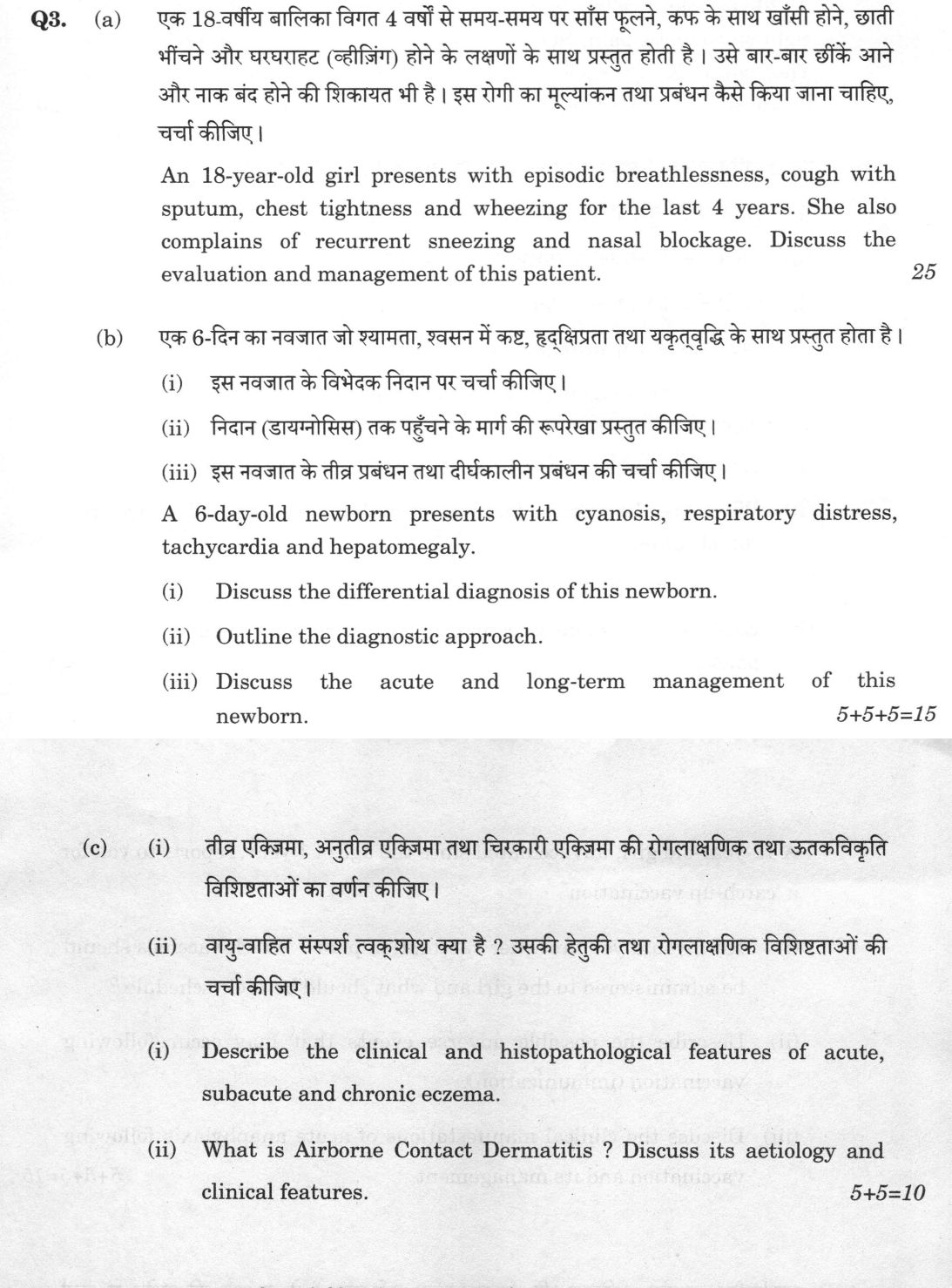
An 18-year-old girl presents with episodic breathlessness, cough with sputum, chest tightness and wheezing for the last 4 years. She also complains of recurrent sneezing and nasal blockage. Discuss the evaluation and management of this patient. 25 marks
A 6-day-old newborn presents with cyanosis, respiratory distress, tachycardia and hepatomegaly. Discuss the differential diagnosis of this newborn.
Outline the diagnostic approach.
Discuss the acute and long-term management of this newborn. 15 marks
Describe the clinical and histopathological features of acute, subacute and chronic eczema.
What is Airborne Contact Dermatitis ? Discuss its aetiology and clinical features. 10 marks
हिंदी में प्रश्न पढ़ें
एक 18-वर्षीय बालिका विगत 4 वर्षों से समय-समय पर साँस फूलने, कफ के साथ खाँसी होने, छाती भींचने और घरघराहट (व्हीज़िंग) होने के लक्षणों के साथ प्रस्तुत होती है। उसे बार-बार छींके आने और नाक बंद होने की शिकायत भी है। इस रोगी का मूल्यांकन तथा प्रबंधन कैसे किया जाना चाहिए, चर्चा कीजिए। (25 अंक)
एक 6-दिन का नवजात जो श्यामता, श्वसन में कष्ट, हृद्क्षिप्रता तथा यकृतवृद्धि के साथ प्रस्तुत होता है। इस नवजात के विभेदक निदान पर चर्चा कीजिए।
निदान (डायग्नोसिस) तक पहुँचने के मार्ग की रूपरेखा प्रस्तुत कीजिए।
इस नवजात के तीव्र प्रबंधन तथा दीर्घकालीन प्रबंधन की चर्चा कीजिए। (15 अंक)
तीव्र एक्जिमा, अनुतीव्र एक्जिमा तथा चिरकारी एक्जिमा की रोगलाक्षणिक तथा ऊतकविकृति विशिष्टताओं का वर्णन कीजिए।
वायु-वाहित संस्पर्श त्वक्शोथ क्या है ? उसकी हेतुकी तथा रोगलाक्षणिक विशिष्टताओं की चर्चा कीजिए। (10 अंक)
Model answer
Drafted with AI by UPSC Answer Check against this question's marking rubric, to the expected length. UPSC does not publish answers for Mains — this is one way to score well, not an official key. How we build rubrics and answers.
(a) An 18-year-old girl with episodic breathlessness, cough, chest tightness, wheeze, sneezing and nasal blockage for 4 years (25 marks)
Working diagnosis. The pattern is bronchial asthma with allergic rhinitis (the "one airway, one disease" concept): recurrent, variable respiratory symptoms with a background of nasal allergy. The differential diagnosis includes vocal cord dysfunction, gastro-oesophageal reflux, post-nasal drip cough, bronchiectasis, cystic fibrosis, tuberculosis, allergic bronchopulmonary aspergillosis (ABPA) and, less often at this age, cardiac disease.
Evaluation.
- History: the pattern of symptoms (episodic, worse at night or early morning, on exercise or with cold air), triggers (dust mite, pollen, smoke, pets, fumes, viral infections, drugs such as aspirin or NSAIDs), personal or family history of atopy (eczema, rhinitis), occupational and home exposures, smoking, previous hospital admissions, courses of oral steroids, and the effect on sleep, school and exercise.
- Examination: diffuse expiratory polyphonic wheeze, prolonged expiration, signs of hyperinflation, and general signs of atopy (pale boggy nasal turbinates, nasal polyps, allergic salute, Dennie-Morgan folds, eczema). Look for clubbing (which is not expected in asthma and suggests another cause).
- Spirometry (the key test): obstruction is shown by an FEV₁/FVC ratio below 0.75–0.80. Variable airflow limitation is confirmed by reversibility: an increase in FEV₁ of more than 12% and 200 mL, 15 minutes after 200–400 µg salbutamol, or peak expiratory flow (PEF) variability above 10% over 1–2 weeks (twice-daily readings). If spirometry is normal, do a bronchial provocation test (methacholine) or an exercise challenge.
- Other tests: blood eosinophil count, total IgE, and skin prick test or allergen-specific IgE to identify the sensitising allergens (house dust mite, pollen); fractional exhaled nitric oxide (FeNO) where available; chest X-ray to exclude other causes (hyperinflation only in asthma); and screening for ABPA (specific IgE and IgG to Aspergillus fumigatus, very high total IgE, eosinophilia) in a patient with persistent symptoms.
- Assess the level of control and risk: daytime symptoms more than twice a week, night waking, reliever use more than twice a week and activity limitation (the GINA symptom-control questions), plus exacerbations, poor adherence and inhaler technique, smoking, rhinitis and reflux.
Management (GINA strategy). The goals are good symptom control, normal activity, a normal lung function, and prevention of exacerbations and drug side effects.
- Non-pharmacological: patient education and a written asthma action plan, inhaler technique training (with a spacer), avoidance of triggers (dust-mite measures, no smoking, avoid NSAIDs if they trigger attacks), regular exercise, and annual influenza and pneumococcal vaccination.
- Drug treatment, in steps. Short-acting β₂-agonist (SABA) alone is no longer recommended, as it leaves airway inflammation untreated. In the preferred track, an inhaled corticosteroid (ICS) with formoterol is the reliever:
- Steps 1–2 (mild asthma): as-needed low-dose ICS-formoterol (an alternative is a daily low-dose ICS with as-needed SABA).
- Step 3: low-dose ICS-formoterol as maintenance and reliever (MART), or low-dose ICS with a long-acting β₂-agonist (LABA).
- Step 4: medium-dose ICS-formoterol (MART), or medium-dose ICS-LABA.
- Step 5: high-dose ICS-LABA with a long-acting muscarinic antagonist (tiotropium), assessment of the phenotype, and biologics for severe type-2 asthma (omalizumab for allergic asthma, and mepolizumab, benralizumab, dupilumab or tezepelumab); a short course of oral steroid only when needed.
- Add-on leukotriene receptor antagonist (montelukast) is useful when rhinitis coexists (with a warning about neuropsychiatric effects).
- Review the response every 1–3 months, step up if control is poor (after checking adherence, technique and comorbidity), and step down after 3 months of good control.
- Acute exacerbation: oxygen, salbutamol by spacer or nebuliser with ipratropium, early systemic corticosteroids (oral prednisolone 1 mg/kg, up to 40–50 mg, for 5–7 days), and intravenous magnesium sulphate in a severe attack; monitor for respiratory failure.
- Treat the allergic rhinitis (uncontrolled rhinitis worsens asthma): intranasal corticosteroid (mometasone or fluticasone), a second-generation oral antihistamine (cetirizine, fexofenadine, bilastine), saline nasal irrigation, and allergen immunotherapy (subcutaneous or sublingual, for house dust mite) if symptoms persist despite treatment.
- Follow-up: review of control, lung function, adherence and side effects every 3–6 months, and a plan for exams and exercise.
(b) A 6-day-old newborn with cyanosis, respiratory distress, tachycardia and hepatomegaly (5 + 5 + 5 = 15 marks)
(b)(i) Differential diagnosis (5 marks)
Cyanosis with heart failure (tachycardia and hepatomegaly) at the end of the first week suggests a duct-dependent congenital heart disease decompensating as the ductus arteriosus closes. The differential diagnosis is:
- Cyanotic heart disease with high pulmonary flow or mixing problems: transposition of the great arteries with a ventricular septal defect or PDA, total anomalous pulmonary venous connection (obstructed or unobstructed), truncus arteriosus, and single-ventricle lesions (tricuspid atresia with a large VSD).
- Left-heart obstruction (shock and cyanosis): hypoplastic left heart syndrome, critical aortic stenosis, interrupted aortic arch and critical coarctation.
- Duct-dependent pulmonary flow: critical pulmonary stenosis or pulmonary atresia and severe Fallot's tetralogy (cyanosis is prominent, hepatomegaly is less common).
- Non-cardiac causes: neonatal sepsis and pneumonia, persistent pulmonary hypertension of the newborn (PPHN), meconium aspiration, respiratory distress syndrome, congenital diaphragmatic hernia, polycythaemia, methaemoglobinaemia and metabolic causes (hypoglycaemia, inborn errors).
(b)(ii) Diagnostic approach (5 marks)
- Clinical: birth and antenatal history, and examination of colour (central cyanosis), respiratory pattern (distress with clear lungs suggests heart disease), all four limb pulses and blood pressure (weak femorals in coarctation), heart sounds (a single second sound, gallop, murmurs), and hepatomegaly.
- Pulse oximetry: pre-ductal (right hand) and post-ductal (foot) saturation, with a difference above 3% or a saturation below 95% suggesting critical heart disease.
- Hyperoxia test: give 100% oxygen for 10 minutes and repeat the arterial blood gas; a PaO₂ that stays below 100–150 mmHg (a rise of less than 20 mmHg) points to a cyanotic heart lesion, whereas a rise above 150 mmHg points to a lung cause.
- Laboratory: arterial blood gas and lactate (acidosis), glucose, calcium, blood count, sepsis screen and cultures.
- Chest X-ray: heart size and shape ("egg on a string" in transposition, "snowman" in supracardiac TAPVC, a boot shape in Fallot's) and the pulmonary blood flow (increased or decreased).
- ECG: axis and ventricular hypertrophy (right axis deviation in TGA and TAPVC, left axis deviation in tricuspid atresia).
- Echocardiography is the definitive test and should be done urgently. CT angiography or cardiac catheterisation is done for surgical planning.
(b)(iii) Acute and long-term management (5 marks)
Acute management.
- Resuscitate: airway, breathing, circulation, and admit to a neonatal intensive care unit, with monitoring and a warm environment.
- Start prostaglandin E₁ infusion immediately (0.01–0.05 µg/kg/min, up to 0.1) to keep the ductus arteriosus open while the diagnosis is confirmed. Be ready for apnoea and intubate if needed.
- Use oxygen with care: in duct-dependent systemic circulation, avoid high oxygen and aim for a saturation of about 75–85%, since oxygen closes the duct and lowers the pulmonary resistance.
- Treat heart failure with diuretics (furosemide) and inotropes (dopamine or dobutamine), correct acidosis, hypoglycaemia, hypocalcaemia and anaemia, restrict fluids, and give antibiotics if sepsis is possible.
- Balloon atrial septostomy (Rashkind procedure) for transposition with an inadequate atrial mixing.
- Transfer to a paediatric cardiac centre for definitive care.
Long-term management.
- Definitive surgery (or catheter intervention) according to the lesion: arterial switch operation for TGA (in the first 2 weeks), repair of TAPVC, a Blalock-Taussig shunt or valvotomy for pulmonary atresia or critical stenosis, and staged palliation (Norwood, Glenn, Fontan) for hypoplastic left heart syndrome.
- Nutritional support and growth monitoring, control of heart failure, and prevention of infective endocarditis with good dental hygiene.
- Routine immunisation, and RSV prophylaxis for haemodynamically significant disease.
- Regular cardiology follow-up with echocardiography, neurodevelopmental assessment, and counselling of the parents, with genetic counselling and a fetal echocardiogram in future pregnancies.
(c) Eczema and airborne contact dermatitis (5 + 5 = 10 marks)
(c)(i) Acute, subacute and chronic eczema (5 marks)
- Acute eczema. Clinical: ill-defined erythema and oedema with papules and vesicles that rupture to give oozing (weeping) and crusting, with intense itching. Histology: spongiosis (intercellular oedema of the epidermis) leading to intra-epidermal vesicles, exocytosis of lymphocytes, oedema of the papillary dermis, and a perivascular lymphocytic infiltrate; the horny layer is normal or only mildly parakeratotic.
- Subacute eczema. Clinical: erythema, scaling and crusting, with fewer vesicles and less oozing, and moderate itching. Histology: less spongiosis, mild to moderate acanthosis with parakeratosis (sometimes with a serum crust), and a mild perivascular infiltrate.
- Chronic eczema. Clinical: thick, dry, leathery skin with accentuated skin markings (lichenification), scaling, excoriations and fissures, and post-inflammatory hyperpigmentation or hypopigmentation, with severe itching. Histology: marked, irregular acanthosis with elongated rete ridges, hyperkeratosis with focal parakeratosis, hypergranulosis, minimal spongiosis, thickening of the papillary dermal collagen (vertical streaking), fibroblast proliferation, and a chronic perivascular infiltrate.
(c)(ii) Airborne contact dermatitis (5 marks)
Definition. Airborne contact dermatitis is a dermatitis (irritant or allergic) of the exposed skin produced by allergens or irritants carried in the air, such as dust, pollen, vapours, sprays and volatile substances.
Aetiology.
- Plants: Parthenium hysterophorus (congress grass, the commonest cause in India, through the sesquiterpene lactone parthenin), other Compositae (chrysanthemum, sunflower), pollen, lichens and weeds.
- Occupational and household agents: wood dust (teak), cement dust, epoxy resin, pesticides, formaldehyde, fragrances, and drug sprays. Some patients also have an associated photosensitivity (chronic actinic dermatitis).
- Mechanism: delayed (type IV) hypersensitivity in the allergic type, and direct injury in the irritant type.
Clinical features. It is seasonal or occupational and usually itchy.
- The eruption involves the exposed areas: the face (especially the eyelids), the neck (V area), the forearms and the hands, with erythema, papules, vesicles, oedema and later lichenification and scaling. The eyelids and the face are swollen.
- Unlike a photodermatitis, it also involves the skin folds and sheltered sites (the upper eyelids, retroauricular skin, and the submental area), because the particles settle there.
- Chronic cases may progress to widespread or erythrodermic disease. The diagnosis is confirmed by patch testing with the suspected allergen (for example parthenium extract), and treatment is avoidance with topical corticosteroids and antihistamines, and immunosuppressants in severe disease.
How this answer will be evaluated
Evaluation rubric
Each sub-part is marked on its own, against the marks and word limit printed on the paper.
- (a) (a) An 18-year-old girl with 4 years of episodic breathlessness, cough with sputum, chest tightness, wheeze, sneezing and nasal blockage: discuss the evaluation and management (25 marks). 25 marks
Must cover
- Working diagnosis of bronchial asthma with allergic rhinitis, with differentials
- Evaluation: history and triggers, spirometry with reversibility (FEV1 rise above 12% and 200 mL), PEF variability, allergy tests, ABPA screen, control assessment
- GINA stepwise treatment with ICS-formoterol reliever and MART, steps up to biologics; SABA-alone not recommended
- Rhinitis treatment (intranasal steroid, antihistamine, montelukast, immunotherapy), action plan, exacerbation care and follow-up
Loses marks
- Recommending SABA alone or long-acting β2-agonist alone.
- Ignoring the rhinitis.
- Omitting spirometry.
Earns more
- Reversibility criteria stated with numbers.
- Inhaler technique, adherence and trigger avoidance.
Extra mark
- FeNO and blood eosinophils guiding biologic choice
- (b) (b) A 6-day-old newborn with cyanosis, respiratory distress, tachycardia and hepatomegaly: differential diagnosis, diagnostic approach, acute and long-term management (5 + 5 + 5 = 15 marks). 15 marks
Must cover
- Duct-dependent congenital heart disease as the leading diagnosis, with differentials (TGA, TAPVC, HLHS, pulmonary atresia) and non-cardiac causes (sepsis, PPHN)
- Approach: pre- and post-ductal saturation, hyperoxia test, blood gas, chest X-ray, ECG, echocardiography
- Acute care: prostaglandin E1 0.01–0.05 µg/kg/min, oxygen with caution, diuretics and inotropes, correction of acidosis, balloon atrial septostomy
- Long-term: lesion-specific surgery (arterial switch, Norwood-Glenn-Fontan, shunt), nutrition, endocarditis prevention, follow-up
Loses marks
- Treating as sepsis alone.
- Giving high-flow oxygen to all.
- Omitting prostaglandin infusion.
Earns more
- Interpretation of hyperoxia test values.
- Radiological signs (egg on a string, snowman).
Extra mark
- Transfer to a cardiac centre and prenatal counselling
- (c) (c) (i) Describe the clinical and histopathological features of acute, subacute and chronic eczema; (ii) what is airborne contact dermatitis; discuss its aetiology and clinical features (5 + 5 = 10 marks). 10 marks
Must cover
- Acute eczema: vesicles and oozing; spongiosis and exocytosis
- Subacute: scaling and crusting; mild acanthosis with parakeratosis
- Chronic: lichenification; marked acanthosis, hyperkeratosis, dermal fibrosis
- Airborne contact dermatitis: definition, Parthenium and other agents, exposed-site distribution with involvement of the folds
Loses marks
- Giving only clinical features.
- Describing spongiosis in chronic eczema as the main feature.
- Naming a wrong plant or wrong distribution.
Earns more
- Both clinical and histological features for all three stages.
- Patch test with parthenium.
Extra mark
- Comparison with photodermatitis on sparing of the folds
What "Discuss" is asking you to do
Lay the issue out from more than one side — how it arose, what is claimed for it, what is held against it, and where it now stands. UPSC attaches discuss to broad topics with several live dimensions, so coverage of the dimensions earns more than the strength of your opinion.
Structure that answers it
Set the issue up → the case as it is made → the case against → the dimension both sides leave out → where the balance now lies
Where marks are lost
Listing facts with no thread between them, or arguing one side throughout and calling it a discussion.
Practice this exact question
Write your answer and it is marked point by point against the model answer above — what you covered, what you missed, what you got wrong.
Evaluate my answer →More from Medical Science 2026 Paper II
- Q1 (a) Discuss the various sputum-based tests for the diagnosis of tuberculosis under the Na…
- Q2 (a) A 20-year-old medical student presents with fever, dry cough, and right-sided chest p…
- Q3 (a) An 18-year-old girl presents with episodic breathlessness, cough with sputum, chest t…
- Q4 (a) A 45-year-old hepatitis-C positive patient presents with icterus, oliguria, abdominal…
- Q5 (a) Enumerate the causes of lower gastrointestinal bleeding in an adult. Discuss the mana…
- Q6 (a) (i) Describe the causes of occipito-posterior position and different modes of deliver…