Paper II — Q7
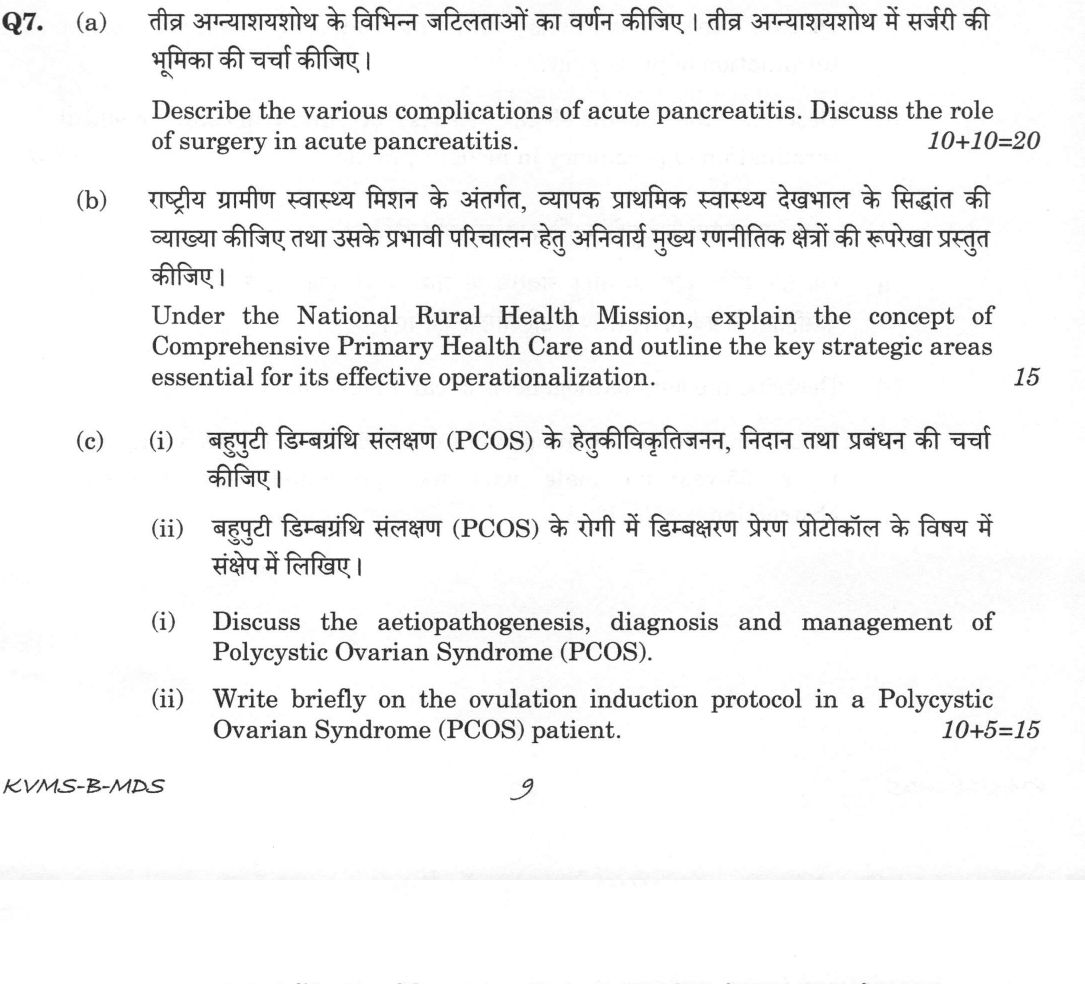
(a) Describe the various complications of acute pancreatitis. Discuss the role of surgery in acute pancreatitis. (20 marks) (b)…
Describe the various complications of acute pancreatitis. Discuss the role of surgery in acute pancreatitis. 20 marks
Under the National Rural Health Mission, explain the concept of Comprehensive Primary Health Care and outline the key strategic areas essential for its effective operationalization. 15 marks
Discuss the aetiopathogenesis, diagnosis and management of Polycystic Ovarian Syndrome (PCOS).
Write briefly on the ovulation induction protocol in a Polycystic Ovarian Syndrome (PCOS) patient. 15 marks
हिंदी में प्रश्न पढ़ें
तीव्र अग्न्याशयशोथ के विभिन्न जटिलताओं का वर्णन कीजिए। तीव्र अग्न्याशयशोथ में सर्जरी की भूमिका की चर्चा कीजिए। (20 अंक)
राष्ट्रीय ग्रामीण स्वास्थ्य मिशन के अंतर्गत, व्यापक प्राथमिक स्वास्थ्य देखभाल के सिद्धांत की व्याख्या कीजिए तथा उसके प्रभावी परिचालन हेतु अनिवार्य मुख्य रणनीतिक क्षेत्रों की रूपरेखा प्रस्तुत कीजिए। (15 अंक)
बहुपुटी डिम्बग्रंथि संलक्षण (PCOS) के हेतुकीविकृतिजनन, निदान तथा प्रबंधन की चर्चा कीजिए।
बहुपुटी डिम्बग्रंथि संलक्षण (PCOS) के रोगी में डिम्बक्षरण प्रेरण प्रोटोकॉल के विषय में संक्षेप में लिखिए। (15 अंक)
Model answer
Drafted with AI by UPSC Answer Check against this question's marking rubric, to the expected length. UPSC does not publish answers for Mains — this is one way to score well, not an official key. How we build rubrics and answers.
(a) Acute pancreatitis: complications and role of surgery (10 + 10 = 20 marks)
(a)(i) Complications of acute pancreatitis (10 marks)
Under the Revised Atlanta classification (2012), the complications are local and systemic, and the severity depends on the organ failure.
Local complications.
- Acute peripancreatic fluid collection: fluid in the first 4 weeks in interstitial oedematous pancreatitis, without a wall, that usually resolves.
- Acute necrotic collection: a collection with variable amounts of fluid and necrotic tissue in necrotising pancreatitis, in the first 4 weeks.
- Pseudocyst: an encapsulated fluid collection with a well-defined fibrous wall, without necrosis, that appears 4 weeks or later.
- Walled-off necrosis: a mature, encapsulated collection of pancreatic and peripancreatic necrosis, after 4 weeks.
- Infected necrosis: infection of a necrotic collection (gas bubbles on CT, positive aspirate), usually in the 2nd–4th week, which carries a high mortality.
- Other local complications: gastric outlet or duodenal obstruction, biliary obstruction, splenic and portal vein thrombosis (with left-sided portal hypertension), colonic necrosis or fistula, haemorrhage and splenic artery pseudoaneurysm, pancreatic ascites and pleural effusion, and pancreatic duct disruption (disconnected duct).
Systemic complications.
- Systemic inflammatory response and organ failure (respiratory: ARDS and hypoxia; cardiovascular: hypotension and shock; renal: acute kidney injury), defined by the modified Marshall score. Failure lasting less than 48 hours is transient, and failure lasting more than 48 hours is persistent (the main determinant of mortality).
- Sepsis, disseminated intravascular coagulation, hypocalcaemia, hyperglycaemia, metabolic acidosis, and abdominal compartment syndrome.
- Pancreatic encephalopathy, Purtscher's retinopathy, subcutaneous fat necrosis (panniculitis) and polyarthritis.
- Late: exocrine and endocrine insufficiency (diabetes), chronic pancreatitis, and recurrent attacks.
Severity. Mild (no organ failure or complication), moderately severe (transient organ failure, or local or systemic complications) and severe (persistent organ failure).
(a)(ii) Role of surgery in acute pancreatitis (10 marks)
Most patients need no surgery: they are treated with fluid resuscitation, analgesia, early enteral feeding and supportive care. Surgery, or another invasive intervention, has a limited role, and its guiding principle is delay: an early necrosectomy (within 2 weeks) has a high mortality, so intervention is postponed until the necrosis has been walled off (usually after about 4 weeks).
- Uncertain diagnosis: laparotomy (or laparoscopy) if a surgical catastrophe such as a perforated ulcer or mesenteric ischaemia cannot be excluded.
- Gallstone pancreatitis: urgent ERCP with sphincterotomy within 24–72 hours for cholangitis or persistent biliary obstruction. Cholecystectomy to prevent recurrence, during the same admission in mild disease, and delayed until the collections have resolved (usually after 6 weeks) in severe disease.
- Sterile necrosis: managed conservatively, with intervention only for a persistent symptom (obstruction, unresolving illness).
- Infected necrosis (the main indication). Confirmed by gas on CT or a positive fine-needle aspirate. Treat with antibiotics (carbapenems) and, preferably after 4 weeks, use the step-up approach: percutaneous or endoscopic transluminal drainage first, then minimally invasive necrosectomy (video-assisted retroperitoneal debridement or endoscopic transgastric necrosectomy) if there is no improvement, and open necrosectomy only as the last resort. The step-up approach reduces major complications and mortality compared with primary open necrosectomy.
- Pseudocyst: observe if asymptomatic. Drainage is indicated for symptoms, infection, bleeding or rapid growth: endoscopic transmural (cystogastrostomy) drainage is preferred, and surgical cystogastrostomy or Roux-en-Y cystojejunostomy is used for a failure or a complicated cyst; percutaneous drainage is a choice for infected cysts. A cyst over 6 cm that persists for more than 6 weeks is a common threshold.
- Complications needing surgery: abdominal compartment syndrome (decompressive laparotomy), haemorrhage (angioembolisation first, then surgery), bowel ischaemia, perforation or colonic necrosis, and a disconnected pancreatic duct (distal pancreatectomy or internal drainage).
(b) Comprehensive Primary Health Care under the National Rural Health Mission (15 marks)
Concept. The National Rural Health Mission (now merged in the National Health Mission) defines Comprehensive Primary Health Care (CPHC) as an expansion of primary care from a narrow, selective set of services (maternal and child health and a few communicable diseases) to a universal, free, comprehensive and continuous package of care close to the community, following the Alma-Ata principle of "health for all". It combines promotive, preventive, curative, rehabilitative and palliative services, is delivered by a team, and acts as the first contact and the gatekeeper of the referral system. In India it is delivered through the transformed Health and Wellness Centres (Ayushman Bharat, now called Ayushman Arogya Mandir), created from sub-centres and primary health centres. Its principles are universality, equity, community participation, intersectoral action, a continuum of care, and person-centred care.
Expanded service package. The 12 packages are: care in pregnancy and childbirth; neonatal and infant health; childhood and adolescent health; family planning and reproductive health; management of communicable diseases (national programmes); management of common communicable diseases and outpatient care for minor ailments; screening, prevention and management of non-communicable diseases (hypertension, diabetes, common cancers); care for common eye and ENT problems; basic oral health care; elderly and palliative care; emergency medical services including trauma; and screening and basic management of mental health problems, with yoga and wellness promotion.
Key strategic areas for effective operationalisation.
- Human resources: a Community Health Officer (a mid-level health provider) leading a team of the ANM, multipurpose worker and ASHA at each sub-centre, and a medical officer at the primary health centre; training, capacity building, and team-based incentives.
- Service package and infrastructure: upgrading the buildings with space for wellness activities and yoga, and sufficient equipment.
- Drugs and diagnostics: an expanded essential medicines list (about 105 drugs at the sub-centre and 172 at the primary health centre) and free diagnostics (about 14 and 63 tests respectively), with an assured supply chain.
- Community mobilisation and health promotion: ASHAs and the Jan Arogya Samitis, Village Health Sanitation and Nutrition Committees, population enumeration, community-based risk assessment (CBAC checklist) and universal screening of those above 30 years.
- Referral and the continuum of care: a two-way referral with follow-up between the health and wellness centre and the higher facilities, with gatekeeping and linkage with Ayushman Bharat PM-JAY for secondary and tertiary care.
- Information technology: an IT application for individual health records, teleconsultation (e-Sanjeevani) and the Ayushman Bharat Digital Mission (ABHA ID).
- Financing and governance: flexible NHM funds and untied grants, and intersectoral convergence.
- Quality assurance and monitoring: the National Quality Assurance Standards, certification, Kayakalp, and performance monitoring.
(c) Polycystic ovary syndrome (10 + 5 = 15 marks)
(c)(i) Aetiopathogenesis, diagnosis and management (10 marks)
Aetiopathogenesis. PCOS is a multifactorial endocrine disorder (5–10% of women of reproductive age), with a genetic predisposition (familial clustering) and environmental factors such as obesity.
- Insulin resistance and compensatory hyperinsulinaemia (in most women, both obese and lean) stimulate ovarian theca cells to produce androgens and reduce the hepatic synthesis of sex hormone-binding globulin (SHBG), thereby increasing free testosterone.
- Increased frequency of GnRH pulses favours LH over FSH. The raised LH stimulates theca-cell androgen production, and the relatively low FSH prevents follicular maturation, so small antral follicles accumulate (the "polycystic" ovary) and there is anovulation.
- Excess androgens cause hirsutism, acne and alopecia; anovulation exposes the endometrium to unopposed oestrogen (with a risk of hyperplasia and cancer); and adrenal androgen excess and a high anti-Müllerian hormone level contribute.
Diagnosis (Rotterdam criteria). Two of the following three, after exclusion of other causes:
- Oligo- or anovulation: cycles longer than 35 days or fewer than 8 cycles a year.
- Clinical or biochemical hyperandrogenism: hirsutism (modified Ferriman-Gallwey score of 8 or more), acne, alopecia, or raised total or free testosterone.
- Polycystic ovaries on ultrasound: 20 or more follicles of 2–9 mm in either ovary (the older threshold was 12 or more) and/or an ovarian volume above 10 mL. (An elevated anti-Müllerian hormone can replace ultrasound in adults; in adolescents, both oligo-anovulation and hyperandrogenism are needed.)
- Exclusions: thyroid disease (TSH), hyperprolactinaemia (prolactin), non-classic congenital adrenal hyperplasia (17-hydroxyprogesterone), Cushing's syndrome, and androgen-secreting tumours (testosterone above 200 ng/dL, or DHEAS above 700 µg/dL).
- Further tests: LH and FSH, SHBG, a 75 g oral glucose tolerance test, HbA1c and a lipid profile, as a screen for the metabolic syndrome, plus assessment for sleep apnoea, fatty liver and depression.
General management. This is by the patient's concern:
- Lifestyle: a weight loss of 5–10% (a healthy diet and 150 minutes of exercise a week) restores ovulation and improves insulin resistance, and is the first step for every woman.
- Menstrual irregularity and endometrial protection: the combined oral contraceptive pill (for example ethinylestradiol 30 µg with drospirenone or cyproterone acetate) is first-line; if it is contraindicated, cyclical progestogen (medroxyprogesterone 10 mg for 10–14 days a month) ensures a withdrawal bleed at least every 3 months.
- Hirsutism and acne: the combined pill, then add an anti-androgen after 6 months (spironolactone 50–100 mg twice daily, or cyproterone acetate), with cosmetic measures (laser). Anti-androgens need contraception because of the risk to a male fetus.
- Metabolic: metformin (500 mg, increased to 1.5–2 g/day) for insulin resistance, impaired glucose tolerance or obesity, and inositol or a GLP-1 receptor agonist as adjuncts; statins for dyslipidaemia; screening for diabetes every 1–3 years.
- Infertility: see part (ii). Psychological support and long-term follow-up for diabetes, cardiovascular disease and endometrial cancer.
(c)(ii) Ovulation induction protocol in PCOS (5 marks)
Before starting: lifestyle change and weight loss, folic acid 400 µg daily, a semen analysis, and confirmation of tubal patency, with other causes of infertility excluded.
- First-line: letrozole (an aromatase inhibitor) 2.5 mg daily from day 3 to day 7 of the cycle, increased in steps of 2.5 mg in each cycle to a maximum of 7.5 mg if there is no ovulation. It gives higher ovulation and live-birth rates than clomiphene in PCOS. The alternative is clomiphene citrate 50 mg daily for 5 days (starting on day 2–5), increased to a maximum of 150 mg. Metformin may be added in resistant cases.
- Monitoring: transvaginal ultrasound follicle tracking from about day 10–12, and if the dominant follicle reaches 18 mm or more, human chorionic gonadotropin (hCG 5000–10,000 IU) is given as the trigger, with timed intercourse or intra-uterine insemination.
- Second-line: low-dose gonadotropins by a chronic step-up regimen (FSH 37.5–75 IU daily, increased by 37.5 IU after 7–14 days if there is no response), with careful monitoring to avoid multiple follicles, or laparoscopic ovarian drilling (about 4 punctures per ovary, 40 J each) in clomiphene-resistant women, especially in those with a high LH level.
- Third-line: IVF or ICSI with an antagonist protocol and a GnRH-agonist trigger to lower the risk of ovarian hyperstimulation syndrome (OHSS), or in-vitro maturation.
- Risks: OHSS and multiple pregnancy, so treatment is limited to 6–9 ovulatory cycles.
How this answer will be evaluated
Evaluation rubric
Each sub-part is marked on its own, against the marks and word limit printed on the paper.
- (a) (a) Describe the various complications of acute pancreatitis; discuss the role of surgery in acute pancreatitis (10 + 10 = 20 marks). 20 marks
Must cover
- Local complications by Revised Atlanta: acute fluid collection, acute necrotic collection, pseudocyst, walled-off necrosis, infected necrosis, vascular and other complications
- Systemic complications: organ failure (transient versus persistent), sepsis, DIC, hypocalcaemia, compartment syndrome
- Principle of delay with conservative treatment of sterile necrosis; ERCP and cholecystectomy timing in gallstone pancreatitis
- Step-up approach for infected necrosis (drainage then minimally invasive necrosectomy); pseudocyst drainage; surgery for compartment syndrome and haemorrhage
Loses marks
- Advising early necrosectomy or operating for sterile necrosis.
- Confusing pseudocyst with acute collection.
- Omitting systemic complications.
Earns more
- Time course (4 weeks) stated.
- Severity grading as mild, moderately severe, severe.
Extra mark
- PANTER trial and endoscopic transgastric necrosectomy
- (b) (b) Under the National Rural Health Mission, explain the concept of Comprehensive Primary Health Care and outline the key strategic areas for its operationalisation (15 marks). 15 marks
Must cover
- Concept: shift from selective to comprehensive, universal, free, continuous care near the community; Health and Wellness Centres
- Expanded package of 12 services including NCD screening, mental health, oral health, elderly and palliative care
- Strategic areas: human resources (Community Health Officer, team incentives), drugs and diagnostics, infrastructure
- Community mobilisation, referral continuum, IT (e-Sanjeevani, ABDM), financing and quality assurance (NQAS)
Loses marks
- Describing only maternal and child health.
- Omitting the referral system.
- Confusing CPHC with tertiary care.
Earns more
- Alma-Ata principles named.
- At least six of the strategic areas.
Extra mark
- Population enumeration and CBAC, and renaming as Ayushman Arogya Mandir
- (c) (c) Discuss the aetiopathogenesis, diagnosis and management of polycystic ovary syndrome; write briefly on the ovulation induction protocol in PCOS (10 + 5 = 15 marks). 15 marks
Must cover
- Aetiopathogenesis: insulin resistance and hyperinsulinaemia, raised LH and androgens, low SHBG, anovulation
- Rotterdam criteria: two of oligo-anovulation, hyperandrogenism, polycystic ovaries (20 follicles or volume above 10 mL) after exclusion of other causes
- General management: lifestyle, combined pill, anti-androgens, metformin, endometrial protection, screening
- Ovulation induction: letrozole 2.5–7.5 mg days 3–7 (or clomiphene 50–150 mg), then gonadotropins or ovarian drilling, then IVF; monitoring and hCG trigger
Loses marks
- Giving LH:FSH ratio as the diagnostic criterion.
- Starting with gonadotropins as first-line.
- Omitting lifestyle measures.
Earns more
- Exclusion tests for thyroid, prolactin and 17-OHP.
- OHSS and multiple pregnancy risks.
Extra mark
- 2023 guideline use of AMH and letrozole as first-line
What "Describe" is asking you to do
Give a full, ordered account of the thing named — its parts, stages or mechanism — in the sequence in which it actually exists or occurs. Most describe questions come from the science optionals, where the marks sit in correct technical detail and, where the stem says so, a labelled diagram.
Structure that answers it
One-line identification of the subject → the parts or stages in their real order, each with its defining detail → labelled diagram where the subject is structural → closing line on function or significance
Where marks are lost
Loose general prose where the examiner is ticking named parts, correct terminology and their sequence; and in the General Studies papers, turning to evaluation before the description is finished.
Practice this exact question
Write your answer and it is marked point by point against the model answer above — what you covered, what you missed, what you got wrong.
Evaluate my answer →More from Medical Science 2026 Paper II
- Q4 (a) A 45-year-old hepatitis-C positive patient presents with icterus, oliguria, abdominal…
- Q5 (a) Enumerate the causes of lower gastrointestinal bleeding in an adult. Discuss the mana…
- Q6 (a) (i) Describe the causes of occipito-posterior position and different modes of deliver…
- Q7 (a) Describe the various complications of acute pancreatitis. Discuss the role of surgery…
- Q8 (a) (i) What are the main objectives and key strategies of the National Strategic Plan (N…