Paper I — Q1
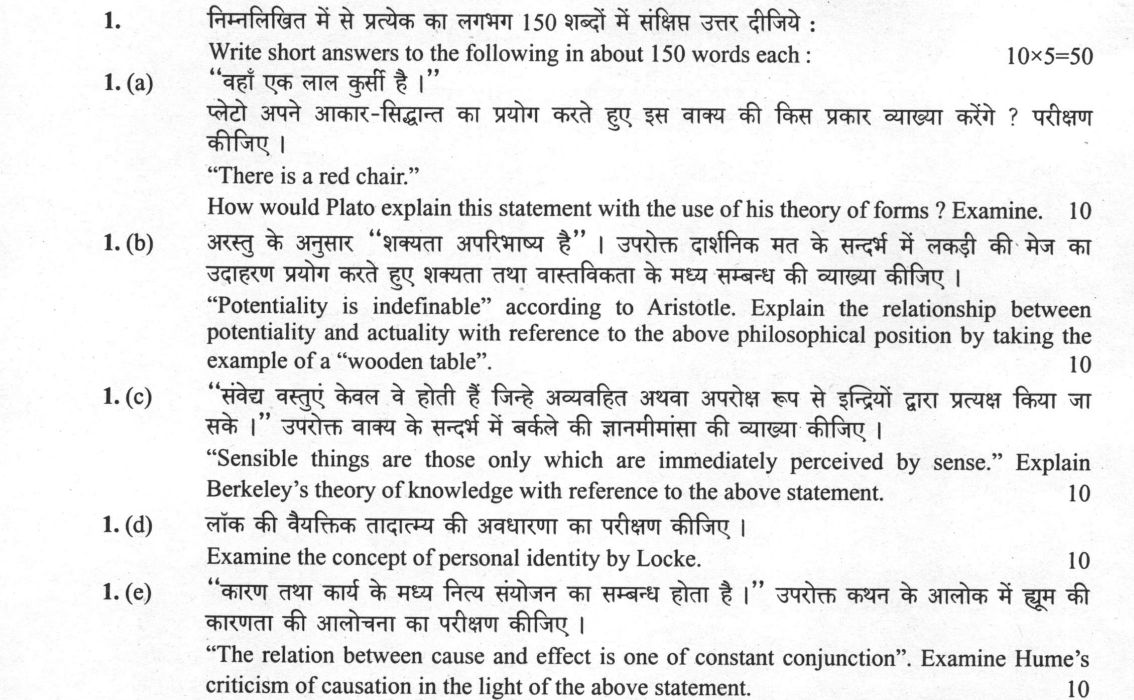
Write short answers to the following in about 150 words each: (a) "There is a red chair." How would Plato explain this statement…
Write short answers to the following in about 150 words each: "There is a red chair." How would Plato explain this statement with the use of his theory of forms ? Examine. 10 marks
"Potentiality is indefinable" according to Aristotle. Explain the relationship between potentiality and actuality with reference to the above philosophical position by taking the example of a "wooden table". 10 marks
"Sensible things are those only which are immediately perceived by sense." Explain Berkeley's theory of knowledge with reference to the above statement. 10 marks
Examine the concept of personal identity by Locke. 10 marks
"The relation between cause and effect is one of constant conjunction". Examine Hume's criticism of causation in the light of the above statement. 10 marks
हिंदी में प्रश्न पढ़ें
निम्नलिखित में से प्रत्येक का लगभग 150 शब्दों में संक्षिप्त उत्तर दीजिए : "वहाँ एक लाल कुर्सी है ।" प्लेटो अपने आकार-सिद्धांत का प्रयोग करते हुए इस वाक्य की किस प्रकार व्याख्या करेंगे ? परीक्षण कीजिए । (10 अंक)
अरस्तु के अनुसार "शक्यता अपरिभाष्य है" । उपरोक्त दार्शनिक मत के संदर्भ में लकड़ी की मेज का उदाहरण प्रयोग करते हुए शक्यता तथा वास्तविकता के मध्य संबंध की व्याख्या कीजिए । (10 अंक)
"सैंवध वस्तुएँ केवल वे होती हैं जिन्हें अव्यवहित अथवा अपरोक्ष रूप से इन्द्रियों द्वारा प्रत्यक्ष किया जा सके ।" उपरोक्त वाक्य के संदर्भ में बर्कले की ज्ञानमीमांसा की व्याख्या कीजिए । (10 अंक)
लॉक की व्यक्तित्व तादात्म्य की अवधारणा का परीक्षण कीजिए । (10 अंक)
"कारण तथा कार्य के मध्य नित्य संयोजन का संबंध होता है ।" उपरोक्त कथन के आलोक में ह्यूम की कारणता की आलोचना का परीक्षण कीजिए । (10 अंक)
Model answer
Written by UPSC Answer Check against this question's marking rubric, to the 150-word length. UPSC does not publish answers for Mains — this is one way to score well, not an official key.
(a) Plato's Theory of Forms and "The Red Chair"
Plato explains the empirical proposition "There is a red chair" by distinguishing between the realm of Becoming (the sensible world of flux) and the realm of Being (the intelligible world of eternal Forms). The sensible red chair is not ultimate reality; rather, it is a transient, imperfect copy that exists only by participating (methexis) simultaneously in two distinct transcendent archetypes: the Form of Chair (Chairness) and the Form of Red (Redness).
Within Plato's epistemological hierarchy, illustrated by the Divided Line and the Allegory of the Cave, sensory perception of the physical chair yields merely mutable opinion (doxa), whereas genuine knowledge (episteme) requires the philosopher's intellectual ascent from these shadowy particulars to the intelligible realm of immutable Forms, culminating in the Form of the Good.
Critically, while Plato’s doctrine accounts for universal predications across diverse particulars, it struggles to explain the exact metaphysical mechanism of participation without generating logical regress, such as the Third Man argument.
(b) Aristotle on Potentiality, Actuality, and the Wooden Table
Aristotle asserts that "potentiality is indefinable" because pure potentiality (prime matter) lacks all determinate form, and definition strictly requires an actualized formal essence. Potentiality (dynamis) can only be understood analogically in relation to actuality (energeia or entelecheia). In a "wooden table," wood represents potentiality—the underlying material substrate (hyle) capable of receiving form—while the finished table represents actuality, where the form (morphe) is realized.
This relationship operates through a teleological process of change (kinesis), wherein the efficient and formal causes guide the wood toward its final cause or purpose. Unlike Plato, who separated Forms into a transcendent realm, Aristotle integrates form and matter through hylomorphism.
Critically, Aristotle successfully overcomes Platonic dualism by grounding change within empirical substances. However, treating potentiality as an indefinable yet real ontological bridge between non-being and being leaves prime matter as a purely conceptual limit rather than a directly verifiable entity.
(c) Berkeley's Theory of Knowledge and Immaterialism
Berkeley’s dictum that sensible things are only what is immediately perceived forms the bedrock of his subjective idealism, summarized as esse est percipi (to be is to be perceived). Rejecting Locke’s unperceived material substratum and the distinction between primary and secondary qualities, Berkeley argues that physical objects are nothing over and above collections of sensible ideas immediately present to the mind.
Epistemologically, Berkeley distinguishes between ideas of imagination, which are faint and voluntarily produced by human minds, and ideas of sense, which are vivid, orderly, and involuntary. Because these sensible ideas exist independent of individual human volition, their continuous existence and coherence are guaranteed by the eternal, omnipresent perception of God, who imprints them directly upon finite minds.
Critically, Berkeley eliminates the skeptical gap inherent in representational realism, yet his system avoids solipsism only by relying on a metaphysical and theological postulate of divine perception.
(d) Locke's Concept of Personal Identity
John Locke defines personal identity not through the continuity of an immaterial soul or a material biological body, but through the psychological continuity of consciousness. A person is a "thinking, intelligent being, that has reason and reflection, and can consider itself as itself, the same thinking thing, in different times and places." This continuity is mediated entirely through memory extending backward to past actions and thoughts.
For Locke, "person" is a forensic term, inextricably linked to moral accountability, legal reward, and punishment. He carefully distinguishes the identity of a "person" from the identity of a "man" (the biological organism) and the identity of a "substance" (the metaphysical soul).
Critically, Locke’s memory criterion encounters severe logical difficulties. Memory gaps, loss of consciousness during sleep (the sleeping man objection), and forgetfulness threaten the continuity of identity, while using memory to define the self risks circularity by presupposing the very conscious agent whose identity it seeks to establish.
(e) Hume's Criticism of Causation and Constant Conjunction
Hume subjects the traditional concept of causality to radical empiricist critique. According to his copy principle, all meaningful ideas must originate from prior sensory impressions. Upon inspecting any causal event, experience reveals only spatial contiguity and temporal succession between events A and B; it yields no impression of an objective "necessary connection" or productive power in the objects themselves.
Consequently, Hume argues that causal inference is not a product of a priori rational demonstration or empirical observation of necessity, but a subjective psychological projection. Repeated observation of "constant conjunction" generates a customary transition or habit of the imagination, leading the mind to expect effect B upon observing cause A.
Critically, Hume dissolves objective metaphysical necessity into psychological expectation. Rather than surrendering to unlivable pyrrhonic skepticism, he adopts a mitigated skepticism, demonstrating that while causation lacks rational justification, natural belief remains indispensable for practical human survival and empirical inquiry.
What "Examine" is asking you to do
Test the proposition the question puts to you and return a finding on how far it holds. Examine stems carry a claim, or ask whether something has happened, and expect evidence weighed both ways before the extent is stated — often with remedial measures attached.
Structure that answers it
Restate the claim as the question frames it → evidence that supports it → evidence that undercuts it → the conditions under which it holds → verdict on how far it stands
Where marks are lost
Stopping at description. An examination has to reach a finding, and “examine with justification” means the extent must be stated, not implied.
How this answer will be evaluated
Approach
Framework: State the position > Argument > Strongest objection > Evaluation. (a) examine: intro > how/why with reasoning > evidence > conclusion | (b) explain: definition/context > points in order > small example > short close | (c) explain: definition/context > points in order > small example > short close | (d) examine: intro > how/why with reasoning > evidence > conclusion | (e) examine: intro > how/why with reasoning > evidence > conclusion Full marks: Precise use of technical vocabulary, clear reconstruction of arguments, strong counter-arguments, and accurate application of examples.
Key points expected
- Distinguish the particular chair from the Form of Chair
- Explain the Form of Redness (or Beauty) as the source of quality
- Describe the relationship of participation (methexis) or imitation
- Contrast the sensible world with the intelligible world
- Define potentiality (dynamis) and actuality (energeia/entelecheia)
- Apply the concepts to the 'wooden table' example
- Explain the transition from potential to actual (e.g., wood to table)
- Address the 'indefinable' nature of potentiality
Evaluation rubric
Each sub-part is marked on its own, against the marks and word limit printed on the paper.
- (a) Explain the statement 'There is a red chair' using Plato's theory of forms. 10 marks · 150 words
examine— intro → how/why with reasoning → evidence → conclusion
Must cover
- Distinguish the particular chair from the Form of Chair
- Explain the Form of Redness (or Beauty) as the source of quality
- Describe the relationship of participation (methexis) or imitation
- Contrast the sensible world with the intelligible world
Loses marks
- Biographical details of Plato
- Confusing Forms with Platonic Ideas in the modern sense
- Failing to address the specific example of the chair
Earns more
- Use of Greek terms: eidos, methexis, noesis
- Reference to the Allegory of the Cave
- Mention of the Demiurge (if relevant to creation)
Extra mark
- Reference to the 'Divided Line' analogy
- (b) Explain the relationship between potentiality and actuality using the example of a wooden table. 10 marks · 150 words
explain— definition/context → points in order → small example → short close
Must cover
- Define potentiality (dynamis) and actuality (energeia/entelecheia)
- Apply the concepts to the 'wooden table' example
- Explain the transition from potential to actual (e.g., wood to table)
- Address the 'indefinable' nature of potentiality
Loses marks
- Biographical details of Aristotle
- Confusing potentiality with mere possibility
- Failing to use the specific example of the wooden table
Earns more
- Use of Greek terms: dynamis, energeia, entelecheia
- Reference to the four causes (material, formal, efficient, final)
- Mention of the 'unmoved mover' as pure actuality
Extra mark
- Reference to the concept of 'telos' (end/goal)
- (c) Explain Berkeley's theory of knowledge with reference to the statement 'Sensible things are those only which are immediately perceived by sense.' 10 marks · 150 words
explain— definition/context → points in order → small example → short close
Must cover
- State Berkeley's 'esse est percipi' (to be is to be perceived)
- Explain the rejection of material substance
- Describe the role of the mind in perceiving sensible things
- Address the 'God as perceiver' argument for the existence of objects
Loses marks
- Biographical details of Berkeley
- Confusing Berkeley's idealism with subjective idealism
- Failing to address the specific statement about sensible things
Earns more
- Use of Latin terms: esse est percipi, res extensa
- Reference to the 'Principles of Human Knowledge'
- Mention of the 'master argument' against abstract ideas
Extra mark
- Reference to the 'Three Dialogues between Hylas and Philonous'
- (d) Examine the concept of personal identity by Locke. 10 marks · 150 words
examine— intro → how/why with reasoning → evidence → conclusion
Must cover
- Define personal identity in terms of consciousness and memory
- Explain the 'principle of personal identity' (continuity of consciousness)
- Address the 'Ship of Theseus' or 'Prince and Cobbler' thought experiments
- Contrast with the 'soul' or 'substance' theories of identity
Loses marks
- Biographical details of Locke
- Confusing personal identity with numerical identity
- Failing to address the specific concept of personal identity
Earns more
- Reference to the 'Essay Concerning Human Understanding'
- Mention of the 'wax' analogy (if relevant to perception)
- Discussion of the 'memory theory' of personal identity
Extra mark
- Reference to the 'Paradox of the Amnesiac'
- (e) Examine Hume's criticism of causation in the light of the statement 'The relation between cause and effect is one of constant conjunction.' 10 marks · 150 words
examine— intro → how/why with reasoning → evidence → conclusion
Must cover
- Define 'constant conjunction' as the basis of causal inference
- Explain Hume's 'fork' (relations of ideas vs. matters of fact)
- Address the 'problem of induction' and the 'is-ought' gap
- Contrast with the 'necessary connection' theory of causation
Loses marks
- Biographical details of Hume
- Confusing 'constant conjunction' with 'necessary connection'
- Failing to address the specific statement about causation
Earns more
- Reference to the 'Treatise of Human Nature'
- Mention of the 'custom' or 'habit' of the mind
- Discussion of the 'fork' (relations of ideas vs. matters of fact)
Extra mark
- Reference to the 'Billiard Ball' analogy
Practice this exact question
Write your answer and it is marked point by point against the model answer above — what you covered, what you missed, what you got wrong.
Evaluate my answer →More from Philosophy 2021 Paper I
- Q1 Write short answers to the following in about 150 words each: (a) "There is a red chair."…
- Q2 (a) Discuss Hegel's Dialectical method. Explain how his dialectical method leads him to t…
- Q3 (a) What are the main arguments put forward by Moore in his paper "A Defence of Common Se…
- Q4 (a) Present a critical exposition of Husserl's criticism of 'natural attitude'. How does…