Paper I — Q2
(a) Discuss Hegel's Dialectical method. Explain how his dialectical method leads him to the Absolute Idealism. (20 marks) (b)…
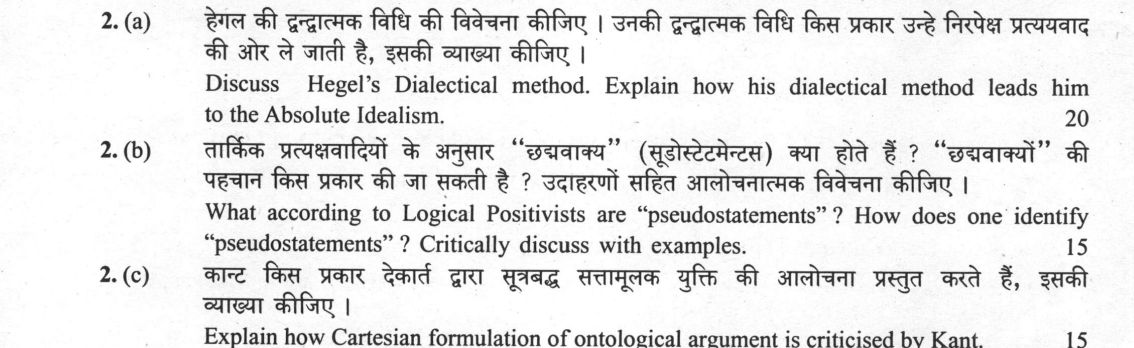
Discuss Hegel's Dialectical method. Explain how his dialectical method leads him to the Absolute Idealism. 20 marks
What according to Logical Positivists are "pseudostatements"? How does one identify "pseudostatements"? Critically discuss with examples. 15 marks
Explain how Cartesian formulation of ontological argument is criticised by Kant. 15 marks
हिंदी में प्रश्न पढ़ें
हेगल की द्वंद्वात्मक विधि की विवेचना कीजिए । उनकी द्वंद्वात्मक विधि किस प्रकार उन्हें निरपेक्ष प्रत्ययवाद की ओर ले जाती है, इसकी व्याख्या कीजिए । (20 अंक)
तार्किक प्रत्यक्षवादियों के अनुसार "छद्मवाक्य" (सुडोस्टेटमेंट्स) क्या होते हैं ? "छद्मवाक्यों" की पहचान किस प्रकार की जा सकती है ? उदाहरणों सहित आलोचनात्मक विवेचना कीजिए । (15 अंक)
कांट किस प्रकार देकार्त द्वारा सृजनबद्ध सत्तामूलक युक्ति की आलोचना प्रस्तुत करते हैं, इसकी व्याख्या कीजिए । (15 अंक)
Model answer
Written by UPSC Answer Check against this question's marking rubric, to the expected length. UPSC does not publish answers for Mains — this is one way to score well, not an official key.
Western philosophical development reflects a continuous dialogue between grand metaphysical system-building and epistemological critiques aimed at defining the limits of human knowledge.
Hegel's Dialectical Method and Absolute Idealism
Hegel conceives the dialectic as a triadic process of Thesis (an abstract, initial affirmation), Antithesis (its inherent negation or contradiction), and Synthesis (*Aufhebung*—a sublation that cancels, preserves, and elevates the truth of both). For instance, pure indeterminate Being, when thought through, reveals itself as devoid of content, yielding Nothing; their dynamic synthesis is Becoming.
Crucially, Hegelian dialectic is not merely an epistemological method but an ontological reality: the cosmos is the rational, self-unfolding process of Spirit (Geist). Unlike Karl Marx's dialectical materialism, which places the material and economic base as primary, Hegel asserts that reality is fundamentally spiritual and conceptual ("What is rational is actual, and what is actual is rational").
Through historical and conceptual evolution, the dialectic overcomes internal contradictions, moving from Subjective Spirit (individual mind) through Objective Spirit (law, morality, state) to Absolute Idealism. In the Absolute Idea, the apparent dualism between subject and object, consciousness and reality, is entirely overcome, culminating in Spirit knowing itself as all reality.
Logical Positivism and Pseudostatements
Logical Positivists of the Vienna Circle (and A.J. Ayer) classify statements lacking cognitive meaning as pseudostatements. These are linguistic expressions that mimic genuine declarative sentences grammatically but fail to convey any factual or logical truth-value. Unlike a false statement (e.g., "The Moon is made of copper"), which is cognitively meaningful because its method of empirical verification is known, a pseudostatement admits no truth conditions whatsoever.
Pseudostatements are identified using the Verification Principle (Hume’s fork reformulated): a proposition is cognitively meaningful if and only if it is:
- Analytic (tautological/logical, true by definition, e.g., "All bachelors are unmarried"); or
- Synthetic (empirically verifiable, at least in principle, through sense experience).
Any assertion falling outside these categories is a pseudostatement. Key examples include metaphysical claims ("The Absolute is beyond time and space"), theological assertions ("God is an infinite spirit"), and normative ethical judgments ("Stealing is evil", which emotivists treat merely as expressions of feeling). Critics point out that the verification criterion itself is neither analytic nor empirically verifiable, rendering the Positivist framework self-undermining.
Cartesian Ontological Argument and Kant’s Critique
Descartes' ontological argument posits that we possess a clear and distinct idea of God as an absolutely perfect being. Because existence is an undeniable perfection, a non-existent God is a contradiction in terms, just as conceiving a triangle without three interior angles summing to 180 degrees is impossible.
Kant famously refutes this by asserting that "existence is not a real predicate." A real, determining predicate enriches or alters the concept of a subject (e.g., "The dog is brown"). In contrast, the copula "is" merely posits the subject and its attributes into actuality. Kant illustrates this with the hundred thalers: a concept containing one hundred actual thalers possesses no more conceptual predicates than a concept containing one hundred merely possible thalers.
Kant demonstrates that while denying the predicate while retaining the subject generates a contradiction, denying both the subject (God) and the predicate (existence) simultaneously leaves no contradiction. Thus, Descartes confuses logical possibility (mere conceptual non-contradiction) with real possibility (instantiation in empirical intuition). For Kant, theoretical reason cannot cross the threshold of sensible experience to prove God's existence, thereby restricting theoretical knowledge to make room for faith as a necessary postulate of practical, moral reason.
The trajectory from Hegel’s absolute metaphysics to Kant’s critical boundaries and Positivism’s linguistic rejection represents philosophy’s systematic maturation from speculative totality to critical, rigorous boundaries of human cognition.
What "Discuss" is asking you to do
Lay the issue out from more than one side — how it arose, what is claimed for it, what is held against it, and where it now stands. UPSC attaches discuss to broad topics with several live dimensions, so coverage of the dimensions earns more than the strength of your opinion.
Structure that answers it
Set the issue up → the case as it is made → the case against → the dimension both sides leave out → where the balance now lies
Where marks are lost
Listing facts with no thread between them, or arguing one side throughout and calling it a discussion.
How this answer will be evaluated
Approach
Framework: UPSC Philosophy Paper 1. (a) discuss: intro > 3-4 dimensions > example > balanced close | (b) critique: the claim > its strengths > its weaknesses > your judgment | (c) explain: definition/context > points in order > small example > short close Full marks: Precise reconstruction of arguments with technical vocabulary and strong critical evaluation.
Key points expected
- Define the triad: thesis, antithesis, synthesis
- Explain the mechanism of Aufhebung (sublation)
- Trace the progression from Being to Absolute Spirit
- Link the method's endpoint to Absolute Idealism
- State the Verification Principle of Meaning
- Define 'pseudostatement' as cognitively meaningless
- Explain the identification criterion (empirical verification)
- Provide a concrete example (e.g., 'God exists')
Evaluation rubric
Each sub-part is marked on its own, against the marks and word limit printed on the paper.
- (a) Reconstruct the dialectical movement and its derivation of Absolute Idealism. 20 marks
discuss— intro → 3-4 dimensions → example → balanced close
Must cover
- Define the triad: thesis, antithesis, synthesis
- Explain the mechanism of Aufhebung (sublation)
- Trace the progression from Being to Absolute Spirit
- Link the method's endpoint to Absolute Idealism
Loses marks
- Biographical details of Hegel
- Vague paraphrase without technical terms
- Confusing dialectic with mere contradiction
Earns more
- Use precise German terms (e.g., Dasein, Essence)
- Distinguish dialectic from formal logic
- Mention the 'Phenomenology of Spirit' as the locus
Extra mark
- Reference the 'Science of Logic' structure
- (b) Define pseudostatements via the verification principle and critique the identification method. 15 marks
critique— the claim → its strengths → its weaknesses → your judgment
Must cover
- State the Verification Principle of Meaning
- Define 'pseudostatement' as cognitively meaningless
- Explain the identification criterion (empirical verification)
- Provide a concrete example (e.g., 'God exists')
Loses marks
- Confusing 'false' with 'meaningless'
- Ignoring the 'critical' aspect of the command
- Vague examples without logical analysis
Earns more
- Distinguish analytic vs. synthetic statements
- Mention the 'Tractatus' influence (Ayer/Carnap)
- Critique the principle's self-refutation
Extra mark
- Reference the 'Logical Syntax of Language'
- (c) Detail Kant's specific objection to the Cartesian ontological argument. 15 marks
explain— definition/context → points in order → small example → short close
Must cover
- State the Cartesian argument's core premise
- Identify 'existence' as a predicate in the argument
- Explain Kant's 'existence is not a real predicate' thesis
- Show how this invalidates the deduction
Loses marks
- Confusing Anselm's and Descartes' versions
- Failing to explain *why* existence is not a predicate
- Biographical details of Kant
Earns more
- Reference the 'Critique of Pure Reason' (A434/B462)
- Use the 'hundred thalers' example
- Distinguish logical vs. real predicates
Extra mark
- Mention the 'Transcendental Dialectic' context
Practice this exact question
Write your answer and it is marked point by point against the model answer above — what you covered, what you missed, what you got wrong.
Evaluate my answer →More from Philosophy 2021 Paper I
- Q1 Write short answers to the following in about 150 words each: (a) "There is a red chair."…
- Q2 (a) Discuss Hegel's Dialectical method. Explain how his dialectical method leads him to t…
- Q3 (a) What are the main arguments put forward by Moore in his paper "A Defence of Common Se…
- Q4 (a) Present a critical exposition of Husserl's criticism of 'natural attitude'. How does…
- Q5 Write short answers to the following in about 150 words each: (a) Does the seed contain t…