Paper I — Q5
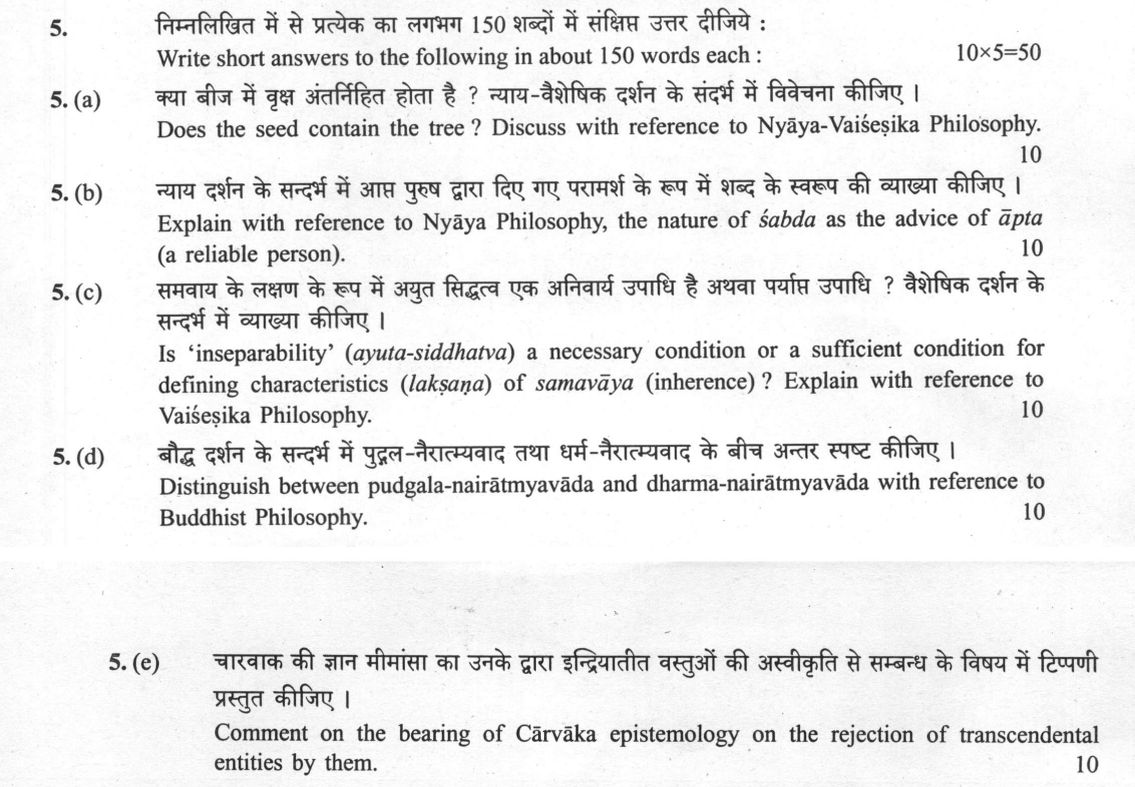
Write short answers to the following in about 150 words each: (a) Does the seed contain the tree ? Discuss with reference to…
Write short answers to the following in about 150 words each: Does the seed contain the tree ? Discuss with reference to Nyāya-Vaiśeṣika Philosophy. 10 marks
Explain with reference to Nyāya Philosophy, the nature of śabda as the advice of āpta (a reliable person). 10 marks
Is 'inseparability' (ayuta-siddhatva) a necessary condition or a sufficient condition for defining characteristics (lakṣaṇa) of samavāya (inherence) ? Explain with reference to Vaiśeṣika Philosophy. 10 marks
Distinguish between pudgala-nairātmyavāda and dharma-nairātmyavāda with reference to Buddhist Philosophy. 10 marks
Comment on the bearing of Cārvāka epistemology on the rejection of transcendental entities by them. 10 marks
हिंदी में प्रश्न पढ़ें
निम्नलिखित में से प्रत्येक का लगभग 150 शब्दों में संक्षिप्त उत्तर दीजिये : क्या बीज में वृक्ष अन्तर्निहित होता है ? न्याय-वैशेषिक दर्शन के संदर्भ में विवेचना कीजिए । (10 अंक)
न्याय दर्शन के संदर्भ में आप्त पुरुष द्वारा दिए गए परामर्श के रूप में शब्द के स्वरूप की व्याख्या कीजिए । (10 अंक)
समवाय के लक्षण के रूप में अयुत सिद्धत्व एक अनिवार्य उपाधि है अथवा पर्याप्त उपाधि ? वैशेषिक दर्शन के संदर्भ में व्याख्या कीजिए । (10 अंक)
बौद्ध दर्शन के संदर्भ में पुद्गल-नैरात्म्यवाद तथा धर्म-नैरात्म्यवाद के बीच अन्तर स्पष्ट कीजिए । (10 अंक)
चार्वाक की ज्ञान मीमांसा का उनके द्वारा ईन्द्रियातीत वस्तुओं की अस्वीकृति से सम्बन्ध के विषय में टिप्पणी प्रस्तुत कीजिए । (10 अंक)
Model answer
Written by UPSC Answer Check against this question's marking rubric, to the 150-word length. UPSC does not publish answers for Mains — this is one way to score well, not an official key.
(a) Whether the seed contains the tree is a dispute over causation. Sāṃkhya’s satkāryavāda says the effect pre-exists in the cause, so the tree is already in the seed; the cause is not merely a condition but the substratum of the effect. Nyāya-Vaiśeṣika rejects this. For them, the effect is non-existent before causation (asatkāryavāda); the tree is not identical with the seed, nor contained in it as a real entity. The seed is a material cause, but the relation between cause and effect is not identity. Nyāya-Vaiśeṣika insists that real relations, such as samavāya, are distinct from identity. If the seed were the tree, the cause would already be the effect, making production meaningless; if the tree were entirely absent, causation would be arbitrary. Their position is a middle course: the effect is not pre-existent, but it is not produced from nothing, because it depends on a cause and relation.
(b) In Nyāya, śabda is a pramāṇa when it is the advice of an āpta, a reliable person. It is not every utterance that yields knowledge; testimony may be false if the speaker is ignorant, deceptive, or inarticulate. Nyāya therefore fixes conditions for āptatva: the speaker must know the object, must desire to communicate it, and must express it properly. The hearer’s acceptance is justified by the speaker’s reliability, not by the sound of words. This distinguishes śabda from casual speech and from mere report. Nyāya also classifies śabda into dṛṣṭārtha and adṛṣṭārtha. Dṛṣṭārtha śabda concerns visible objects, as when a reliable person says, “Go to Kāśī”; the object can be verified later. Adṛṣṭārtha śabda concerns invisible or super-sensible matters, such as Vedic injunctions about ritual results; here the authority of the āpta is decisive. Thus śabda is epistemically valuable because it extends knowledge beyond direct perception through a trustworthy source.
(c) In Vaiśeṣika, samavāya is the relation of inherence, as between a substance and its quality, a whole and its part, or a universal and its particular. Its defining characteristic is ayuta-siddhatva, inseparability: the related terms cannot be separated while the relation holds. However, inseparability alone is not sufficient to define samavāya. Many pairs are inseparable in a loose sense without being related by inherence. Therefore Vaiśeṣika adds a further condition, sannikarṣa or niyata-sambandha, a fixed relation or contact. This distinguishes samavāya from saṃyoga, mere conjunction or contact, which is separable and spatial. In saṃyoga, two things touch and can be separated; in samavāya, the relation is non-spatial and permanent for the duration of the entities. Thus ayuta-siddhatva is a necessary condition for samavāya, but only with the additional condition of fixed relation does it become the sufficient defining mark of inherence.
(d) Buddhist philosophy is marked by nairātmyavāda, the denial of a permanent self. The first form, pudgala-nairātmyavāda, denies an eternal, unchanging self in persons. Early Buddhist schools, often grouped as Hīnayāna, including Sarvāstivāda and Sautrāntika, hold that the person is a conventional aggregate of skandhas, not a real soul. Yet they do not deny all reality; they accept dharmas, the ultimate factors of experience, as possessing svabhāva, intrinsic nature. The second form, dharma-nairātmyavāda, goes further. Schools such as Yogācāra and Mādhyamika deny that dharmas themselves have independent, intrinsic existence. For Mādhyamika, all dharmas are dependently originated and therefore empty; for Yogācāra, they are ultimately mind-dependent. Thus pudgala-nairātmyavāda rejects the self while retaining real dharmas, whereas dharma-nairātmyavāda rejects svabhāva in dharmas as well. The latter brings Buddhist thought to śūnyatā, the emptiness of all phenomena, as its culmination. This distinction shows the internal development of Buddhist thought from personal emptiness to universal emptiness.
(e) Cārvāka or Lokāyata philosophy is epistemologically minimal. It accepts pratyakṣa, direct perception, as the only valid pramāṇa and rejects anumāna, inference; śabda, verbal testimony; and upamāna, comparison. This has a decisive bearing on its rejection of transcendental entities. Since ātman, īśvara, mokṣa, karma, and svarga are not directly perceivable, Cārvāka holds that they cannot be established by valid knowledge. Inference is rejected because its logical basis is not certain; śabda is rejected because scripture depends on a reliable source that itself cannot be verified; upamāna is rejected because it adds no new knowledge. Consequently, entities that are super-sensible, such as God, soul, heaven, and liberation, are dismissed as unverifiable. This epistemology underwrites Lokāyata materialism: what is real is what can be experienced, especially the material elements and consciousness. The practical result is a denial of afterlife and moral accountability beyond this life, with emphasis on present pleasure. Thus, in Cārvāka, epistemology shapes ontology and ethics.
What "Discuss" is asking you to do
Lay the issue out from more than one side — how it arose, what is claimed for it, what is held against it, and where it now stands. UPSC attaches discuss to broad topics with several live dimensions, so coverage of the dimensions earns more than the strength of your opinion.
Structure that answers it
Set the issue up → the case as it is made → the case against → the dimension both sides leave out → where the balance now lies
Where marks are lost
Listing facts with no thread between them, or arguing one side throughout and calling it a discussion.
How this answer will be evaluated
Approach
Framework: UPSC Philosophy Paper 1 (Indian Philosophy). (a) discuss: intro > 3-4 dimensions > example > balanced close | (b) explain: definition/context > points in order > small example > short close | (c) explain: definition/context > points in order > small example > short close | (d) compare: paired headings or table > key differences > significance > conclusion | (e) comment: context > arguments both sides > judgment > close Full marks: Precise technical vocabulary, clear argumentation, strong counter-arguments, and balanced evaluation.
Key points expected
- State the Nyāya-Vaiśeṣika position on the seed-tree relation
- Define the relevant ontological categories (e.g., dravya, guṇa)
- Present the strongest counter-argument (e.g., from Buddhist or Mīmāṃsā perspective)
- Provide a balanced evaluation of the argument
- Define śabda-pramāṇa in Nyāya philosophy
- Explain the concept of āpta and its criteria
- Describe how śabda functions as advice from a reliable person
- Provide a small example to illustrate the concept
Evaluation rubric
Each sub-part is marked on its own, against the marks and word limit printed on the paper.
- (a) Reconstruct the Nyāya-Vaiśeṣika argument on the ontological status of the seed (bīja) and tree (vṛkṣa). 10 marks · 150 words
discuss— intro → 3-4 dimensions → example → balanced close
Must cover
- State the Nyāya-Vaiśeṣika position on the seed-tree relation
- Define the relevant ontological categories (e.g., dravya, guṇa)
- Present the strongest counter-argument (e.g., from Buddhist or Mīmāṃsā perspective)
- Provide a balanced evaluation of the argument
Loses marks
- Biographical details of philosophers
- Vague paraphrase without technical terms
- Failure to present a counter-argument
Earns more
- Use precise Sanskrit technical vocabulary
- Reference specific Nyāya-Vaiśeṣika texts or thinkers
- Distinguish between potential and actual existence
- Address the problem of causation
Extra mark
- Cite a specific verse from Nyāya Sūtra or Vaiśeṣika Sūtra
- Reference a specific commentator's interpretation
- (b) Explain the Nyāya theory of śabda-pramāṇa, focusing on the role of āpta (reliable person). 10 marks · 150 words
explain— definition/context → points in order → small example → short close
Must cover
- Define śabda-pramāṇa in Nyāya philosophy
- Explain the concept of āpta and its criteria
- Describe how śabda functions as advice from a reliable person
- Provide a small example to illustrate the concept
Loses marks
- Biographical details of philosophers
- Vague paraphrase without technical terms
- Failure to provide a concrete example
Earns more
- Use precise Sanskrit technical vocabulary
- Distinguish between different types of śabda
- Address the epistemological status of śabda
- Reference specific Nyāya texts or thinkers
Extra mark
- Cite a specific verse from Nyāya Sūtra
- Reference a specific commentator's interpretation
- (c) Analyze the role of 'inseparability' (ayuta-siddhatva) in defining samavāya (inherence) in Vaiśeṣika philosophy. 10 marks · 150 words
explain— definition/context → points in order → small example → short close
Must cover
- Define samavāya and ayuta-siddhatva
- Explain whether ayuta-siddhatva is necessary or sufficient for samavāya
- Provide reasoning for the classification
- Reference specific Vaiśeṣika texts or thinkers
Loses marks
- Biographical details of philosophers
- Vague paraphrase without technical terms
- Failure to clearly state whether ayuta-siddhatva is necessary or sufficient
Earns more
- Use precise Sanskrit technical vocabulary
- Distinguish between necessary and sufficient conditions
- Address potential objections to the classification
- Provide a concrete example of samavāya
Extra mark
- Cite a specific verse from Vaiśeṣika Sūtra
- Reference a specific commentator's interpretation
- (d) Distinguish between pudgala-nairātmyavāda and dharma-nairātmyavāda in Buddhist philosophy. 10 marks · 150 words
compare— paired headings or table → key differences → significance → conclusion
Must cover
- Define pudgala-nairātmyavāda and dharma-nairātmyavāda
- Identify key differences between the two positions
- Explain the philosophical implications of each
- Reference specific Buddhist texts or thinkers
Loses marks
- Biographical details of philosophers
- Vague paraphrase without technical terms
- Failure to clearly distinguish between the two positions
Earns more
- Use precise Sanskrit technical vocabulary
- Provide a table or paired headings for comparison
- Address the significance of the distinction
- Reference specific Buddhist schools or thinkers
Extra mark
- Cite a specific verse from Buddhist texts
- Reference a specific commentator's interpretation
- (e) Comment on how Cārvāka epistemology leads to the rejection of transcendental entities. 10 marks · 150 words
comment— context → arguments both sides → judgment → close
Must cover
- Define Cārvāka epistemology
- Explain the rejection of transcendental entities
- Provide arguments for and against this rejection
- Offer a judgment on the validity of the Cārvāka position
Loses marks
- Biographical details of philosophers
- Vague paraphrase without technical terms
- Failure to provide a balanced evaluation
Earns more
- Use precise Sanskrit technical vocabulary
- Reference specific Cārvāka texts or thinkers
- Address the epistemological basis for the rejection
- Provide a balanced evaluation of the argument
Extra mark
- Cite a specific verse from Cārvāka texts
- Reference a specific commentator's interpretation
Practice this exact question
Write your answer and it is marked point by point against the model answer above — what you covered, what you missed, what you got wrong.
Evaluate my answer →More from Philosophy 2021 Paper I
- Q2 (a) Discuss Hegel's Dialectical method. Explain how his dialectical method leads him to t…
- Q3 (a) What are the main arguments put forward by Moore in his paper "A Defence of Common Se…
- Q4 (a) Present a critical exposition of Husserl's criticism of 'natural attitude'. How does…
- Q5 Write short answers to the following in about 150 words each: (a) Does the seed contain t…
- Q6 (a) Explain with reference to Yoga Philosophy, the nature of kleśas. How does the removal…
- Q7 (a) How do the advocates of anirvacanīya-khyāti refute the position of the Naiyāyikas and…
- Q8 (a) According to Śrī Aurobindo, 'the awakening of the psychic being and its gradual promi…