Paper I — Q4
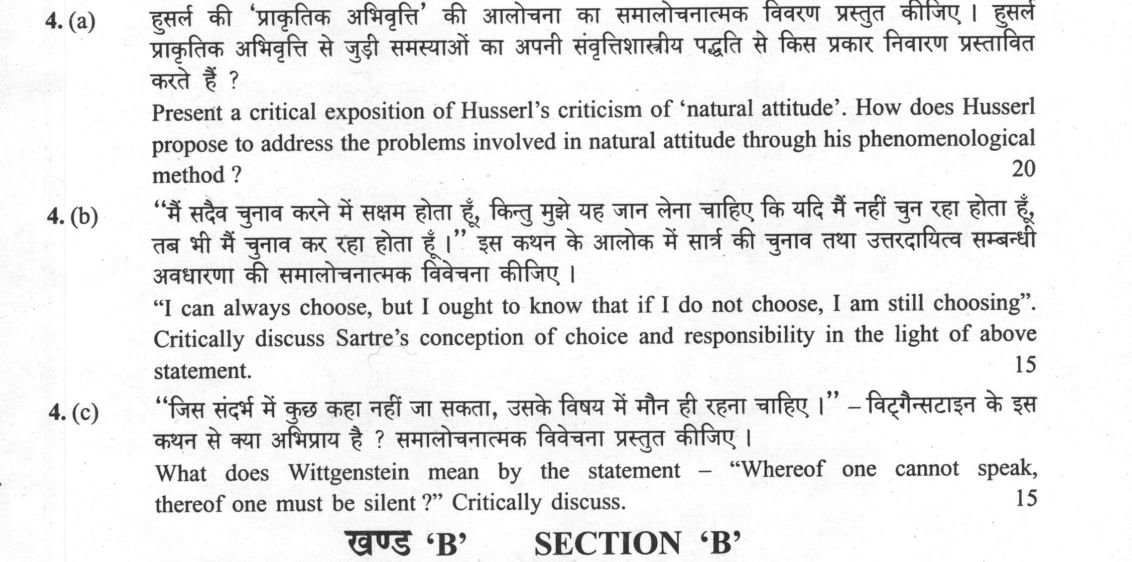
(a) Present a critical exposition of Husserl's criticism of 'natural attitude'. How does Husserl propose to address the problems…
Present a critical exposition of Husserl's criticism of 'natural attitude'. How does Husserl propose to address the problems involved in natural attitude through his phenomenological method ? 20 marks
"I can always choose, but I ought to know that if I do not choose, I am still choosing". Critically discuss Sartre's conception of choice and responsibility in the light of above statement. 15 marks
What does Wittgenstein mean by the statement – "Whereof one cannot speak, thereof one must be silent ?" Critically discuss. 15 marks
हिंदी में प्रश्न पढ़ें
हुसर्ल की 'प्राकृतिक अभिवृत्ति' की आलोचना का समालोचनात्मक विवरण प्रस्तुत कीजिए । हुसर्ल प्राकृतिक अभिवृत्ति से जुड़ी समस्याओं का अपनी संकुटिशास्त्रीय पद्धति से किस प्रकार निवारण प्रस्तावित करते हैं ? (20 अंक)
"मैं सदैव चुनाव करने में सक्षम होता हूँ, किन्तु मुझे यह जान लेना चाहिए कि यदि मैं नहीं चुन रहा होता हूँ, तब भी मैं चुनाव कर रहा होता हूँ ।" इस कथन के आलोक में सार्त्र की चुनाव तथा उत्तरदायित्व सम्बन्धी अवधारणा की समालोचनात्मक विवेचना कीजिए । (15 अंक)
"जिस संदर्भ में कुछ कहा नहीं जा सकता, उसके विषय में मौन ही रहना चाहिए ।" – विट्टगेन्स्टाइन के इस कथन से क्या अभिप्राय है ? समालोचनात्मक विवेचना प्रस्तुत कीजिए । (15 अंक)
Model answer
Written by UPSC Answer Check against this question's marking rubric, to the expected length. UPSC does not publish answers for Mains — this is one way to score well, not an official key.
Husserl on the Natural Attitude and Phenomenological Method
Husserl critiques the ‘natural attitude’—the unexamined, common-sense presumption that an objective world exists independently of consciousness and is directly accessible to perception. In The Crisis of European Sciences, Husserl argues that this dogmatic realism led modern sciences into naturalism and psychologism, precipitating a foundational crisis by detaching scientific constructs from their origins in subjective experience.
To overcome this relativism and establish philosophy as a rigorous science (strenge Wissenschaft), Husserl formulates the phenomenological method. It begins with the epoché (phenomenological bracketing), which suspends all metaphysical judgments regarding the external existence of objects. Through subsequent reductions—eidetic reduction (distilling essential structures from empirical particulars) and transcendental reduction (tracing phenomena back to the meaning-constituting acts of the transcendental ego)—the world is analyzed purely as intended by consciousness (intentionality).
Critically, while Husserl claims this yields apodictic certainty by grounding knowledge in pure subjectivity, it risks collapsing into solipsism. In Cartesian Meditations, he attempts to resolve this through an account of intersubjectivity and the ‘Lifeworld’ (Lebenswelt). However, Husserl's method struggles to fully bridge the chasm between the detached, transcendental ego and concrete, historical human existence.
Sartre on Choice and Radical Responsibility
Sartre’s assertion that "if I do not choose, I am still choosing" stems from his foundational ontology: "existence precedes essence." Human consciousness (pour-soi), defined by nothingness and radical freedom, lacks any predetermined essence or external moral anchor. Consciousness is dynamic intentionality; hence, human beings are "condemned to be free." Inaction, silence, or submission to convention are not evasions of choice, but deliberate choices to abstain, which implicitly endorse existing circumstances.
Refusing this ontological freedom results in bad faith (mauvaise foi)—the self-deception of pretending one is a determined object (en-soi) without agency. Consequently, freedom entails an agonizing, inescapable responsibility. In choosing for oneself, one creates an image of human value and assumes responsibility for the world.
Critically, Sartre’s early existentialism posits an unconditioned, absolute freedom that borders on ethical voluntarism. By treating all choices as self-justifying acts of authentic will, his framework lacks criteria for moral deliberation. As Simone de Beauvoir argues in The Ethics of Ambiguity, Sartre overlooks situated constraints; genuine freedom is not merely an abstract ontological absolute, but a concrete capacity conditioned by material, political, and social realities.
Wittgenstein on the Limits of Language
In Proposition 7 of the Tractatus Logico-Philosophicus, Wittgenstein concludes: "Whereof one cannot speak, thereof one must be silent." Working through the Picture Theory of meaning, the early Wittgenstein holds that meaningful propositions must share a logical form with empirical states of affairs. Thus, the sayable is strictly coextensive with the propositions of natural science.
Matters of value—ethics, aesthetics, metaphysics, and the meaning of life—do not represent empirical facts within the world; they transcend it. Therefore, these domains are strictly unsayable. They belong to the "mystical" (das Mystische), which cannot be stated in descriptive propositions but only shows itself. Silence is not an act of skepticism, but a protective boundary against metaphysical pseudo-problems.
Critically, this demarcative strategy is self-undermining: the propositions of the Tractatus itself are non-empirical and, by its own criteria, strictly nonsensical. Wittgenstein acknowledges this through the metaphor of the ladder, which one must throw away after climbing. Recognizing the inadequacy of this rigid atomism, Wittgenstein in Philosophical Investigations abandons this formal boundary for a therapeutic conception of philosophy, analyzing how meaning is generated within dynamic, contextual "language-games" embedded in lived forms of life.
Conclusion
Husserl, Sartre, and Wittgenstein represent three distinct modern responses to the limitations of naive realism. Husserl seeks foundational certainty through transcendental grounding; Sartre confronts existential groundlessness through authentic moral commitment; and Wittgenstein diagnoses linguistic confusions through logical and therapeutic critique. Together, they demonstrate that meaning and value are not pre-given empirical facts, but are actively constituted through consciousness, existential choice, and linguistic practice.
What "Critically examine" is asking you to do
Test the proposition the question puts to you and return a finding on how far it holds. Examine stems carry a claim, or ask whether something has happened, and expect evidence weighed both ways before the extent is stated — often with remedial measures attached. “Critically” is not a section added at the end: name the yardstick you are judging by — the evidence, the stated objective, a constitutional principle, a rival explanation — and let a verdict close each part of the body. Where the question quotes a claim, that verdict must land on the claim itself, accepted, qualified or rejected, and not on the theme in general.
Structure that answers it
Restate the claim as the question frames it → evidence that supports it → evidence that undercuts it → the conditions under which it holds → verdict on how far it stands
Where marks are lost
Merits in one paragraph, demerits in the next, and a conclusion calling for a balanced and holistic approach. That is a survey with the judgement left out and it holds the answer in the middle band. The opposite error is reading “critically” as permission to attack — and with the odd pairings, critically describe or critically explain, the exposition still carries most of the marks, the judgement being a layer on it rather than a substitute for it.
How this answer will be evaluated
Approach
Framework: State the position > Argument > Strongest objection > Evaluation. (a) critique: the claim > its strengths > its weaknesses > your judgment | (b) critique: the claim > its strengths > its weaknesses > your judgment | (c) critique: the claim > its strengths > its weaknesses > your judgment Full marks: Precise technical vocabulary, strong counter-arguments, and clear evaluation of limits.
Key points expected
- Define 'natural attitude' (Lebenswelt) and its presuppositions
- Explain the 'phenomenological reduction' (epoché)
- Describe the 'transcendental ego' as the solution
- Evaluate the limits of the reduction
- Explain 'radical freedom' and 'condemned to be free'
- Analyze 'non-choice' as a form of choice
- Discuss 'bad faith' (mauvaise foi) as evasion
- Address the scope of responsibility
Evaluation rubric
Each sub-part is marked on its own, against the marks and word limit printed on the paper.
- (a) Exposition of Husserl's critique of natural attitude and his methodological solution. 20 marks
critique— the claim → its strengths → its weaknesses → your judgment
Must cover
- Define 'natural attitude' (Lebenswelt) and its presuppositions
- Explain the 'phenomenological reduction' (epoché)
- Describe the 'transcendental ego' as the solution
- Evaluate the limits of the reduction
Loses marks
- Biographical details of Husserl
- Confusing Husserl with Heidegger's Dasein
- Vague paraphrase of 'consciousness'
Earns more
- Mention 'bracketing' of the world
- Reference to 'Cartesian Meditations'
- Distinction between noesis and noema
- Mention of 'intentionality'
Extra mark
- Reference to 'Crisis in European Sciences'
- Mention of 'transcendental intersubjectivity'
- (b) Critical discussion of Sartre's choice and responsibility via the provided quote. 15 marks
critique— the claim → its strengths → its weaknesses → your judgment
Must cover
- Explain 'radical freedom' and 'condemned to be free'
- Analyze 'non-choice' as a form of choice
- Discuss 'bad faith' (mauvaise foi) as evasion
- Address the scope of responsibility
Loses marks
- Biographical details of Sartre
- Confusing Sartre with Kierkegaard
- Ignoring the specific quote provided
Earns more
- Reference to 'Existence Precedes Essence'
- Mention of 'situation' (facticity)
- Link to 'anguish' (angoisse)
- Mention of 'the look' (le regard)
Extra mark
- Reference to 'Being and Nothingness'
- Mention of 'project' (projet)
- (c) Critical discussion of Wittgenstein's statement on the limits of language. 15 marks
critique— the claim → its strengths → its weaknesses → your judgment
Must cover
- Contextualize within the 'Tractatus Logico-Philosophicus'
- Distinguish 'saying' from 'showing'
- Explain the 'mystical' or 'ethical' as unsayable
- Evaluate the 'ladder' metaphor
Loses marks
- Biographical details of Wittgenstein
- Confusing early and late Wittgenstein
- Treating 'silence' as mere ignorance
Earns more
- Reference to 'picture theory of meaning'
- Mention of 'logical form'
- Distinction between 'facts' and 'values'
- Reference to 'limits of my language'
Extra mark
- Reference to 'Tractatus' proposition 7
- Mention of 'ethics is transcendental'
Practice this exact question
Write your answer and it is marked point by point against the model answer above — what you covered, what you missed, what you got wrong.
Evaluate my answer →More from Philosophy 2021 Paper I
- Q1 Write short answers to the following in about 150 words each: (a) "There is a red chair."…
- Q2 (a) Discuss Hegel's Dialectical method. Explain how his dialectical method leads him to t…
- Q3 (a) What are the main arguments put forward by Moore in his paper "A Defence of Common Se…
- Q4 (a) Present a critical exposition of Husserl's criticism of 'natural attitude'. How does…
- Q5 Write short answers to the following in about 150 words each: (a) Does the seed contain t…
- Q6 (a) Explain with reference to Yoga Philosophy, the nature of kleśas. How does the removal…
- Q7 (a) How do the advocates of anirvacanīya-khyāti refute the position of the Naiyāyikas and…