Paper I — Q3
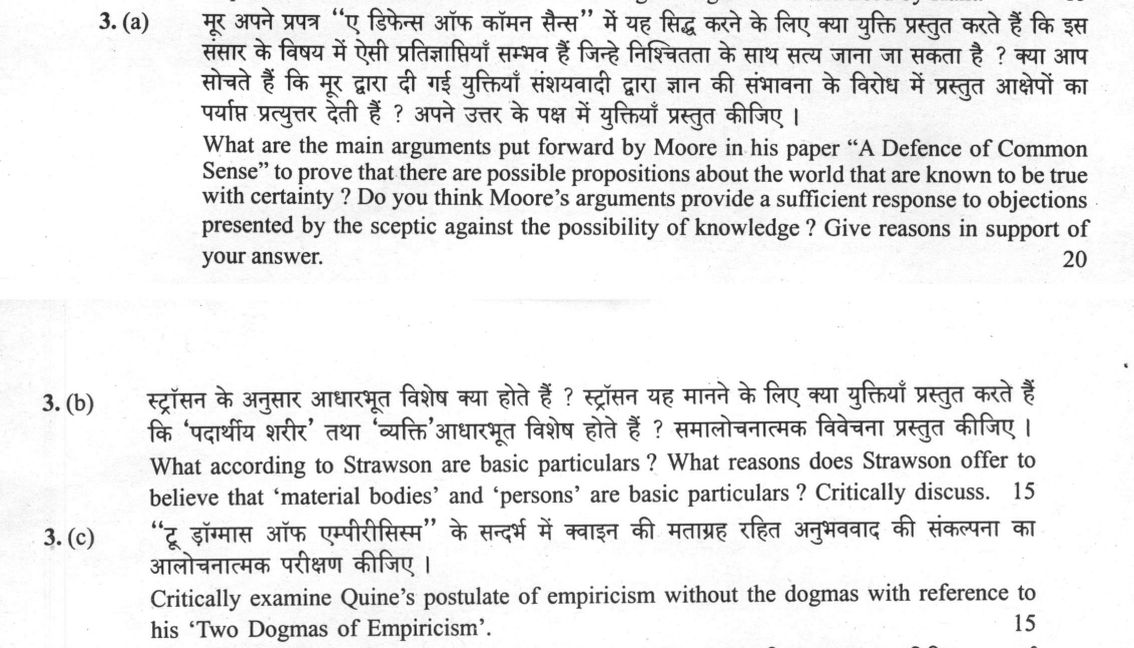
(a) What are the main arguments put forward by Moore in his paper "A Defence of Common Sense" to prove that there are possible…
What are the main arguments put forward by Moore in his paper "A Defence of Common Sense" to prove that there are possible propositions about the world that are known to be true with certainty? Do you think Moore's arguments provide a sufficient response to objections presented by the sceptic against the possibility of knowledge? Give reasons in support of your answer. 20 marks
What according to Strawson are basic particulars ? What reasons does Strawson offer to believe that 'material bodies' and 'persons' are basic particulars ? Critically discuss. 15 marks
Critically examine Quine's postulate of empiricism without the dogmas with reference to his 'Two Dogmas of Empiricism'. 15 marks
हिंदी में प्रश्न पढ़ें
मूर अपने प्रपत्र "ए डिफेंस ऑफ कॉमन सेंस" में यह सिद्ध करने के लिए क्या युक्ति प्रस्तुत करते हैं कि इस संसार के विषय में ऐसी प्रतिज्ञाएँ संभव हैं जिन्हें निश्चितता के साथ सत्य जाना जा सकता है ? क्या आप सोचते हैं कि मूर द्वारा दी गई युक्तियाँ संशयवादी द्वारा ज्ञान की संभावना के विरोध में प्रस्तुत आक्षेपों का पर्याप्त प्रत्युत्तर देती हैं ? अपने उत्तर के पक्ष में युक्तियाँ प्रस्तुत कीजिए । (20 अंक)
स्ट्रॉसन के अनुसार आधारभूत विशेष क्या होते हैं ? स्ट्रॉसन यह मानने के लिए क्या युक्तियाँ प्रस्तुत करते हैं कि 'पदार्थीय शरीर' तथा 'व्यक्ति' आधारभूत विशेष होते हैं ? समालोचनात्मक विवेचना प्रस्तुत कीजिए । (15 अंक)
"टू डॉगमास ऑफ एम्पीरिसिस्म" के संदर्भ में क्वाइन की मताग्रह रहित अनुभववाद की संकल्पना का आलोचनात्मक परीक्षण कीजिए । (15 अंक)
Model answer
Written by UPSC Answer Check against this question's marking rubric, to the expected length. UPSC does not publish answers for Mains — this is one way to score well, not an official key.
Moore and common sense Moore argues in “A Defence of Common Sense” that common-sense propositions are known with certainty because they are more certain than any argument denying them. He lists truisms such as “here is one hand”, “here is another”, “I am a body”, “there are other bodies”, “the past exists” and “other minds exist”. His hand-waving proof is a paradigm: if I know that here is one hand and here is another, I know that there are at least two material things; hence the external-world sceptic is wrong. Moore also holds that knowing entails being certain, so common-sense propositions are certain.
Critically, Moore’s proof is not sufficient for the sceptic. The sceptic does not deny that Moore can say “here is one hand”; he denies that this premise gives knowledge of an external world, or that it is known in the required sense. Thus the proof is question-begging against a radical sceptic, because it assumes the perceptual certainty the sceptic challenges. It is better read as a Wittgensteinian hinge proposition: such statements are not justified by evidence but frame evidence and doubt. Contextualism helps: ordinary contexts allow knowledge of hands, while sceptical contexts raise standards. Moore therefore exposes sceptical incoherence but does not meet the sceptic’s demand for proof of premises.
Strawson’s basic particulars Strawson calls material bodies and persons basic particulars because they can be identified without reference to other particulars; non-basic particulars are identified only through relations to basic ones. Material bodies are basic because they can be re-identified across time and space by spatiotemporal continuity. Persons are basic because the concept of a person primitively combines physical and psychological predicates, irreducible to either bodily or mental description alone.
The critical difficulty is whether this asymmetry is secure. Material bodies are often identified through relations to other bodies, landmarks and perceptual contexts; if identification always depends on a background of other particulars, bodies may not be strictly basic. Persons may be identified by social roles, language and psychological continuity, which seem to depend on material bodies and other persons. If persons are not material bodies, Strawson must explain their ontological status; if they are, the primitive concept may collapse into body plus mental states. Strawson’s account is persuasive in showing that bodies and persons are fundamental to ordinary identification, but it risks circularity: the criteria of basicness are chosen to fit bodies and persons, and the irreducibility of persons remains contested.
Quine’s empiricism without dogmas In “Two Dogmas of Empiricism,” Quine attacks the analytic/synthetic distinction and reductionism. Analyticity is circular: definitions, verificationism and interchangeability salva veritate presuppose synonymy or meaning that cannot be independently fixed. Reductionism is rejected because no meaningful statement can be reduced to immediate experience. Quine replaces these dogmas with confirmational holism: beliefs form a web whose edges touch experience, and any part can be revised to accommodate evidence. This yields ontological relativity, since theory choice is constrained by evidence but not uniquely determined by it.
Critically, Quine does not eliminate dogmas so much as relocate them. His critique depends on pragmatic and semantic notions such as synonymy and meaning, which he cannot fully naturalise. Grice-Strawson and Davidson’s critiques show that his semantic notions may presuppose analyticity or destabilise belief attribution. Quine’s naturalised epistemology is therefore a major advance, but it leaves open whether holism is a theory of knowledge or a description of scientific practice.
Moore, Strawson and Quine each shift the ground: Moore defends common sense as a framework, Strawson anchors ontology in identifiable particulars, and Quine naturalises empiricism. None fully defeats scepticism, but each shows that sceptical challenges often rest on a mistaken picture of knowledge, identification or meaning.
What "Critically examine" is asking you to do
Test the proposition the question puts to you and return a finding on how far it holds. Examine stems carry a claim, or ask whether something has happened, and expect evidence weighed both ways before the extent is stated — often with remedial measures attached. “Critically” is not a section added at the end: name the yardstick you are judging by — the evidence, the stated objective, a constitutional principle, a rival explanation — and let a verdict close each part of the body. Where the question quotes a claim, that verdict must land on the claim itself, accepted, qualified or rejected, and not on the theme in general.
Structure that answers it
Restate the claim as the question frames it → evidence that supports it → evidence that undercuts it → the conditions under which it holds → verdict on how far it stands
Where marks are lost
Merits in one paragraph, demerits in the next, and a conclusion calling for a balanced and holistic approach. That is a survey with the judgement left out and it holds the answer in the middle band. The opposite error is reading “critically” as permission to attack — and with the odd pairings, critically describe or critically explain, the exposition still carries most of the marks, the judgement being a layer on it rather than a substitute for it.
How this answer will be evaluated
Approach
Framework: UPSC Philosophy Paper 1. (a) critique: the claim > its strengths > its weaknesses > your judgment | (b) critique: the claim > its strengths > its weaknesses > your judgment | (c) critique: the claim > its strengths > its weaknesses > your judgment Full marks: Precise reconstruction of arguments, strong counter-arguments, and clear evaluation.
Key points expected
- Identify Moore's 'common sense' propositions (e.g., 'Here is a hand')
- Explain the 'Gifford Lectures' context and the target (idealism/skepticism)
- Reconstruct the 'hand' argument against the skeptic
- Evaluate the 'common sense' defense against the 'circularity' objection
- Define 'basic particulars' (spatiotemporal, publicly identifiable)
- Explain why 'material bodies' are basic particulars
- Explain why 'persons' are basic particulars
- Critically discuss the 'public identifiability' criterion
Evaluation rubric
Each sub-part is marked on its own, against the marks and word limit printed on the paper.
- (a) Reconstruct Moore's argument for common sense and evaluate its response to skepticism. 20 marks
critique— the claim → its strengths → its weaknesses → your judgment
Must cover
- Identify Moore's 'common sense' propositions (e.g., 'Here is a hand')
- Explain the 'Gifford Lectures' context and the target (idealism/skepticism)
- Reconstruct the 'hand' argument against the skeptic
- Evaluate the 'common sense' defense against the 'circularity' objection
Loses marks
- Biographical details of G.E. Moore
- Vague paraphrase of 'common sense' without examples
- Failure to address the skeptic's specific objection
Earns more
- Mention the 'Gifford Lectures' context
- Reference the 'circularity' objection (Moore's proof of external world)
- Distinguish Moore's 'common sense' from mere opinion
- Mention the 'Gifford Lectures' context
Extra mark
- Reference the 'Gifford Lectures' context
- Mention the 'circularity' objection
- (b) Define Strawson's 'basic particulars' and evaluate the status of bodies and persons. 15 marks
critique— the claim → its strengths → its weaknesses → your judgment
Must cover
- Define 'basic particulars' (spatiotemporal, publicly identifiable)
- Explain why 'material bodies' are basic particulars
- Explain why 'persons' are basic particulars
- Critically discuss the 'public identifiability' criterion
Loses marks
- Confusing 'basic particulars' with 'substances'
- Biographical details of P.F. Strawson
- Failure to distinguish bodies from persons
Earns more
- Reference 'Individuals: An Essay in the Philosophy of Persons'
- Mention the 'public identifiability' criterion
- Distinguish 'basic' from 'non-basic' particulars
- Reference 'Individuals: An Essay in the Philosophy of Persons'
Extra mark
- Reference 'Individuals: An Essay in the Philosophy of Persons'
- Mention the 'public identifiability' criterion
- (c) Examine Quine's rejection of the analytic-synthetic and a priori-a posteriori distinctions. 15 marks
critique— the claim → its strengths → its weaknesses → your judgment
Must cover
- Identify the 'Two Dogmas' (analytic-synthetic, a priori-a posteriori)
- Explain Quine's 'web of belief' metaphor
- Discuss the 'underdetermination of theory by evidence'
- Evaluate the impact on the 'analytic' concept
Loses marks
- Biographical details of W.V.O. Quine
- Confusing 'analytic' with 'tautological'
- Failure to explain the 'web of belief' metaphor
Earns more
- Reference 'Two Dogmas of Empiricism' (1951)
- Mention the 'web of belief' metaphor
- Explain the 'underdetermination of theory by evidence'
- Reference 'Two Dogmas of Empiricism' (1951)
Extra mark
- Reference 'Two Dogmas of Empiricism' (1951)
- Mention the 'web of belief' metaphor
Practice this exact question
Write your answer and it is marked point by point against the model answer above — what you covered, what you missed, what you got wrong.
Evaluate my answer →More from Philosophy 2021 Paper I
- Q1 Write short answers to the following in about 150 words each: (a) "There is a red chair."…
- Q2 (a) Discuss Hegel's Dialectical method. Explain how his dialectical method leads him to t…
- Q3 (a) What are the main arguments put forward by Moore in his paper "A Defence of Common Se…
- Q4 (a) Present a critical exposition of Husserl's criticism of 'natural attitude'. How does…
- Q5 Write short answers to the following in about 150 words each: (a) Does the seed contain t…
- Q6 (a) Explain with reference to Yoga Philosophy, the nature of kleśas. How does the removal…