Paper I — Q8
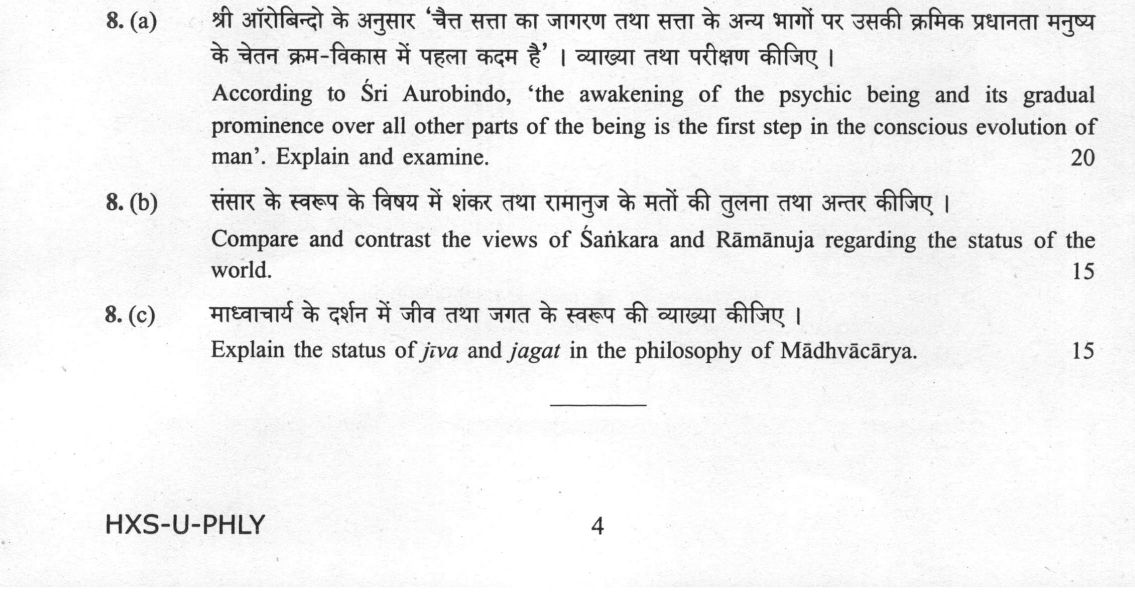
(a) According to Śrī Aurobindo, 'the awakening of the psychic being and its gradual prominence over all other parts of the being…
According to Śrī Aurobindo, 'the awakening of the psychic being and its gradual prominence over all other parts of the being is the first step in the conscious evolution of man'. Explain and examine. 20 marks
Compare and contrast the views of Śaṅkara and Rāmānuja regarding the status of the world. 15 marks
Explain the status of jīva and jagat in the philosophy of Mādhvācārya. 15 marks
हिंदी में प्रश्न पढ़ें
श्री अरोबिन्दो के अनुसार 'चैत सत्ता का जागरण तथा सत्ता के अन्य भागों पर उसकी क्रमिक प्रधानता मनुष्य के चेतन क्रम-विकास में पहला कदम है' । व्याख्या तथा परीक्षण कीजिए । (20 अंक)
संसार के स्वरूप के विषय में शंकर तथा रामानुज के मतों की तुलना तथा अन्तर कीजिए । (15 अंक)
माध्वाचार्य के दर्शन में जीव तथा जगत् के स्वरूप की व्याख्या कीजिए । (15 अंक)
Model answer
Written by UPSC Answer Check against this question's marking rubric, to the expected length. UPSC does not publish answers for Mains — this is one way to score well, not an official key.
Part (a): The psychic being and conscious evolution Aurobindo’s claim locates the psychic being not as the ego or a fragment of mind, but as the inner soul-principle that organises the fivefold ontology: annamaya, prāṇamaya, manomaya, vijñānamaya and ānandamaya. It stands behind the mental, vital and physical instruments, guiding them toward truth. It is distinct from Brahman/Īśvara, which is the supramental source, and from the ego-self, which is a limited centre of identification. Its gradual prominence over the other parts of the being is the first step in conscious evolution: the individual’s choices, desires and perceptions are no longer ruled by chance vital impulses or social conditioning but by the soul’s own truth. In Aurobindo’s scheme, involution brings the supramental into matter, while evolution unfolds it back; the psychic being is the bridge, the stable centre through which the lower nature is transformed and the supermind is prepared. Critically, this is stronger than a mere moral or psychological self: it gives evolution an inner subject. Yet it risks a subtle dualism if the psychic being is treated as a separate entity rather than a functional centre of the one being. Compared with Jung’s individuation, both describe a deeper centre integrating personality, but Aurobindo’s is metaphysical and evolutionary, not only psychological. Compared with Patañjali’s puruṣa, the psychic being is not a passive witness but an active evolving soul. Thus the claim is defensible as Aurobindo’s key soteriological principle, provided the psychic being is understood as the evolving soul-principle, not a new absolute.
Part (b): Śaṅkara and Rāmānuja on the world Śaṅkara’s vivartavāda holds that the world is not an independent reality; it is mithyā, dependent on Brahman and ultimately indeterminable (anirvacanīya) because it is neither absolutely real nor absolutely unreal. Its apparent existence is due to adhyāsa, superimposition of name and form on Brahman. Liberation is therefore jñāna-mārga: knowledge of the one non-dual Brahman removes ignorance. Rāmānuja’s Viśiṣṭādvaita rejects this. For him the world is real, a sat-kārya-vāda position, and is Brahman’s prakāra or mode and śarīra or body. Brahman is not attributeless but possesses real qualities and relations. His aprthak-siddhi says the world is not separate from Brahman, but it is not mere illusion either; it is a real attribute or body of the divine. Soteriologically, this supports prapatti, surrender to the personal God, alongside knowledge and devotion, because the world and self are real and the soul needs grace. Ontologically, Rāmānuja preserves gradation: Brahman, souls and matter are distinct yet inseparable, unlike Śaṅkara’s absolute non-duality.
Part (c): Mādhva’s jīva and jagat Mādhva’s dvaita affirms real plurality. The jīva is a real, distinct entity, graded by svarūpa-bheda into nitya, mukta and nitya-saṁsārin/tamo-yogya, producing a taratamya hierarchy of souls. The jagat is real and independent in its own category, yet paratantra, dependent on Viṣṇu. Here Viṣṇu is the efficient cause (nimitta-kāraṇa), while Prakṛti is the material cause (upādāna-kāraṇa); the world is not a transformation of Viṣṇu’s substance. The pañca-bheda doctrine maintains fivefold difference: between God and soul, God and matter, soul and matter, soul and soul, and matter and matter. Viśeṣa explains how attributes inhere in substances without collapsing them. Mādhva’s epistemological realism, which accepts the world as truly distinct, contrasts sharply with Śaṅkara’s idealism, where the world’s independence is denied.
Conclusion The three Vedāntic schools show a spectrum from non-dualism to real plurality. Aurobindo’s psychic being can be read as a dynamic, evolutionary complement: it makes the soul the agent of conscious transformation. Śaṅkara’s world is dependent and ultimately unreal; Rāmānuja’s is real but inseparable from Brahman; Mādhva’s is real, distinct and graded. A critical verdict is that Aurobindo’s claim is philosophically coherent if the psychic being is treated as the evolving soul-principle within a supramental evolution, while the Vedāntic schools differ mainly on whether reality is one, qualified one, or many.
What "Critically examine" is asking you to do
Test the proposition the question puts to you and return a finding on how far it holds. Examine stems carry a claim, or ask whether something has happened, and expect evidence weighed both ways before the extent is stated — often with remedial measures attached. “Critically” is not a section added at the end: name the yardstick you are judging by — the evidence, the stated objective, a constitutional principle, a rival explanation — and let a verdict close each part of the body. Where the question quotes a claim, that verdict must land on the claim itself, accepted, qualified or rejected, and not on the theme in general.
Structure that answers it
Restate the claim as the question frames it → evidence that supports it → evidence that undercuts it → the conditions under which it holds → verdict on how far it stands
Where marks are lost
Merits in one paragraph, demerits in the next, and a conclusion calling for a balanced and holistic approach. That is a survey with the judgement left out and it holds the answer in the middle band. The opposite error is reading “critically” as permission to attack — and with the odd pairings, critically describe or critically explain, the exposition still carries most of the marks, the judgement being a layer on it rather than a substitute for it.
How this answer will be evaluated
Approach
Framework: UPSC Philosophy Paper I. (a) examine: intro > how/why with reasoning > evidence > conclusion | (b) compare: paired headings or table > key differences > significance > conclusion | (c) explain: definition/context > points in order > small example > short close Full marks: Precise technical reconstruction with Sanskrit terms and clear distinctions.
Key points expected
- Define 'psychic being' (jīvatma) distinct from mind and soul
- Explain the 'gradual prominence' over other parts of being
- Link to 'conscious evolution' (supramental evolution)
- Examine the 'first step' claim in the evolutionary sequence
- Śaṅkara: World as māyā/avidyā (unreal or dependent)
- Rāmānuja: World as śarīra (real body of Brahman)
- Contrast the status of 'jagat' (real vs. apparent)
- Significance of the difference for soteriology
Evaluation rubric
Each sub-part is marked on its own, against the marks and word limit printed on the paper.
- (a) Reconstruct Aurobindo's argument for the psychic being as the pivot of evolution. 20 marks
examine— intro → how/why with reasoning → evidence → conclusion
Must cover
- Define 'psychic being' (jīvatma) distinct from mind and soul
- Explain the 'gradual prominence' over other parts of being
- Link to 'conscious evolution' (supramental evolution)
- Examine the 'first step' claim in the evolutionary sequence
Loses marks
- Confusing 'psychic being' with the 'soul' or 'self' (ātman)
- Biographical details of Aurobindo
- Vague spiritualism without technical reconstruction
Earns more
- Reference to 'The Life Divine' or 'The Synthesis of Yoga'
- Distinction between psychic and mental evolution
- Mention of 'chitta' or 'karma-yoga' as the mechanism
Extra mark
- Citation of specific Sanskrit terms from Aurobindo's usage
- Reference to the 'descent of the Supermind'
- (b) Contrast Advaita and Viśiṣṭādvaita ontologies regarding the reality of the world. 15 marks
compare— paired headings or table → key differences → significance → conclusion
Must cover
- Śaṅkara: World as māyā/avidyā (unreal or dependent)
- Rāmānuja: World as śarīra (real body of Brahman)
- Contrast the status of 'jagat' (real vs. apparent)
- Significance of the difference for soteriology
Loses marks
- Treating both as identical 'idealism'
- Biographical details of the philosophers
- Failing to distinguish 'māyā' from 'śarīra'
Earns more
- Use of 'vivarta' vs. 'pariṇāma' (transformation)
- Mention of 'nirguṇa' vs. 'saguṇa' Brahman
- Reference to 'tattvavāda' (theory of reality)
Extra mark
- Citation of specific verses from Brahma Sutra Bhashya
- Reference to 'sambandha' (relation) in Rāmānuja
- (c) Define the ontological status of jīva and jagat in Dvaita Vedānta. 15 marks
explain— definition/context → points in order → small example → short close
Must cover
- Jīva: Real, distinct, and dependent on Īśvara
- Jagat: Real, distinct, and dependent on Īśvara
- The 'fivefold difference' (pañca-bheda) framework
- Rejection of identity between jīva and Brahman
Loses marks
- Confusing Dvaita with Viśiṣṭādvaita
- Biographical details of Mādhvācārya
- Failing to state the 'real' status of the world
Earns more
- Mention of 'svātantrya' (independence) of Īśvara
- Distinction between 'jīva' and 'jagat' as categories
- Reference to 'bheda' (difference) as the core principle
Extra mark
- Citation of 'Anubhāva' (experience) as proof of difference
- Reference to 'tattva' (reality) in Mādhva's terminology
Practice this exact question
Write your answer and it is marked point by point against the model answer above — what you covered, what you missed, what you got wrong.
Evaluate my answer →More from Philosophy 2021 Paper I
- Q5 Write short answers to the following in about 150 words each: (a) Does the seed contain t…
- Q6 (a) Explain with reference to Yoga Philosophy, the nature of kleśas. How does the removal…
- Q7 (a) How do the advocates of anirvacanīya-khyāti refute the position of the Naiyāyikas and…
- Q8 (a) According to Śrī Aurobindo, 'the awakening of the psychic being and its gradual promi…