Paper I — Q7
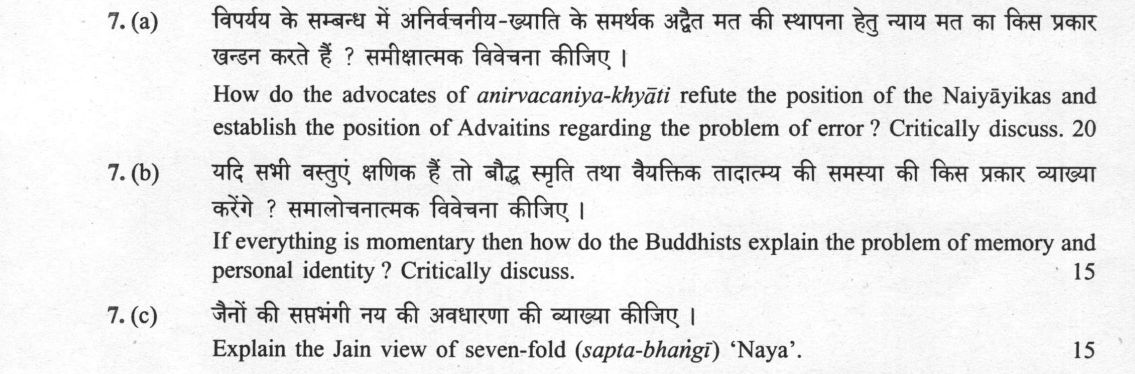
(a) How do the advocates of anirvacanīya-khyāti refute the position of the Naiyāyikas and establish the position of Advaitins…
How do the advocates of anirvacanīya-khyāti refute the position of the Naiyāyikas and establish the position of Advaitins regarding the problem of error ? Critically discuss. 20 marks
If everything is momentary then how do the Buddhists explain the problem of memory and personal identity ? Critically discuss. 15 marks
Explain the Jain view of seven-fold (sapta-bhaṅgī) 'Naya'. 15 marks
हिंदी में प्रश्न पढ़ें
विपर्यय के सम्बन्ध में अनिर्वचनीय-ख्याति के समर्थक अद्वैत मत की स्थापना हेतु न्याय मत का किस प्रकार खण्डन करते हैं ? समीक्षात्मक विवेचना कीजिए । (20 अंक)
यदि सभी वस्तुएं क्षणिक हैं तो बौद्ध स्मृति तथा वैयक्तिक तादात्म्य की समस्या की किस प्रकार व्याख्या करेंगे ? समालोचनात्मक विवेचना कीजिए । (15 अंक)
जैनों की सप्तभंगी नय की अवधारणा की व्याख्या कीजिए । (15 अंक)
Model answer
Written by UPSC Answer Check against this question's marking rubric, to the expected length. UPSC does not publish answers for Mains — this is one way to score well, not an official key.
Error and Advaita. The Advaitin answer to error begins with the rope-snake: the snake is not Brahman, yet it is not sheer nothing, because it is experienced and later sublated. Hence Shankara’s anirvacanīya-khyāti treats the erroneous appearance as indescribable, neither sat nor asat. This is why Advaita calls the appearance māyā: it is experienced and has causal efficacy, yet is negated by knowledge, so it cannot be classified under the law of excluded middle. It is a vivarta, an apparent transformation of Brahman under avidyā, not a real change. Against the Naiyāyikas, who hold anyathā-khyāti (anyathā-siddhi), the Advaitin argues that error cannot be a mislocation of a real object: if silver were really in the shell, the perception would be true; if it is only elsewhere, the apparent silver in the shell is not a real object and cannot be sublated as a real thing. Nyāya’s account also presupposes a real object with real properties, whereas the snake has no independent existence. The Advaitin also rejects the sat-khyāti view that error is somehow real, or a true but incomplete cognition, because if the snake or the silver-cognition were real, it could not be destroyed by knowledge; it would remain a real object or a real cognition. The proof of prior ignorance is badha: the snake is sublated when the rope is known, showing it was neither permanently real nor absolutely unreal, but an indescribable appearance of Brahman. Critically, this preserves non-duality but risks making error epistemically opaque: if the snake is neither real nor unreal, how can it be a cognition with a content?
Momentariness, memory and identity. Buddhist kṣaṇikavāda says every dharma is momentary; no self persists. Memory seems to require a past object and a present subject, but the past moment is gone. Abhidharma answers that memory is a new momentary cognition produced by a causal trace (vāsanā) in the stream (saṃtāna) of consciousness; the remembered object is not the same moment but a causally connected counterpart. Yogācāra adds ālayavijñāna, a store-house consciousness that carries karmic seeds, explaining continuity without a permanent soul. Pudgalavāda posits a pudgala, neither identical with nor different from the aggregates, to ground personal identity. Critically, this preserves anattā and causality, but it leaves the “I” of memory conventional: the stream is not a person, yet it functions as one. The remembered “I” is a conventional designation over the aggregates. Nyāya would object that without a permanent self, memory, responsibility and re-identification remain only causal conventions, not genuine identity.
Jain sapta-bhaṅgī. Jain naya is a partial standpoint, and sapta-bhaṅgī gives seven conditioned predications: syād asti (it exists), syād nāsti (it does not exist), syād asti-nāsti (it exists and does not exist), syād avaktavya (it is indescribable), syād asti-avaktavya (it exists and is indescribable), syād nāsti-avaktavya (it does not exist and is indescribable), and syād asti-nāsti-avaktavya (it exists, does not exist, and is indescribable). For a pot, it exists as a product, does not exist as an independent substance, both from different standpoints, and is indescribable when all aspects are considered together. This expresses anekāntavāda: truth is many-sided, and ekānta absolutism is rejected. Critically, it avoids dogmatism and accommodates change, but it can seem to dilute assertion, since every claim is qualified by “from some respect,” making decisive refutation difficult.
Thus each resolves a different tension: Advaita protects non-duality at the cost of epistemic opacity, Buddhism secures memory and identity through causal continuity but leaves the self conventional, and Jainism offers the most defensible method against absolutism, though it weakens decisive assertion.
What "Critically discuss" is asking you to do
Lay the issue out from more than one side — how it arose, what is claimed for it, what is held against it, and where it now stands. UPSC attaches discuss to broad topics with several live dimensions, so coverage of the dimensions earns more than the strength of your opinion. “Critically” is not a section added at the end: name the yardstick you are judging by — the evidence, the stated objective, a constitutional principle, a rival explanation — and let a verdict close each part of the body. Where the question quotes a claim, that verdict must land on the claim itself, accepted, qualified or rejected, and not on the theme in general.
Structure that answers it
Set the issue up → the case as it is made → the case against → the dimension both sides leave out → where the balance now lies
Where marks are lost
Merits in one paragraph, demerits in the next, and a conclusion calling for a balanced and holistic approach. That is a survey with the judgement left out and it holds the answer in the middle band. The opposite error is reading “critically” as permission to attack — and with the odd pairings, critically describe or critically explain, the exposition still carries most of the marks, the judgement being a layer on it rather than a substitute for it.
How this answer will be evaluated
Approach
Framework: State the position > Argument > Strongest objection > Evaluation. (a) discuss: intro > 3-4 dimensions > example > balanced close | (b) discuss: intro > 3-4 dimensions > example > balanced close | (c) explain: definition/context > points in order > small example > short close Full marks: Precise technical vocabulary, strong argument reconstruction, clear critical evaluation, balanced close.
Key points expected
- Define Anirvacaniya-khyati (inexplicable error) precisely
- Reconstruct Naiyayika Satkaryavada or Vivarta-vada position on error
- Present Advaita refutation of Naiyayika position
- Critically evaluate the validity of the Advaita solution
- State the Buddhist doctrine of momentariness (Kshanika-vada)
- Explain the problem of memory under momentariness
- Explain the problem of personal identity (Anatman)
- Critically evaluate the Buddhist explanation
Evaluation rubric
Each sub-part is marked on its own, against the marks and word limit printed on the paper.
- (a) Reconstruct the Anirvacaniya-khyati argument against Naiyayika and establish Advaita position. 20 marks
discuss— intro → 3-4 dimensions → example → balanced close
Must cover
- Define Anirvacaniya-khyati (inexplicable error) precisely
- Reconstruct Naiyayika Satkaryavada or Vivarta-vada position on error
- Present Advaita refutation of Naiyayika position
- Critically evaluate the validity of the Advaita solution
Loses marks
- Biographical details of Sankara or Naiyayika founders
- Vague paraphrase without technical vocabulary
- Failing to present the strongest counter-argument
Earns more
- Use Sanskrit terms: Anirvacaniya-khyati, Satkaryavada, Vivarta
- Distinguish between error and illusion (Maya)
- Reference specific Advaita texts or thinkers (e.g., Sankara)
- Balanced close acknowledging limitations of the theory
Extra mark
- Mention specific examples used in Advaita (e.g., rope-snake)
- Reference to specific Naiyayika counter-arguments
- (b) Explain Buddhist solution to memory and identity problems given momentariness. 15 marks
discuss— intro → 3-4 dimensions → example → balanced close
Must cover
- State the Buddhist doctrine of momentariness (Kshanika-vada)
- Explain the problem of memory under momentariness
- Explain the problem of personal identity (Anatman)
- Critically evaluate the Buddhist explanation
Loses marks
- Biographical details of Buddhist founders
- Vague paraphrase without technical vocabulary
- Failing to address both memory and identity problems
Earns more
- Use Sanskrit terms: Kshanika-vada, Anatman, Pratityasamutpada
- Reference specific Buddhist thinkers (e.g., Vasubandhu, Dignaga)
- Distinguish between memory and personal identity issues
- Balanced close acknowledging challenges to the theory
Extra mark
- Mention specific Buddhist texts (e.g., Abhidharmakosha)
- Reference to specific examples used in Buddhist argumentation
- (c) Explain the Jain Sapta-bhangi Naya (seven-fold view). 15 marks
explain— definition/context → points in order → small example → short close
Must cover
- Define Sapta-bhangi Naya precisely
- List and explain the seven aspects (Bhanga)
- Provide a small example illustrating the concept
- Short close on the significance of the view
Loses marks
- Biographical details of Jain founders
- Vague paraphrase without technical vocabulary
- Failing to list all seven aspects clearly
Earns more
- Use Sanskrit terms: Sapta-bhangi, Naya, Bhanga
- Reference specific Jain texts or thinkers (e.g., Kundakunda)
- Distinguish between Naya and Marga
- Clear and ordered presentation of the seven aspects
Extra mark
- Mention specific Jain examples (e.g., pot, cloth)
- Reference to specific Jain philosophical debates
Practice this exact question
Write your answer and it is marked point by point against the model answer above — what you covered, what you missed, what you got wrong.
Evaluate my answer →More from Philosophy 2021 Paper I
- Q4 (a) Present a critical exposition of Husserl's criticism of 'natural attitude'. How does…
- Q5 Write short answers to the following in about 150 words each: (a) Does the seed contain t…
- Q6 (a) Explain with reference to Yoga Philosophy, the nature of kleśas. How does the removal…
- Q7 (a) How do the advocates of anirvacanīya-khyāti refute the position of the Naiyāyikas and…
- Q8 (a) According to Śrī Aurobindo, 'the awakening of the psychic being and its gradual promi…