Paper I — Q6
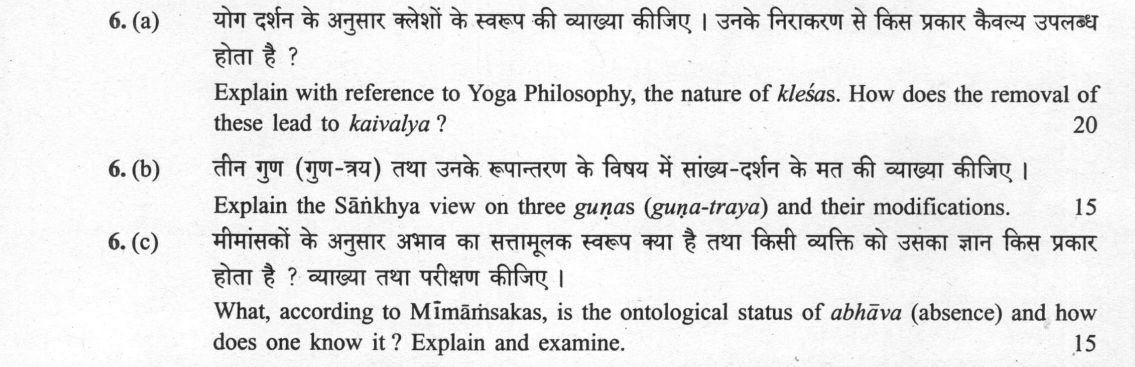
(a) Explain with reference to Yoga Philosophy, the nature of kleśas. How does the removal of these lead to kaivalya ? (20…
Explain with reference to Yoga Philosophy, the nature of kleśas. How does the removal of these lead to kaivalya ? 20 marks
Explain the Sāṅkhya view on three gunas (guna-traya) and their modifications. 15 marks
What, according to Mīmāṃsakas, is the ontological status of abhāva (absence) and how does one know it ? Explain and examine. 15 marks
हिंदी में प्रश्न पढ़ें
योग दर्शन के अनुसार क्लेशों के स्वरूप की व्याख्या कीजिए । उनके निराकरण से किस प्रकार कैवल्य उपलब्ध होता है ? (20 अंक)
तीन गुण (गुण-त्रय) तथा उनके रूपान्तरण के विषय में सांख्य-दर्शन के मत की व्याख्या कीजिए । (15 अंक)
मीमांसकों के अनुसार अभाव का सत्तामूलक स्वरूप क्या है तथा किसी व्यक्ति को उसका ज्ञान किस प्रकार होता है ? व्याख्या तथा परीक्षण कीजिए । (15 अंक)
Model answer
Written by UPSC Answer Check against this question's marking rubric, to the expected length. UPSC does not publish answers for Mains — this is one way to score well, not an official key.
Nature of Kleśas and Kaivalya in Yoga
In Pātañjala Yoga, kleśas are psychological-metaphysical afflictions inherent in the citta (mind-stuff) that cause suffering and bind the puruṣa to the empirical cycle of transmigration (saṃsāra). Patañjali identifies five kleśas: avidyā (spiritual ignorance), asmitā (egoism/false identification of puruṣa with buddhi), rāga (attachment to pleasure), dveṣa (aversion to pain), and abhiniveśa (instinctive clinging to life and fear of death).
Among these, avidyā is the breeding ground (kṣetra) and root cause of all other afflictions, defining the non-eternal as eternal, the impure as pure, and the non-self (anātman) as the self (ātman). This ignorance activates asmitā, which gives rise to desire (rāga) and antipathy (dveṣa), culminating in abhiniveśa. These afflictions form the kleśa-mūla, generating latent impressions (saṃskāras and vāsanās) that constitute the karmāśaya (reservoir of karmas). This reservoir inexorably drives rebirth, lifespan, and empirical experience (jāti-āyus-bhoga).
The removal of kleśas proceeds through Aṣṭāṅga Yoga and abhyāsa-vairāgya, which cultivate viveka-khyāti (unwavering discriminative discernment between puruṣa and prakṛti). Viveka-khyāti burns the affliction-seeds (dagdha-bīja), rendering them incapable of germination. This brings about citta-vṛtti-nirodha (cessation of mental modifications). With the eradication of afflictions, the citta undergoes *pratiprasava*—the inverse involution and dissolution of mental modifications back into primary prakṛti. Consequently, puruṣa ceases to falsely reflect in citta-vṛttis, sheds phenomenal entanglement (puruṣa-kāśa), and abides in its pristine, self-luminous transcendence (svarūpa-pratiṣṭhā), which constitutes kaivalya (liberation).
Sāṅkhya View on Guṇa-Traya and Modifications
Sāṅkhya metaphysics posits mūlaprakṛti as the ultimate material cause of the universe, constituted by three reals or guṇas: sattva, rajas, and tamas. Sattva represents lightness, harmony, and illumination (prakāśa); rajas represents mobility, passion, and stimulation (upastambhaka and cala); and tamas represents heaviness, inertia, and obstruction (guru and varaṇaka). The guṇas never exist in isolation; they function through mutual suppression, mutual support, mutual generation, and co-existence (anyonya-abhibhava-āśraya-janana-mithuna-vṛttayaḥ), acting cooperatively like the wick, oil, and flame in a lamp.
The modifications (pariṇāma) of the guṇas occur in two modes:
- Sādharmya-pariṇāma (homogeneous transformation): During cosmic dissolution (pralaya), the guṇas remain in equilibrium (sāmyāvasthā), each transforming only within itself without interacting (sattva into sattva, etc.).
- Vaidharmya-pariṇāma (heterogeneous transformation): Proximity to puruṣa (puruṣa-sannidhi) disturbs this equilibrium, initiating cosmic evolution.
In this heterogeneous modification, rajas activates the other guṇas, leading to the sequential emergence of twenty-three evolutes: mahat (cosmic intellect), ahaṅkāra (ego-sense), five tanmātras (subtle essences), eleven indriyas (organs of sense and action, plus manas), and five mahābhūtas (gross elements).
Ontological Status and Epistemology of Abhāva in Mīmāṃsā
Kumārila Bhāṭṭa accords abhāva (non-existence/absence) the status of an independent, objective ontological category (padārtha). For the Bhāṭṭa Mīmāṃsakas, reality is dual-natured: an entity possesses both a positive aspect (bhāvātmaka) and a negative aspect (abhāvātmaka). Abhāva is not a mere void; it is determined in reference to its counter-positive (bhāva-pratiyogin).
Kumārila classifies abhāva broadly into saṃsargābhāva (absence of a relation) and anyonyābhāva or dharmābhāva (mutual absence/essential difference between two entities, e.g., "a jar is not a cloth"). Saṃsargābhāva is threefold: prāgabhāva (prior non-existence before production), pradhvaṃsābhāva (posterior non-existence after destruction), and atyantābhāva (absolute absence across all time, e.g., "air lacks color").
Epistemologically, Kumārila establishes anupalabdhi (non-apprehension) as an autonomous, sixth pramāṇa to cognize abhāva. When an object capable of being perceived is not perceived in an appropriate locus (yogyānupalabdhi), the non-perception directly generates the valid cognition of its absence without sensory contact (sannikarṣa).
Conversely, the Prābhākara school rejects abhāva as an independent ontological category and denies anupalabdhi as a separate pramāṇa. Prābhākara contends that the non-existence of a jar on the floor is nothing other than the perception of the bare locus (bhūtalamātra) itself.
Thus, while Yoga and Sāṅkhya resolve the metaphysical and psychological entanglement of consciousness through causal involution, Mīmāṃsā secures an exhaustive realism by grounding both presence and absence in rigorous epistemology.
What "Explain" is asking you to do
Make the working of something clear — what sets it off, what follows from what, and what it produces. Explain is the Commission's mechanism word: it dominates the technical papers and the “explain why” stems, where the marks sit in the causal chain and not in the label.
Structure that answers it
State what it is → the initiating condition → the chain of cause, step by step → an instance where it plays out → what the chain produces
Where marks are lost
Describing what something looks like instead of why it works that way. Naming the stages without linking them reads as description too.
How this answer will be evaluated
Approach
Framework: Indian Philosophy (Paper I). (a) explain: definition/context > points in order > small example > short close | (b) explain: definition/context > points in order > small example > short close | (c) examine: intro > how/why with reasoning > evidence > conclusion Full marks: Precise technical vocabulary, clear argument, strong counter-argument, exact Sanskrit terms.
Key points expected
- List the five kleśas (avidyā, asmitā, rāga, dveṣa, abhiniveśa)
- Define kleśas as 'vṛtti-vikṣepaka' (disturbers of citta)
- Explain the role of 'nirodha' (citta-vṛtti-nirodha) in removal
- Link removal to 'kaivalya' (isolation of puruṣa)
- Identify the three guṇas (sattva, rajas, tamas)
- Explain 'guṇa-vṛtti' (modifications of guṇas)
- Describe the process of 'pariṇāma' (evolution)
- Mention the role of 'prakṛti' in this process
Evaluation rubric
Each sub-part is marked on its own, against the marks and word limit printed on the paper.
- (a) Define kleśas in Yoga and explain the mechanism of their removal leading to kaivalya. 20 marks
explain— definition/context → points in order → small example → short close
Must cover
- List the five kleśas (avidyā, asmitā, rāga, dveṣa, abhiniveśa)
- Define kleśas as 'vṛtti-vikṣepaka' (disturbers of citta)
- Explain the role of 'nirodha' (citta-vṛtti-nirodha) in removal
- Link removal to 'kaivalya' (isolation of puruṣa)
Loses marks
- Confusing kleśas with 'karma' or 'vāsanā'
- Vague description of 'peace' without technical terms
- Biographical details of Patañjali
Earns more
- Mention 'pratyāhāra' or 'dhyāna' as specific means
- Reference 'Patañjali Yoga Sūtra' (e.g., 2.15-2.16)
- Distinguish 'taraṇa' (dissipation) from 'nirodha' (suppression)
Extra mark
- Cite specific Sūtra numbers (e.g., 2.15, 2.16)
- Mention 'sādhana' (practice) and 'viveka' (discernment)
- (b) Explain the Sāṅkhya view on the three guṇas and their modifications (vṛtti). 15 marks
explain— definition/context → points in order → small example → short close
Must cover
- Identify the three guṇas (sattva, rajas, tamas)
- Explain 'guṇa-vṛtti' (modifications of guṇas)
- Describe the process of 'pariṇāma' (evolution)
- Mention the role of 'prakṛti' in this process
Loses marks
- Confusing guṇas with 'tattvas' (categories)
- Vague description of 'nature' without technical terms
- Biographical details of Kapila
Earns more
- Explain 'sattva' as illuminating, 'rajas' as active, 'tamas' as inert
- Reference 'Sāṅkhya Kārikā' (e.g., 15-17)
- Mention 'mahat' (intellect) as the first modification
Extra mark
- Cite specific Kārikā numbers
- Mention 'guṇa-samāya' (equilibrium) and 'guṇa-viṣeṣa' (disturbance)
- (c) Examine the Mīmāṃsaka ontological status of abhāva and the means of its knowledge. 15 marks
examine— intro → how/why with reasoning → evidence → conclusion
Must cover
- Define 'abhāva' (absence) in Mīmāṃsā
- Explain 'anupalabdhi' (non-apprehension) as pramāṇa
- Distinguish 'atyantika' (eternal) from 'prāgabhāva' (prior) abhāva
- Explain the 'ontological status' (real vs. unreal)
Loses marks
- Confusing 'abhāva' with 'śūnyatā' (Nāgārjuna)
- Vague description of 'absence' without technical terms
- Biographical details of Jaimini
Earns more
- Reference 'Jaimini' or 'Kumārila Bhaṭṭa'
- Mention 'sādhya' (object) and 'sādhaka' (subject) in anupalabdhi
- Explain 'anupalabdhi' as 'absence of presence'
Extra mark
- Cite specific Mīmāṃsā Sūtra or Bhaṣya
- Mention 'anupalabdhi' as 'fifth pramāṇa'
Practice this exact question
Write your answer and it is marked point by point against the model answer above — what you covered, what you missed, what you got wrong.
Evaluate my answer →More from Philosophy 2021 Paper I
- Q3 (a) What are the main arguments put forward by Moore in his paper "A Defence of Common Se…
- Q4 (a) Present a critical exposition of Husserl's criticism of 'natural attitude'. How does…
- Q5 Write short answers to the following in about 150 words each: (a) Does the seed contain t…
- Q6 (a) Explain with reference to Yoga Philosophy, the nature of kleśas. How does the removal…
- Q7 (a) How do the advocates of anirvacanīya-khyāti refute the position of the Naiyāyikas and…
- Q8 (a) According to Śrī Aurobindo, 'the awakening of the psychic being and its gradual promi…