Paper II — Q1
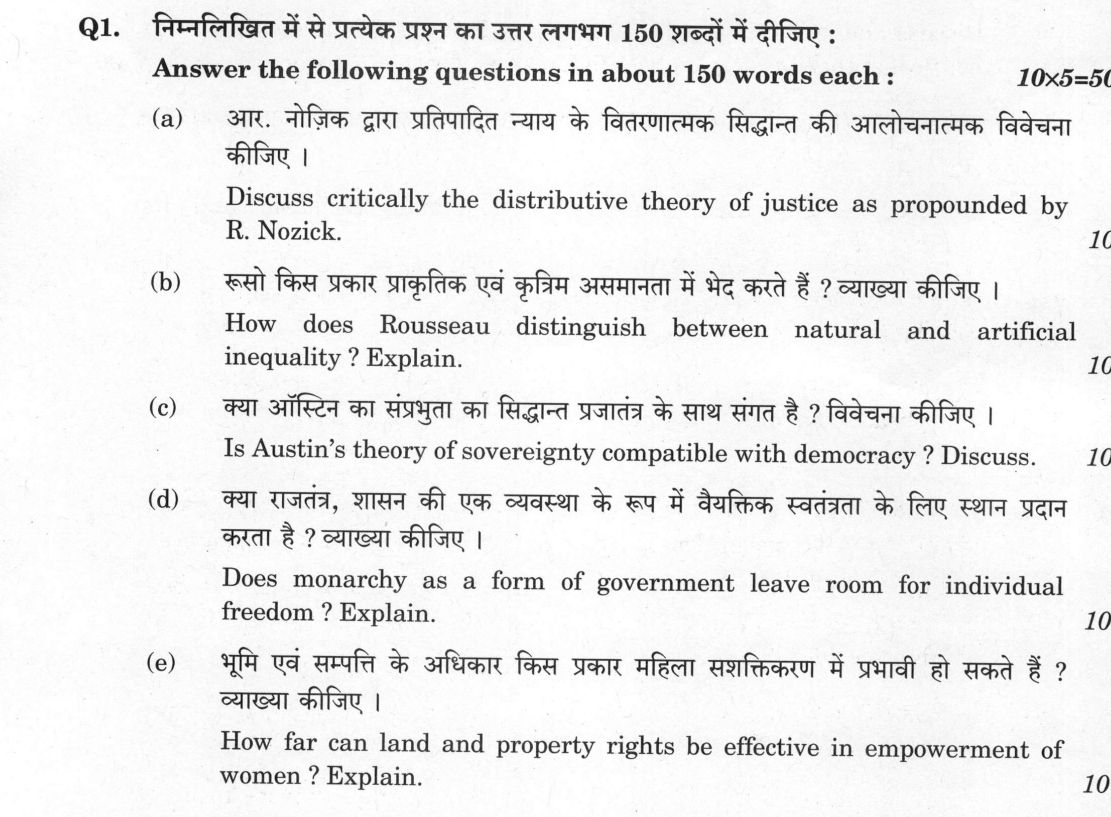
Answer the following questions in about 150 words each: (a) Discuss critically the distributive theory of justice as propounded…
Answer the following questions in about 150 words each:
Discuss critically the distributive theory of justice as propounded by R. Nozick. 10 marks
How does Rousseau distinguish between natural and artificial inequality? Explain. 10 marks
Is Austin's theory of sovereignty compatible with democracy? Discuss. 10 marks
Does monarchy as a form of government leave room for individual freedom? Explain. 10 marks
How far can land and property rights be effective in empowerment of women? Explain. 10 marks
हिंदी में प्रश्न पढ़ें
निम्नलिखित में से प्रत्येक प्रश्न का उत्तर लगभग 150 शब्दों में दीजिए :
आर. नोजिक द्वारा प्रतिपादित न्याय के वितरणात्मक सिद्धांत की आलोचनात्मक विवेचना कीजिए। (10 अंक)
रूसो किस प्रकार प्राकृतिक एवं कृत्रिम असमानता में भेद करते हैं ? व्याख्या कीजिए। (10 अंक)
क्या ऑस्टिन का संप्रभुता का सिद्धांत प्रजातंत्र के साथ संगत है ? विवेचना कीजिए। (10 अंक)
क्या राजतंत्र, शासन की एक व्यवस्था के रूप में वैयक्तिक स्वतंत्रता के लिए स्थान प्रदान करता है ? व्याख्या कीजिए। (10 अंक)
भूमि एवं सम्पत्ति के अधिकार किस प्रकार महिला सशक्तिकरण में प्रभावी हो सकते हैं ? व्याख्या कीजिए। (10 अंक)
Model answer
Written by UPSC Answer Check against this question's marking rubric, to the 150-word length. UPSC does not publish answers for Mains — this is one way to score well, not an official key.
(a) Nozick's Distributive Theory of Justice
In Anarchy, State, and Utopia, Robert Nozick propounds the Entitlement Theory of justice, rejecting patterned and end-state distributive models like John Rawls's Difference Principle. Nozick articulates three principles: justice in initial acquisition (legitimate appropriation of unheld resources), justice in transfer (voluntary market transactions and gifts), and rectification of past injustices. To demonstrate the flaw of patterned principles, Nozick introduces the Wilt Chamberlain thought experiment: if individuals freely spend their legitimately held resources to watch a player, the resulting unequal distribution is inherently just, because liberty inevitably upsets patterns.
Critics argue that Nozick overlooks historical violence in initial acquisitions, making rectification practically impossible. Furthermore, by prioritizing absolute property rights and self-ownership, his theory treats structural socioeconomic deprivation as morally unproblematic, reducing justice to formal market procedures without regard for substantive equality.
(b) Rousseau on Natural vs. Artificial Inequality
In his Discourse on the Origin of Inequality, Jean-Jacques Rousseau distinguishes between natural (or physical) inequality and artificial (moral or political) inequality. Natural inequality stems from innate biological differences established by nature, such as variations in age, bodily strength, health, and mental qualities. In the state of nature, guided by simple self-preservation (amour de soi) and natural pity, these differences remain benign and inconsequential.
Artificial inequality, conversely, is established through human convention, mutual consent, and social institutions. It emerged when human beings formed societies and invented private property—marked by the first person who enclosed land and declared, "This is mine." This institutionalization catalyzed amour-propre (vanity and competitive self-love), replacing natural harmony with social hierarchies of wealth, status, and domination. For Rousseau, while natural inequality is inevitable, artificial inequality is an arbitrary social construct that requires democratic reform.
(c) Austin's Sovereignty and Democracy
John Austin's analytical positivism defines sovereignty as a determinate human superior who receives habitual obedience from society while not being in habitual obedience to any other power. Austinian sovereignty is characterized as legally illimitable, indivisible, and supreme, functioning through commands backed by coercive sanctions.
This formulation sits in sharp tension with modern democracy. Democratic governance rests upon popular sovereignty, the separation of powers, and constitutionalism, wherein state power is divided and constrained by fundamental rights. As H.L.A. Hart argued in his critique, Austin fails to distinguish between being obliged by a gunman's command and having a rule-based obligation; democratic legal systems operate on a shared "rule of recognition" rather than habitual obedience to an uncommanded commander. Austin's model is compatible with democracy only if sovereignty is abstracted into the amending constituent power of the people.
(d) Monarchy and Individual Freedom
The capacity of monarchy to accommodate individual freedom depends on the constitutional framework within which it operates. Absolute monarchy, epitomized by the Hobbesian sovereign, concentrates unrestrained power in a single ruler, leaving freedom contingent solely upon the sovereign's discretion and the "silence of the law."
However, constitutional and limited monarchy actively preserves freedom by subordinating the monarch to the rule of law and representative institutions. As Montesquieu observed in The Spirit of the Laws, a moderate monarchy can foster civil liberty when intermediate and subordinate powers—such as the judiciary and regional assemblies—check monarchical authority and prevent despotism. Contemporary constitutional monarchies, such as the United Kingdom or Bhutan's calibrated evolution into a democratic constitutional monarchy, demonstrate that crown authority can coexist with robust civil rights by decoupling symbolic headship from democratic governance.
(e) Land and Property Rights in Women's Empowerment
Land and property rights serve as critical structural drivers for women's empowerment by securing economic independence, expanding collateral access, and enhancing intra-household bargaining power. In India, statutory reforms such as the Hindu Succession (Amendment) Act, 2005 conferred equal coparcenary rights to daughters, while government initiatives promoting joint pattas (homestead land titles) and Self-Help Groups (SHGs) have advanced female asset ownership.
Historically, redistributive experiments like the Bhoodan movement predominantly vested land in male household heads, reinforcing female dependency. Moreover, despite formal legislative parity, patriarchal customary norms, patrilocal marriage systems, and administrative inertia frequently hinder women from claiming their de jure rights. To realize genuine empowerment, statutory entitlements must be accompanied by gender-responsive land administration, legal literacy, and community-level interventions that dismantle structural socio-cultural barriers.
What "Discuss" is asking you to do
Lay the issue out from more than one side — how it arose, what is claimed for it, what is held against it, and where it now stands. UPSC attaches discuss to broad topics with several live dimensions, so coverage of the dimensions earns more than the strength of your opinion.
Structure that answers it
Set the issue up → the case as it is made → the case against → the dimension both sides leave out → where the balance now lies
Where marks are lost
Listing facts with no thread between them, or arguing one side throughout and calling it a discussion.
How this answer will be evaluated
Approach
Framework: State the position > Argument > Strongest objection > Evaluation. (a) critique: the claim > its strengths > its weaknesses > your judgment | (b) explain: definition/context > points in order > small example > short close | (c) discuss: intro > 3-4 dimensions > example > balanced close | (d) explain: definition/context > points in order > small example > short close | (e) explain: definition/context > points in order > small example > short close Full marks: Precise reconstruction of the argument, strong counter-arguments, and clear evaluation.
Key points expected
- Define entitlement theory (acquisition, transfer, rectification)
- Contrast with Rawls' difference principle
- Explain the 'Wilt Chamberlain' argument
- Critique the 'historical' vs 'end-state' distinction
- Define 'natural inequality' (physical/mental differences)
- Define 'artificial inequality' (social/political distinctions)
- Explain the role of 'civil society' in creating artificial inequality
- Link artificial inequality to the 'social contract'
Evaluation rubric
Each sub-part is marked on its own, against the marks and word limit printed on the paper.
- (a) Reconstruct Nozick's entitlement theory and evaluate its limits. 10 marks · 150 words
critique— the claim → its strengths → its weaknesses → your judgment
Must cover
- Define entitlement theory (acquisition, transfer, rectification)
- Contrast with Rawls' difference principle
- Explain the 'Wilt Chamberlain' argument
- Critique the 'historical' vs 'end-state' distinction
Loses marks
- Biographical details of Nozick
- Confusing Nozick with Hayek or Friedman
- Vague summary without critical evaluation
Earns more
- Mention 'minimal state' or 'night-watchman state'
- Reference 'Anarchy, State, and Utopia'
- Discuss the 'Kantian' constraint on persons
- Mention the 'rectification principle' for past injustices
Extra mark
- Cite specific Nozickian terms like 'self-ownership'
- Reference the 'Lockean proviso'
- (b) Distinguish natural from artificial inequality in Rousseau's thought. 10 marks · 150 words
explain— definition/context → points in order → small example → short close
Must cover
- Define 'natural inequality' (physical/mental differences)
- Define 'artificial inequality' (social/political distinctions)
- Explain the role of 'civil society' in creating artificial inequality
- Link artificial inequality to the 'social contract'
Loses marks
- Confusing Rousseau with Hobbes or Locke
- Failing to distinguish the two types clearly
- Vague generalities about inequality
Earns more
- Reference 'Discourse on Inequality' (Second Discourse)
- Mention 'force' and 'wealth' as sources of artificial inequality
- Discuss the 'state of nature' vs 'civil state'
- Mention 'amour de soi' vs 'amour-propre'
Extra mark
- Cite specific Rousseauian terms like 'legitimate inequality'
- Reference the 'general will' as a solution
- (c) Assess the compatibility of Austin's sovereignty with democracy. 10 marks · 150 words
discuss— intro → 3-4 dimensions → example → balanced close
Must cover
- Define Austin's 'sovereign' (determinate, supreme, independent)
- Explain the 'command theory' of law
- Analyze the tension between 'sovereign' and 'democratic will'
- Evaluate the 'parliamentary sovereignty' argument
Loses marks
- Confusing Austin with Kelsen or Hart
- Failing to address the 'democracy' aspect
- Vague summary without critical analysis
Earns more
- Reference 'The Province of Jurisprudence Determined'
- Mention 'habitual obedience' and 'habitual subjection'
- Discuss the 'separation of law and morality'
- Mention the 'determinate' nature of the sovereign
Extra mark
- Cite specific Austinian terms like 'independent sovereign'
- Reference the 'command' and 'sanction' elements
- (d) Explain if monarchy allows for individual freedom. 10 marks · 150 words
explain— definition/context → points in order → small example → short close
Must cover
- Define 'monarchy' (single ruler, hereditary/elected)
- Explain the 'divine right' or 'traditional' justification
- Analyze the 'limits' on monarchical power (constitution, law)
- Evaluate the 'individual freedom' in a monarchical context
Loses marks
- Confusing monarchy with dictatorship
- Failing to address the 'individual freedom' aspect
- Vague generalities about government forms
Earns more
- Reference 'constitutional monarchy' (e.g., UK, Japan)
- Mention 'absolute monarchy' (e.g., historical France)
- Discuss the 'rule of law' as a check on power
- Mention 'civil liberties' and 'fundamental rights'
Extra mark
- Cite specific examples of monarchies with strong freedoms
- Reference the 'separation of powers' in monarchies
- (e) Explain the role of land/property rights in women's empowerment. 10 marks · 150 words
explain— definition/context → points in order → small example → short close
Must cover
- Define 'land and property rights' (ownership, control, access)
- Explain the 'economic independence' link to empowerment
- Analyze the 'social and legal barriers' to women's property rights
- Evaluate the 'impact' of property rights on women's status
Loses marks
- Confusing property rights with general economic rights
- Failing to address the 'women's empowerment' aspect
- Vague generalities about property rights
Earns more
- Reference 'Hindu Succession Act' (India) or similar laws
- Mention 'land titling' and 'registration' processes
- Discuss 'gender bias' in property laws
- Mention 'economic security' and 'social status'
Extra mark
- Cite specific laws or policies promoting women's property rights
- Reference 'microfinance' or 'land reform' programs
Practice this exact question
Write your answer and it is marked point by point against the model answer above — what you covered, what you missed, what you got wrong.
Evaluate my answer →More from Philosophy 2021 Paper II
- Q1 Answer the following questions in about 150 words each: (a) Discuss critically the distri…
- Q2 (a) Discuss whether Amartya Sen's idea of justice is an improvement upon Rawl's theory of…
- Q3 (a) Discuss anarchism as a political ideology. Is it possible to dispense with political…
- Q4 (a) Discuss the views of Dr. B.R. Ambedkar regarding caste-discrimination in Indian socie…