Paper II — Q2
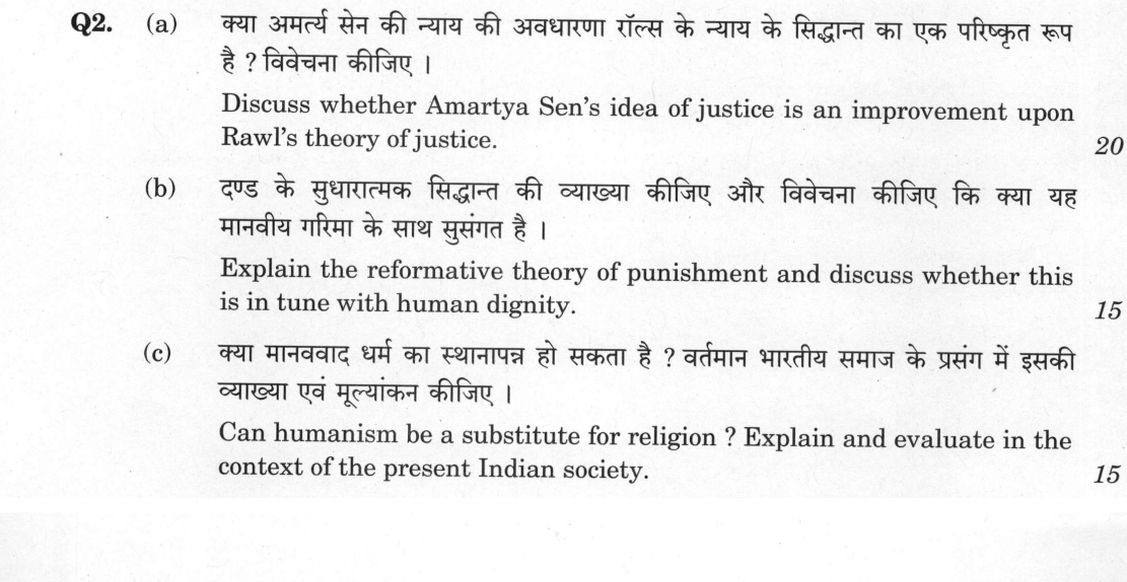
(a) Discuss whether Amartya Sen's idea of justice is an improvement upon Rawl's theory of justice. (20 marks) (b) Explain the…
Discuss whether Amartya Sen's idea of justice is an improvement upon Rawl's theory of justice. 20 marks
Explain the reformative theory of punishment and discuss whether this is in tune with human dignity. 15 marks
Can humanism be a substitute for religion? Explain and evaluate in the context of the present Indian society. 15 marks
हिंदी में प्रश्न पढ़ें
क्या अमर्त्य सेन की न्याय की अवधारणा रॉल्स के न्याय के सिद्धांत का एक परिष्कृत रूप है ? विवेचना कीजिए। (20 अंक)
दण्ड के सुधारात्मक सिद्धांत की व्याख्या कीजिए और विवेचना कीजिए कि क्या यह मानवीय गरिमा के साथ सुसंगत है। (15 अंक)
क्या मानववाद धर्म का स्थानापन्न हो सकता है ? वर्तमान भारतीय समाज के प्रसंग में इसकी व्याख्या एवं मूल्यांकन कीजिए। (15 अंक)
Model answer
Written by UPSC Answer Check against this question's marking rubric, to the expected length. UPSC does not publish answers for Mains — this is one way to score well, not an official key.
The three parts ask whether Indian moral and political philosophy can combine comparative justice, humane punishment and secular humanism for a plural society.
Justice and capability Rawls begins from an original position behind a veil of ignorance, where rational agents, not knowing their class, talent or conception of the good, choose principles of justice. His two principles secure equal basic liberties, fair equality of opportunity, and the difference principle, which permits inequalities only if they benefit the least advantaged. This gives a powerful institutional grammar: constitutional democracy, basic rights and public reason can be justified without appealing to any particular comprehensive doctrine. Sen, in The Idea of Justice, critiques Rawls as “transcendental institutionalism”, a search for perfectly just institutions that may ignore actual suffering. He proposes “realization-focused comparison”, asking which social arrangements reduce identifiable injustices, and distinguishes nyaya, substantive justice, from niti, procedural rules. His capability approach evaluates freedom to achieve functionings such as health, education and public participation. Famines illustrate this: people starve not merely because food is absent but because entitlements fail. Sen’s view is an improvement in practicality, pluralism and attention to deprivation, especially for India’s caste, gender and regional inequalities, where procedural rules alone may not secure substantive freedom. Yet Rawls remains valuable for providing a stable institutional framework, while Sen supplies a comparative method for reform. Thus, Sen extends Rawlsian liberalism from ideal institutions to real freedoms, making justice a matter of comparative public debate rather than metaphysical perfection.
Reformative punishment and dignity The reformative theory holds that punishment should rehabilitate the offender and restore social membership. Bentham’s utilitarianism shaped deterrence, but reformative theory is rooted more in positivist criminology and modern humanitarian penology than in Benthamite calculation. It differs from retributive theory, based on desert, and from deterrence, based on fear. Article 21 gives constitutional force to this humane impulse, protecting life and personal liberty and implying dignity. Post-2016 prison reforms, such as the Model Prison Manual and National Prison Policy, open jails, vocational training and education, reflect this. A Kantian dignity argument can support reformative aims if the offender is treated as a person, an end in himself, capable of moral growth, not merely as a means to social utility; Kant’s retributive theory warns against purely reformative punishment. Yet limits remain: in the Nirbhaya case, public sentiment demanded punishment, showing that victim justice and desert cannot be ignored.
Humanism, religion and India Humanism, in Sartre’s existentialist ethics and Camus’s absurdist humanism, locates moral responsibility in human choice, revolt and solidarity. Indian Renaissance humanism sought reason, dignity and social reform. Religion performs sociological functions: Durkheim saw it sustaining collective conscience, community and ritual; in modern division-of-labour societies, organic solidarity grows, but these functions persist. In India, constitutional humanism appears in the Preamble’s justice, liberty, equality and fraternity and in DPSPs promoting welfare and social justice. Rationalist movements led by Periyar and Gora challenged superstition and caste, while debates over Sabarimala and triple talaq show the tension between religious custom, gender justice and constitutional morality. Syncretic possibilities lie in treating religion as a source of moral imagination while subjecting it to constitutional scrutiny; humanism can absorb religious ethics without surrendering critical reason. It is a critical complement, not a substitute.
Conclusion Sen’s plural justice, reformative punishment and secular humanism offer a coherent alternative to rigid traditional frameworks: justice as capability expansion, punishment as dignified restoration, and ethics as constitutional morality. Ayushman Bharat, post-2016 prison reforms and constitutional morality show their relevance. The way forward is to hold religion accountable to dignity, equality and reason, so plural society can pursue justice without majoritarian claims.
What "Discuss" is asking you to do
Lay the issue out from more than one side — how it arose, what is claimed for it, what is held against it, and where it now stands. UPSC attaches discuss to broad topics with several live dimensions, so coverage of the dimensions earns more than the strength of your opinion.
Structure that answers it
Set the issue up → the case as it is made → the case against → the dimension both sides leave out → where the balance now lies
Where marks are lost
Listing facts with no thread between them, or arguing one side throughout and calling it a discussion.
How this answer will be evaluated
Approach
Framework: UPSC Mains Philosophy Paper II. (a) discuss: intro > 3-4 dimensions > example > balanced close | (b) explain: definition/context > points in order > small example > short close | (c) evaluate: criteria > evidence > balanced judgment Full marks: Precise technical vocabulary, strong counter-arguments, concrete examples, and clear evaluation.
Key points expected
- Define Rawls' 'justice as fairness' and 'primary goods'.
- Define Sen's 'capability approach' and 'functionings'.
- Identify the 'comparative' vs 'transcendental' institutional distinction.
- Evaluate the 'agency' vs 'resource' distinction.
- Define the 'reformative' or 'rehabilitative' theory.
- Contrast with 'retributive' or 'deterrent' theories.
- Discuss the concept of 'human dignity' in this context.
- Evaluate the feasibility of reform in prison settings.
Evaluation rubric
Each sub-part is marked on its own, against the marks and word limit printed on the paper.
- (a) Compare Sen's capability approach with Rawls' theory of justice to determine if it is an improvement. 20 marks
discuss— intro → 3-4 dimensions → example → balanced close
Must cover
- Define Rawls' 'justice as fairness' and 'primary goods'.
- Define Sen's 'capability approach' and 'functionings'.
- Identify the 'comparative' vs 'transcendental' institutional distinction.
- Evaluate the 'agency' vs 'resource' distinction.
Loses marks
- Biographical details of Sen or Rawls.
- Vague paraphrase without technical terms.
- Failing to present the strongest counter-argument.
Earns more
- Mention the 'blindness' of Rawls' veil of ignorance.
- Reference the 'Nussbaum' list of central capabilities.
- Discuss the 'welfare' vs 'capability' distinction.
- Mention the 'real freedom' concept.
Extra mark
- Cite specific examples from 'The Idea of Justice' (2009).
- Reference the 'development as freedom' argument.
- (b) Explain the reformative theory of punishment and its alignment with human dignity. 15 marks
explain— definition/context → points in order → small example → short close
Must cover
- Define the 'reformative' or 'rehabilitative' theory.
- Contrast with 'retributive' or 'deterrent' theories.
- Discuss the concept of 'human dignity' in this context.
- Evaluate the feasibility of reform in prison settings.
Loses marks
- Confusing reformative with retributive theory.
- Ignoring the 'human dignity' aspect of the question.
- Vague generalities without specific examples.
Earns more
- Mention 'recidivism' rates as evidence.
- Reference 'Kant' or 'Mill' on dignity.
- Discuss 'social reintegration' mechanisms.
- Mention the 'Indian Penal Code' context.
Extra mark
- Cite a specific Supreme Court judgment on prisoner rights.
- Reference the 'UN Standard Minimum Rules' (Nelson Mandela Rules).
- (c) Evaluate if humanism can replace religion in the context of present Indian society. 15 marks
evaluate— criteria → evidence → balanced judgment
Must cover
- Define 'humanism' in a philosophical context.
- Analyze the role of religion in Indian society.
- Assess the 'substitute' claim with evidence.
- Provide a balanced judgment on the feasibility.
Loses marks
- Biographical details of humanist thinkers.
- Vague paraphrase without technical terms.
- Failing to address the 'Indian context' specifically.
Earns more
- Mention 'secularism' in the Indian Constitution.
- Reference 'Gandhi' or 'Tagore' on religion.
- Discuss 'moral relativism' vs 'universal ethics'.
- Mention 'social reform' movements.
Extra mark
- Cite specific data on religious demographics in India.
- Reference a specific philosophical text on humanism.
Practice this exact question
Write your answer and it is marked point by point against the model answer above — what you covered, what you missed, what you got wrong.
Evaluate my answer →More from Philosophy 2021 Paper II
- Q1 Answer the following questions in about 150 words each: (a) Discuss critically the distri…
- Q2 (a) Discuss whether Amartya Sen's idea of justice is an improvement upon Rawl's theory of…
- Q3 (a) Discuss anarchism as a political ideology. Is it possible to dispense with political…
- Q4 (a) Discuss the views of Dr. B.R. Ambedkar regarding caste-discrimination in Indian socie…
- Q5 Answer the following questions in about 150 words each: (a) Discuss the nature of God as…