Paper II — Q4
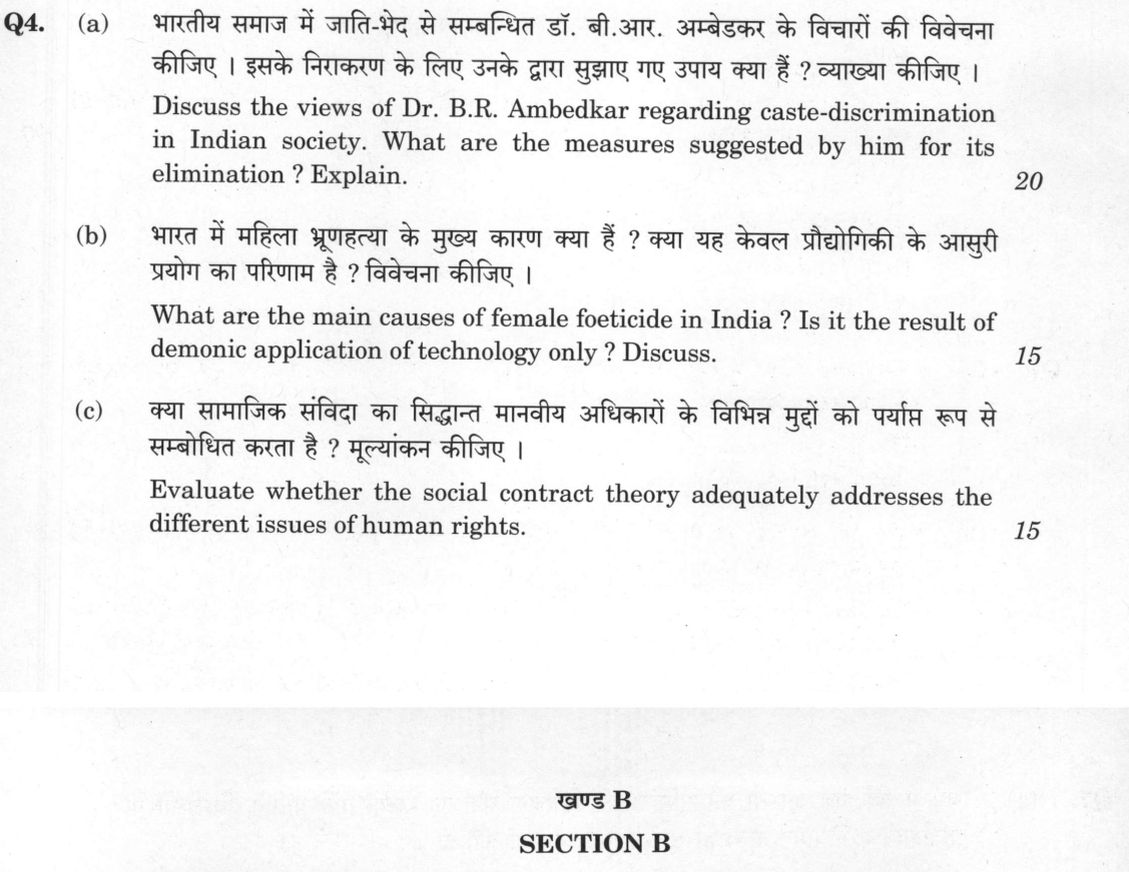
(a) Discuss the views of Dr. B.R. Ambedkar regarding caste-discrimination in Indian society. What are the measures suggested by…
Discuss the views of Dr. B.R. Ambedkar regarding caste-discrimination in Indian society. What are the measures suggested by him for its elimination? Explain. 20 marks
What are the main causes of female foeticide in India? Is it the result of demonic application of technology only? Discuss. 15 marks
Evaluate whether the social contract theory adequately addresses the different issues of human rights. 15 marks
हिंदी में प्रश्न पढ़ें
भारतीय समाज में जाति-भेद से सम्बन्धित डॉ. बी.आर. अम्बेडकर के विचारों की विवेचना कीजिए । इसके निराकरण के लिए उनके द्वारा सुझाए गए उपाय क्या हैं ? व्याख्या कीजिए । (20 अंक)
भारत में महिला भ्रूणहत्या के मुख्य कारण क्या हैं ? क्या यह केवल प्रौद्योगिकी के आसुरी प्रयोग का परिणाम है ? विवेचना कीजिए । (15 अंक)
क्या सामाजिक संविदा का सिद्धान्त मानवीय अधिकारों के विभिन्न मुद्दों को पर्याप्त रूप से सम्बोधित करता है ? मूल्यांकन कीजिए । (15 अंक)
Model answer
Written by UPSC Answer Check against this question's marking rubric, to the expected length. UPSC does not publish answers for Mains — this is one way to score well, not an official key.
Justice, human dignity, and fundamental rights require interrogating both historical social hierarchies and the theoretical frameworks that justify them.
Ambedkar on Caste Discrimination and Measures for Its Elimination
Dr. B.R. Ambedkar conceptualized the caste system not merely as a division of labour, but as a rigid "division of labourers" arranged in an ascending scale of reverence and a descending scale of contempt. This system of "graded inequality" prevents the formation of common social consciousness, as every caste takes pride in being superior to the one beneath it, precluding united action against oppression. Ambedkar rejected the apologist view that caste is an innocent social mechanism, arguing in Annihilation of Caste that it derives its immutable authority from sacred Hindu scriptures like the Manusmriti. Caste discrimination is thus a religiously sanctioned denial of liberty, equality, and fraternity.
To eliminate caste, Ambedkar proposed a multi-pronged strategy. First, he advocated the destruction of the divine sanctity of the shastras, arguing that genuine reform requires dynamiting the religious scriptures that sanctify caste. Second, at the social level, he identified inter-caste marriage as the only real solvent of caste consciousness, as fusion of blood alone creates the feeling of kith and kin. Third, through legal-constitutional means, he instituted fundamental rights (Articles 14, 15, and the abolition of untouchability under Article 17), alongside reservations in public employment and legislatures to secure political representation. Fourth, he advocated state socialism and economic restructuring to break upper-caste monopoly over land and resources. Finally, recognizing that constitutional morality alone could not eradicate entrenched social prejudice, Ambedkar led the mass conversion to Buddhism (Navayana) in 1956, establishing an alternative spiritual-democratic foundation rooted in prajna (understanding), karuna (compassion), and samata (equality).
Causes of Female Foeticide: Beyond Technological Determinism
Female foeticide in India is not merely the result of a demonic application of technology; technology is merely a facilitative tool that accelerates pre-existing structural misogyny. The primary drivers are deeply entrenched in patriarchal institutions: intense son-preference driven by lineage continuation and funeral rites, the extortionate dowry system, patrilineal property inheritance patterns, and the socio-economic perception of daughters as economic liabilities.
Ultrasound and amniocentesis technologies are ethically neutral instruments. Their conversion into tools of elimination reflects what Amartya Sen terms the phenomenon of "missing women"—where deep-seated anti-female bias manifests as natality inequality. In Martha Nussbaum’s capabilities approach, female foeticide represents the ultimate deprivation of the central capabilities of "life" and "bodily integrity." The weak enforcement of the Pre-Conception and Pre-Natal Diagnostic Techniques (PCPNDT) Act, 1994, combined with commercial medical malpractices, enables this bias. Addressing it demands not just technological surveillance, but systemic social transformation through initiatives like Beti Bachao Beti Padhao, strict inheritance parity, and dismantling patriarchal norms.
Evaluation of Social Contract Theory on Human Rights
Social contract theory offers a vital foundation for human rights by deriving legitimate political authority from the consent of equal individuals. John Rawls modernized this tradition through the "original position" and the "veil of ignorance," demonstrating that rational persons would choose principles securing equal basic liberties and safeguarding the least advantaged.
However, classical contractarianism (Hobbes, Locke, Rousseau) suffers from severe structural exclusions. As Carole Pateman demonstrates in The Sexual Contract, the original pact was a patriarchal agreement that relegated women to the private sphere, outside the protection of civil rights. Susan Moller Okin similarly argues that contract theories fail to address gender justice within the family. Furthermore, post-colonial critics highlight that classical contract theory historically excluded colonized peoples, the enslaved, and the propertyless, treating rights as privileges of European propertied males.
Because social contract theory relies on mutual advantage among roughly equal bargaining agents, it struggles to protect vulnerable groups who cannot reciprocate, such as future generations, non-human animals, and persons with severe disabilities. Consequently, contemporary philosophy supplements contractarianism with the human capabilities approach of Sen and Nussbaum, natural rights paradigms, cosmopolitan theories of global justice (such as Thomas Pogge's), and Will Kymlicka’s framework of group-differentiated rights for cultural minorities.
Addressing systemic deprivations requires moving beyond formal contractual reciprocity toward an inclusive ethic of capability, substantive constitutional democracy, and continuous moral reconstruction of society.
What "Discuss" is asking you to do
Lay the issue out from more than one side — how it arose, what is claimed for it, what is held against it, and where it now stands. UPSC attaches discuss to broad topics with several live dimensions, so coverage of the dimensions earns more than the strength of your opinion.
Structure that answers it
Set the issue up → the case as it is made → the case against → the dimension both sides leave out → where the balance now lies
Where marks are lost
Listing facts with no thread between them, or arguing one side throughout and calling it a discussion.
How this answer will be evaluated
Approach
Framework: UPSC Mains Philosophy Paper II. (a) discuss: intro > 3-4 dimensions > example > balanced close | (b) discuss: intro > 3-4 dimensions > example > balanced close | (c) evaluate: criteria > evidence > balanced judgment Full marks: Precise reconstruction of arguments, specific technical vocabulary, and strong counter-arguments.
Key points expected
- Identify caste as a 'condition' not just a 'process' (Annihilation of Caste)
- Distinguish between 'communalism' and 'casteism' in his analysis
- Detail the 'Depersonalization of Religion' as a primary measure
- Explain the role of 'Political Power' and 'Education' in social change
- Identify 'son preference' and 'dowry' as primary socio-economic drivers
- Explain the 'demonic application' of ultrasound technology (PGP)
- Discuss the 'MTP Act' or 'PCPNDT Act' as regulatory responses
- Evaluate the 'economic burden' of daughters in rural India
Evaluation rubric
Each sub-part is marked on its own, against the marks and word limit printed on the paper.
- (a) Reconstruct Ambedkar's critique of caste and his specific political remedies for its elimination. 20 marks
discuss— intro → 3-4 dimensions → example → balanced close
Must cover
- Identify caste as a 'condition' not just a 'process' (Annihilation of Caste)
- Distinguish between 'communalism' and 'casteism' in his analysis
- Detail the 'Depersonalization of Religion' as a primary measure
- Explain the role of 'Political Power' and 'Education' in social change
Loses marks
- Biographical details of Ambedkar's life
- Vague generalities about 'social justice' without specific measures
- Confusing Ambedkar's views with Gandhi's 'Hindu-Muslim unity' focus
Earns more
- Reference to the 'Depersonalization of Religion' concept
- Mention of the 'Depersonalization of Religion' concept
- Linkage of caste to the 'Hindu Code' or 'Manusmriti'
- Reference to the 'Depersonalization of Religion' concept
Extra mark
- Citation of the 'Depersonalization of Religion' concept
- Reference to the 'Depersonalization of Religion' concept
- (b) Analyze the socio-economic causes of female foeticide and evaluate the role of technology. 15 marks
discuss— intro → 3-4 dimensions → example → balanced close
Must cover
- Identify 'son preference' and 'dowry' as primary socio-economic drivers
- Explain the 'demonic application' of ultrasound technology (PGP)
- Discuss the 'MTP Act' or 'PCPNDT Act' as regulatory responses
- Evaluate the 'economic burden' of daughters in rural India
Loses marks
- Blaming technology without addressing the underlying social demand
- Ignoring the 'economic' or 'social' causes of son preference
- Vague moralizing without structural analysis
Earns more
- Reference to the 'PCPNDT Act' (2003)
- Mention of 'sex-selective abortion' as a specific mechanism
- Linkage to 'patriarchal' social structures
- Reference to 'son preference' in agricultural economies
Extra mark
- Citation of specific 'sex ratio' data (e.g., 2011 Census)
- Reference to the 'PCPNDT Act' (2003)
- (c) Critically assess the Social Contract Theory's capacity to address human rights issues. 15 marks
evaluate— criteria → evidence → balanced judgment
Must cover
- Define the 'state of nature' and 'social contract' (Hobbes/Locke/Rousseau)
- Identify the 'liberal' bias in the theory (individual rights over collective)
- Critique the 'exclusion' of women and minorities from the 'contract'
- Evaluate the 'procedural' vs 'substantive' justice debate
Loses marks
- Summarizing the theory without evaluating its limits
- Ignoring the 'exclusion' of marginalized groups from the contract
- Vague generalities about 'rights' without specific theoretical critique
Earns more
- Reference to 'Rawls' 'Veil of Ignorance' as a modern revision
- Mention of 'feminist critiques' (e.g., Susan Moller Okin)
- Linkage to 'universal' vs 'particular' rights
- Reference to 'Hobbes' 'Leviathan' or 'Locke' 'Two Treatises'
Extra mark
- Citation of 'Rawls' 'A Theory of Justice'
- Reference to 'Hobbes' 'Leviathan' or 'Locke' 'Two Treatises'
Practice this exact question
Write your answer and it is marked point by point against the model answer above — what you covered, what you missed, what you got wrong.
Evaluate my answer →More from Philosophy 2021 Paper II
- Q1 Answer the following questions in about 150 words each: (a) Discuss critically the distri…
- Q2 (a) Discuss whether Amartya Sen's idea of justice is an improvement upon Rawl's theory of…
- Q3 (a) Discuss anarchism as a political ideology. Is it possible to dispense with political…
- Q4 (a) Discuss the views of Dr. B.R. Ambedkar regarding caste-discrimination in Indian socie…
- Q5 Answer the following questions in about 150 words each: (a) Discuss the nature of God as…
- Q6 (a) Discuss the concept of immortality of soul with special reference to Hindu tradition.…
- Q7 (a) Discuss the role of reason and faith in religion. Can reason be a regulative force in…